
Pineberries grow best in USDA Zones 5 through 8, which covers most of the temperate United States, the UK, central Europe, and the cooler parts of southern Australia and New Zealand. See Fragaria WONDERFUL PINEBERRY - Missouri Botanical Garden Plant Finder for cultivation and hardiness information. They are cultivated garden strawberries (Fragaria × ananassa) grown exactly like any other strawberry, which means they thrive in full sun, well-drained slightly acidic soil, and moderate climates where summer heat does not become brutal. Outside those zones, they can still be grown successfully in containers, raised beds, or under low tunnels, it just takes a bit more effort to manage heat, cold, or both.
Pineberry Where Do They Grow: Zones, Soils & Growing Tips
Marcus Holloway
30 Jul 2026
Where pineberries grow: the geography-first answer
Pineberries are a cultivated form, not a wild plant, so there is no native geographic range to point to on a map. What matters for you as a grower is whether your climate matches what Fragaria × ananassa needs. The sweet spot is USDA Zones 5–8, roughly equivalent to RHS hardiness ratings H4–H5 in the UK. That range includes the Pacific Northwest, the Upper South, New England, the Midwest, most of the UK, Germany, France, the Netherlands, and the cooler regions of southeastern Australia. In Zone 9 and above, summer heat typically hammers fruit quality and reduces yields, though protected systems can work. In Zone 4 and colder, outdoor crowns need solid winter mulching to survive. Tropics and subtropics are generally too warm for reliable production without highly adapted selections and season-specific timing.
| USDA Zone | Climate Description | Pineberry Growing Advice |
|---|---|---|
| Zone 3–4 | Cold continental; harsh winters | Marginal outdoors; mulch heavily in autumn; consider containers moved to an unheated garage over winter |
| Zone 5–6 | Temperate; cold winters, warm summers | Ideal outdoor production; in-ground beds or raised beds; standard strawberry care applies |
| Zone 7–8 | Mild temperate to warm-temperate | Good outdoor culture; watch for heat in Zone 8 summers; afternoon shade helpful in Zone 8 |
| Zone 9–10 | Warm subtropical; hot summers | Challenging; use containers, shade cloth, or short-season plasticulture; expect reduced yields without adapted cultivars |
| Zone 11+ | Tropical; no winter chill | Not recommended without strong season manipulation; standard pineberry cultivars will fail to fruit reliably |
What actually is a pineberry?
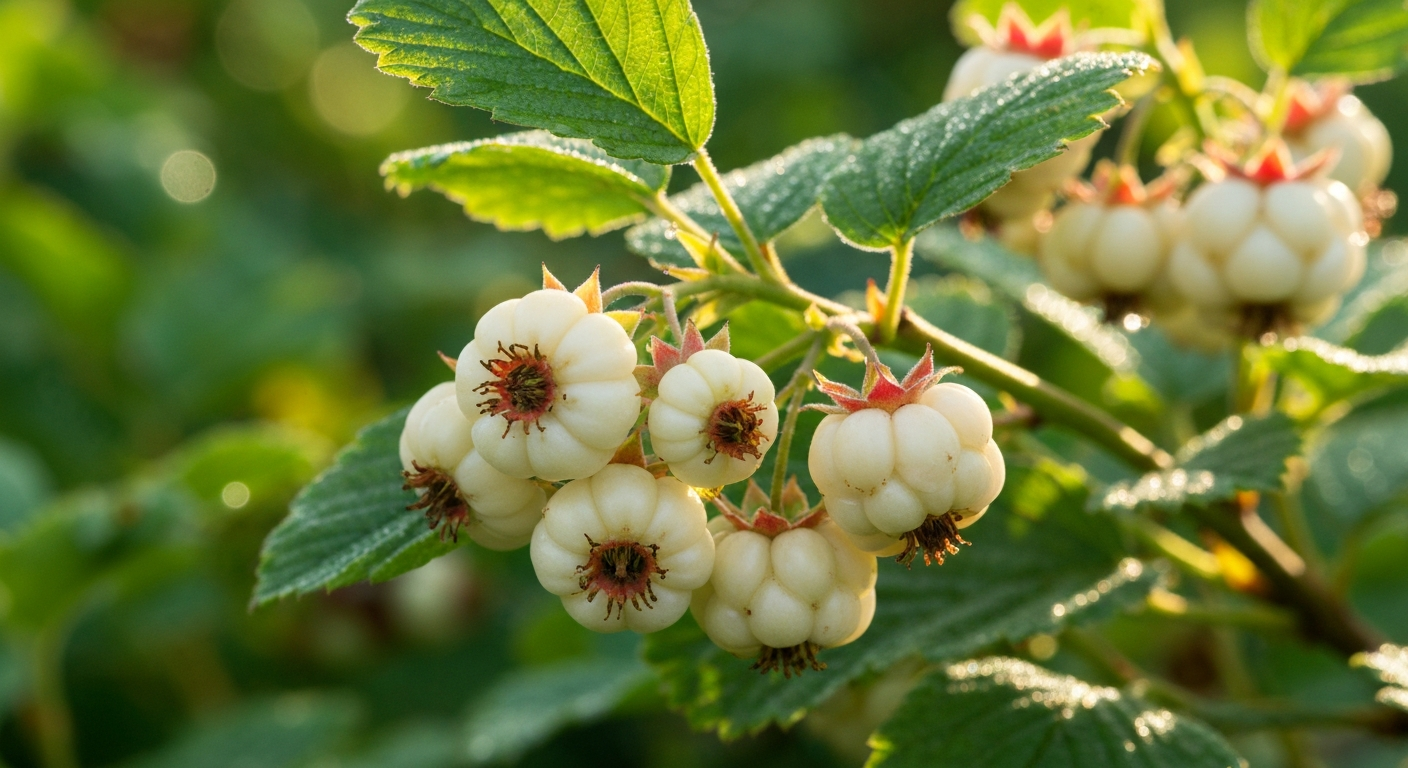
A pineberry is a white-fruited cultivar of the common garden strawberry, Fragaria × ananassa. The fruit ripens to a creamy white or pale blush color with red achenes (the tiny seed-like dots on the surface) and gives off a noticeable pineapple-like aroma, that combination is where the name comes from. The flavor is genuinely different from a red strawberry: lighter, more floral, less acidic, and yes, faintly pineapple-ish. I grew my first pineberry plant in a 12-inch pot on a west-facing deck, and the first ripe berry really did stop me in my tracks.
Despite the exotic name and appearance, pineberries are not a wild species or some rediscovered jungle fruit. Modern garden strawberries were originally bred from two wild parents: the Chilean strawberry (Fragaria chiloensis, which historically included white-fruited forms in South America) and the North American wild strawberry (Fragaria virginiana). Pineberry cultivars are deliberate selections from that same gene pool, chosen specifically for white fruit color and pineapple aroma. There is nothing to 'discover' in the wild, any pineberry you buy is a named cultivar bred and released by horticulturalists. Notable recent examples include Florida Pearl (FL 16.78-109), released by UF/IFAS breeders and granted U.S. Plant Patent PP33,477, which was trialed at multiple sites before release. What that means practically: buy certified plants or crowns from reputable nurseries, not seeds, because seed-grown plants will not reliably reproduce the parent cultivar's traits.
Which climates actually suit pineberries
Temperate climates: the comfort zone
Zones 5–7 are the sweet spot. Cool winters give pineberry crowns the dormancy they need, springs are mild enough for establishment, and summers are warm but not aggressively hot. The Pacific Northwest, the UK (especially England and Wales), the Netherlands, Germany, and New Zealand's South Island all fall into this bucket. In these regions you can plant in-ground beds or raised beds without overthinking season extension. The plants will behave exactly like any other garden strawberry.
Warm-temperate microclimates: workable with adjustments
In Zone 8, think Atlanta, the UK's Southwest Coast, coastal California, parts of inland southeastern Australia, summer heat is the limiting factor. You can still grow pineberries successfully here, but afternoon shade, consistent drip irrigation, and raised beds with good airflow all matter more. During multi-site trials of white strawberry selections in Florida (Zone 9), researchers found that most standard pineberry types suffered heat stress and reduced fruit quality without protected culture. See Florida Pearl® ‘FL 16.78-109’ Pineberry (HortScience 2023) for multi-site trial data showing standard pineberry types suffered heat stress and reduced fruit quality in Florida without protected culture. If you are in a Zone 8 microclimate, lean toward containers or low tunnels and prioritize a cultivar description that mentions heat tolerance.
Tropical and subtropical limits
Zones 10 and above are genuinely problematic. Pineberries need a cool period to trigger dormancy, and without it crowns exhaust themselves producing leaves rather than fruit. If you are in southern Florida, tropical Queensland, or a similar climate and you are set on trying pineberries, treat them as annuals planted in autumn for a cool-season harvest window and discard after one season. You will get more satisfaction from a berry naturally adapted to your climate, but more on that in the comparison section below.
Site and soil requirements
Pineberries need at least six hours of direct sun daily, and eight or more hours is better. Morning sun is preferable because it dries dew off the foliage quickly, which directly cuts your risk of gray mold and other fungal diseases. Avoid planting in frost pockets, low-lying areas where cold air settles on still nights, because late spring frosts will nail open blossoms and you will lose your harvest.
Soil pH should sit between 6.0 and 6.5. Outside that range, nutrient uptake becomes less efficient even if you have fertilized well. Test your soil before planting and adjust at least three months in advance, lime to raise pH, sulfur to lower it. The soil texture matters as much as chemistry: strawberries need well-drained sandy loam or any soil with high organic matter that does not hold standing water. Waterlogged soil is the single fastest way to kill pineberry crowns through root and crown rots (Phytophthora and red stele are the usual culprits). If your soil is heavy clay, raised beds are not optional, they are the correct answer.
- Full sun: minimum 6 hours, 8+ hours ideal; site with morning sun exposure
- Soil pH: 6.0–6.5; test first and amend 3+ months before planting
- Soil type: well-drained sandy loam or raised bed with high organic matter
- No standing water: crown and root rots develop rapidly in waterlogged conditions
- Avoid frost pockets: site on gentle slopes or elevated areas with good air drainage
- Water: consistent 1–2 inches (25–50 mm) per week; drip irrigation at the root zone is best
- Air circulation: space plants 12–18 inches apart and avoid dense planting to reduce fungal pressure
Region-specific growing guidance
North America
In the Northeast, Great Lakes region, and Pacific Northwest (Zones 5–7), pineberries perform reliably in raised beds or in-ground rows with the same setup you would use for any June-bearing strawberry. Plant bare-root crowns or potted transplants in spring after the last frost, or in late summer for an autumn establishment period. In Zone 8 (parts of the Southeast, Pacific Southwest), time your planting for autumn rather than spring so the crop runs through the cooler months and finishes before peak summer heat. Growers in Texas or the Deep South have found that treating pineberries as cool-season annuals, planting in October, harvesting through February–April, then removing plants, often gives better results than fighting summer heat. In Zones 3–4, in-ground growing is possible but you need a thick straw mulch (3–4 inches) over crowns after the ground freezes in autumn, removed in early spring.
UK and Europe
Most of England, Wales, the Netherlands, Belgium, and Germany fall squarely into the pineberry comfort zone. The RHS treats strawberry cultivars with H3–H4 hardiness ratings, which aligns with the temperate UK climate. Plant bare-root runners in late summer (July–September) for a crop the following year, or pot-grown plants in spring for a smaller first-year harvest. Scottish growers and those in exposed northern European locations will benefit from a polytunnel or cold frame, not just to protect from frost but to extend the season and keep fruit dry during wet summers, Botrytis gray mold is the constant enemy in damp climates. The key pineberry cultivars available in the UK (such as 'Natural Albino' and 'White D') are sold as runners from specialist soft-fruit nurseries rather than hardware stores, so order early.
Australia and New Zealand
Southern Australia (Victoria, Tasmania, the Adelaide Hills, the South Island of New Zealand) occupies the equivalent of Zones 6–8 and is well-suited for pineberry production. Plant in autumn (March–May) for a spring harvest. Avoid the humid subtropical conditions of coastal Queensland and northern NSW in Australia, or Northland in New Zealand, the heat and humidity create serious fungal disease pressure and the crowns struggle to get adequate chill hours. In cooler elevated areas of Victoria or the Canterbury Plains, in-ground culture works well. In Sydney or Brisbane, containers and a cool-season planting window are the practical path.
Tropical and subtropical limits and local alternatives
If you are in a tropical or humid subtropical climate and want to grow a small, unusual berry, pineberry is genuinely the wrong choice. You will fight the climate every step. Consider instead a berry that is native to or naturalized in warmer climates. The comparison section later in this article covers options like serviceberry, boysenberry, and soapberry that might be better suited to your region.
How to replicate ideal conditions: in-ground, raised beds, containers, and greenhouses
In-ground beds
For Zones 5–7, in-ground beds are the simplest and most productive option. Prepare a bed that is at least 8 inches deep, amended with compost to reach roughly 20–30% organic matter content. Set crowns so the midpoint of the crown is exactly at soil level, the topmost roots should be just below the surface. Too deep and the crown rots; too shallow and it dries out and frost-heaves. Rows spaced 18 inches apart with 12 inches between plants gives each crown enough light and airflow. Cover the bed with black plastic mulch or straw to suppress weeds and keep fruit clean.
Raised beds
Raised beds are the right move in heavy clay soils, poorly drained gardens, or Zone 8+ locations where you want better heat management. Build beds 8–12 inches tall using a mix of topsoil, compost, and either coarse sand or perlite to ensure drainage. The slight elevation also improves air circulation around the crown, which matters a lot for disease prevention. In my own Zone 7 garden, switching from flat in-ground beds to 10-inch raised beds reduced my Botrytis losses noticeably in wet springs.
Containers
Containers are the most flexible option for anyone in a marginal zone, a small space, or a patio garden. Day-neutral or everbearing pineberry cultivars work best in containers because they produce fruit continuously rather than in one flush. Use a container at least 12 inches in diameter and 10–18 inches deep; you can fit up to four plants in a 14-inch pot. Fill with a light, well-draining potting mix, a blend of good-quality potting compost, perlite (about 20–25% by volume), and a slow-release balanced fertilizer incorporated at planting. Containers dry out much faster than ground beds, so check moisture daily in warm weather and set up a drip emitter or self-watering reservoir if you can.
| Container Type | Minimum Size | Plants per Container | Best Potting Mix | Notes |
|---|---|---|---|---|
| Standard pot (round) | 12 in (30 cm) diameter, 10 in (25 cm) deep | 2–3 plants | Potting compost + 20–25% perlite + slow-release fertilizer | Good for balconies; move indoors below Zone 5 in winter |
| Large pot or half-barrel | 14–18 in (35–45 cm) diameter, 12–18 in (30–45 cm) deep | 4–6 plants | As above; add extra compost for moisture retention | Best container yield; suits patios and decks |
| Window box / trough | At least 8 in (20 cm) deep, 6 in (15 cm) wide per plant | 1 plant per 6 in of length | Lightweight potting mix with water-retaining granules | Good for railings; needs more frequent watering |
| Hanging basket | 12–14 in (30–35 cm) diameter | 3 plants | Potting compost + coir + slow-release fertilizer | Dries fast; line with moss or use water-retaining liner |
| Raised planter / grow bag | 12+ in (30+ cm) deep | 4–8 plants | Potting compost + perlite + lime to adjust pH if needed | Best for small patios; easy to move for season extension |
Greenhouses, low tunnels, and frost protection
Low tunnels with floating row cover fabric are the most cost-effective season-extension tool for pineberries. In cooler zones, deploy them in early spring to warm the soil and protect blossoms from late frosts, this alone can advance your harvest by two to three weeks. In warmer zones, use shade cloth instead of row cover during the hottest months to protect fruit from sunscald. A polytunnel or cold greenhouse gives full control over temperature and keeps rain off the foliage, which is hugely valuable in wet climates like Scotland or maritime New Zealand. If you are growing in containers below Zone 5, move pots into an unheated garage or shed over winter once the crowns have gone dormant, the plants need cold but not a hard freeze through the roots.
Planting calendar and propagation
Pineberries do not come true from seed. Like most modern Fragaria × ananassa cultivars, their specific traits, white fruit color, aroma, plant habit, are not reliably reproduced when grown from seed. Always propagate from certified disease-free crowns, potted transplants, or rooted runners. Runners are the easiest home-garden method: let a healthy established plant send out its runners in late summer, pin the plantlets onto a small pot of compost, wait two to three weeks for roots to establish, then sever the runner from the mother plant. Each healthy parent can produce six to twelve runners per season.
| Region | Best Planting Time | First Harvest | Notes |
|---|---|---|---|
| North America Zone 5–7 | Early spring (March–April) or late summer (August) | Following spring (spring plant) or early summer (late-summer plant) | Remove first flowers after planting to build crown strength |
| North America Zone 8 | Autumn (September–October) | Late winter to spring | Treat as cool-season crop; remove plants before summer heat |
| UK and Northern Europe | Late summer (July–September, bare-root runners) | Following June–July | Pot-grown plants can go in spring for a smaller first-year crop |
| Southern Australia / NZ (cooler regions) | Autumn (March–May) | September–November | Mulch crowns lightly over winter in coldest areas |
| Subtropical (Zones 9–10) | Autumn (October–November) | February–April | Treat as annuals; remove after spring harvest |
When planting, set the crown so its midpoint is level with the soil surface and the topmost root is just below it. For day-neutral and everbearing cultivars, pinch off the first flush of flowers for three to four weeks after planting. It feels counterproductive, but it channels energy into root and crown development, and you will get more fruit overall from a well-established plant than from one that exhausted itself fruiting immediately after transplanting.
Routine care: feeding, mulching, watering, and seasonal tasks
Pineberries are light feeders compared to vegetables, but they do need consistent nutrition. Apply a balanced fertilizer (roughly 10-10-10 or equivalent) at planting and a low-nitrogen, higher-potassium feed once flowering begins, too much nitrogen after flowering pushes leaf growth at the expense of fruit. For containers, use a liquid tomato-type fertilizer every two weeks during the growing season because pot nutrients flush out quickly. Avoid heavy nitrogen feeding in late summer, which can produce lush growth vulnerable to frost damage.
Mulch is one of the most useful tools in pineberry growing. Straw mulch (2–3 inches deep) keeps fruit clean, regulates soil temperature, conserves moisture, and suppresses weeds. Apply it after planting in spring or after the ground freezes in autumn as a winter protective layer. In warm climates, black plastic mulch under the plants is widely used in commercial and semi-commercial settings because it also warms the soil and controls weeds.
Water pineberries with drip irrigation at the root zone if at all possible, targeting 1–2 inches (25–50 mm) per week depending on weather and soil type. Overhead watering wets foliage and fruit, encouraging Botrytis and other fungal problems. After harvest in late summer, tidy up old leaves and any dead or diseased plant material. In June-bearing-style systems, you would also mow back the foliage (renovation), but for most home everbearing or day-neutral pineberry setups, simply remove old and damaged leaves, thin crowns to prevent overcrowding, and fertilize lightly to promote autumn growth.
Pests, diseases, and climate-related troubleshooting
Botrytis gray mold is the most common problem for pineberry growers in cool, damp climates. You will see fuzzy gray spores on rotting fruit, especially during cool, wet springs. Prevention is everything: good airflow between plants, no overhead irrigation, prompt removal of any infected fruit or leaves, and straw mulch to prevent soil splash onto fruit. Fungicide applications are an option if infection becomes severe, but good site and spacing choices reduce the need significantly.
Root and crown rots (Phytophthora, red stele) are the main killers in poorly drained soils. Plants suddenly wilt and do not recover; roots are often reddish-brown and mushy rather than white and firm. The fix is almost always preventive: plant in raised beds or well-drained soil, never in areas where water pools. Once established, these diseases are extremely difficult to treat. Remove affected plants promptly to prevent spread.
Spotted wing drosophila (SWD) has become a significant problem across North America, Europe, and Australasia. Unlike common fruit flies, SWD lays eggs in intact ripe fruit, and you typically discover the infestation when you spot tiny maggots inside picked berries. Monitor with traps, harvest fruit as soon as it ripens (do not let it sit on the plant), and use fine insect-exclusion netting over the bed or tunnel if SWD pressure is high in your area.
- Botrytis gray mold: improve airflow, use drip irrigation, remove infected material promptly
- Phytophthora and red stele root rot: plant in raised beds or well-drained soil only; remove affected plants
- Verticillium wilt: avoid planting where tomatoes, potatoes, or peppers have recently grown; choose resistant cultivars
- Spotted wing drosophila: harvest promptly, use SWD traps, cover with fine exclusion netting
- Slugs and snails: use copper tape on container rims, slug pellets (iron phosphate-based is wildlife-safe), or beer traps
- Birds: net the bed or tunnel before fruit ripens — they will strip white pineberries fast because the pale color does not trigger the same alarm as red fruit
- Two-spotted spider mites: common in hot, dry conditions; improve irrigation and use predatory mites or insecticidal soap
One climate-specific note: in Zone 8 and warmer, anthracnose (Colletotrichum) becomes a more significant disease during warm, wet conditions. It can cause crown rot in addition to fruit rot and is more aggressive in hot-humid climates than in temperate ones. Look for dark, water-soaked lesions on crowns and fruit. If you are in a warm-humid zone, choose cultivars with documented anthracnose resistance where possible.
Yield and harvest expectations
Pineberries produce smaller individual fruits than most red strawberry cultivars, typically around 5–10 grams per berry. A well-established, healthy plant in a good year might give you 150–300 grams of fruit per season, though yields vary considerably by cultivar, site, and care. In containers the yield is usually at the lower end of that range. Do not expect commercially impressive volumes from home plants in the first year, year two is generally significantly more productive once crowns are well-rooted.
Harvest timing varies by region but generally falls in late spring to early summer (May–July in the Northern Hemisphere; September–November in the Southern Hemisphere) for spring-planted crops. Everbearing and day-neutral cultivars in containers will produce a smaller but more continuous supply from late spring through autumn. Fruit is ripe when it turns fully creamy-white or pale blush and the achenes flush red, unlike red strawberries, you cannot judge ripeness by color intensity alone. A ripe pineberry gives slightly under thumb pressure and will be noticeably aromatic.
Pineberry plants are typically productive for three to four years before yields drop and disease risk rises. Plan to renovate your bed or replace container plants every three years. Take new runners from your healthiest plants in year two to maintain a rolling stock of young, vigorous plants.
How pineberries compare to other berries for your climate
One of the most practical questions I get is: 'I want an unusual berry for my garden, should I grow a pineberry, or would something else suit my conditions better?' Here is a quick, honest comparison. Boysenberries, for instance, grow as trailing canes that need support and are well-suited to Zones 5–9, actually tolerating more summer heat than pineberries, if you are in a warm Zone 8 garden, a boysenberry may be more productive for less effort. Bilberries are woodland-edge plants that thrive in acidic, poor soils in cooler, moister climates (Zones 2–6), making them a better choice than pineberries for Scottish hillside gardens or boreal Canada. Serviceberries are multi-use shrubs hardy from Zone 2–9 that handle both cold and heat better than pineberries and produce good crops with minimal fuss, an excellent choice if you want a reliable, low-maintenance berry across a wide range of climates. For more on their range and preferred habitats, see where do serviceberries grow.
Barberry, bayberry, and bearberry all occupy very different ecological niches from pineberries. Barberry is an ornamental shrub with edible but tart fruit, hardy in Zones 4–8 and tolerant of poor soils. Bayberry is a coastal and woodland shrub (Zones 3–7) grown more for its waxy berries and landscape value than for edible fruit. For more detail on its native range and habitats, see where does bayberry grow. Bearberry is a low-growing ground cover for cold, acidic, dry soils in Zones 2–6, essentially the opposite of pineberry requirements, and while the berries are edible, they are dry and mealy raw. For specifics on where does bearberry grow, see the section on where does bearberry grow. Soapberries (various Sapindus species) are warm-climate trees grown in Zones 7–10 for their saponin-rich fruit, primarily used for cleaning rather than eating. For details on where do soap berries grow, see our guide to soapberry (Sapindus) distribution and cultivation. The point is: pineberries occupy a very specific temperate niche. If your climate is too cold, too hot, or too dry for pineberries, one of these alternatives is likely a better fit.
| Berry | Hardiness (USDA Zones) | Best Climate | Growth Habit | Pineberry vs. This Berry |
|---|---|---|---|---|
| Pineberry | 5–8 (optimal) | Cool to mild temperate | Low ground cover / crown | Baseline comparison |
| Boysenberry | 5–9 | Temperate to warm-temperate | Trailing cane (needs support) | More heat-tolerant; better for Zone 8–9 gardens |
| Bilberry | 2–6 | Cool, moist; acidic soils | Low shrub / ground cover | Better for cold, acidic-soil gardens; no summer heat needed |
| Serviceberry | 2–9 | Very wide range | Shrub to small tree | Far more climate-versatile; lower maintenance |
| Barberry | 4–8 | Temperate; tolerates poor soil | Upright shrub | Ornamental focus; not a culinary berry alternative |
| Bayberry | 3–7 | Coastal and woodland temperate | Shrub | Not primarily edible; grown for wax and landscape use |
| Bearberry | 2–6 | Cold, dry, acidic soils | Prostrate ground cover | Thrives where pineberry would fail; mealy raw fruit |
| Soapberry | 7–10 | Warm temperate to subtropical | Medium to large tree | Non-edible fruit; suited to climates too warm for pineberry |
Actionable next steps: where to start
If you are in Zones 5–8, the simplest next step is to order certified pineberry crowns or potted transplants from a specialist soft-fruit nursery. Look for named cultivars rather than generic 'pineberry' plants, named selections have documented traits and disease status. In North America, check small-fruit specialists and mail-order nurseries that sell certified virus-free strawberry stock. In the UK, soft-fruit runners from companies like Ken Muir or R.V. Roger are a reliable source. Order in late summer for autumn planting (UK) or in late winter for early spring delivery (North America).
Before you plant, run a quick microclimate check on your site. Spend one morning noting which parts of your garden receive sun from 7 AM onwards, that is your morning-sun spot. Check whether water pools after heavy rain; if it does, that spot needs a raised bed or container. A simple home soil pH test (kits cost a few dollars or pounds) will tell you whether you need to add lime or sulfur before planting.
If you are in a marginal zone, Zone 4 or colder, Zone 9 or warmer, start with containers rather than in-ground beds. A 14-inch pot with a couple of pineberry plants is a low-cost, low-commitment way to test whether you can make them work in your climate before investing in a full bed. You can move containers to a protected spot when temperatures threaten, and if the plants do not perform, you have lost very little.
- Test your soil pH and amend to 6.0–6.5 at least eight weeks before planting
- Identify the sunniest, most air-drained spot in your garden — ideally morning sun from 7 AM
- Check drainage by digging a 12-inch hole, filling it with water, and timing how fast it drains (more than 1 hour = poor drainage, use raised beds)
- Order certified disease-free pineberry crowns or potted plants from a reputable specialist nursery
- Prepare a raised bed or large container with a well-draining compost-perlite mix before the plants arrive
- Set up drip irrigation or plan a consistent hand-watering schedule targeting the root zone rather than foliage
- In marginal zones, have frost protection materials (row cover fabric or a low tunnel frame) ready before plants arrive
Image suggestions for this article
- Close-up of a ripe pineberry on the plant showing the creamy-white fruit and red achenes against green foliage — helps readers identify ripe fruit and understand the visual difference from red strawberries
- Side-by-side photo of a pineberry and a standard red strawberry at similar ripeness stages — useful for the 'what is a pineberry' section
- Overhead shot of a raised bed setup showing crown planting depth with a small ruler or hand visible — illustrates the correct crown-at-soil-level planting technique
- Container arrangement showing a 14-inch pot with three pineberry plants on a patio or balcony — practical visual for the container guidance section
- Runner propagation sequence: mother plant sending out a runner, plantlet pinned into a small pot, and the severed plantlet as a new independent plant — three-image sequence for the propagation section
- Low tunnel setup over a pineberry bed with row cover fabric, showing how it is clipped or pinned at the edges — illustrates frost and season-extension protection
- Photo of Botrytis gray mold on a pineberry fruit for the pest and disease section — helps readers identify the problem early
- Harvest basket of mixed pineberries alongside red strawberries — appealing finishing image for the yield and harvest section
FAQ
Article title and meta description
Title: Pineberry — Where Do They Grow? Zones, Soils, Propagation & Regional Tips Meta (≤160): Grow pineberries successfully: USDA/RHS zones, soil, site, propagation, containers, pests & region-specific tips.
What is a pineberry and is it wild or cultivated?
A pineberry is a cultivated white-fruited garden strawberry (Fragaria × ananassa) with red achenes and a pineapple‑like aroma. Modern pineberries are selections/breeding results of the garden strawberry lineage (not a newly discovered wild species). They behave like other cultivated strawberries for planting, propagation and care.
Geography-first: In which climates and USDA / RHS zones do pineberries grow best?
Broad answer: Pineberries grow best in temperate gardens and warm‑temperate microclimates where typical garden strawberry cultivars succeed. They follow general garden strawberry hardiness and cultural limits: - USDA Zones 5–8: Best for in‑ground cultures with normal strawberry care (most reliable yields and winter hardiness). - USDA Zones 8–10: Possible but often need protected culture, extra cooling, shade or high‑tunnel production because heat and humidity reduce fruit quality and yields. - RHS (UK): Treat like other strawberries (H3–H4 for many cultivars); sheltered, well‑drained sites or containers/greenhouse for cooler/wetter areas. - Tropics/Subtropics: Generally poor performance for open‑ground outdoor culture due to heat/humidity and pest pressure; use high‑elevation sites, cooled greenhouses, or avoid.
Site and soil requirements (sun, moisture, drainage, pH)
Site: Full sun (minimum 6 hours; 8+ ideal). Prefer sites with morning sun and good air drainage to reduce fungal disease and avoid frost pockets. Soil: Well‑drained sandy loam or raised beds rich in organic matter. Avoid waterlogged soils (risk of crown/root rots). Target pH 5.5–6.5 (commonly 6.0–6.5). Moisture: Consistent moisture; aim for roughly 1–2 in (25–50 mm) water per week depending on rainfall, use drip irrigation to keep foliage/fruit dry and lower disease pressure.
How to judge your region's suitability (practical microclimate checklist)
Checklist: - Winter chill: Are winters cool enough for strawberry dormancy? (Zones 5–8 are ideal.) - Summer heat: Do summer highs regularly exceed 85°F/29°C? If yes, expect heat stress unless protected. - Rain/humidity: Do you have prolonged wet seasons during fruiting? If yes, plan for disease management and row covers/ventilated tunnels. - Frost risk: Will late spring frosts occur? Choose sites with air drainage or plan frost protection. If most answers point to temperate or mild‑temperate conditions, open‑ground pineberries are realistic; otherwise use containers/greenhouse.
Region-specific guidance: North America
Zones 5–8 (most of temperate North America): Plant in spring or fall, in‑ground or raised beds, full sun, drip irrigation, mulch for winter and weed control. Use day‑neutral / everbearing cultivars for extended harvests. Zones 8–10 (southern USA): Use protected culture—high tunnels, shade cloth, or containers with afternoon shade and evaporative cooling; choose heat‑tolerant day‑neutral selections and manage SWD and anthracnose carefully. In very cold alpine pockets, provide winter mulch and snow cover protection.