
Cape gooseberries grow natively in the Andean highlands of South America, particularly in Peru, Ecuador, Colombia, and Bolivia, where they thrive at elevations of roughly 800 to 3,000 meters. Outside that native range, they grow successfully across tropical, subtropical, Mediterranean, and warm-temperate climates worldwide. In cold-winter regions like most of the northern United States and the UK, they are grown as warm-season annuals, started indoors and treated much like tomatoes. Give them full sun, well-drained soil, and protection from frost, and they will produce almost anywhere.
Where Do Cape Gooseberries Grow: Climate, Zones & Tips
Marcus Holloway
24 Jul 2026
Cape Gooseberry at a Glance
Before diving into where they grow, it helps to get the naming confusion out of the way. Cape gooseberry (Physalis peruviana) goes by several names depending on where you are: goldenberry, Inca berry, ground cherry, Peruvian groundcherry, and simply physalis. Despite the name, it has no botanical relationship to the true gooseberry (Ribes), which is a completely different plant family. The 'cape' in the name likely traces back to the Cape of Good Hope in South Africa, where the plant became an important crop after being introduced from South America.
| Detail | Information |
|---|---|
| Botanical name | Physalis peruviana |
| Family | Solanaceae (nightshade family) |
| Common names | Cape gooseberry, goldenberry, Inca berry, ground cherry |
| Native range | Andean highlands of Peru, Ecuador, Colombia, Bolivia |
| Native elevation | Approx. 800 to 3,000 m above sea level |
| Optimal growing temp | Around 18°C (64°F) |
| Frost tolerance | None — damaged or killed at 0°C (32°F) |
| Where it thrives | Tropical, subtropical, Mediterranean, warm-temperate zones |
Because its native Andean home sits at high altitude, cape gooseberry is adapted to a cooler kind of tropical climate, think mild days and cool nights rather than humid lowland heat. That is actually good news for growers in warm-temperate regions: you do not need year-round heat to grow it well. What you do need is a frost-free growing window and plenty of direct sun.
Natural Habitat and Growth Habit
In its native Andean habitat, cape gooseberry grows as a soft-stemmed, sprawling subshrub, reaching roughly 1 to 1.5 meters tall and nearly as wide. It is not a vine, it does not climb, and it definitely does not grow on a tree. This is a point worth clarifying because questions like 'do gooseberries grow on trees?' come up often, and the answer for both cape gooseberries and true gooseberries (Ribes) is no. Both are low-growing shrubby plants. In frost-free climates, cape gooseberry behaves as a short-lived perennial or subshrub, living two to three years and getting woody at the base. In temperate gardens with cold winters, the frost kills the top growth and the plant is treated as an annual, started fresh each season.
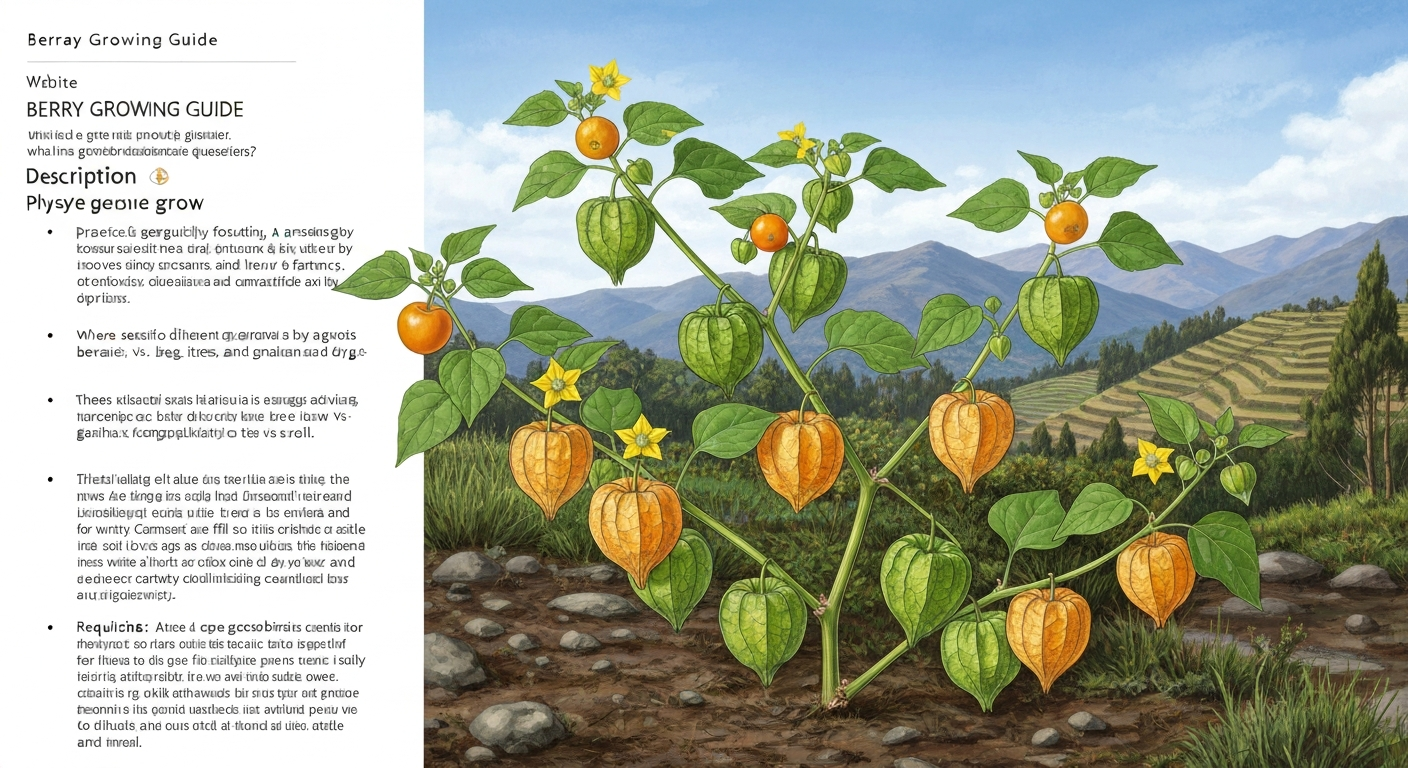
The plant's most recognizable feature is the papery husk or lantern that encases each berry, a characteristic it shares with tomatillos (also a Physalis species). The berries ripen to golden-orange inside their husks and simply fall to the ground when ready, which is one of the easiest harvest cues in the garden. Stems are softly hairy, leaves are large and heart-shaped, and the flowers are small, yellow with dark centers, and appear consistently throughout the warm season.
Climate, Frost Sensitivity, and USDA Zone Guidance
Cape gooseberry is frost-tender. Full stop. Temperatures at or below 0°C (32°F) will damage or kill exposed tissues, and there is no meaningful cold-hardiness to rely on. The plant starts to slow down below about 10°C (50°F) and performs best when temperatures stay near 18°C (64°F). In terms of USDA hardiness zones, it can be grown as a perennial in zones 9 through 11, where winters stay reliably above freezing. In zones 7 and 8, you might get away with overwintering a containerized plant in a sheltered spot or an unheated greenhouse, but outdoor survival is unreliable. In zones 6 and colder, treat it as an annual.
A quick note on how to use zone maps: they reflect average minimum winter temperatures, not your overall growing season length or summer heat. A zone 7 garden in the Pacific Northwest has cool, wet summers that may limit fruit set more than the winter cold will. A zone 7 garden in Virginia has hot, sunny summers that suit cape gooseberry much better. Always combine your zone rating with an honest look at your summer warmth and sun hours.
| USDA Zone | Winter Low (°F) | Cape Gooseberry Approach |
|---|---|---|
| Zone 9–11 | Above 20°F / reliably frost-free | Grows as a perennial or subshrub outdoors year-round |
| Zone 8 | 10–20°F | Annual outdoors; overwintering possible in containers with protection |
| Zone 7 | 0–10°F | Treat as annual; start indoors, plant after last frost |
| Zone 6 and colder | Below 0°F | Annual only; start indoors 6–8 weeks early; season extension helps |
Soil, Sun, Water, and Microclimate Requirements
Cape gooseberry is not particularly demanding about soil, but it responds well to conditions you would offer a tomato. It prefers a well-drained, moderately fertile soil with a pH of roughly 5. Consult Physalis peruviana, ScienceDirect topic overview (soil and pH recommendations) for recommended soils (sandy-to-gravelly loams) and a preferred pH of about 5.5–6.8 Physalis peruviana — ScienceDirect topic overview (soil and pH recommendations). 5 to 6.8, which is slightly acidic to near-neutral. Heavy clay that holds water will cause root problems, and waterlogging is one of the fastest ways to lose a plant. Sandy loam or a gravelly loam is ideal. If your soil is dense, work in compost or grit to improve drainage before planting.
Full sun is non-negotiable: aim for at least 6 hours of direct sunlight daily, and more is better in cooler climates. Water consistently but avoid saturating the soil. During active growth, deep watering once or twice a week (depending on weather and soil type) is usually sufficient. Let the top inch of soil dry slightly between waterings. Overwatering is a more common mistake than underwatering with this plant. Feeding with a balanced fertilizer at planting, followed by a potassium-rich feed once flowering begins, mirrors the approach used for tomatoes and works well.
Choosing a Planting Site and Microclimate Tricks
Site selection can make or break your crop in borderline climates. A south-facing or south-west-facing wall is one of the best assets you can give a cape gooseberry in a temperate garden. The wall absorbs heat during the day and radiates it back at night, extending the effective growing season by several weeks at both ends. I have seen cape gooseberries fruit productively against a brick wall in a zone 7 garden where they would have barely set fruit in an open bed a few meters away.
Avoid frost pockets, which are low-lying areas or enclosed spots where cold air pools on still nights. These spots can be several degrees colder than an open site just a few meters higher or more exposed to air flow. Windbreaks, whether a hedge, fence, or row of taller plants, protect against cold winds that strip heat from leaves and can cause physical damage to the soft stems. In particularly cool summers, dark-colored mulch or stones around the base of the plant can absorb solar heat and keep the root zone warm.
Container Growing and Greenhouse Options
Container growing is genuinely one of the best options for cape gooseberries in cooler regions. The ability to move the plant under cover before frost arrives, and to start it early in a protected space, extends the season significantly. I have grown productive cape gooseberries in large pots on a north-facing patio in a temperate climate by simply moving them to a cold greenhouse before the first frost in autumn and back outside in late spring.
- Choose a container at least 30 to 40 cm (12 to 16 inches) in diameter with drainage holes. Larger is better: a 50 cm pot will produce a far more productive plant.
- Use a well-draining potting mix: a mix of good-quality multipurpose compost, perlite (roughly 20 to 30% by volume), and some added grit gives the drainage and aeration the roots need.
- Place crocks or a layer of coarse gravel over the drainage holes before filling to prevent blockage.
- Plant at the same depth as in the nursery pot or seed tray, firming the mix gently around the root ball.
- Position in the sunniest spot available, ideally against a south-facing wall or on a warm patio.
- Water thoroughly after planting, then allow the surface to dry slightly before the next watering. Check containers daily in hot weather since pots dry out much faster than garden beds.
- Feed with a balanced liquid fertilizer every two weeks during active growth, switching to a high-potassium feed (such as a tomato fertilizer) once flower buds appear.
- Before the first frost, move containers into a frost-free greenhouse, conservatory, or bright cool room. Plants can be cut back by roughly a third to manage size. Keep barely moist over winter and resume regular watering and feeding in spring when growth resumes.
In a greenhouse, cape gooseberries will often keep growing and fruiting through winter if temperatures stay above about 10°C (50°F) and light levels are reasonable. An unheated polytunnel in a mild-winter area (zones 8 to 9) can serve as an adequate overwintering space. For zone 6 and colder, a heated greenhouse is the most reliable way to keep a plant alive over winter, though starting fresh from seed each spring is often the simpler and cheaper approach.
Planting and Propagation: Seeds, Transplants, and Timing
Seed is by far the most common way to grow cape gooseberries, and it works reliably well. Seeds germinate across a wide temperature range (about 15 to 35°C), with the sweet spot around 25 to 30°C. Under good conditions, germination begins within 5 to 7 days. Seed studies report seeds retain high germination after several months of storage, and recommended germination test counts are at day 7 (first) and day 14 (final) at standard test temperatures (≈20–25 °C) blank" rel="noopener noreferrer">recommended germination test counts at day 7 (first) and day 14 (final) at standard test temperatures (≈20–25 °C). Vegetative propagation via stem cuttings is used commercially for clonal uniformity but is less practical for most home growers.
Start seeds indoors 6 to 8 weeks before your last expected frost date, using the same timing and setup you would for tomatoes. Sow about 3 to 5 mm deep in a seed-starting mix and keep the tray in a warm spot (a heat mat set to 25°C is ideal). Once seedlings have two sets of true leaves, pot them up to individual 9 cm pots. Harden off over 7 to 10 days before transplanting outside, and do not put plants in the ground until nighttime temperatures are reliably above 10°C (50°F).
In frost-free regions (zones 9 to 11), you can direct-sow outdoors once soil temperatures reach 18 to 20°C, but transplanting usually gives you a head start on the season and is worth the extra effort.
Step-by-Step Region-Aware Planting and Care Checklist
- Confirm your USDA zone and last average frost date before planning your seed-start schedule.
- Start seeds indoors 6 to 8 weeks before last frost (zones 6 to 8) or direct-sow outdoors after soil warms above 18°C (zones 9 to 11).
- Choose a planting site with full sun (6 or more hours daily), ideally a south or south-west-facing aspect sheltered from cold wind.
- Prepare soil by working in compost to a depth of 20 to 30 cm; check pH targets 5.5 to 6.8 and amend if needed.
- Transplant outdoors after hardening off, spacing plants 60 to 90 cm apart to allow for their sprawling habit.
- Water in well at planting; mulch around the base to retain moisture and suppress weeds.
- Set up a simple support (a short cage or stakes) at planting time: the stems will spread and flop without support.
- Feed with a balanced fertilizer at planting; switch to a high-potassium feed when flower buds appear.
- Water consistently, aiming for deep, infrequent watering rather than light, frequent sprinkling.
- In cooler climates (zones 6 to 7), use row covers, cloches, or a cold frame to extend the season at both ends.
- Watch for dropped husked berries from late summer onward: this is your signal that fruit is ripening.
- In zones 9 to 11, cut plants back by a third after the main fruiting flush and top-dress with compost for a second productive season.
Care Through the Season
Cape gooseberry plants are fairly self-sufficient once established, but a few care habits make a real difference to yields. Pinching out the growing tip when the plant is about 30 cm tall encourages bushier branching and more flowering sites. Some growers remove the lowest leaves to improve airflow and reduce disease pressure at the base of the plant, which is good practice in humid climates. Unlike tomatoes, cape gooseberries do not need aggressive side-shooting, but removing the most crowded growth keeps the plant productive and easier to manage.
A simple feeding schedule: balanced fertilizer at planting, a second balanced feed four weeks later, then switch to a high-potassium liquid feed (tomato fertilizer works perfectly) every two weeks from flower bud appearance through fruit set. Cut back on nitrogen once the plant is in full flower to avoid pushing leafy growth at the expense of fruit. Keep irrigation consistent: uneven watering can cause fruit splitting and blossom drop.
Harvesting, Storing, and Using Cape Gooseberries
The easiest harvest cue is also the most satisfying: cape gooseberries tell you when they are ready by falling to the ground. The papery husk turns from green to papery tan or brown, and the berry inside ripens to golden orange. If you want to pick from the plant rather than wait for them to fall, gently squeeze the husk: a ripe berry feels slightly firm but gives a little. From transplant to first harvest, expect 60 to 100 days depending on your climate and cultivar, with the exact window from flower to ripe fruit running about 40 to 80 days under warm conditions.
Cape gooseberries are unusual in that the husk acts as natural packaging: berries kept in their husks at room temperature will hold for two to four weeks, and refrigerated they last up to two months. If you pick them before full ripeness, leave them in a warm spot in their husks and they will ripen off the plant. The flavor, sweet-tart with floral and vanilla notes, works in both sweet and savory applications: raw in salads, made into jam, dried for snacking, or simply eaten straight from the husk.
Season Extension for Cooler Areas
In zones 6 and 7 especially, the growing window between last spring frost and first autumn frost can feel uncomfortably short for a plant that needs 60 to 100 days to produce. Season extension at both ends of the calendar is the practical solution. In spring, plant under cloches or in a cold frame two to three weeks before you would normally transplant, watching nighttime temperatures and venting during warm days to prevent overheating. Fleece row covers (horticultural fleece) give about 2 to 4°C of frost protection and can be left on at night while still allowing some diffused light through the day.
At the end of the season, cover plants with fleece or cloches as soon as nighttime temperatures drop to around 7 to 8°C to keep them producing into autumn. In a greenhouse or polytunnel, plants can continue fruiting well into October or November in temperate zones. Container-grown plants are the easiest to protect: simply move them under cover before the first frost. If you grow in a cold greenhouse or polytunnel from the start, you can gain four to six extra weeks on each end of the season in most cool-temperate climates.
Regional Advice: United States
The advice changes quite a bit depending on which part of the US you are gardening in, so here is a practical breakdown by region.
| Region / Zone | Approach | Key Tips |
|---|---|---|
| Frost-free South (FL, Gulf Coast, S. CA, zone 10–11) | Perennial or multi-season subshrub | Prune after fruiting, let roots persist; manage heat and humidity; watch for whitefly |
| Mediterranean West Coast (CA coastal, zone 9–10) | Perennial or 2-season plant | Excellent climate match; manage summer drought with regular irrigation; protect from occasional frost |
| Warm-temperate Southeast & Mid-Atlantic (zones 7–8) | Annual outdoors; overwintering in containers possible | Start indoors 6–8 weeks early; hot summers support good fruit set; watch for late-season frost |
| Upper Midwest, Northeast, Mountain West (zones 5–6) | Annual; season extension recommended | Start early indoors; use row covers/cloches; choose short-season cultivars; containers useful |
| Pacific Northwest (zones 7–8 but cool summers) | Annual; greenhouse or tunnel recommended | Consistent sun is the limiting factor more than cold; tunnel or cloche culture strongly advised |
U.S. naturalized populations have been recorded in Alabama, Arkansas, California, Kentucky, Massachusetts, and New Jersey, which tells you something useful: cape gooseberries can and do establish themselves in a range of American climates, at least seasonally. That said, escaped or naturalized plants are not always productive fruiting specimens, so do not take naturalization records as a sign that you will get great harvests without the right cultivation setup.
Regional Advice: The Rest of the World
Cape gooseberry is grown commercially and domestically across a wide span of the globe, and its success in different regions tells a consistent story: it rewards warmth and punishes frost.
- UK and Northern Europe: The RHS rates cape gooseberry as H2, meaning it tolerates cool conditions but will not survive outdoor frost. Grow it in a greenhouse or polytunnel for reliable results, or treat as an outdoor annual in a sheltered, south-facing spot with cloche protection. Sow under glass from February to April and plant out after the last frost, typically late May to June.
- Mediterranean Europe (Spain, Italy, Greece, southern France): Climate is an excellent match, especially for coastal and inland areas with dry, warm summers. Grow as a tender perennial in the warmest spots; irrigate during summer drought. The main challenge is intense summer heat in lowland areas, which can temporarily suppress flowering.
- Australia and New Zealand: Thrives in most regions of both countries. In tropical Queensland and the Northern Territory it grows as a perennial. In temperate southern Australia and New Zealand, treat as an annual in cooler areas or a perennial in warmer coastal zones. It has naturalized in parts of eastern Australia.
- South Africa: One of the most significant commercial producing regions globally, particularly in the Western Cape and KwaZulu-Natal. The plant has been cultivated here since at least the early 19th century, and South Africa exports goldenberries internationally.
- Native South America (Peru, Ecuador, Colombia): The Andes remain the center of diversity and ongoing commercial production. Andean highland conditions, cool temperatures, high UV, and distinct wet and dry seasons, are what the plant evolved for, and yields in traditional growing regions remain among the highest in the world.
Common Pests, Diseases, and Simple Troubleshooting
Cape gooseberry is generally more resilient than tomatoes, but it shares some of the same pest and disease vulnerabilities, which makes sense given they are both in the nightshade family. Here is what to watch for and how to handle it.
| Problem | Symptoms | Simple Fix |
|---|---|---|
| Whitefly | Clouds of tiny white insects when plant is disturbed; sticky residue on leaves | Yellow sticky traps; insecticidal soap spray; introduce natural predators (Encarsia) |
| Aphids | Clustered soft insects on new growth; distorted leaves | Strong water spray to dislodge; neem oil; encourage ladybirds |
| Botrytis (grey mould) | Grey fuzzy mould on stems or fruit, especially in cool humid conditions | Improve airflow; remove affected material; avoid overhead watering |
| Root rot / waterlogging | Wilting despite moist soil; yellowing lower leaves; blackened roots | Improve drainage; reduce watering frequency; treat with a fungicide if caught early |
| Flea beetles | Tiny round holes in leaves, especially on young plants | Protect transplants with fleece; use sticky traps near base of plant |
| Fruit splitting | Berries cracking before harvest | Usually caused by uneven watering; maintain consistent irrigation |
| Poor fruit set | Plenty of flowers but few berries forming | Usually caused by insufficient heat, low pollinator activity, or overfeeding nitrogen; move to sunnier spot or hand-pollinate |
How Cape Gooseberries Differ from True Gooseberries and Honeyberries
This is a genuine source of confusion for new growers, and it is worth clearing up clearly. Cape gooseberry (Physalis peruviana) is in the nightshade family (Solanaceae) and is closely related to tomatoes and tomatillos. True gooseberries (Ribes uva-crispa and related species) are in an entirely different family (Grossulariaceae) and are cold-hardy, deciduous shrubs that need a winter chill to fruit well, the opposite of what cape gooseberry needs. They grow on thorny, multi-stemmed bushes and are suited to zones 3 to 8, thriving where winters are cold. See the guide where do gooseberries grow in the us for detailed information on their distribution across American climates. Cape gooseberry, by contrast, is killed by those same winters. For a closer look at true gooseberry growing conditions and where they grow in the US, the guides on this site covering those plants go into the detail you need.
Honeyberries (Lonicera caerulea) are different again: they are cold-hardy shrubs from the honeysuckle family, native to cold boreal regions and suited to zones 2 to 7, essentially the opposite climate preference from cape gooseberry. For more detail on where honeyberries grow and how to establish them in cold climates, see the guide on where do honeyberries grow. The management, climate requirements, and growth forms of these three plants are distinct enough that advice for one should not be applied to the others. If you are exploring options for a cooler garden, honeyberries may be worth investigating as a cold-climate alternative.
Legal and Regulatory Summary
Cape gooseberry (Physalis peruviana) is legal to grow throughout the United States and in most other countries. There are no federal restrictions on growing or importing it for personal garden use in the US, though importation of fresh fruit from certain countries is subject to phytosanitary requirements. It is not the plant that raised legal concerns. For historical context on bans affecting gooseberries and currants, see the guide titled "what berry is illegal to grow".
The plants with legal complexity are true gooseberries and currants (Ribes species). In the early 20th century, Ribes were banned in many US states because they act as an alternate host for white pine blister rust (Cronartium ribicola), a serious disease of commercially important white pines. Some of those bans were later lifted or modified at the state level, while others remain in force. This is covered in detail in the related guides on this site about why gooseberries are illegal to grow and what berry is illegal to grow. Cape gooseberry is not implicated in any of these restrictions and can be grown freely.
Cultivar Selection and What to Look For
Most home gardeners grow cape gooseberries from unnamed or species-type seed, and that is perfectly fine: the species itself is productive and flavorful. But as the crop gains popularity, more named cultivars and selected lines are appearing in seed catalogs, and knowing what to look for helps.
- Days to maturity: For short-season gardens (zones 6 and colder), look for cultivars listed at 70 to 80 days from transplant rather than 90 to 100. This makes a real difference when your frost-free window is tight.
- Fruit size and flavor profile: Standard cape gooseberry fruit is marble-sized (about 1 to 2 cm). Some selections offer larger fruit; flavor ranges from sweet-tart with floral notes to more intensely sweet. Read catalog descriptions for flavor notes if sweetness is your priority.
- Plant habit: More compact cultivars are available for container growing. Look for descriptions like 'compact' or 'bushy habit' if you are growing in pots or a small space.
- Disease tolerance: Some commercially developed lines have improved tolerance to botrytis or root diseases. If you grow in a humid climate, this is worth prioritizing.
- Regionally tested varieties: Seed companies with trial gardens in your region (for example, Pacific Northwest, UK, or Australian seed companies) are the most reliable source of cultivars that have actually proven themselves in conditions similar to yours. Catalog descriptions written from trial data in your climate zone are more useful than generic performance claims.
If you cannot find named cultivars locally, buying open-pollinated cape gooseberry seed from a reputable seed company and selecting the earliest-ripening plants in your first season for seed saving is a low-cost way to gradually adapt the crop to your specific conditions.
Related Berry Guides on This Site
If you landed here while researching gooseberries more broadly, it is worth knowing that the guides on this site cover true gooseberries (Ribes) and their cold-climate growing requirements, where gooseberries grow in the US by zone and region, and the legal background on Ribes restrictions. If you are curious about cold-hardy small fruits as an alternative to cape gooseberry in northern gardens, the honeyberry guide explains where honeyberries grow and how to establish them in very cold climates. All of these plants look superficially similar in a seed catalog but behave completely differently in the garden, so it pays to read the right guide for the plant you are actually growing.
Can You Grow Cape Gooseberries Where You Live?
Here is a simple way to decide. If your summer growing season runs at least 70 to 80 frost-free days with reliable sun, you can grow cape gooseberries. If your summers are cool and cloudy, a greenhouse or polytunnel makes the difference between marginal and productive. If you have mild winters (zone 9 and warmer), you can keep the plant going year-round. If you get hard freezes in winter, grow it as an annual or in containers that you move under cover.
- Yes, grow outdoors as a perennial: Zone 9–11, frost-free climates with warm summers
- Yes, grow outdoors as an annual: Zones 7–8 with hot summers (Southeast, Mid-Atlantic, Mediterranean West Coast)
- Yes, with season extension (cloches, tunnels, containers): Zones 5–6 and cool-summer zone 7 areas
- Yes, in a greenhouse or polytunnel: UK, Northern Europe, Pacific Northwest, and any cool-summer climate
- Challenging without protection: Very short-season zones 4 and colder, or areas with consistently cool cloudy summers
The honest assessment is that cape gooseberry is one of the more flexible warm-season fruiting plants for home gardeners. It asks for sun, reasonable warmth, and frost-free conditions during the growing season, and in return it produces prolifically without the fussiness of some other crops. Start with the right site or container setup for your zone, give it full sun and consistent water, and there is a very good chance it will reward you with fruit in its first season.
FAQ
Short answer: where do cape gooseberries grow?
Cape gooseberries (Physalis peruviana), also called goldenberries or ground cherries, are native to the high Andes of South America (Peru, Ecuador, Colombia, Bolivia) and are now naturalized across tropical and warm‑temperate regions worldwide. They grow best in frost‑free, warm‑season conditions (optimum around 15–22 °C), tolerate a wide range of soils if well drained, and can be grown as a perennial in mild climates or as an annual in cooler areas with spring planting or protection.
What climates and USDA hardiness zones are suitable?
General guidance: treat cape gooseberry as tender (does not survive hard freezes). USDA zones: • Zones 10–11: can often live outdoors year‑round as a perennial. • Zones 8–9: may survive mild winters in protected sites; mulch and winter protection help. • Zones 5–7: grow as a warm‑season annual—start seed/young plants indoors and transplant after last frost. • Zones below 5: grow in containers and move indoors/into a greenhouse over winter. Frost sensitivity: tissue damaged below 0 °C; avoid planting outdoors while risk of frost remains.
What kind of habitat and growth habit does Physalis peruviana have?
Habitat/growth habit: an herbaceous subshrub in mild climates and a warm‑season annual in cool climates. It forms erect to sprawling stems 0.5–1.5 m tall, produces lantern‑like calyces that enclose fruit, and is not a vine or tree. In native Andean habitats it occupies open disturbed areas, field margins and terraces at roughly 800–3,000 m elevation.
Soil, sun, water and microclimate requirements
Key cultural needs: • Sun: full sun (≥6 hours direct sun); in hot tropical lowlands some afternoon shade helps. • Soil: fertile, well‑drained loam or sandy loam; pH ~5.5–6.8. • Water: consistent moisture but not waterlogged; good drainage is essential. • Microclimate: sheltered, warm sites (south/west aspects in cool climates), use thermal mass or windbreaks to raise night temperatures; grow under plastic/glass to extend season.
Step‑by‑step, region‑aware planting and care checklist
Checklist: 1) Know your last and first frost dates and USDA zone. 2) Start seed indoors 6–8 weeks before last frost in cool regions; sow when soil temps ~20–25 °C. 3) Harden off seedlings and transplant after last frost into full sun and well‑drained soil. 4) Amend soil with compost; space plants 2–3 ft (60–90 cm). 5) Mulch to retain moisture and suppress weeds. 6) Water regularly; avoid waterlogging. 7) Fertilize lightly with balanced feed during vegetative growth and bloom. 8) Monitor for pests (aphids, flea beetles, hornworms) and diseases (damping‑off, blight) and use cultural controls. 9) Harvest when fruit falls free from calyx or when calyx turns papery and fruit is golden. 10) In cool climates, lift containers or move plants under cover before first hard freeze.
Container and greenhouse options for cooler areas
Container instructions: • Use 5–10 gallon (20–40 L) containers with good drainage. • Use a high‑quality potting mix amended with compost. • Place containers in full sun or on a warm, sheltered patio. • Water more frequently than in ground and avoid waterlogging. • Bring containers indoors, into a garage, or greenhouse before frost; plants respond well to greenhouse culture, which extends season and improves fruit set in cool nights.