
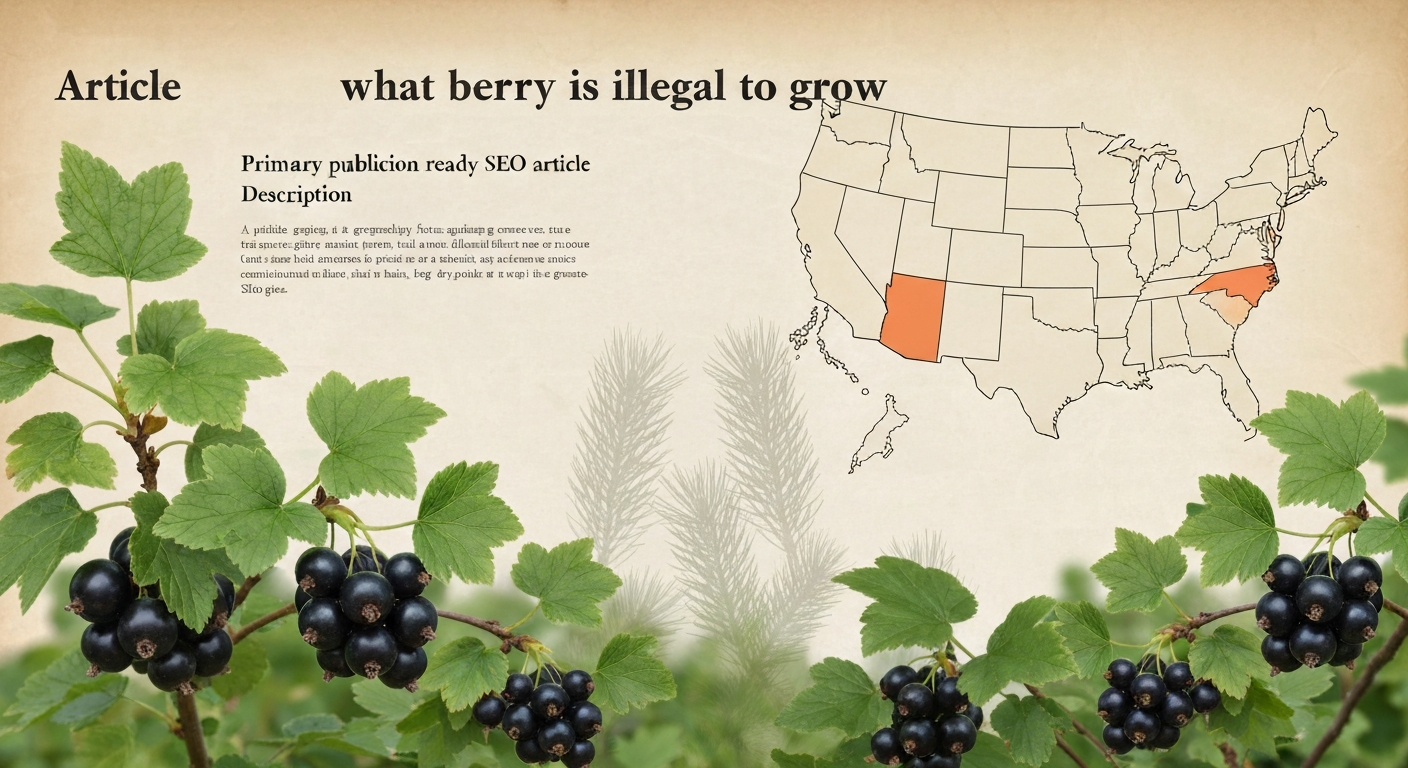
The berry that has most famously been illegal to grow in the United States is the black currant (Ribes nigrum), along with other currants and gooseberries in the Ribes genus. A federal ban was put in place in the early 20th century to stop the spread of white pine blister rust, a devastating fungal disease that needs both white pine trees and Ribes plants to complete its life cycle. The federal restriction was effectively lifted in the 1960s, but several states kept their own laws on the books, and some still enforce them today. So whether growing gooseberries or currants is legal where you live depends entirely on your state, county, and sometimes even your specific township. For a concise explanation, read why are gooseberries illegal to grow.
What Berry Is Illegal to Grow: Gooseberries, Currants, Rules
Which berry was banned and why it happened
The short version: currants and gooseberries (all species in the genus Ribes) were the target. The federal government launched an aggressive eradication campaign starting in the early 1900s after white pine blister rust (caused by the fungus Cronartium ribicola) arrived in North America from Europe. This fungus is what plant pathologists call obligately heteroecious, which just means it cannot complete its life cycle on a single host. It alternates between five-needle pines (like eastern white pine and western white pine) and Ribes plants. Without Ribes nearby, the rust cannot spread back into pine stands. That biology made currants and gooseberries the obvious target for control.
Federal quarantine and eradication efforts ran from the 1930s through the 1960s, documented in USDA reports and Federal Register notices dating as far back as December 1959. Forest Health and Biotechnology: Possibilities and Considerations (National Academies, 2019), discussion of federal WPBR eradication efforts documents USDA/APHIS large‑scale Ribes removal, quarantine enforcement, and research and breeding programs focused on white‑pine‑blister‑rust from the early 20th century through the 1960s Forest Health and Biotechnology: Possibilities and Considerations (National Academies, 2019) — discussion of federal WPBR eradication efforts. Millions of hectares of Ribes were removed from forests and farms. The thinking was logical at the time: eliminate the alternate host, stop the disease. By the 1960s, federal authorities concluded that total eradication was not realistic and lifted the nationwide prohibition, handing regulatory authority down to individual states. Some states kept their bans. Others relaxed them. A few never had restrictions at all. The result is the patchwork of rules that still confuses gardeners today.
How white pine blister rust actually spreads
Understanding the disease cycle helps explain why regulators focused so hard on Ribes and why proximity to white pines still matters. Cronartium ribicola starts on five-needle pines, where it produces spores (aeciospores) that blow through the air and land on Ribes leaves. On the Ribes plant, the fungus produces two more spore types, the last of which (basidiospores) travels back to infect pine needles. Infection moves from the needles down into pine branches and eventually the main stem, killing the tree. The fungus cannot jump directly from pine to pine, so breaking the Ribes link in the chain was the core strategy.
Black currant (Ribes nigrum) is the most susceptible species in the Ribes family. Red and white currants and most gooseberries carry lower susceptibility, which is part of why regulations have historically been stricter for black currants specifically. Researchers have developed rust-resistant black currant cultivars, including Consort, Coronet, Crusader, and Titania, that carry a resistance gene. However, peer-reviewed field studies from New Hampshire and other locations have shown that resistance can break down under local pathogen pressures, so resistant varieties are not a blanket guarantee and still need local verification before you plant near white pines.
Where the law stands today: it really does depend on your state
Several states still have active restrictions on Ribes, and the specifics vary considerably. Michigan's law (Act 313 of 1929, still codified in Michigan Compiled Laws) declares cultivated black currant a public nuisance and prohibits planting, possessing, propagating, selling, or offering plants, roots, or cuttings for sale anywhere in the state. Maine prohibits European black currant statewide and maintains county- and township-level quarantine zones for other Ribes species. New Jersey requires a special permit from the state Department of Agriculture to possess or move black currant cultivars and restricts red currants and gooseberries in defined municipalities. Rhode Island restricts Ribes planting and transport in specified areas under its Department of Environmental Management rules. Rhode Island Dept. of Environmental Management, White Pine Blister Rust regulatory text (RICR 250‑RICR‑40‑10‑2) restricts planting, transport, and possession of cultivated black currant (Ribes nigrum) and other Ribes species in specified areas or by permit Rhode Island Dept. of Environmental Management — White Pine Blister Rust regulatory text (RICR 250‑RICR‑40‑10‑2). Other states have their own variations.
Outside the U.S., Canada takes a similar regional approach. The Canadian Food Inspection Agency restricts imports of propagative Ribes material from Europe, and British Columbia's provincial production guides warn against planting susceptible Ribes varieties within roughly 300 meters (about 1,000 feet) of five-needle pine stands, recommending a 1-kilometer buffer near particularly valuable forests.
How to find out what applies to you
I always tell fellow gardeners to treat this like a property line question: you need to look it up for your specific address, not your general region. Here is the path I recommend working through, in order:
- Start with your state Department of Agriculture website. Search for 'Ribes quarantine,' 'white pine blister rust,' or 'currant gooseberry restriction.' Most state ag agencies post current quarantine maps and permitted species lists.
- Check USDA APHIS (Animal and Plant Health Inspection Service) for federal-level import rules if you are ordering plants from outside the country or across state lines.
- Contact your county cooperative extension office. Extension agents are the most accessible and locally accurate resource for this. Call or email and ask directly: 'Are there any restrictions on planting Ribes (currants or gooseberries) in this county?' They will know.
- Check municipal or township ordinances if you live in a town that borders significant white pine habitat, especially in Maine, New Hampshire, Vermont, or the Great Lakes states. Some restrictions operate at a township level.
- Ask your nursery. Reputable local nurseries in restricted areas will not carry prohibited varieties, and they usually know the rules well.
What to do if restrictions apply to your location
A restriction does not always mean you cannot grow anything. Depending on your state's rules, you may have real options. In New Jersey, for example, a permit from the state ag department allows black currant cultivation under controlled conditions. Some states distinguish between black currant and other Ribes species, meaning red currants and gooseberries might be unrestricted even where black currant is banned. Check whether resistant cultivars like Titania or Consort are specifically exempted in your state's regulations, since a handful of states have carve-outs for certified rust-resistant varieties.
Container growing is one of the most practical workarounds where outright planting prohibitions apply. Growing in large pots (15- to 25-gallon containers work well for currants and gooseberries) means the plant is technically not 'planted' in the ground, which can place it in a regulatory gray zone in some jurisdictions. I want to be careful here: do not assume container growing is automatically legal in your state. Verify with your state ag department. That said, in states where Ribes is unrestricted or permit-accessible, container growing is an excellent option for cold climates or limited garden space. Greenhouse cultivation also isolates plants entirely from outdoor Ribes populations and the pine ecosystem, and some regulatory frameworks treat greenhouse specimens differently. Again, check locally before assuming.
If you are in a fully restricted state with no permit pathway, choosing a botanically unrelated berry that fills a similar flavor niche is the practical move. Jostaberry (a black currant-gooseberry hybrid) has its own regulatory status depending on the state, so check before assuming it is permitted. Honeyberries (discussed below) are a completely different genus and are unrestricted everywhere I am aware of in the U.S.
What Ribes plants actually look like (they are shrubs, not trees)
One of the most common questions I hear from newer gardeners is: do gooseberries grow on trees? The answer is no. All Ribes species, whether gooseberries or currants, are deciduous shrubs. They typically reach 3 to 5 feet tall and wide, sometimes stretching to 6 feet in ideal conditions. They do not form a central trunk like a tree. Instead, they grow as multi-stemmed shrubs with arching canes that emerge from the base.
Telling gooseberries from currants is straightforward once you know what to look for. Gooseberry stems carry sharp thorns or spines at each node, and the fruit grows singly or in small clusters of two or three. Currants are thornless and produce long, dangling clusters called strigs that can hold 10 to 30 berries each. Leaf shape is similar between the two groups: both have palmate (maple-like) lobed leaves, though currant leaves often have a distinctive aromatic scent when rubbed, particularly in black currant. The berry color tells you species too: black currant (Ribes nigrum) produces dark purple-black fruit; red currant (Ribes rubrum) is bright red; white currant is translucent creamy-yellow; gooseberries range from green to yellow, red, or nearly black depending on cultivar.
The most common lookalike confusion is with wild Ribes species that grow naturally in forests and hedgerows. In restricted states, wild Ribes are often subject to removal programs too. If you are unsure whether a plant on your property is a Ribes species, your county extension office or state forestry department can help with identification, and many will come out for a site visit.
Cape gooseberry and honeyberry: different plants entirely
Two berries frequently come up in searches about gooseberries and currants, and they are worth clarifying because they are botanically unrelated to Ribes and face no blister rust restrictions whatsoever.
Cape gooseberry (Physalis peruviana)
Despite its name, the cape gooseberry is not a gooseberry at all. It belongs to the nightshade family (Solanaceae), making it a relative of tomatoes, peppers, and tomatillos, not Ribes. The plant is native to South America and produces small, sweet-tart golden berries inside a papery husk. It has no host relationship with white pine blister rust and is entirely unrestricted. Cape gooseberry grows as a sprawling, tender perennial in warm climates (USDA zones 8 to 11) and as an annual in cooler zones. It thrives in well-drained soil with full sun and warm summers, making it well-suited to the Southeast, Southwest, and coastal California. In colder zones it can be started indoors and grown as a summer annual.
Honeyberry (Lonicera caerulea)
Honeyberry, also called haskap, belongs to the honeysuckle family (Caprifoliaceae) and is likewise completely unrelated to Ribes. It produces elongated, blueberry-flavored blue-purple fruit on a compact shrub, typically 4 to 6 feet tall. Honeyberry is one of the most cold-tolerant fruiting shrubs available to northern gardeners, reliably hardy to USDA zone 3 and in some cultivars down to zone 2. It has no blister rust issues and no regulatory restrictions that I am aware of anywhere in the United States or Canada. For gardeners in restricted states who want a tangy, currant-like berry experience, honeyberry is genuinely one of the best alternatives.
| Feature | Gooseberry / Currant (Ribes) | Cape Gooseberry (Physalis peruviana) | Honeyberry (Lonicera caerulea) |
|---|---|---|---|
| Plant family | Grossulariaceae | Solanaceae (nightshade) | Caprifoliaceae (honeysuckle) |
| Plant form | Deciduous shrub, 3–6 ft | Sprawling tender perennial/annual, 2–4 ft | Deciduous shrub, 4–6 ft |
| Fruit type | Round berries in clusters or singly | Round berry in papery husk | Elongated blue-purple berry |
| Subject to blister rust rules? | Yes (especially black currant) | No | No |
| USDA hardiness | Zones 3–7 (varies by species) | Zones 8–11 (annual elsewhere) | Zones 2–7 |
| Best U.S. regions | Northeast, Midwest, Pacific Northwest, Mountain West | Southeast, Southwest, coastal California | Northern states, Mountain West, Pacific Northwest |
| Sun needs | Full sun to part shade | Full sun | Full sun to light shade |
| Moisture needs | Consistent moisture, well-drained | Moderate, well-drained | Consistent moisture, adaptable |
Where these berries grow in the U.S.: a climate primer
Gooseberries and currants are cool-climate plants. See where do gooseberries grow in the U.S. for a state-by-state guide to growing conditions and suitability. For a concise summary of where gooseberries grow, see where do gooseberries grow. They originated in temperate and boreal Europe and Asia, and they perform best in USDA zones 3 through 6, with some varieties tolerating zone 7 if given afternoon shade and consistent moisture. They need a genuine winter chill (typically 800 to 1,500 chill hours depending on species) and dislike hot, humid summers, which is why they largely disappear from cultivation south of the Mason-Dixon line. The Pacific Northwest, Northeast, upper Midwest, and Mountain West are their sweet spots in the United States. In the Pacific Northwest, mild, moist winters and cool summers create near-ideal conditions. In the Northeast and Midwest, they handle the cold well but can suffer in dry summers without supplemental irrigation.
Honeyberries overlap broadly with gooseberries and currants on the climate map but push even further north. For more detail on where do honeyberries grow, see our guide on where do honeyberries grow. They are the go-to choice for Minnesota, the Upper Peninsula of Michigan, Montana, and similar frigid zones where other fruiting shrubs struggle. They also tolerate late spring frosts remarkably well because they bloom early but the flowers can withstand brief dips to around 20°F (-6°C).
Cape gooseberry occupies almost the opposite end of the climate spectrum. For more detail on where do cape gooseberries grow, see the dedicated guide to growing cape gooseberries in suitable climates. It wants heat, a long growing season, and frost-free conditions for maximum production. The Gulf Coast, Southwest deserts (with afternoon shade and irrigation), and Southern California coast are natural fits. In zones 6 and 7, it can produce as a summer annual started indoors 6 to 8 weeks before last frost, but yields will be lower than in warm-climate gardens.
Growing these berries at home: region-by-region practical guide
Before anything else: confirm your local regulations on Ribes (see the section above on checking your state ag department and extension office) before purchasing or planting gooseberries or currants. Everything below assumes you have done that homework and are cleared to grow.
Gooseberries and currants
Site and soil: these shrubs want well-drained, fertile soil with a pH between 6.0 and 6.5. They tolerate heavier clay soils better than most fruiting shrubs, but standing water will kill the roots. Amend heavy soil with compost before planting. They grow well in full sun in cool climates but benefit from afternoon shade in warmer zones (6b and 7). Spacing of 4 to 5 feet between plants works for most gooseberry varieties; currants can go a bit closer at 3 to 4 feet.
Pacific Northwest (zones 6–8, west of Cascades): This is arguably the best gooseberry and currant territory in the country. Cool, wet winters and mild summers suit them perfectly. American gooseberry varieties (Ribes hirtellum cultivars like Pixwell and Poorman) and European types (Ribes uva-crispa, such as Invicta and Hinnonmäki Red) both perform well here. Powdery mildew is the main disease concern, so choose mildew-resistant cultivars and ensure good air circulation.
Northeast (zones 4–6): Another ideal region. Red and white currants thrive here, and most gooseberry cultivars handle the winters without issue. Summer drought stress is a more realistic problem than cold injury. Mulch heavily and irrigate during dry spells in July and August. Check state rules carefully if you are in Maine, New Hampshire, Vermont, or New York, as quarantine zones vary by county.
Midwest (zones 4–6): Great conditions in the upper Midwest; more challenging in zone 6b states like Ohio and Illinois where summer heat arrives early. Gooseberries handle the harsh winters fine. In Missouri and Kansas (zone 6–7), I would focus on heat-tolerant gooseberry varieties and give plants the shadiest feasible site. Mulching with 3 to 4 inches of wood chips helps retain soil moisture through the hot months.
Mountain West (zones 3–6): Excellent zone compatibility for both currants and gooseberries. The main considerations are irrigation (dry summers require regular watering, especially in high desert areas) and late spring frosts. Plant in a slightly sheltered spot if late freezes are common in your area. At elevations above 6,000 feet, choose the hardiest cultivars: Ribes odoratum (clove currant) is remarkably tough and tolerates drier conditions than other species.
Southeast (zones 7–9): This is genuinely difficult territory for most gooseberries and currants. The combination of summer heat, humidity, and insufficient winter chill makes reliable production unlikely. If you are determined, try clove currant (Ribes odoratum), which has the best heat tolerance in the genus, and site it in morning sun with afternoon shade. I will be honest though: honeyberry or cape gooseberry will serve most Southeast gardeners much better.
Southwest (zones 7–11): Similarly challenging except at higher elevations (above 5,000 to 6,000 feet in New Mexico, Arizona, and Colorado). In those cooler mountain microclimates, gooseberries and currants can do well. At lower elevations, the heat is simply too intense.
Container growing: I have grown red currants in 20-gallon fabric pots with good success. Use a high-quality potting mix blended with perlite for drainage, and add a slow-release fertilizer at planting. Containers dry out faster than in-ground beds, so check moisture every day or two during summer. Pots also allow you to move plants to protect them from late frosts or excessive heat. One important note: container plants in cold climates may need root protection in winter since pots expose roots to air temperatures rather than the insulating effect of the ground. Move them to an unheated garage or barn once dormant, or wrap with insulating material.
Honeyberries (haskap)
Site and soil: honeyberries are more forgiving than gooseberries. They tolerate a wide pH range (5.5 to 7.0), handle wet soils better than most fruiting shrubs, and thrive in full sun to light shade. Spacing of 4 to 6 feet works well depending on cultivar; larger Russian cultivars may need 6 to 8 feet.
Pollination: this is the non-negotiable for honeyberries. You need at least two compatible cultivars for cross-pollination and fruit set. Different breeding lines (Japanese haskap types versus Russian types) may not cross-pollinate efficiently, so buy plants specifically labeled as compatible pollinators. Berry Blue and Polar Jewel are a common compatible pair, but check the nursery's recommendations for the specific cultivars you choose.
Northern states (zones 2–5): Honeyberries are almost perfect here. They bloom very early in spring (often late March or April in zone 4), which can be risky in some years, but the flowers withstand surprisingly hard frosts. In Minnesota, Wisconsin, Michigan's Upper Peninsula, and similar climates, honeyberries fruit reliably when other soft fruits struggle. Expect yields of 3 to 6 pounds per mature plant; some established plants exceed 10 pounds in peak years.
Mountain West and Pacific Northwest (zones 3–6): Excellent performance. In Washington and Oregon, early blooming means pollinators need to be active while the weather is still cold, so plant in a somewhat sheltered, south-facing spot to maximize pollinator visits. In the Mountain West, the early bloom can align poorly with late frosts at higher elevations, so choose later-blooming cultivars when available.
Container growing: honeyberries can be grown in large containers (25 gallons or more per plant) but they resent root restriction as they mature. I would only use containers long-term if in-ground planting is truly impossible. Short-term container growing as a season extender or frost protection strategy works fine.
Cape gooseberries (Physalis peruviana)
Site and soil: cape gooseberry wants full sun, warmth, and fast-draining soil. It is drought tolerant once established but produces more fruit with regular watering. Soil pH between 6.0 and 7.0 suits it well. Like its tomato relatives, it benefits from consistent rather than irregular watering to prevent fruit splitting.
Southeast and Gulf Coast (zones 8–10): This is prime cape gooseberry territory. Plant after the last frost date and let it run. It can sprawl significantly (4 feet wide or more) so give it room or use a tomato cage for support. In Florida and coastal Gulf states, it may behave as a short-lived perennial.
Southwest (zones 8–11): Thrives in warm, dry climates with irrigation. In Phoenix or Tucson, afternoon shade is helpful in peak summer. Start seeds indoors in late winter (January or February) to get a long enough growing season in higher-altitude parts of Arizona and New Mexico.
Northern zones (zones 4–7, grown as annual): Start seeds indoors 6 to 8 weeks before your last frost date. Transplant out when nighttime temperatures stay above 45°F. Even in a shorter season, a well-started plant can produce a meaningful crop from late summer into fall. In zones 5 and 6 I typically get harvest starting in August and continuing until first frost.
Container growing: cape gooseberry is one of the better fruiting plants for container cultivation. A 10- to 15-gallon pot is sufficient for a single plant. It can be grown on a sunny patio in virtually any zone and brought indoors before frost in cooler climates. In a sunny indoor space (or under grow lights), it can even overwinter and fruit again the following season, though I find starting fresh each year gives better results in most home setups.
Quick variety and region reference
| Crop | Recommended Varieties | Best U.S. Regions | Key Notes |
|---|---|---|---|
| Black currant (Ribes nigrum) | Titania, Consort, Ben Sarek | Pacific Northwest, Northeast, Midwest, Mountain West | Check state rules first; Consort and Titania have rust resistance but verify locally |
| Red/white currant (Ribes rubrum) | Red Lake, Rovada, Blanka (white) | Pacific Northwest, Northeast, Midwest, Mountain West | Less legally restricted than black currant; still verify in ME, MI, NJ, RI |
| Gooseberry (Ribes uva-crispa / hirtellum) | Invicta, Pixwell, Hinnonmäki Red, Poorman | Pacific Northwest, Northeast, Midwest, Mountain West | American types more mildew-resistant; European types often larger fruited |
| Honeyberry/haskap (Lonicera caerulea) | Berry Blue, Polar Jewel, Tundra, Aurora | Northern states, Mountain West, Pacific Northwest | Needs 2 compatible cultivars for pollination; no regulatory restrictions |
| Cape gooseberry (Physalis peruviana) | Standard (often sold as species, not named cultivars) | Southeast, Southwest, coastal California; annual in zones 4–7 | Unrelated to Ribes; no rust concerns; grown like a tomato |
The most important step before you buy any currant or gooseberry plant is the legal check. Once you have confirmed you are in the clear (or obtained any needed permit), these are genuinely rewarding fruiting shrubs that produce well with relatively little maintenance compared to more demanding crops. For gardeners in restricted states, honeyberry is the most direct substitute in terms of climate suitability and growing style. Cape gooseberry fills a different garden niche but is worth adding if you have a warm, sunny spot to spare. Start with your county extension office, ask the right questions, and you will know exactly where you stand before the first plant goes in the ground.
FAQ
Short answer — what berry is (or was) illegal to grow in parts of North America and why?
Historically and in some jurisdictions today, members of the Ribes genus (currants and gooseberries — especially cultivated black currant, Ribes nigrum) have been restricted or prohibited. Restrictions originated in the 20th century to limit spread of white‑pine‑blister‑rust, a fungal disease that requires both five‑needle (white) pines and Ribes hosts to complete its life cycle. Federal U.S. planting bans were phased out in the 1960s, but several U.S. states and some Canadian provinces still maintain quarantines, permit programs, or prohibitions in certain areas.
Which Ribes species are commonly restricted and are all currants/gooseberries the same in terms of risk?
Regulated species commonly include the cultivated black currant (Ribes nigrum), many black‑currant cultivars, and in some places certain hybrids. Risk varies: black currants are generally more susceptible to blister rust, while red and white currants and gooseberries tend to be less susceptible. State/provincial lists and rules differ, so susceptibility does not automatically equal prohibition everywhere.
How did the legal restrictions start and what changed?
Early 20th‑century forestry programs linked Ribes removal to control of white‑pine‑blister‑rust, prompting federal quarantine and eradication programs and local bans in pine‑producing regions. By the 1960s the federal nationwide planting prohibition was effectively ended and regulatory authority shifted largely to states/provinces, some of which kept or later adopted their own restrictions or permit systems.
How should a home gardener check whether currants or gooseberries are legal to grow where they live?
Always check current local rules before planting. Steps: 1) Search your state/provincial agriculture department and forestry/forest‑health pages for 'Ribes', 'currant', 'gooseberry' or 'white‑pine‑blister‑rust'. 2) Contact your county extension office or plant‑pest program for up‑to‑date guidance and permit information. 3) If buying or moving plants, ask the nursery for a phytosanitary statement and check import/movement rules. Do not rely on older secondary sources—laws and quarantines can be amended.
If my area restricts Ribes, what practical options do I have?
Options include: 1) Apply for a permit if your state issues special‑use permits for research or production. 2) Choose resistant or tolerant cultivars only if allowed and validated locally. 3) Grow Ribes in containers, a greenhouse, or secure nursery settings where local rules permit contained culture (check regulations—containment may still be regulated). 4) Select legal alternatives (see next Q&A). 5) Work with your extension agent if you want to petition for a change or participate in coordinated monitoring.
Do gooseberries grow on trees? What do currants and gooseberries look like and how to identify them?
Gooseberries and currants are deciduous shrubs, not trees. Typical identification: multi‑stemmed woody shrubs 1–2 m tall (often shorter), alternate simple leaves (lobed), clusters (racemes) of small rounded fruits in summer. Gooseberries often have single fruits (sometimes with fuzz or spines on the stems) and larger solitary berries; currants typically form pendent clusters of small berries. Black currants are dark purple/black; red currants are translucent red; white currants are pale/amber. If unsure, get a local extension or nursery to confirm before planting.