
Yes, goji berries can grow in India, but not everywhere. Your best chances are in the cooler hill states: Jammu and Kashmir, Himachal Pradesh, Uttarakhand, Ladakh, and parts of northeast India like Arunachal Pradesh. These regions sit at elevations roughly between 900 and 2,100 m above sea level, which gives goji the winter chill it needs and the well-drained, moderately dry conditions it prefers. On the hot, humid plains of central or coastal India, growing goji is genuinely difficult without protected-culture workarounds. If you are in the hills, though, this plant is more achievable than most people assume.
Where Goji Berries Grow in India: Regions, Tips & Guide
Marcus Holloway
16 Jul 2026
What goji actually is and where it comes from
The name 'goji' covers two closely related species: Lycium barbarum L. (Barbary wolfberry or Himalayan goji) and Lycium chinense Mill. (Chinese wolfberry or Chinese boxthorn). Both are used for food and traditional medicine, both are sold under the 'goji berry' label, and the terms goji and wolfberry are completely interchangeable in practice. If you want to dig deeper into the wolfberry side of things, the broader wolfberry family is covered in a related guide on where wolfberries grow.
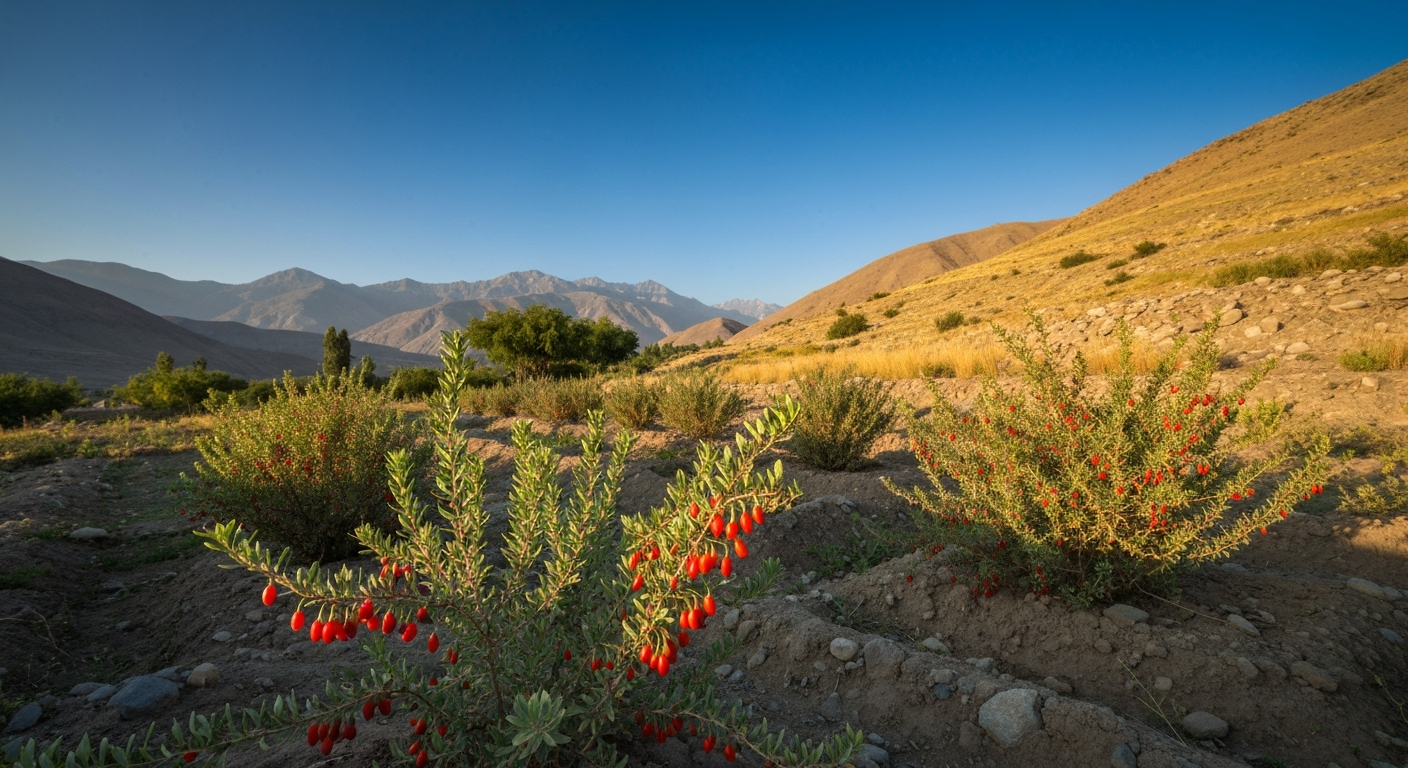
Commercially, goji cultivation is dominated by northwest China, specifically the Ningxia and Gansu provinces, which together supply more than 70% of China's goji crop. The conditions there are stark: an average annual temperature of around 8 to 9.5 degrees Celsius, annual rainfall of only 175 to 270 mm, a frost-free window of roughly 160 to 170 days, and elevations around 1,100 m. It is a dry, continental, sunny climate. That profile matters a lot when you are trying to figure out which part of India can actually support these plants. For a global overview of suitable climates and regions, see where do goji berries grow.
Beyond China, goji is cultivated in parts of Central Asia, Eastern Europe, the United States (especially Utah and the Intermountain West), Canada, and Australia. In India, the plant is not a new introduction in the botanical sense: Lycium species including wild relatives like L. ruthenicum have been recorded in Himalayan and northeastern hill zones for a long time. See PMC review, Polyphenol‑Rich Wild Fruits of the Indian Himalayas (mentions Lycium occurrence and elevation range) PMC review — Polyphenol‑Rich Wild Fruits of the Indian Himalayas (mentions Lycium occurrence and elevation range). What is newer is deliberate cultivation for fruit production, which is still in pilot or small-scale stages at places like the Jammu and Kashmir Medicinal Plants Introduction Centre.
Which parts of India are actually suited to goji
I want to be direct here because this is the question most Indian growers are really asking. The regions with the most natural fit are all in the hills and mountains of northern and northeastern India. The key driver is elevation combined with a dry-to-semi-arid or at least well-drained environment and cool winters.
- Ladakh and Kargil (J&K/UT): Arguably the closest match to goji's native habitat in all of India. Dry, sunny, cold winters, alkaline soils. Wild Lycium relatives already grow here. Excellent candidate region.
- Jammu and Kashmir valleys (Srinagar belt, 1,500–1,800 m): Good elevation, proper winter dormancy, lower humidity than the plains. The J&K Medicinal Plants Introduction Centre has actively promoted goji here.
- Himachal Pradesh (Spiti, Lahaul, Kinnaur, and drier mid-hill valleys, 900–2,100 m): Spiti and Kinnaur especially mimic the Ningxia profile with dry, cold conditions and alkaline-leaning soils.
- Uttarakhand (Garhwal and Kumaon hills, especially the drier rain-shadow valleys above 1,000 m): The wetter, south-facing slopes have too much humidity, but drier interior valleys are promising.
- Arunachal Pradesh and parts of Assam (higher elevations only, above ~1,200 m): Lycium has been recorded here. Rainfall is higher than ideal, so site drainage becomes critical.
- Parts of Sikkim and northern West Bengal (Darjeeling district, above 1,000 m): Marginal but possible with careful site selection on well-drained slopes.
States like Punjab, Haryana, Rajasthan, Gujarat, Maharashtra, Andhra Pradesh, Tamil Nadu, and Kerala are generally not suitable for open-field goji cultivation. The combination of high summer heat, humidity, and lack of meaningful winter chill stresses the plant, reduces yield, and increases disease pressure. Container culture with seasonal management is the only realistic path in those regions, which I will cover below.
Climate, elevation, and hardiness: matching goji's needs to Indian zones
Lycium barbarum is cold-hardy across USDA Hardiness Zones roughly 5 through 9, with most extension sources putting the sweet spot at Zones 6 to 9. India does not use the USDA system officially, but you can roughly correlate: the high-altitude Himalayan valleys (Ladakh, Spiti, Kinnaur) sit in USDA Zone 5 to 6 equivalents, which is ideal. Mid-hill areas of Himachal and Uttarakhand (1,000 to 1,800 m) map to roughly Zones 7 to 8, also excellent. The upper plains of Punjab or Haryana might reach Zone 9 in winter minimums, which is the edge of workable territory. Anywhere Zone 10 equivalent or warmer is a serious stretch without intervention.
Goji needs a genuine winter dormancy period with some weeks of cold temperatures below 7 degrees Celsius. This is why the comparison to Canada is actually instructive: growers in Canada's colder zones face the opposite problem (too cold, too short a season), while most of lowland India faces the inverse (not cold enough, season too long and too humid). The Himalayan belt, sitting between those extremes, is where the opportunity lies. If you are curious how goji fares in those very-cold climates, the guide on growing goji berries in Canada covers the cold-end challenges in detail.
| Indian Region | Approx. Elevation (m) | USDA Zone Equivalent | Winter Chill | Suitability |
|---|---|---|---|---|
| Ladakh / Spiti / Kinnaur | 2,500–3,500 | 4–6 | Strong | Excellent (with wind protection) |
| J&K valleys (Srinagar area) | 1,500–1,800 | 6–7 | Good | Very Good |
| Himachal Pradesh mid-hills (dry valleys) | 1,000–1,800 | 7–8 | Good | Good |
| Uttarakhand (drier inner valleys) | 900–1,600 | 7–8 | Moderate–Good | Good with drainage focus |
| Arunachal Pradesh / Sikkim hills | 1,200–2,000 | 7–8 | Moderate | Marginal–Good (drainage critical) |
| Northern plains (Punjab, UP foothills) | 200–500 | 9–10 | Weak | Marginal; container preferred |
| Central / Southern plains | 0–500 | 10–12 | None–Minimal | Not suitable for open field |
Soil, sun, and water: what goji actually needs
Soil type and pH
Goji is not fussy about soil fertility, but it is extremely fussy about drainage. In Ningxia's commercial fields, the soil pH runs around neutral to slightly alkaline (field measurements around 7.1 are typical), and the texture is loam or sandy loam with excellent aeration. Goji tolerates mildly saline and alkaline conditions better than most berries, which is actually a useful trait in parts of Ladakh and Rajasthan where soil alkalinity is common. What kills goji reliably is waterlogged, heavy clay soil. If water sits around the roots for even a short period, root rot follows. In the wetter northeastern hill zones or in the high-rainfall valleys of Uttarakhand's outer ranges, raised beds or slope planting is not optional, it is essential.
Sunlight
Full sun means full sun here. Aim for at least 6 hours of direct sunlight daily; more is better. Light shade noticeably reduces fruit yield and sugar content. In the Himalayan belt, south- or southeast-facing slopes maximize sun exposure and also provide the warmth needed for fruit ripening. Avoid north-facing terraces or positions shaded by taller trees or buildings for most of the day.
Water
Once established (after the first full season), goji is drought-tolerant. This is a genuinely useful trait for the drier Himalayan valleys. However, during flowering and fruit fill, consistent moisture matters. Chinese commercial growers use drip irrigation specifically during those phases to avoid blossom drop and improve fruit size. For Indian home growers, this translates to regular watering from when flower buds appear through harvest, then backing off during dormancy in winter. Do not over-water in the hot season, and never let the root zone stay wet overnight if you can help it.
Plains, foothills, or high hills: choosing your site in India
This is where I find Indian growers most need a straight answer rather than hedged generalities, so here is my honest site assessment.
| Site Type | Key Advantage | Key Challenge | Verdict |
|---|---|---|---|
| High Himalayan valleys (Ladakh, Spiti, Kinnaur) | Best climate match; dry, sunny, cold winters; alkaline soils suit goji | Wind exposure; very short frost-free season; may need windbreaks | Best open-field option in India |
| Mid-hills (J&K, Himachal, Uttarakhand, 900–1,800 m) | Good winter chill; cooler summers; longer growing season than high hills | Some areas too wet on south slopes; drainage management needed | Excellent if drainage and site aspect are managed |
| Northeastern hills (Arunachal, Sikkim, above 1,200 m) | Lycium recorded naturally; adequate elevation | Higher rainfall and humidity; disease pressure higher; drainage critical | Workable with raised beds and good air circulation |
| Northern plains and sub-Himalayan belt (below 600 m) | Accessible; long growing season | Insufficient winter chill; high summer humidity; prone to root rot | Container or greenhouse only |
| Central and southern India | Long season, good sun | No meaningful winter chill; high humidity; heat stress | Not recommended; protected culture marginal |
My personal recommendation: if you are in Himachal Pradesh or Uttarakhand and you have a south-facing slope between 1,000 and 1,800 m with reasonably well-drained, non-waterlogged soil, plant goji in the ground and expect it to do well with modest care. If you are in the plains, containers on a rooftop or veranda with seasonal management is the realistic route. Do not give up on goji just because you are not in the hills, but do go in with clear eyes about what the container route demands.
Container, greenhouse, and protected-culture options
Goji is actually a reasonable container subject. The plant is shrubby, responds well to pruning, and can be kept manageable in a large pot. For growers in the plains or anywhere the climate is marginal, here is how to make it work.
- Container size: use at least a 30–40 litre container (roughly 12–16 inches / 30–40 cm diameter and depth). Larger is better for root run and moisture stability.
- Potting mix: a free-draining mix is non-negotiable. A reliable mix for Indian conditions is two parts coarse river sand or perlite, one part compost, and one part garden loam. Avoid heavy black cotton soil or pure coco peat alone.
- Placement: full sun position, ideally a south-facing terrace, rooftop, or veranda. Move containers to a cooler, sheltered spot in peak summer (April–June) in very hot plains cities.
- Winter treatment (plains): in Delhi or similar cities where winters are mild, you may not get full dormancy. Reduce watering sharply in December–January to simulate a rest period, which helps improve the following season's fruiting.
- Greenhouse and net-house: in very hot or humid lowland zones, a shade net (30–50% shade) during peak summer reduces heat stress without causing the yield-reducing shade that affects full-season shade. A simple greenhouse or poly-tunnel helps in very cold high-altitude sites where the frost-free window is too short.
- Repotting: every 2–3 years, refresh the mix and move up one container size to maintain vigour.
How to propagate and plant goji: a practical step-by-step guide
There are three workable methods: softwood cuttings, hardwood cuttings, and seed. For home growers in India, cuttings are the most reliable route to a true-to-type, faster-cropping plant. Seeds are variable, slower, and produce inconsistent fruit quality, though they work if cuttings are unavailable.
Method 1: Softwood cuttings (recommended for most Indian growers)
- Timing: take cuttings in late spring to early summer. For hill states like Himachal Pradesh and Uttarakhand, this means roughly May to June when new growth is actively extending. For the plains, late February to March works before the intense heat sets in.
- Cut 10–15 cm (4–6 inch) sections of new, green, flexible growth just below a node. Remove the lower leaves, leaving 2–3 leaves at the tip.
- Dip the cut end in a rooting hormone powder or gel (IBA-based, available at most Indian horticulture nurseries).
- Insert cuttings into a mix of equal parts perlite and coarse sand, or perlite and coco peat. Avoid heavy soil at this stage.
- Keep the propagation tray or pot moist but not saturated, under indirect bright light. Cover loosely with a polythene bag or clear plastic to retain humidity.
- Roots typically develop in 3 to 4 weeks. Once you see new leaf growth and feel resistance when you gently tug, roots are established.
- Pot up into a 15 cm container with the standard potting mix described above and grow on for 6–8 weeks before planting out.
Method 2: Hardwood cuttings (winter dormant season)
- Timing: collect hardwood cuttings during full dormancy. In J&K and Himachal Pradesh this is December to February. In the plains, January is the closest equivalent rest period.
- Cut pencil-thick, dormant stems into 15–20 cm sections, each with at least 3 nodes. Cut the top at an angle and the bottom flat so you always know which end goes down.
- Dip the base in rooting hormone and insert upright into a sandy, free-draining mix, leaving one or two nodes above soil.
- Water in and keep in a sheltered, frost-free location. New growth will appear in spring; wait until roots are well formed before transplanting.
- Hardwood cuttings are slower to root but very low effort and can be taken in large batches if you already have a mother plant.
Method 3: Seed propagation
- Timing: sow seeds in late winter indoors (February for hill states; January for plains). Surface sow on moist seed-raising mix and barely cover with fine sand.
- Germination is slow and uneven — expect 2 to 4 weeks and sometimes longer. Keep soil moist and temperatures above 18 degrees Celsius.
- Thin to the strongest seedling per cell once two true leaves appear. Pot on gradually.
- Seedling plants will typically take 2 to 3 years to fruit reliably, compared to 1 to 2 years from cuttings. For that reason, cuttings from a known-performing plant are strongly preferred.
Planting out: spacing, timing, and setup
- Timing: plant out in early spring after the last hard frost. In J&K and Himachal Pradesh, this is typically March to April. In Uttarakhand's lower hills, February to March works well. Plains growers should plant in October to November to avoid summer heat stress on young plants.
- Spacing: space plants 1.2 to 1.5 m apart within a row and 1.5 m between rows for a hedged/trellised system. Single plants in a garden can be given more room (1.5–2 m all round).
- Support: install a simple trellis, fence, or 3-wire support at planting time. Goji is a loose, arching shrub that sprawls without support. Training it upright improves air circulation and makes harvest much easier.
- First-year care: water regularly until established (roughly 6–8 weeks after planting), then reduce frequency. Apply a balanced organic fertiliser or compost mulch in spring. Avoid high-nitrogen feeds in the first season as they push leafy growth at the expense of roots.
- Pruning principle: goji fruits on new lateral shoots from the previous year's wood. In late winter, remove dead or weak canes and shorten remaining canes by about one-third. In summer, tip-prune laterals to encourage short fruiting spurs. Remove the oldest canes every year or two to keep the plant productive. This renewal pruning is the single most impactful thing you can do for ongoing yields.
Pruning, pests, harvest, and sourcing in India
Pruning recap
The pruning calendar for hill-state Indian growers runs like this: late winter (February in lower hills, March in higher zones) for main structural pruning; early summer (May to June) for tip pruning of new laterals to encourage spur formation; and autumn cleanup of any diseased or dead wood after harvest. Handbook, Emerging Fruit Crops (Lycium) (spacing and pruning notes) reports commercial Chinese spacing of about 1.0–1.5 m between plants and ~1.5 m between rows for hedged systems and recommends training on low trellis/wires with annual renewal pruning because fruit forms on new laterals blank" rel="noopener noreferrer">Handbook — Emerging Fruit Crops (Lycium) (spacing and pruning notes). Plains container growers follow a shifted version of this, doing their main prune in January and light tip pruning in March.
Pests and diseases to watch in India
- Aphids: the most common pest on goji worldwide, and India is no exception. Watch for clusters on new growth in spring. A strong water spray or neem oil solution handles light infestations.
- Whitefly and spider mites: more common in hot, dry plains conditions. Neem oil or insecticidal soap spray is effective. Good air circulation and avoiding overwatering reduce pressure.
- Powdery mildew: a fungal issue that flares in humid conditions with poor airflow, particularly in the wetter northeastern hill zones. Keep plants well-spaced and thinned. Sulphur-based fungicide or a baking soda spray works as a preventive.
- Root rot (Phytophthora spp.): the biggest killer in Indian conditions, driven by waterlogging. Prevention is everything: good drainage, raised beds, and not overwatering.
- Fruit fly: in some hill districts, fruit flies can attack ripening berries. Netting the plant during ripening or using fruit fly traps helps.
Harvest timing
Goji berries typically ripen from mid-summer through autumn. In J&K, Himachal Pradesh, and Uttarakhand hill regions, expect the main harvest window from July through September, with repeat flushes possible until the first frosts. Berries should be harvested when fully red and slightly soft. Fresh berries are highly perishable and should be used within a few days, dried immediately, or frozen. Traditional sun drying on mesh racks works well in the dry air of Ladakh, Spiti, and Kinnaur.
Sourcing plants and seeds in India
Goji planting material in India is still somewhat niche but increasingly available. The J&K Medicinal Plants Introduction Centre has been active in promoting and supplying goji material in the north. Online nurseries and horticultural platforms now list Lycium barbarum seeds and occasionally rooted cuttings. When buying seeds, look for named Lycium barbarum or Lycium chinense rather than vague 'goji berry' labels from untraceable sources. If you are in Himachal Pradesh or Uttarakhand, check with state horticulture department nurseries, as some carry medicinal and fruit crop introductions including Lycium. Avoid impulse buys from street vendors selling unlabelled seeds, as germination rates and plant identity are unreliable.
A quick note on goji vs. juniper and juneberry for Indian growers
If you have been searching around this topic, you may have come across juniper berries or juneberries as related results. They are completely different plants. Juniper berries come from Juniperus species (conifers), and several juniper species do grow wild in India's Himalayan regions. For more detail on juniper distribution and whether juniper berries grow in India, see do juniper berries grow in India. The guide on whether juniper berries grow in India covers that distinction clearly. Juneberries (Amelanchier spp.) are a different genus again, native to North America and temperate Europe, and are not established in Indian cultivation. For more on their native range and cultivation, see where do juneberries grow. The name confusion matters because the growing conditions, propagation methods, and culinary uses are entirely different. See our guide on can you grow juniper from berries for propagation details and how juniper propagation differs from goji. For food-grade goji production, you want Lycium barbarum or Lycium chinense specifically.
The honest bottom line for Indian growers
Goji berries are a genuinely viable crop for India's hill states. They suit the dry Himalayan valleys better than almost any other introduced berry crop, because those valleys actually replicate the arid, alkaline, high-elevation conditions of northwest China where goji thrives commercially. If you are in Ladakh, Spiti, Kinnaur, the drier parts of Himachal or Uttarakhand, or the cooler elevated pockets of J&K, the plant will reward basic care with reliable annual harvests. For plains growers, containers are the route, and the effort is higher, but it is not impossible. Match your site, sort your drainage, give it full sun, and keep up with the annual pruning, that combination does most of the work for you.
FAQ
Short answer: Can goji berries (Lycium spp.) be grown successfully in India and where should I try?
Yes. Lycium barbarum/chinense (goji or ‘wolfberry’) can be grown in India, especially in cooler hill and high‑plateau microclimates. Best Indian zones: temperate to cool subtropical hill areas — Jammu & Kashmir, Ladakh (lower elevations and sheltered sites), Himachal Pradesh, Uttarakhand, parts of Arunachal Pradesh and Assam foothills; also experimental plantings in higher‑altitude parts of Sikkim and some dry rain‑shadow valleys. In plains with hot humid summers success is limited unless you replicate cooler, drier conditions (see greenhouse, high‑sun, well‑drained containers and irrigation strategies below).
What climate, elevation and hardiness (USDA‑equivalent) should I target?
Natural commercial reference is NW China (Ningxia) — warm‑temperate continental with cool winters. In India, aim for elevations roughly 900–2,100 m ASL where winters provide chill but summers are not excessively humid. USDA equivalent: roughly zones USDA 6–9 for most cultivated selections (some genotypes tolerate colder crowns but young plants need protection). If you live in lower elevations with humid, hot monsoons (Coastal/central India), goji is much harder to grow outdoors without controlled conditions.
What soil, sun and water conditions do goji need in India?
Soil: well‑drained loam to sandy‑loam; pH neutral to slightly alkaline (~6.5–8.0). Avoid waterlogged heavy clays. Sun: full sun (≥6 hours) for best flowering and fruit sugar; light afternoon shade can help in very hot valleys. Water: drought‑tolerant once established, but requires regular, even moisture during flowering and fruit fill—drip irrigation is ideal. Tolerant of some salinity/alkali common in arid hill soils.
Should I plant goji on hillsides or plains in India — which is better?
Hillsides (well‑drained slopes) and high‑plateau sites with cool winters are generally better because they offer good drainage, chill and lower humidity. Plains with hot, humid summers are less suitable; if you must plant there, use raised beds, excellent drainage, good air circulation, and consider partial shade or greenhouse/container culture to control humidity and heat.
Can I grow goji in containers or greenhouses in India?
Yes. Containers: use large pots (20–30+ liters) with free‑draining mix; suitable for terraces and warmer lowland regions where soil conditions or drainage are poor. Greenhouse: useful in humid or tropical plains to control humidity, pests and to give cool night temperatures; use ventilation and shading in summer. Containers and greenhouses also let you overwinter potted plants in colder, non‑hardy areas.
Step‑by‑step propagation: how do I start plants from seeds, cuttings or nursery stock?
Seeds: clean ripe berries, ferment/clean pulp, sow fresh or cold‑stratify for faster germination; germination is variable and slow — expect several weeks to months. Cuttings (recommended): take softwood cuttings late spring–summer (10–15 cm), dip in rooting hormone, root in perlite:peat or coarse sand/compost under high humidity; roots in ~3–4 weeks. Hardwood cuttings can also be taken in late winter/dormant season. Nursery stock: buy certified plants or grafted/virus‑free material, acclimatize before planting. For uniform, earlier cropping prefer cuttings or tissue‑culture derived plants.