
Juniper berries grow naturally across a huge swath of the Northern Hemisphere, from the rocky slopes of the American West and the mountains of Europe to the subarctic scrubland of Canada and the Mediterranean coastline. You'll find them on dry, sun-baked hillsides, open rocky outcrops, canyon edges, and sandy well-drained terraces. If your climate is temperate, reasonably sunny, and not waterlogged, there's a good chance at least one juniper species is already growing near you or will grow happily in your garden.
Where Does Juniper Berries Grow: Climate, Species, and Timing
Marcus Holloway
15 Apr 2026
Juniper berries aren't actually berries
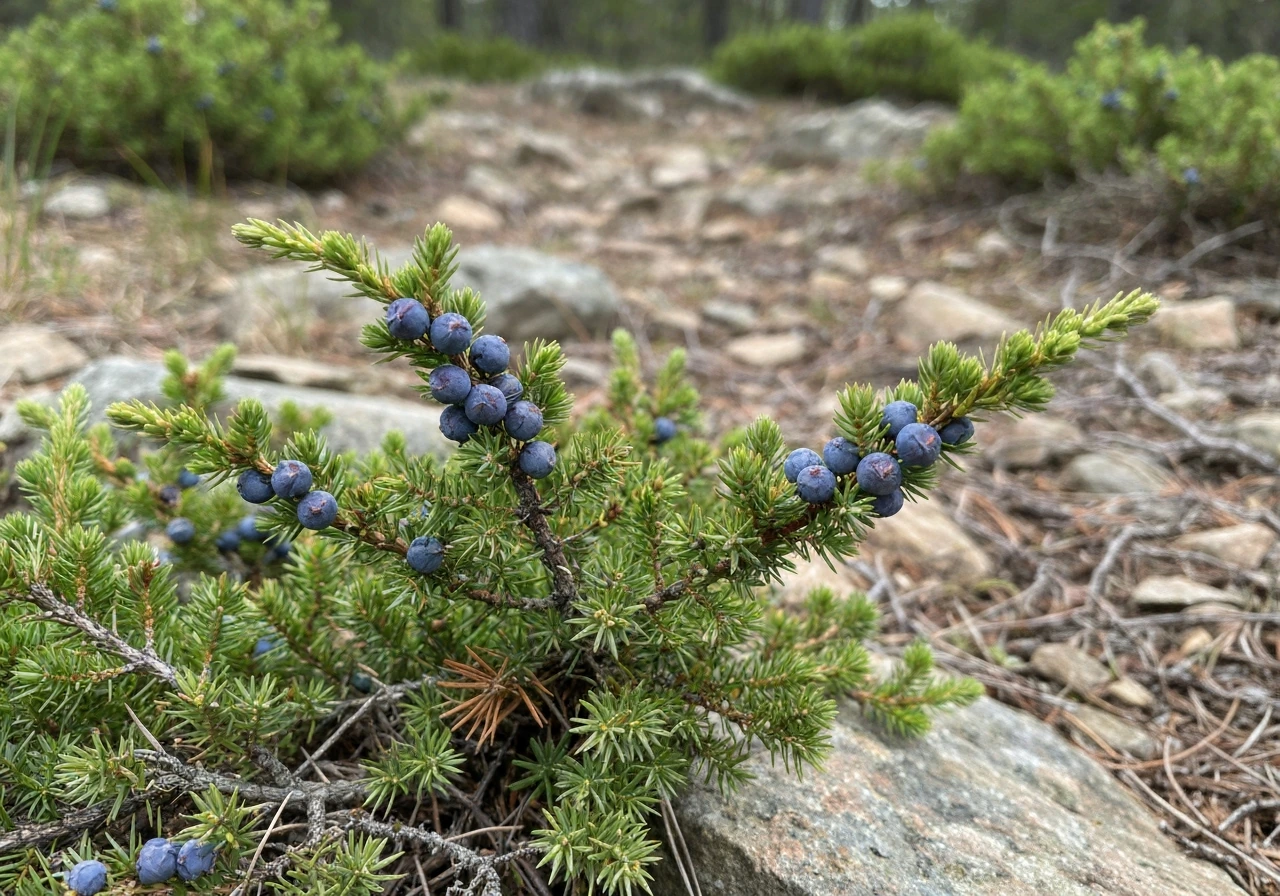
This is worth getting out of the way early because it matters for identification and harvest. What everyone calls a juniper berry is actually a fleshy seed cone. Junipers are conifers, so they produce cones like a pine or spruce, but in juniper the cone's scales become soft, fleshy, and fused together into a round, berry-like structure called a galbulus. The result looks and feels like a berry, but botanically it's a modified cone. Once you know that, a lot of things make more sense: why the "berries" sometimes take two years to ripen, why you need both male and female plants to get them, and why some species that look similar produce cones that are toxic to eat.
Nature's Notebook, which tracks plant phenology across the U.S., consistently labels these structures as seed cones on monitoring guides for species like Juniperus ashei and Juniperus virginiana. A quick look at any juniper in late summer and you can see both the small pollen-producing male cones and the rounder, plumper female seed cones on separate branches or, more often, on entirely separate plants.
Where juniper berries grow naturally
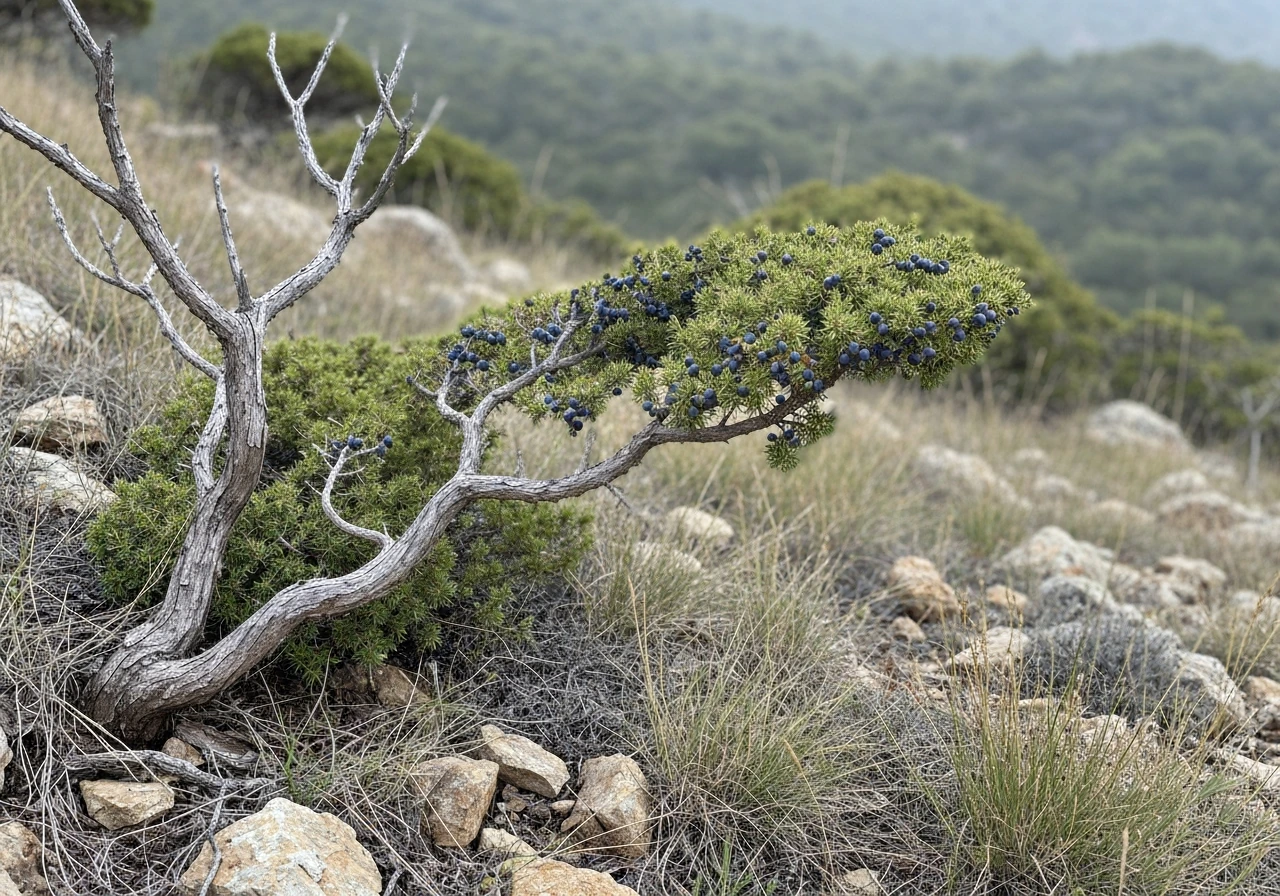
Junipers as a genus have one of the widest natural distributions of any woody plant group in the Northern Hemisphere. Common juniper (Juniperus communis) alone ranges from the subarctic regions of Canada and Scandinavia all the way down through the mountains of Central Europe, across the Himalayas, and into the American Rockies. It colonizes dry, open, rocky ground and is often one of the first woody plants to move into a cleared or disturbed site. In the eastern United States, eastern redcedar (Juniperus virginiana) thrives in open fields, roadsides, rocky glades, and forest edges, particularly in the Chesapeake Bay watershed and surrounding states. Rocky Mountain juniper (Juniperus scopulorum) dominates dry canyon walls and exposed slopes in the interior West, including the canyon country around Bryce Canyon National Park.
Around the Mediterranean, the story shifts. Prickly juniper (Juniperus oxycedrus) is native to southern Europe, North Africa, and parts of western Asia, thriving in the warm, dry summers and mild winters that define that climate. Savin juniper (Juniperus sabina) pushes higher in elevation, growing in the mountains of central and southern Europe and western Asia at elevations ranging from roughly 1,000 to 3,300 meters. If you're wondering whether juniper berries grow in India, the answer is yes in the higher, cooler mountain zones where conditions match those alpine European habitats.
The common thread across all these regions is habitat preference: junipers like open sun, well-drained soil, and don't mind rocky, nutrient-poor ground. They are remarkably drought tolerant and will quietly out-compete other plants on sites where water drains fast. What they don't like is shade, standing water, or heavy clay. Keep that in mind when you're trying to replicate these conditions in your own garden.
What juniper trees and shrubs look like in the wild
Juniper growth form varies a lot by species, which is one reason people sometimes walk right past them without recognizing what they're looking at. Eastern redcedar can grow into a full tree 15 to 30 feet tall with a dense, columnar or pyramidal crown. Rocky Mountain juniper is similar in stature, often appearing as a small tree on canyon rims. Common juniper, especially the variety depressa found in the northeastern U.S. and Canada, is a low-growing, spreading shrub that hugs the ground, often on rocky outcrops or open slopes. Prickly juniper in the Mediterranean tends to be a scrubby shrub or small tree with very sharp, needle-like foliage.
All junipers share some key visual traits: scale-like or needle-like evergreen foliage (often both on the same plant at different growth stages), reddish-brown peeling or fibrous bark, and those round, waxy, berry-like seed cones on the female plants. The cones start green and gradually turn blue-purple or blue-black as they ripen. If you're out hiking and you spot a shrubby evergreen with small round blue-purple fruits on dry, rocky ground, there's a strong chance you're looking at a juniper. Just don't eat anything until you've confirmed the species, because not all junipers produce edible cones.
Which juniper species actually produce the berries
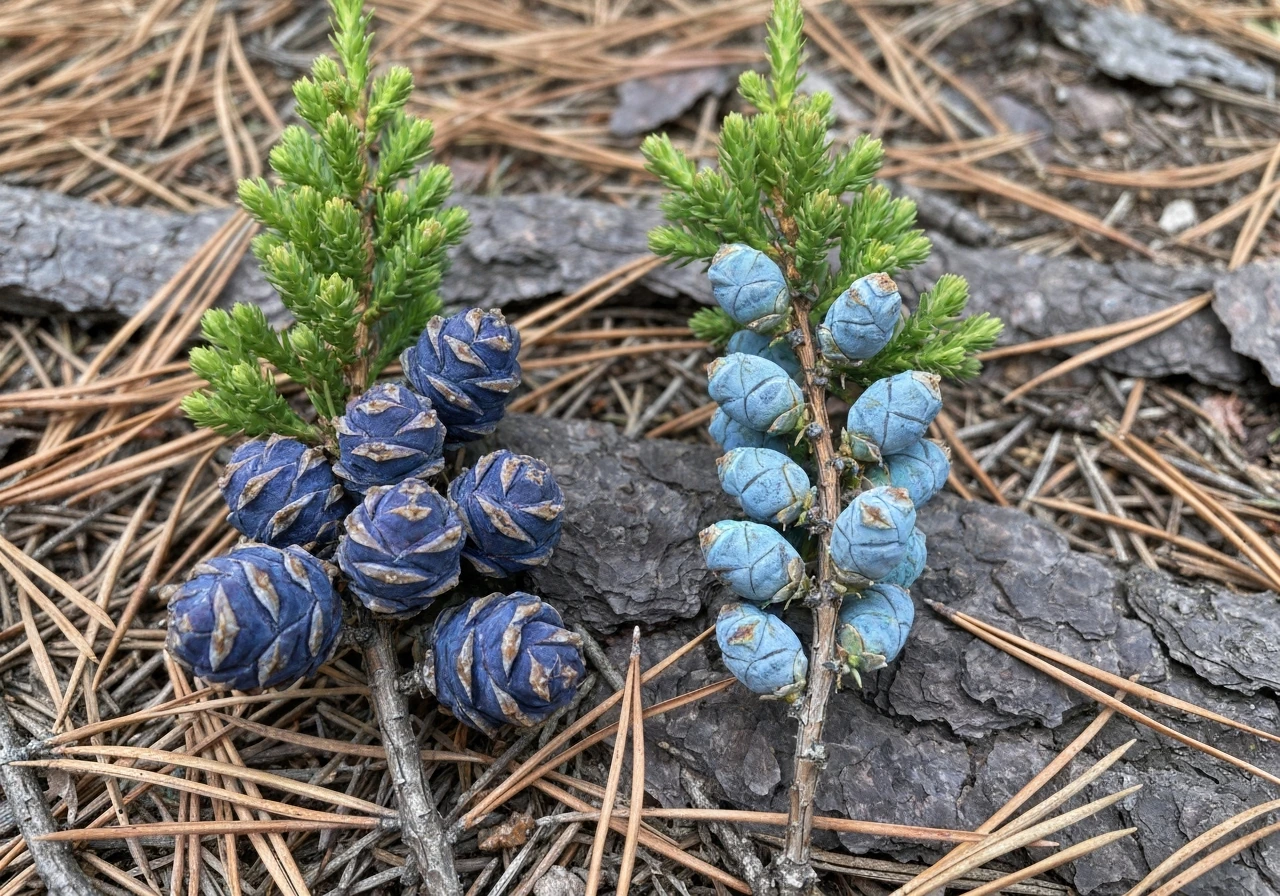
Not every juniper is worth harvesting from, and a couple are genuinely toxic. Here's a practical breakdown of the main species and what they produce.
| Species | Region | Cone size / color | Ripening time | Edibility |
|---|---|---|---|---|
| Juniperus communis (Common juniper) | Circumpolar: North America, Europe, Asia | Small, spherical; blue-black with waxy bloom | 18 months to 2-3 years | Yes, widely used in cooking and gin flavoring |
| Juniperus virginiana (Eastern redcedar) | Eastern North America | ~0.4–0.7 cm; dark blue/purple, waxy | 1 season: late July to mid-November | Yes, though bitter and resinous; mainly for wildlife |
| Juniperus scopulorum (Rocky Mountain juniper) | Western North America, Rockies | Small; blue, waxy | 2 years; ripe by Nov/Dec of 2nd year | Edible but very resinous; used ornamentally |
| Juniperus oxycedrus (Prickly juniper) | Mediterranean region | Larger than communis; green to orange-brown | 2 years | Edible but not widely used culinarily |
| Juniperus monosperma (Oneseed juniper) | Southwest U.S. | Small; copper to blue; 1 seed | 1 season: August to November | Edible, used by Indigenous peoples |
| Juniperus sabina (Savin juniper) | Central/Southern Europe, W. Asia | Small, dark blue | 1–2 years | TOXIC. Do not consume. |
Savin juniper deserves a direct warning. It's a well-documented toxic species, and the foraging literature is clear: consuming it can cause serious harm. If you're foraging, not just growing for ornament, stick to Juniperus communis, which is the species universally used in cooking and is what gives gin its distinctive flavor. When in doubt, don't eat it.
When juniper berries grow and ripen
Timing is one of the trickier aspects of juniper because it varies significantly between species. Common juniper flowers from January through April, and the cones that result from that flowering don't ripen until 18 months later, sometimes longer. Common juniper’s strobili (cone structures) form during June or July, the cone scales fuse during the second year to produce the berry-like galbulus, and seed maturation typically occurs during the second growing season common juniper flowers from January through April. Some sources put full seed ripeness at up to 3 years for Juniperus communis, which is unusually slow and explains why you'll often see cones in multiple stages of color on the same plant at the same time.
Eastern redcedar runs on a faster schedule. It flowers in early to late spring, and cones mature in a single season, typically between late July and mid-November depending on your latitude. The cones don't open and will persist on the tree through winter, so you're not racing against a narrow window. Rocky Mountain juniper sits at the slower end: female flowers become conspicuous in late summer, pollen isn't released until the following April, and the resulting berries don't reach full ripeness until November or December of the second year after pollination. They can hang on the tree into winter, which is actually convenient for harvest timing.
Oneseed juniper follows a middle path: pollen sheds around late March, female cones appear a week or two after that, and the cones ripen in a single season from August through November. Creeping juniper (Juniperus horizontalis), a common low-growing landscape plant in the northern U.S. and Canada, produces cones that appear in May or June and take one to two years to turn fully blue-purple.
The practical takeaway: if you're planting eastern redcedar or oneseed juniper, you can potentially harvest in the same calendar year the flowers open. If you're growing common juniper, plan on waiting through two full growing seasons after you first see flowering before expecting ripe cones. Also keep in mind that eastern redcedar can take around 10 years from planting before it starts producing cones reliably, so patience is genuinely part of the deal.
Growing juniper for berries in your garden
Site, soil, and sun
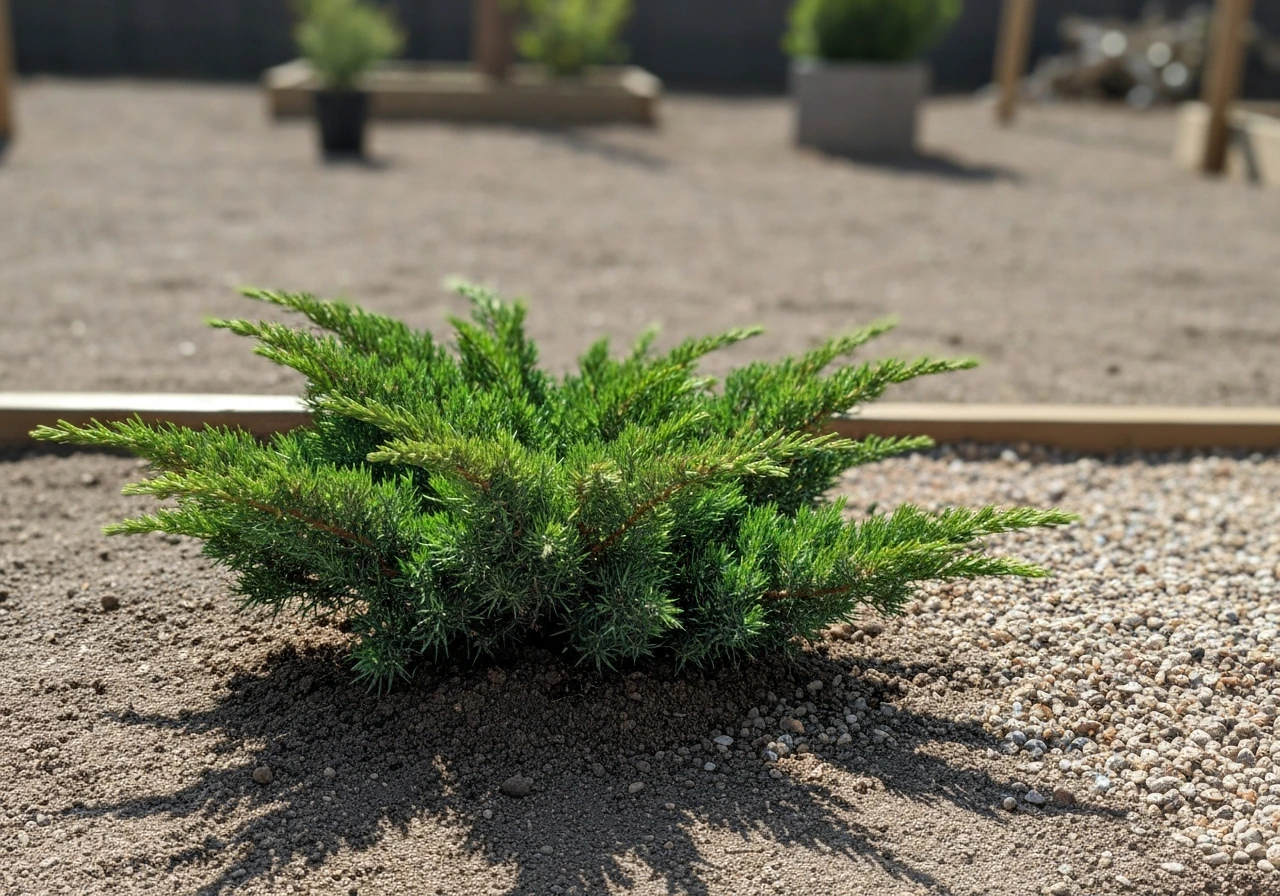
Junipers want full sun, ideally 6 or more hours a day. They will tolerate partial shade, but cone production drops off noticeably without good light exposure. Soil needs to drain well. That's the non-negotiable. Junipers handle a wide range of soil pH and will grow in sandy, rocky, or nutrient-poor ground that would stress most plants. University of Georgia's extension guidance puts it simply: open, sunny locations with well-drained soil, and they're very drought tolerant once established. When planting, set the root ball at the soil surface or even slightly above it rather than burying it deep, especially in heavier soils.
If your garden soil is clay-heavy or stays wet for extended periods, either amend heavily with grit and organic matter, build a raised bed, or grow in containers. Junipers do not tolerate root rot and will decline quickly in wet conditions.
Male and female plants: you probably need two
This is the most common reason home growers end up with a beautiful juniper shrub and zero berries. Most junipers, including common juniper, are dioecious, meaning male and female reproductive structures are on separate plants. Only female plants produce the seed cones we call berries, and they only produce them when there's a male nearby for wind pollination. If you plant a single specimen, odds are you won't get berries unless there's already a male juniper in your neighborhood. Buy at least one male and one female plant, or look for cultivars that a reliable nursery has sexed and labeled. Space them close enough for wind to carry pollen between them, but junipers are not self-fertile, so don't count on a solo plant.
Container growing
Smaller juniper species and cultivars grow well in containers, which is useful if you're in a mild climate that doesn't get enough cold dormancy, or if your garden soil is heavy and poorly drained. Use a fast-draining potting mix, choose a container with generous drainage holes, and don't overwater. The main limitation with containers is that most female junipers grown this way will produce fewer cones than in-ground plants, partly because root restriction limits overall plant vigor. If you're growing for ornament and curiosity, containers work fine. If you want reliable berry harvests, in-ground planting in a compatible climate zone is the better path.
Choosing the right species for your region
Species matching matters more with junipers than with many other garden plants because these are adapted to very specific climate profiles. Eastern redcedar is one of the most adaptable species for gardeners in the eastern U.S., tolerating USDA zones 2 through 9. Common juniper is the go-to for cooler, northern climates and does well in zones 2 through 6. Rocky Mountain juniper suits dry, high-elevation western climates, zones 3 through 7. If you're in a Mediterranean climate, prickly juniper is the natural fit. If you're curious how this kind of climate matching works for other berry-like plants, the principles are similar to what's covered in guides on where goji berries grow, where species selection based on heat and chill hours makes or breaks a harvest.
If you're gardening in Canada and wondering which juniper or similar species will hold up through harsh winters, the same cold-hardiness thinking applies that comes up when discussing whether you can grow goji berries in Canada. Common juniper and creeping juniper are your safest bets for northern Canadian gardens, both being genuinely cold-hardy into zone 2.
If your juniper isn't producing berries
Run through this checklist before assuming something is wrong with the plant:
- Is it female? Many nursery junipers are sold without sex identification. No female plant means no berries, full stop.
- Is there a male plant nearby? Wind pollination needs a male within a reasonable distance, ideally within the same garden.
- Is it old enough? Eastern redcedar can take around 10 years to begin cone production. Common juniper may take 5 to 10 years.
- Is it getting enough sun? Shade significantly reduces cone set across all species.
- Is the soil draining properly? Stressed plants in wet soil often stop or reduce reproductive output before showing obvious decline.
- Are you waiting long enough after flowering? Common juniper cones take 18 months or more to ripen.
How to identify ripe juniper berries and confirm the right plant
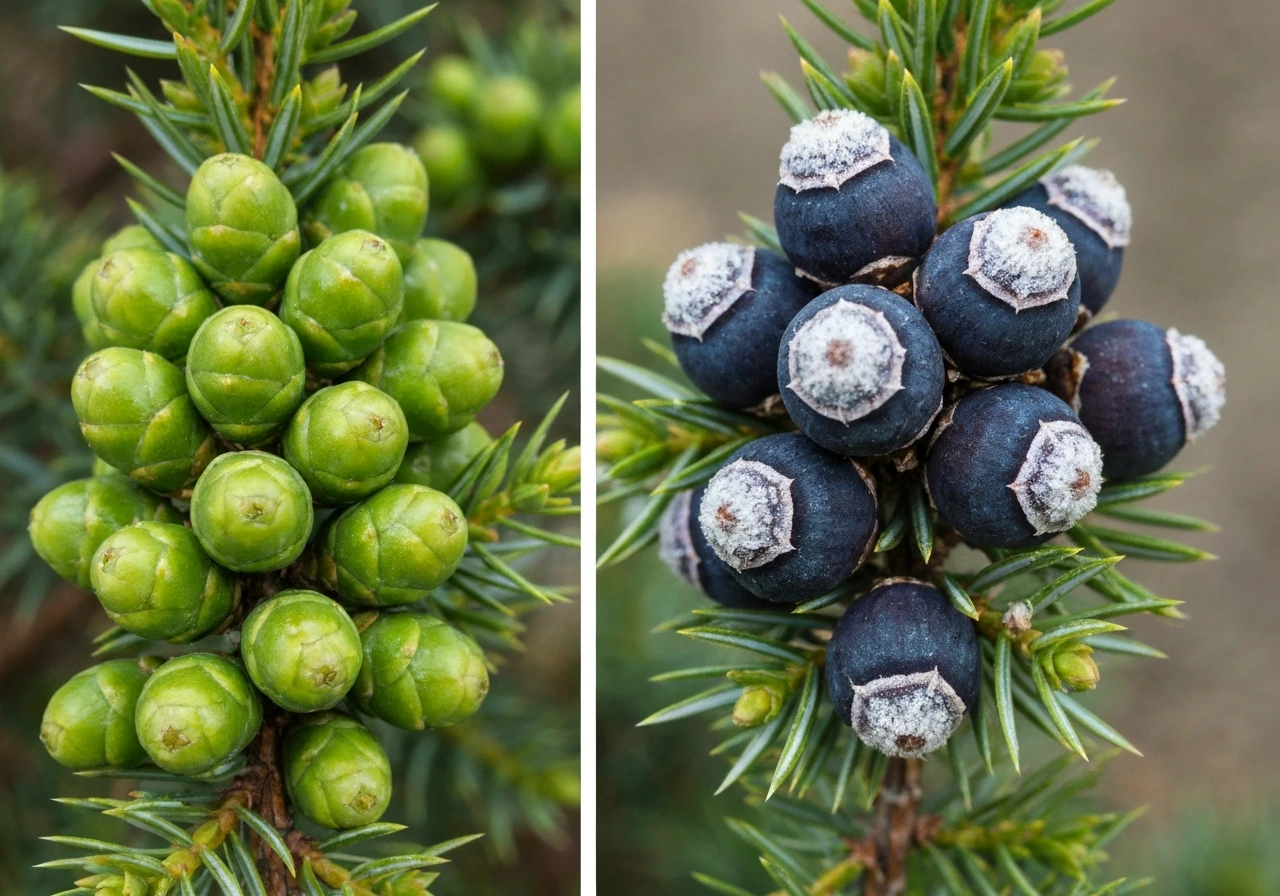
Ripeness on Juniperus communis is fairly straightforward: the cones start out green and over 18 months or more transition to a dark blue-purple or nearly black color with a whitish waxy film, or bloom, that you can rub off with your thumb. That waxy coating is a reliable ripeness indicator. Unripe cones are green and hard. For eastern redcedar, look for the same dark blue to brownish-blue color with a white waxy coating; the cones are small, roughly a quarter inch in diameter, and contain two or three hard seeds. Rocky Mountain juniper berries follow a similar color pattern, turning blue and waxy by November or December of their second year.
For species confirmation before you eat anything, look for these features together: needle-like or scale-like evergreen foliage, peeling or fibrous reddish-brown bark, round waxy seed cones (not elongated like a pine cone), and a resinous, piney-gin aroma when you crush a leaf or cone. Cross-reference with a reliable local field guide or plant ID app and confirm species before harvesting. If the cones are elongated, oval, or brown and papery, you're not looking at a juniper. And if you ever find yourself uncertain about a species in an unfamiliar landscape, treat it the same way you would with lesser-known berry-producing plants like wolfberries, where species-level identification is important before consuming anything.
One more useful distinction: juneberries (Amelanchier species) are a completely different plant from junipers that often get confused in common plant names. If you want to understand the difference, a guide on where juneberries grow lays out their habitat and appearance clearly. The two plants don't overlap botanically at all.
Propagating juniper from the berries themselves
If you've got a productive female plant and want to expand your planting, you can grow juniper from berries, but it takes patience. Seeds inside the cones have a double dormancy and typically need a period of warm stratification followed by cold stratification before they'll germinate. Germination can take one to three years in natural conditions. Cuttings from female plants are usually faster and more reliable for maintaining a known female plant.
Your practical checklist for finding, timing, and growing juniper berries
- Identify the juniper species native or adapted to your region before buying anything.
- Buy sexed plants: at least one confirmed male and one confirmed female for cone production.
- Plant in full sun with sharply draining soil. If your soil stays wet, build a raised bed or use containers with extra drainage.
- For eastern redcedar or oneseed juniper, expect your first cone harvest 1 season after flowering, but plan on 10 years before production is consistent.
- For common juniper, cones ripen in 18 months or more from flowering. Plant for the long game.
- Harvest when cones are dark blue-purple to nearly black with a visible waxy white bloom that rubs off easily.
- Crush and smell before eating: a strong, resinous, gin-like aroma confirms you've got a juniper. No aroma or a different smell means stop and reidentify.
- Never consume cones from Juniperus sabina or any species you cannot positively identify.
Junipers reward patient growers who match the right species to their climate and give the plants the open, sunny, well-drained conditions they evolved in. The cone timing is slow by garden standards, especially for common juniper, but a well-placed female plant will produce reliably for decades once it hits its stride. If you enjoy growing other drought-tolerant berry-producing plants from dry climates, some of the regional habitat thinking here overlaps with what you'd encounter exploring where goji berries grow in India, where dry, sunny, well-drained conditions are equally central to successful cultivation.
FAQ
If juniper grows in my area, why are there no “berries” on my plant?
Most junipers produce seed cones only on female plants, and pollen usually comes from male plants nearby. If you have only one juniper in a yard, it is common to see cones never form, even though the plant looks healthy.
How close do male and female junipers need to be to get berries?
Yes, look for a male and female pairing, either by planting two plants of the right species or by buying plants that a nursery has sexed. For spacing, keep them close enough that wind can carry pollen, and do not assume a self-fertile “single plant” variety unless it is specifically labeled that way.
What is the quickest visual check that juniper berries are actually ripe?
Ripe cones are usually dark blue-purple or nearly black and have a whitish waxy coating you can sometimes rub off. If they are green, papery, or lack that waxy bloom, they are often not ready, even if they look like mature fruit from far away.
Do I need to harvest juniper berries at a specific moment, or can I pick them later?
In garden plantings, eastern redcedar can hold cones through winter, so you can often harvest later rather than immediately. For common juniper, “two years of color stages on one plant” is normal, but that does not mean every cone is edible, so only pick ones that meet the ripeness and wax-bloom signs.
Can I eat juniper berries from any juniper I find while hiking?
Definitely. Savin juniper is notably toxic, and not every juniper species has edible cones. Treat any unfamiliar blue “juniper berry” as unsafe until you confirm the species using multiple traits, ideally with a reliable local identification guide.
What should I change first if junipers grow but never fruit (or start declining)?
For home gardening, prioritize drainage over exact soil pH. If your ground stays wet or you have heavy clay, even hardy junipers can fail due to root rot, so raised beds, grit amendments, or containers with excellent drainage are usually the practical fix.
Can a juniper look healthy but still be the wrong sex for berry production?
Not necessarily. Dioecious plants can look identical while one sex makes no cones. If you want a harvest, you must choose the right sex during buying, then manage sun and drainage, because even a correct female plant may under-produce if light is weak.
What are the most common look-alikes that cause foraging mistakes?
Yes, and it helps avoid mistakes with similar-looking plants. Some people confuse junipers with elongated, pine-cone-like structures or with other berry names. Confirm key traits together (evergreen scale or needle foliage, reddish-brown peeling bark, and round waxy seed cones) before any eating.
Is it easy to grow juniper berries from store-bought cones or berries?
If you are starting from seed, expect a long timeline, and seed dormancy can require warm then cold stratification cycles. Even then, you may not get the same plant traits, and you still must eventually have a male nearby for female cone production.
What is the fastest and safest way to start a juniper patch for harvesting?
For best reliability, cuttings and properly sourced named plants tend to be faster and more predictable than seed. If you are foraging, you can also reduce risk by focusing on cultivation, using a known culinary species and verified sex rather than harvesting unknown wild cones.
What troubleshooting steps should I follow when my juniper has no or poor fruiting?
If you are not seeing cones, check for dioecy first, then light. Cone production drops noticeably in shade, even when the plant survives. After that, confirm that your cones are the correct ripeness stage by checking the color plus waxy bloom, not just “blue fruit.”
How do I choose the right juniper for my winter climate if I want berries?
In cold regions, choosing a locally hardy species matters more than adding a lot of fertilizer or water. Common juniper and creeping juniper are generally more cold-tolerant than many Mediterranean types, and choosing the wrong species can lead to dieback or weak flowering.