
Dewberries do not grow on trees. They grow on low-trailing or arching canes that run along the ground, sometimes rooting where they touch the soil. Think of them as a ground-hugging version of a blackberry, spreading across open fields, sunny roadsides, and disturbed edges rather than climbing into any tree canopy. If you spotted something that looked like a blackberry growing from a tree, it is almost certainly a different plant entirely.
Do dewberries grow on trees? Growth, ID & planting guide
Marcus Holloway
21 Jul 2026
What are dewberries? Plant description and natural growth habit
Dewberries belong to the genus Rubus, the same genus as blackberries and raspberries. The name 'dewberry' does not point to a single species but rather to a group of trailing, prostrate Rubus species whose growth habit keeps them close to the ground. Many North American 'dewberries' are treated as Rubus species such as R. flagellaris (northern dewberry), R. trivialis (southern dewberry), and R. ursinus (western dewberry), see Dewberry - Rubus flagellaris | NC State Extension Plant Toolbox. The most common North American species include Rubus flagellaris (northern dewberry), Rubus trivialis (southern dewberry), and Rubus ursinus (western dewberry or California trailing blackberry). In Europe, Rubus caesius is the most recognized dewberry species, though it tends to be a bit more upright than its North American relatives.
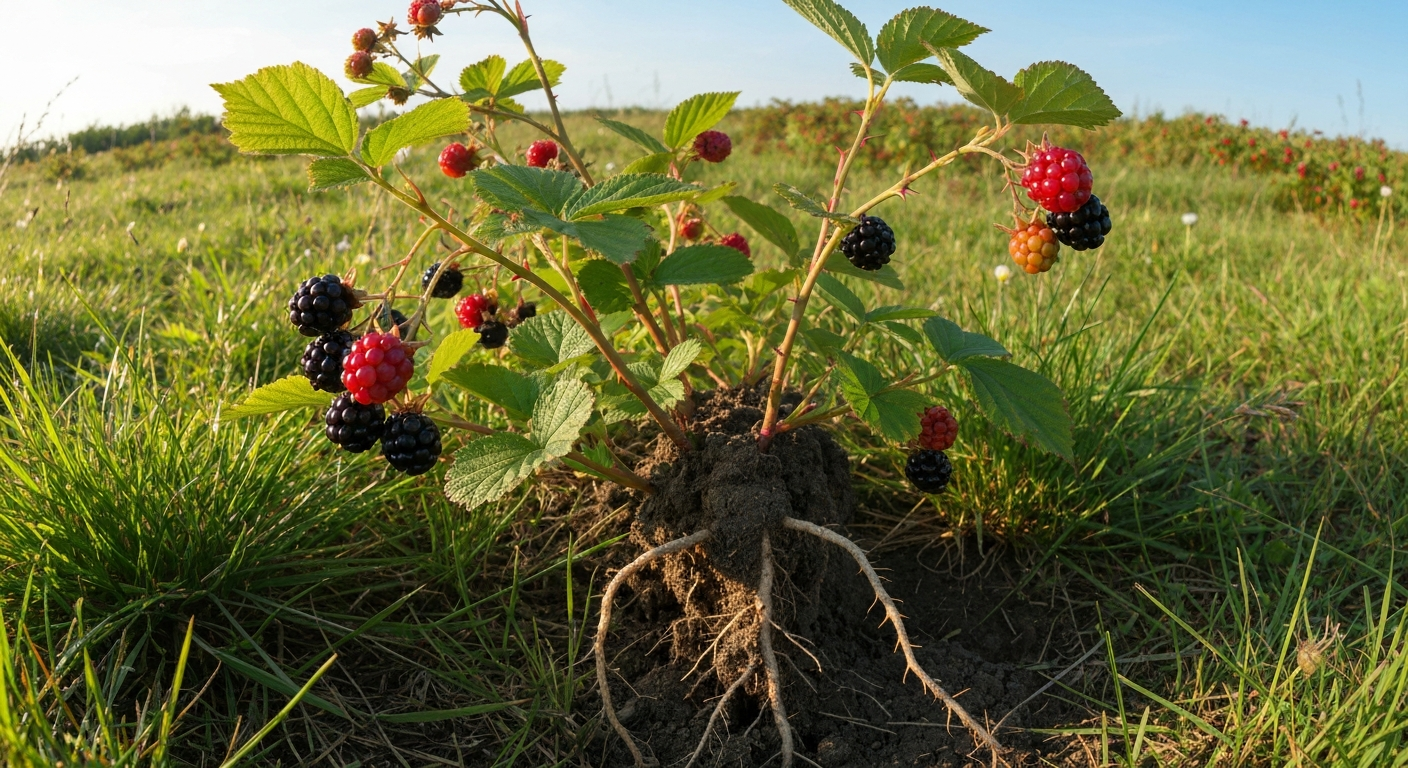
The canes on a dewberry plant are woody, typically armed with small thorns or bristles, and in species like R. ursinus they can reach 3 to 6 meters in length while still hugging the ground. A key feature is tip-layering: when a long cane arches over and its tip touches bare soil, it can root and produce a new plant. This is not a tree-like structure in any sense. There is no central trunk, no upward branching crown, and no elevation above a few feet at most. The canes are biennial, meaning first-year canes (primocanes) grow vegetatively, and second-year canes (floricanes) flower, produce fruit, and then die back. This cycle is the same one you see in blackberries and is important to understand for pruning.
Where dewberries grow: natural habitats and regional distribution
Dewberries are sun-lovers. In the wild, you find them at field edges, hedgerows, roadsides, disturbed ground, fence lines, woodland margins, and sandy or rocky open sites. For more detail on where do dewberries grow, see the regional distribution and habitat notes below. They are early colonizers, meaning they move in fast wherever the soil gets turned up or a clearing opens. I have found Rubus flagellaris carpeting an old pasture corner and R. ursinus spreading across a logged hillside in Oregon within a couple of seasons. They are not shade plants, and they will thin out and stop fruiting well if trees grow up and close the canopy over them.
Regionally, northern dewberry (R. flagellaris) covers a huge swath of the eastern and central United States, with documented native distribution across states including Alabama, Arkansas, Connecticut, Florida, Georgia, Iowa, Illinois, Indiana, Massachusetts, Michigan, Minnesota, Missouri, New York, Ohio, Pennsylvania, Texas, Virginia, and Wisconsin, as well as parts of Ontario and Quebec in Canada. Western dewberry (R. ursinus) is native to the Pacific Coast from British Columbia south through California and east into Idaho. Southern dewberry (R. trivialis) is concentrated in the southeastern states from Texas through the Carolinas. If you are outside these ranges, check whether a native Rubus dewberry species is documented in your region before sourcing plants.
Climate zones and hardiness
Rubus ursinus is listed as hardy to around USDA Zone 3, making it one of the tougher options for northern gardeners. R. trivialis, on the other hand, is a mild-climate plant that performs best in the Southeast and Gulf Coast region and struggles with hard winters. For most home gardeners, the practical advice is to look for the species or cultivar native to or bred for your climate zone rather than assuming all dewberries are equally cold-hardy.
How to grow dewberries: soil, sun, water, containers, and propagation
Growing dewberries is not complicated, but giving them the right start matters. They need full sun (6 or more hours daily), well-drained soil, and consistent moisture during fruit development. Waterlogged soil is one of the few things that will reliably kill them. Most extension guides recommend a soil pH of roughly 5.5 to 6.5 for brambles, and it is worth doing a quick soil test before planting since soils that are too alkaline will show up as nutrient deficiency even if you are watering and fertilizing correctly.
Site selection and microclimate tips
Choose a site that drains well and is sheltered from harsh prevailing winter winds if you are in a colder zone. Avoid frost pockets (low spots where cold air settles) because late frosts can wipe out blossoms. In my own garden, I lost a full season of fruit on a R. ursinus planting that sat at the base of a slight slope, where cold air pooled on two or three nights in May. Moving the planting upslope the following year fixed the problem. Row covers are a straightforward solution for protecting early blossoms in marginal climates. UNH Cooperative Extension's Fruit IPM Reports and seasonal notes recommend row covers and other frost protection methods such as overhead irrigation for protecting blossoms Fruit IPM Reports and seasonal notes (UNH Cooperative Extension).
Growing in containers
Dewberries can be grown in containers, which is useful if your native soil is clay-heavy, alkaline, or waterlogged. Use the largest container you can manage: a 5-gallon pot is a functional minimum, but a 10 to 20-gallon container gives the root system enough room to support vigorous fruiting. Use a well-draining potting mix, water consistently (containers dry out faster than garden beds), and fertilize more frequently than you would with in-ground plants since nutrients leach out with irrigation. Container plants will need some form of support or trellis to keep trailing canes organized.
Propagation by tip-layering
The easiest and most reliable way to propagate dewberries is tip-layering, which mimics exactly what the plant does naturally. In late summer, take a long, flexible primocane and bend the tip down into a small hole in the soil nearby. Bury just the tip (about 6 to 10 cm deep), pin or weigh it in place, and water it regularly. By the following spring, the tip will have rooted and you can sever it from the parent plant with a clean cut. Dig the new plant up a few weeks later and transplant it to its permanent spot. I have had close to 100% success with this method on healthy plants.
Pruning and harvest timing
Because dewberry canes are biennial, pruning is straightforward once you understand the cycle. After floricanes finish fruiting (typically early to midsummer depending on your region), cut them to the ground. This clears space and light for the primocanes that will become next year's fruiting wood. Do not cut the primocanes that grew this season; they need to overwinter and fruit next year. Harvest timing generally runs ahead of blackberries: southern dewberries ripen as early as April in Texas and Florida, while northern and western species ripen from late May through July depending on location and season.
Identifying dewberries: a practical ID checklist
Getting dewberry identification right matters both for foraging confidence and for distinguishing them from lookalikes. Here is what to look for across the plant.
- Fruit: small to medium aggregate drupelets (like a blackberry), typically black or dark purple when ripe, often with a slight waxy or bluish bloom; each drupelet is plump and glossy
- Canes: long, trailing or low-arching woody stems that stay close to the ground; typically armed with small recurved thorns or stiff bristles; canes do not form an upright shrub structure
- Leaves: compound leaves with 3 to 5 leaflets (depending on species), leaflets ovate to lanceolate with serrated margins; underside often paler and slightly hairy
- Flowers: 5-petaled white flowers, similar to blackberry blossoms, appearing in spring before blackberries typically bloom in the same region
- Season: fruit ripens earlier than most blackberries; late spring to early summer is the core dewberry window across most of North America
- Rooting habit: tips of trailing canes root where they contact bare soil, creating small daughter plants at the end of long arching canes
The earlier ripening season is one of the most reliable field markers for separating dewberries from upright blackberries in overlapping territory. If you are picking what looks like a blackberry in late April or May in the Southeast, it is almost certainly a dewberry.
Dewberries vs blackberries and raspberries: clear distinguishing features
These three are closely related, and the confusion is completely understandable. The clearest differences come down to growth habit, fruit structure, and season.
| Feature | Dewberry | Blackberry | Raspberry |
|---|---|---|---|
| Growth habit | Trailing/prostrate canes, ground-hugging | Upright or arching shrubby canes, 1–3 m tall | Upright canes, 1–2 m tall, often suckering |
| Fruit color when ripe | Black to dark purple, often with waxy bloom | Shiny black, no bloom | Red (most), gold, or black; hollow when picked |
| Fruit core | Solid (drupelet cluster stays on receptacle) | Solid | Hollow (receptacle stays on plant) |
| Bloom/harvest season | Earlier: late spring to early summer | Later: mid to late summer | Summer (varies by type) |
| Tip-rooting | Common and natural | Less typical; spreads more by root suckers | Spreads primarily by root suckers |
| Habitat tendency | Open disturbed ground, fields, low edges | Fields, hedgerows, woodland edges | Woodland edges, disturbed areas, cooler climates |
The hollow vs. solid fruit test is the fastest way to separate raspberries from both dewberries and blackberries. Pick the fruit: if it pulls free and leaves a hollow cavity, it is a raspberry. If the receptacle comes with the fruit and it is solid, you have a dewberry or blackberry. Then look at the cane: trailing along the ground points to dewberry; upright shrub habit points to blackberry.
Common lookalikes and safety: poisonous berries and the red berries you find in grass
Dewberries have a reasonably safe lookalike profile compared to some other wild fruits, but there are a few plants worth knowing before you forage. The most important rule is: confirm identity before eating any wild berry, and be especially cautious with red berries you encounter growing in grass or low ground cover.
Pokeweed (Phytolacca americana) produces clusters of dark purple-black berries on tall, stout, magenta-stemmed plants. At first glance the fruit color can seem similar to a dewberry, but the plant structure is completely different: a thick upright stalk, large simple leaves, and no thorns or canes. Pokeweed berries are toxic. Nightshade species (Solanum spp.) produce small dark berries but on entirely different plant structures and in different clusters than any Rubus. Moonseed (Menispermum canadense) produces black grape-like fruits and is worth knowing as toxic, though it grows as a vine rather than a trailing cane.
Red berries found in grass are a separate and frequently asked-about category. Small red berries growing at ground level in turf or grassy areas are commonly wild strawberry (edible), mock strawberry (edible but bland), bunchberry (Cornus canadensis, edible), or potentially lily of the valley berries (Convallaria, toxic) and baneberry (Actaea, toxic). Dewberries are not typically the plant producing red berries in grass: a ripe dewberry is black or very dark purple, not red. For more details on identifying small red berries found in lawns, see our guide on what are the red berries that grow in the grass and how to tell edible from toxic species. If you are finding red berries in your lawn or grassy areas, the identification process is different from dewberry ID.
Edibility and safety of tree-grown berries: which are safe and which can be toxic
Since dewberries grow on trailing canes and not on trees, the question of tree-borne berry safety is a separate but related one worth covering here. Many people discover dark or colorful berries growing on trees and wonder whether they are edible. For a short guide on which tree-borne berries are edible and which are not, see can you eat berries that grow on trees. See our guide on whether berries that grow on trees are poisonous for identification and safety tips. For a quick guide to common edible and toxic fruits you might find on trees, see what berries grow on trees. The answer depends entirely on the species, and getting it wrong can cause anything from a stomach ache to serious poisoning.
Some tree-borne fruits are familiar and safe: elderberries (Sambucus, technically a large shrub or small tree) are edible when cooked but mildly toxic raw; mulberries (Morus) are completely edible and delicious; serviceberries (Amelanchier) are excellent eating; hawthorn berries (Crataegus) are edible and widely used for jellies and teas. On the toxic side, the berries of yew trees (Taxus) are highly dangerous (the flesh is mildly sweet but the seed is extremely toxic), privet berries (Ligustrum) are toxic, and the berries of many ornamental trees planted in suburban landscapes (holly, Ilex; chokecherry in quantity; buckthorn, Rhamnus) range from mildly to seriously problematic. A useful mental rule: assume any unfamiliar berry from a tree requires positive identification before tasting.
| Tree/Shrub | Berry color | Edibility | Notes |
|---|---|---|---|
| Mulberry (Morus spp.) | Dark purple to black, or white/red | Safe, edible | One of the best foraging finds from a tree |
| Serviceberry (Amelanchier spp.) | Dark purple to blue-black | Safe, edible | Sweet, mild flavor; excellent fresh or cooked |
| Elderberry (Sambucus spp.) | Dark purple-black clusters | Edible cooked, mildly toxic raw | Cook before eating; leaves and stems toxic |
| Hawthorn (Crataegus spp.) | Red to dark red | Edible, tart | Seeds contain cyanogenic compounds; avoid eating seeds in large amounts |
| Yew (Taxus spp.) | Bright red with exposed seed | Flesh mildly edible, seed highly toxic | Do not eat the seed; used in landscaping, common hazard |
| Holly (Ilex spp.) | Bright red or black | Toxic | Even small amounts cause vomiting and serious illness |
| Privet (Ligustrum spp.) | Dark blue-black | Toxic | Common in hedgerows; do not confuse with elderberry |
| Buckthorn (Rhamnus spp.) | Black clusters | Toxic | Strong purgative effect; invasive in many regions |
Wildlife interactions and dispersal: how birds and mammals spread dewberries
Dewberries are a significant wildlife food source, and the relationship between the plant and the animals that eat it is a big reason they show up in so many places. Passerine birds, thrushes, robins, starlings, and a variety of other fruit-eating birds consume Rubus fruits heavily during ripening season. See also the bird whose diet includes berries that grow on lava for a unique example of avian berry dispersal. Mammals including raccoons, foxes, bears, squirrels, and deer also eat them. The seeds pass through the digestive system intact and are deposited in new locations, which is how dewberries colonize fence lines, island edges, roadsides, and any disturbed patch where conditions suit them.
This dispersal dynamic has real practical implications for gardeners. If you plant dewberries or they are already present on your property, expect them to spread beyond their original planting area through both tip-layering and bird-dispersed seed. Managing spread means either accepting a wider patch over time or cutting back canes before tip-rooting occurs and removing any seedlings that come up in unexpected spots. On the flip side, if you want to naturalize an area quickly or establish a wildlife-friendly hedgerow, dewberries are excellent candidates: birds find the fruit reliable and attractive, and the dense low canes provide nesting cover and shelter for small mammals and ground-nesting birds.
Birds that consume dewberries are in many cases the same species responsible for spreading other Rubus varieties and a wide range of fruiting shrubs and vines across a landscape. This is worth keeping in mind if you are designing a garden planting that includes berries on vines or other ground-level fruiting plants alongside dewberries: the birds will find them all, which means a diverse planting may establish and self-renew more readily than a monoculture.
Growth forms side by side: trees vs. vines vs. trailing brambles
One of the most useful things a home gardener can understand early is that berries come from very different plant structures, and knowing which structure you are working with tells you a lot about how to site, support, and manage the plant. Dewberries are firmly in the trailing bramble category: no trunk, no canopy, no upright structure. Here is a quick comparison of the main growth forms you will encounter.
| Growth form | Examples | Height/spread | Support needed? | Container-friendly? |
|---|---|---|---|---|
| Trailing bramble (vine-like) | Dewberry, trailing blackberry (R. ursinus) | Canes 1–6 m long, ground-level | Optional trellis or fence | Yes, with large container |
| Upright bramble/shrub | Blackberry, raspberry | 1–3 m tall shrub | Trellis or stake recommended | Yes, with support |
| Vine (true climbing) | Grape, kiwi | Can reach 10+ m | Strong trellis or arbor required | Possible with heavy pruning |
| Tree (true fruiting tree) | Mulberry, serviceberry, hawthorn | 3–15+ m tall | None needed at maturity | Dwarf varieties only |
| Low shrub/groundcover | Lingonberry, bearberry | Under 50 cm | None needed | Yes, excellent |
| Bog/wetland shrub | Cranberry, highbush blueberry | 30 cm to 2 m | None needed | Yes, with acid mix |
If you are deciding what to plant and space or climate is a limiting factor, this growth-form comparison is your starting point. Dewberries and trailing blackberries are among the best options for covering ground quickly, providing food for wildlife, and fitting into an informal or naturalistic planting. They are not the right choice if you want a tidy, contained fruiting plant: for that, an upright blackberry variety or a compact blueberry shrub will serve you better. And if your goal is to grow something from a tree, mulberries and serviceberries are worth exploring since they are genuinely productive, easy to identify, and safe to eat.
FAQ
Quick answer — do dewberries grow on trees?
No. Dewberries are trailing or low-growing brambles (members of Rubus) that grow on canes which trail along the ground, form mats, or arch and root at the tips. They are not tree‑borne; if you find berries on a tree, they are a different species.
What is the natural habitat and regional distribution of dewberries?
Dewberries occur across temperate regions of North America, Europe and western North America depending on the species (examples: Rubus flagellaris in much of eastern and central North America and Rubus ursinus on the Pacific Coast). Typical habitats are sunny edges, fields, hedgerows, disturbed ground, dunes and woodland margins — places with good light and well‑drained soils.
How do dewberries differ in growth form from blackberries, raspberries and tree‑borne berries?
Growth form summary: - Dewberries: trailing/prostrate or low arching canes that often root at tips (mat‑forming). - Blackberries: many are upright or arching cane brambles; some cultivars are erect, some are semi‑erect, and some are trailing—overlap exists. - Raspberries: usually have hollow fruit that comes off the receptacle, canes often upright; many species form taller canes. - Tree‑borne berries: true tree fruits (cherries, serviceberries, hackberries) grow on woody branches; these are a different growth habit and taxonomy. Use habit (ground‑trailing vs woody trunk/branches) to distinguish.
ID checklist — how to recognize dewberries in the field
Use this checklist: - Growth habit: canes low to the ground, trailing, forming mats or arching and rooting at tips. - Leaves: compound leaves with 3–5 leaflets (varies by species); undersides sometimes lighter. - Stems: woody canes with small prickles/thorns in many species. - Flowers: white to pinkish five‑petaled flowers in late spring to early summer. - Fruit: aggregate drupelets similar to blackberries but often smaller, ripening to dark purple/black; fruits are borne on low canes or near the ground. - Habitat: found on hedgerows, field margins, dunes or disturbed sites. If berries are growing on a trunk/at head height, they are not dewberries.
How to distinguish dewberries from poisonous lookalikes (including red berries found in grass)
Poisonous lookalikes: many red berries found in grass (e.g., pokeweed, bittersweet, baneberries, some Solanum) are not Rubus and have different leaves, flowers and growth form. Identification tips: - Check growth habit: are fruits on bramble canes with compound leaves and thorns? If yes, very likely Rubus. - Fruit structure: Rubus fruits are aggregate drupelets (multiple small bumps) that come off a fleshy core (blackberries) or leave the core behind (raspberries). Poisonous berries are often single‑seed or have different internal structure. - Leaf/flower: look for compound leaves and five‑petaled bramble flowers. - If unsure, do not eat. When red berries are low in grass with herbaceous stems and simple leaves, treat as unknown and avoid tasting.
Are dewberries edible and safe to eat?
Yes—true dewberries (Rubus species) are edible and commonly eaten fresh, cooked or made into jams. However, always positively identify before eating. Do not consume berries you cannot identify; many non‑Rubus red or dark berries from other plants can be toxic.