Some berries that grow on trees are perfectly safe to eat, and some will put you in the emergency room. The honest answer is that tree-borne berries span the full spectrum from delicious and cultivated (think blank" rel="noopener noreferrer">mulberries and serviceberries) to genuinely life-threatening (yew, Taxus spp., can cause fatal cardiac arrhythmia from even a small seed ingestion). The growth habit of a plant, tree, shrub, vine, or ground-bramble, tells you almost nothing on its own about whether its fruit is edible. What actually matters is the species. That means reliable identification before you touch or taste anything is non-negotiable.
Are Berries That Grow on Trees Poisonous? Guide for Gardeners
Marcus Holloway
18 Jul 2026
How to read this guide and use region-aware advice
This guide is written for home gardeners, hobby farmers, and curious growers who want both safety information and practical growing knowledge. Because berry species vary enormously by region, I've flagged where specific trees are native or commonly naturalized: North America (including USDA hardiness zones where relevant), the UK and Ireland, continental Europe, Australia, New Zealand, and southern Africa. A species that's a familiar edible hedgerow plant in one country may be an invasive weed in another, or simply absent altogether. Use the region notes in the table and text as a filter for what's actually relevant to your garden or foraging area.
One terminology note worth getting out of the way early: botanically speaking, a 'berry' is a fleshy fruit developed from a single ovary with seeds embedded in the pulp, tomatoes and grapes are true botanical berries, while raspberries technically aren't. In everyday gardening language, people use 'berry' loosely for any small, fleshy fruit, and that's the convention I'll follow here. Where botanical precision matters for identification or safety, I'll be specific about fruit structure (aril, drupe, pome, aggregate) because those details can help you distinguish look-alikes in the field.
How to tell edible from toxic tree-borne berries
There is no single reliable visual shortcut that separates edible tree berries from toxic ones. Red, orange, and black colouring appear in both camps. Birds eating berries is often cited as a safety indicator, but birds metabolize certain compounds that are toxic to mammals, so watching a robin strip a yew tree tells you nothing useful about human safety. With that said, there are consistent warning traits and identification features worth learning.
Warning traits that increase risk
- Berries with a visible aril (a fleshy, often brightly coloured cup or coat around a hard seed, as seen in yew): the aril itself may be less toxic, but the seed inside is highly poisonous — never chew or crush yew berries.
- Bitter, acrid, or burning taste: while you should never taste-test an unidentified berry, bitterness in a plant you're already handling is a red flag for alkaloids or saponins.
- Milky or coloured sap in the stems or leaves near the fruit cluster: latex or coloured exudate is a common marker in toxic plants.
- Strong, unpleasant smell from crushed leaves or bark near the fruit: many toxic species (elderberry is a partial exception) have noticeably rank foliage.
- Berries growing in tight, umbrella-shaped (umbel) or flat-topped clusters on a plant with elder-like pinnate leaves: this could be elderberry (conditionally edible when cooked) or one of several toxic look-alikes.
- Berries that persist on the plant through winter on an ornamental garden tree or hedge shrub: many high-risk ornamentals (holly, cotoneaster, pyracantha) are planted precisely because their fruit is decorative and persistent.
Reliable identification features
- Leaf shape, arrangement (opposite vs alternate), and margin (toothed, lobed, entire): these are the most stable identification characters across seasons.
- Bark texture and colour, bud shape, and branching pattern: useful when berries aren't present and when confirming a tree's ID from a second angle.
- Fruit structure: count the seeds, note whether there's a stone (drupe), a core (pome), embedded seeds in pulp (true berry), or an aril. A mulberry, for instance, is an aggregate of small drupelets on an elongated receptacle — once you've seen one, it's unmistakable.
- Flower remnant at the base of the fruit: elderberries have a distinctive tiny star-shaped calyx scar; hawthorn (mildly toxic) berries have a persistent calyx cup at the tip.
- Cross-reference with a regional flora or a vetted photographic field guide for your specific geography — the USDA PLANTS database, Flora of North America (eFloras), Kew's Plants of the World Online, and state/university extension resources are more reliable than general internet image searches.
Step-by-step identification and safety checklist
I use a version of this checklist myself whenever I encounter an unfamiliar fruiting tree, not because I'm overly cautious, but because I've had enough 'pretty sure that's edible' moments to know that confidence without verification is how people end up calling poison control. Work through each step before making any decision about eating or handling berries.
- Stop before you touch. Note the tree's size, overall shape, and setting (urban garden, hedgerow, woodland edge, streamside). Context narrows the list of likely species significantly.
- Photograph the full tree, a single leaf (upper and lower surface), a close-up of the berries, the bark, and any visible flowers or remnants. Multiple angles from multiple parts of the plant matter more than one perfect shot.
- Identify the leaf arrangement: are leaves opposite each other on the stem, or do they alternate? Opposite-leaved trees include elder, ash, and maples; alternate-leaved trees include mulberry, hawthorn, and serviceberry. This one detail eliminates large groups of candidates.
- Check the fruit structure: does it have a stone or pit (drupe)? Multiple small seeds in pulp (berry)? A core structure (pome, like hawthorn)? An aril around a hard seed (yew)? Count the seeds if you can do so without putting fruit near your mouth.
- Cross-reference your photographs against a vetted regional resource — your state or county extension service, a university herbarium, or a regional flora. Do not rely on a single app identification alone; apps make species-level errors with tree fruits.
- If you cannot achieve a confident, species-level ID using at least two independent sources, do not eat the berries. Label the location and return when the tree is flowering if needed — flowers are usually the easiest characters to confirm.
- Even after a confident ID, verify edibility guidance from a food-safety or extension source, not just a foraging blog. Some species (elderberry is the classic example) require cooking to neutralize toxins in ripe fruit.
- If you or someone else has already ingested unknown berries: do not induce vomiting unless specifically instructed to do so by a medical professional. Collect a sample of the plant or photograph it, note the amount ingested and the time, and call your national poison control centre immediately. In the US, that number is 1-800-222-1222 (Poison Help, AAPCC). In the UK, call 111 and mention the National Poisons Information Service. Australian and New Zealand callers should contact the Poisons Information Centre at 13 11 26.
Common tree-bearing berries: edible and poisonous by region
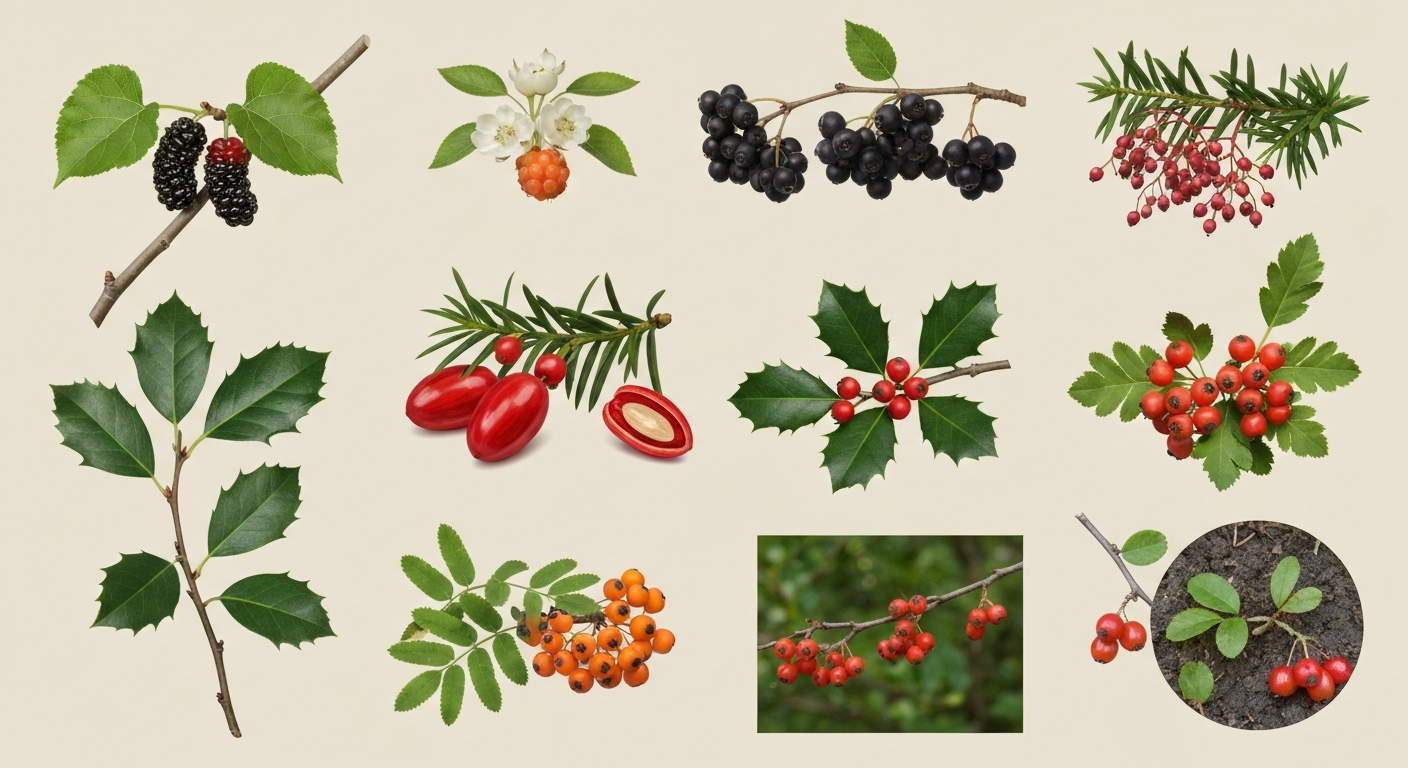
The table below covers the most commonly encountered tree-borne berries across the major English-speaking growing regions. See the section what berries grow on trees for a region-by-region list of tree-borne berries and identification notes. Toxicity ratings reflect typical human adult exposures: 'low' means GI upset in most cases; 'high' means potentially fatal with small ingestions, particularly in children. 'Conditional' means the species is edible when correctly prepared but toxic raw or in parts. Growing notes are included to help you recognize these trees in a garden or landscape setting.
| Species (common name) | Botanical name | Edibility/Toxicity | Regions present | Key growing notes |
|---|---|---|---|---|
| Mulberry (white/red/black) | Morus alba / M. rubra / M. nigra | Edible (ripe fruit) | North America, UK, Europe, Australia, NZ | Deciduous tree, 6–15 m; thrives in USDA zones 4–8 (species-dependent); tolerates most soils; vigorous; stains everything purple |
| Serviceberry / Juneberry | Amelanchier spp. | Edible | North America, UK/Europe (some spp.) | Multi-stemmed large shrub or small tree; zones 3–9; excellent for cold climates; white spring flowers precede early-summer fruit |
| Elderberry | Sambucus nigra / S. canadensis | Conditional (cook ripe berries; raw/unripe berries and all other parts toxic) | North America, UK, Europe, NZ, Australia (introduced) | Fast-growing shrub-tree to 6 m; zones 3–9; moist, fertile soil; flat-topped cream flower clusters; harvest only fully ripe dark berries |
| Strawberry tree | Arbutus unedo | Edible (ripe only; fruit is gritty and mildly intoxicating in large amounts) | UK/Ireland, Mediterranean, mild coastal climates | Evergreen small tree; zones 7–10; acid to neutral soil; simultaneous flowers and prior-year fruit in autumn; good container candidate in milder zones |
| Yew | Taxus baccata / T. brevifolia / T. cuspidata | HIGHLY TOXIC (all parts except aril flesh; seeds especially dangerous) | North America, UK, Europe (widely planted ornamental) | Evergreen; zones 4–7; extremely shade tolerant; red arils with exposed seed; never plant where children or livestock have access |
| Holly | Ilex aquifolium / I. opaca and others | Toxic (low–moderate; GI symptoms, rarely serious in adults) | North America, UK, Europe, parts of Australia | Evergreen shrub/tree; zones 5–9; separate male/female plants needed for berries; classic winter ornamental; keep away from pets and young children |
| Cotoneaster | Cotoneaster spp. | Mildly toxic (GI upset; cyanogenic glycosides in some spp.) | UK, Europe, North America, Australia (invasive in some regions) | Evergreen/semi-evergreen shrub or small tree; zones 5–8; persistent red/orange berries; listed as invasive in parts of Australia and NZ |
| Pyracantha (firethorn) | Pyracantha coccinea and spp. | Mildly toxic (GI upset; large ingestions cause vomiting) | UK, Europe, North America, South Africa | Thorny evergreen shrub/tree; zones 6–9; popular wall-trained ornamental; orange/red/yellow berries; veterinary exposures reported in autumn |
| Hawthorn | Crataegus monogyna / C. laevigata and spp. | Mildly edible (haws/berries used in preserves; seeds contain cyanogenic compounds — do not chew seeds) | North America, UK, Europe, parts of Australia | Deciduous hedgerow tree; zones 4–8; red pome-like berries (haws); extremely thorny; common field boundary plant |
| Rowan / Mountain ash | Sorbus aucuparia and spp. | Low toxicity raw (GI upset); safe cooked (jellies, preserves) | UK, Europe, North America (S. americana) | Deciduous; zones 3–7; bright orange-red berry clusters; common in upland and northern gardens; birds strip fruit fast in autumn |
| Bird cherry | Prunus padus / P. virginiana (chokecherry) | Fruit edible when cooked; raw fruit and especially pits toxic (cyanogenic glycosides) | UK, Europe, North America | Deciduous small tree; zones 3–7; fruit very astringent raw; traditional use in jams and wines after cooking; do not eat pits |
| Bittersweet nightshade (shrub/climber on trees) | Solanum dulcamara | Toxic (all parts, especially green berries; ripe red berries still poisonous) | North America, UK, Europe (widespread weed) | Scrambling shrub, often grows through tree canopies; zones 4–8; berries ripen from green to yellow to red — all stages toxic; common garden weed |
A word on elderberry specifically: I've grown Sambucus nigra 'Black Beauty' in my garden for several years, and the berries are genuinely delicious in a cooked syrup or cordial. But I had a neighbour once who snacked on a handful of raw, nearly-ripe berries straight from the bush and spent an unpleasant afternoon regretting it. Cook the ripe berries. Discard all other plant parts. That's the rule.
Growth habit comparison: trees vs shrubs vs vines vs ground-brambles
Understanding where a berry plant physically sits in the landscape helps enormously with both identification and cultivation. For a brief list of common berries that grow on vines, see what berries grow on vines. I think of it as four broad growth categories, and once you internalize the differences, you start to read a habitat much more quickly when you're foraging or planning a new planting.
| Growth habit | Typical height/spread | Example berry plants | Key ID clue | Garden use |
|---|---|---|---|---|
| Tree (single woody trunk) | 3–15+ m | Mulberry, yew, elder (large specimens), hawthorn, rowan | Single persistent trunk; woody branching architecture visible in winter | Specimen planting, hedgerow, orchard |
| Shrub (multi-stem from base) | 0.5–4 m | Holly, cotoneaster, pyracantha, elderberry (typical garden size), blueberry | Multiple stems from ground level; no single dominant trunk | Mixed border, foundation planting, screen |
| Vine / scrambler (climbing on support) | Variable, 2–10+ m of spread | Bittersweet nightshade, grape, some Rubus spp. | Needs support; twines, tendrils, or hooks onto other plants or structures | Fence, trellis, arbour; some invasive in hedges |
| Ground-bramble / trailing cane | 0.3–1.5 m, spreading along ground | Dewberry (Rubus caesius / R. trivialis), some Rubus spp. | Trailing or arching canes rooting at tips; thorny; close to ground | Naturalised areas, woodland edge, slopes |
The practical takeaway here is that a berry found high in a branching canopy almost certainly belongs to the tree itself, while berries found threaded through the lower branches of a tree may belong to a scrambling vine or shrub growing nearby. Bittersweet nightshade (Solanum dulcamara) is a classic example: its toxic red berries are often found draped through the lower canopy of hedgerow trees and are sometimes mistaken for berries belonging to the tree host. Always trace the fruiting stem back to its own root system before you assign a berry to a particular plant.
Where do dewberries and other ground-brambles grow?
Dewberries (Rubus caesius in Europe; Rubus trivialis and related species in North America) are one of the most commonly misidentified wild edibles, and they're worth understanding on their own terms. Unlike a blackberry bush, which forms upright canes that can grow well over head height, dewberries trail along the ground, rooting at the nodes and sprawling outward across sunny, open areas. Do dewberries grow on trees? No, dewberries are trailing ground-brambles that root at the nodes rather than forming upright, tree‑height canes. You'll find them most commonly along roadsides, field margins, woodland edges, coastal dunes, and disturbed ground. They have a genuine preference for well-drained, even sandy soils, quite different from the moisture-loving blackberry. The fruit looks very similar to a blackberry but tends to be smaller, with fewer and larger drupelets, and it typically ripens a bit earlier in the season. If you want more detail on where do dewberries grow, see the regional notes on their typical habitats and soil preferences.
In terms of safety, dewberries are edible and widely foraged. The risk is misidentification with other low-growing trailing plants in the same habitat, particularly in North America where baneberry (Actaea spp.) grows in woodland edges and produces clusters of attractive red or white berries that are genuinely poisonous. The stem of a baneberry plant is herbaceous (non-woody), and the berries are held on thin, bright red stalks in a cluster, once you know what to look for, they don't look much like a Rubus fruit, but in a hurried glance they can fool you.
For gardeners wanting to grow dewberries, the key conditions to replicate are open sun, excellent drainage, and room to trail. They're not well suited to formal garden beds but work very well on a sunny slope, along a fence base, or as naturalised ground cover on poorer soils. In North America, R. trivialis is hardy across much of the Southeast (USDA zones 6–9); European R. caesius is hardy well into zone 5. Container growing is not ideal given their trailing, rooting habit, but a large raised bed with good drainage can work as a contained alternative.
Red berries low in grass: common species, look-alikes and danger signals
Few foraging scenarios carry more real-world risk than small red berries found at or near ground level in lawns, meadows, or woodland floors. Children are disproportionately exposed here, and the combination of small, brightly coloured, bite-sized fruit with easy ground-level access is exactly the situation that generates the most poison control calls involving plants.
Species most commonly found as red berries in or near grass
| Species | Plant type | Toxicity | Key distinguishing feature |
|---|---|---|---|
| Baneberry (red or white) | Actaea rubra / A. pachypoda | TOXIC (all parts; cardiac and neurological effects) | Berries on bright red stalks in a domed cluster; plant is herbaceous with large divided leaves |
| Wild strawberry | Fragaria vesca | Edible | Trifoliate leaves, white flowers, berries on thin runners very close to ground; achenes visible on fruit surface |
| Lily of the valley | Convallaria majalis | TOXIC (all parts; cardiac glycosides) | Paired oval leaves from base; berries in a row along a single stem; no thorns, no compound leaves |
| Lords-and-ladies / Cuckoo pint | Arum maculatum | TOXIC (all parts; intense irritant raphides) | Berries in a tight spike (spadix), leaves arrow-shaped; common in shaded woodland margins |
| Partridge berry | Mitchella repens | Edible (bland) | Tiny trailing evergreen with paired leaves and paired red berries; woodland ground cover in eastern North America |
| Herb Paris / Paris quadrifolia | Paris quadrifolia | TOXIC (all parts) | Single dark berry on a single stem; leaves in a whorl of four; very distinctive once known |
| Bittersweet nightshade (low growth) | Solanum dulcamara | TOXIC (all stages) | Berries ripen from green to red; leaves lobed or with ear-like basal lobes; often sprawling near ground |
| Yew seedlings (fallen arils) | Taxus spp. | HIGHLY TOXIC (seeds) | Red cup-shaped aril around a hard seed; fallen under parent tree; needles present on any attached stem fragment |
The practical rule I follow in my own garden: if I find small red berries at or near ground level and I can't immediately and confidently identify the plant, I treat the area as off-limits for children and pets until I've properly IDed it. For gardens where young children play, it's worth doing a deliberate walk-through each autumn specifically looking for low-growing berrying plants in lawn edges and shaded borders. Lily of the valley, lords-and-ladies, and bittersweet nightshade are all common garden plants that self-seed into unexpected spots and go unnoticed until they're fruiting.
For pet owners: dogs are particularly prone to investigating and eating low-growing berries, and holly, yew, and bittersweet nightshade are all commonly found in suburban gardens in the UK and North America. Holly berries cause GI upset in dogs and cats; yew berries are potentially fatal for both animals and people. If your garden contains yew and you have dogs, it's worth sweeping fallen arils from paths and lawn edges regularly through autumn and winter, especially after wind events. Contact a veterinary poisons line if you suspect your pet has eaten any part of a yew plant.
Birds, berries, and what wildlife consumption tells you
Birds strip cotoneaster, pyracantha, holly, yew, and rowan berries enthusiastically through winter, these are critical food sources for thrushes, waxwings, fieldfares, and robins. NSW WeedWise notes that Cotoneaster (Cotoneaster spp.) is mildly toxic to humans and is considered a weed/invasive in parts of Australia (Cotoneaster | NSW WeedWise, NSW Department of Primary Industries) blank" rel="noopener noreferrer">Cotoneaster | NSW WeedWise (NSW Department of Primary Industries). It's tempting to read bird feeding as a safety endorsement, but bird digestive physiology differs significantly from mammalian digestion. Many birds pass hard seeds intact at speed, limiting toxin exposure, and their gut chemistry handles compounds like taxine alkaloids differently to ours. The presence of birds feeding on a berry tells you that the plant has wildlife value; it tells you nothing reliable about human or pet safety. For example, the Hawaiian ʻōʻū is a bird whose diet includes berries that grow on lava fields.
FAQ
Are berries that grow on trees poisonous?
Short answer: Not always. Many tree‑borne fruits are edible (e.g., mulberries, serviceberries, ripe elderberries when cooked, Arbutus/strawberry‑tree fruits) and are cultivated and eaten worldwide. However, some tree fruits are clearly toxic (e.g., yew, holly, some cotoneaster/pyracantha species and a few ornamental/woodland trees), and others can cause mild to moderate gastrointestinal upset. Treat unknown berries as potentially hazardous until positively identified.
What’s the quickest safety checklist to follow before eating a wild tree berry?
Step‑by‑step identification and safety checklist: 1) Do not taste unless you can identify the species with confidence. 2) Check the plant’s leaves, bark, berry arrangement (cluster, single, drupe), seed/stone presence, and ripeness color—use a trusted regional flora or extension key. 3) Note habitat and season—some ripe fruits appear only briefly. 4) If the species is known to contain toxins (e.g., yew, holly, unripe elderberry), avoid entirely or follow cooked‑berry guidelines from extension services. 5) Avoid folklore tests (salt, silver, animal eating); they are unreliable. 6) When in doubt, consult your regional extension, poison control, or an experienced local forager.
How can I tell edible from toxic tree‑borne berries — practical ID tips and look‑alikes?
Identification tips: 1) Leaf arrangement and shape: many genera are diagnosed by leaves (opposite vs alternate, simple vs compound). 2) Fruit structure: determine whether it’s a botanical berry, drupe (single stone), or aggregate fruit. 3) Flower/fruit cluster pattern: umbels, racemes, solitary drupes, or dense clusters are diagnostic. 4) Ripeness: some fruits (elderberry) are edible only when fully ripe and cooked; unripe fruits can be toxic. 5) Seeds/stones: toxic species may have hard seeds or arils (e.g., yew seed is inside a red aril but the seed & other tissues are toxic). 6) Common look‑alikes: baneberries (Actaea) and some small woodland red berries sit low in grass and can be mistaken for edible species. 7) Size and location: very small bright red berries in low clumps are more often ornamental or toxic; tree‑level clusters that match known edible species (mulberry, serviceberry) are commonly safe when ID’d. Use regional keys/extension photos to confirm.
Which common tree‑bearing berries are edible, and which are poisonous? (region‑aware summary)
Common examples (summary—always confirm locally): Edible/widely used: - Mulberry (Morus spp.) — edible fresh; temperate regions, small to medium trees. - Serviceberry/Juneberry/Saskatoon (Amelanchier spp.) — edible raw or cooked; temperate N. Hemisphere. - Elderberry (Sambucus nigra and relatives) — ripe berries used cooked for syrups/jams; raw/unripe or other plant parts contain toxins. - Arbutus/Strawberry‑tree (Arbutus unedo) — edible when ripe; Mediterranean/Atlantic climates. - Some wild cherries and prunus drupes — edible when ripe, but stones/other parts contain cyanogenic compounds (avoid crushing/chewing stones). Potentially toxic or poisonous: - Yew (Taxus spp.) — highly toxic; all parts (seeds/needles) dangerous; reported fatal cardiac toxicity. - Holly (Ilex spp.) — berries cause nausea/vomiting; common in many regions. - Cotoneaster / Pyracantha (ornamental shrubs/trees) — often mildly to moderately toxic (GI upset); regionally invasive in some climates. - Horse‑chestnut (Aesculus hippocastanum) seeds — cause vomiting/diarrhea; not edible. - Coriaria/Tutu (some Southern Hemisphere species) and certain Solanum spp. (poroporo) — highly toxic in NZ/Australia. Regional notes: - North America/Europe: mulberry, serviceberry, and properly prepared elderberry are commonly edible; yew and holly are common toxic garden/woodland plants. - UK/Ireland/Europe: Arbutus less common but other toxic species (yew, holly, cotoneaster) occur. - Australia/New Zealand/South Africa: several native shrubs/trees have toxic fruits (check national plant lists); some European ornamentals (cotoneaster, pyracantha) can be invasive and mildly toxic. Always consult local extension guides or plant databases (USDA, Kew, SANBI, NZPCN, state/region extensions) for species‑level confirmation.
How do tree fruits differ from shrubs, vines, and ground‑brambles (dewberries/blackberries)?
Growth habit comparison: - Trees: single main trunk, fruit often at mid to top canopy (mulberry, yew, holly). - Shrubs: multi‑stemmed, lower habit; many ornamentals (cotoneaster, pyracantha) and edible shrubs (some wild cherries). - Vines/brambles: trailing or climbing (blackberries, dewberries); dewberries are ground‑trailing Rubus with aggregate fruits that ripen low to the ground. - Ground‑brambles (dewberries) produce aggregate accessory fruits (not true botanical berries) and are generally identifiable by canes, pinnate leaves, and thorny trailing stems. Location and plant form help ID berries and reduce mix‑ups with toxic low‑growing species.
What wildlife interactions should gardeners expect with tree berries?
Wildlife interactions: - Birds: many bird species are major dispersers of tree fruits (mulberries, cotoneaster, holly), and birds often eat what people avoid. Bird presence can indicate edible fruits but is not proof of safety for humans. - Mammals: raccoons, foxes, deer, and rodents may feed on low or tree fruits. - Pollinators: fruit set often depends on pollinators (bees) or self‑fertility depending on species. Note: animal consumption does not guarantee human safety; some fruits are safe for birds but toxic to people or livestock.