Yes, many berries that grow on trees are completely safe to eat, and some are genuinely delicious. Mulberries, serviceberries, elderberries (cooked), jujubes, strawberry tree fruits, and hackberries are all tree-borne fruits eaten by people around the world. The critical catch is that not every tree-berry is edible. For a concise guide to whether berries that grow on trees are poisonous, see our article are berries that grow on trees poisonous. Yew berries, for example, contain seeds that can cause cardiac arrest, and several ornamental shrubs produce berries that look harmless but are not. The rule is simple: identify before you eat. If you cannot make a confident identification, do not taste. For a quick list and photos of common species, see what berries grow on trees.
Can You Eat Berries That Grow on Trees? A Grower's Guide
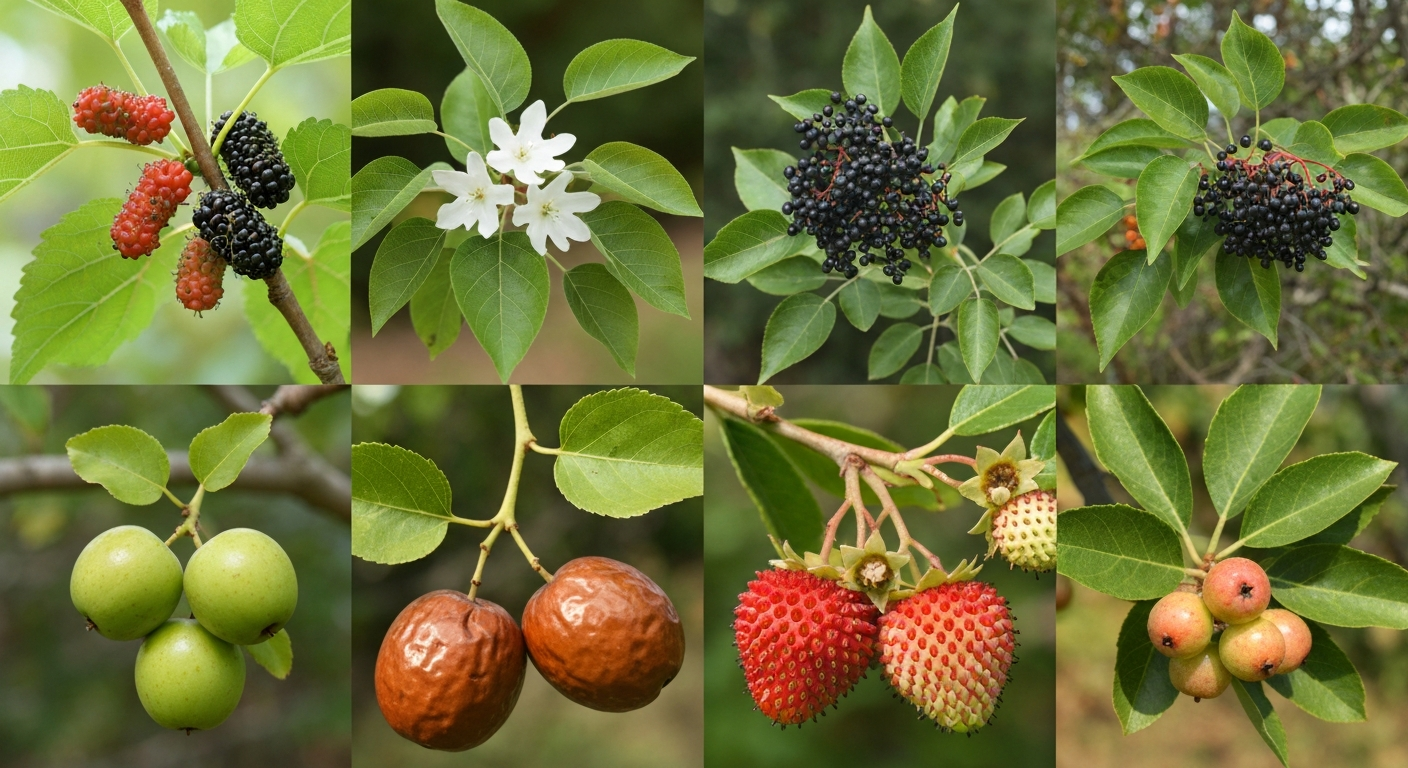
Common edible berries that grow on trees
The following species are the ones I recommend most often to home growers and foragers. Each one has a track record of culinary use, is reasonably identifiable, and is genuinely worth growing if your climate suits it.
| Tree / Species | Edible Parts | Flavor Profile | Common Uses |
|---|---|---|---|
| Mulberry (Morus rubra, M. alba, M. nigra) | Ripe fruit | Sweet, blackberry-like; M. nigra richest flavor | Fresh eating, jam, wine, smoothies |
| Serviceberry / Juneberry (Amelanchier spp.) | Ripe fruit | Sweet, mild, blueberry-like | Pies, jam, fresh eating, wine |
| Elderberry (Sambucus canadensis / S. nigra) | Ripe dark berries (cooked), flowers | Tart, earthy, floral; better cooked | Syrups, jam, wine, cordials (cook first) |
| Jujube / Chinese Date (Ziziphus jujuba) | Flesh and skin of ripe fruit | Apple-like fresh; sweet date-like when dried | Fresh eating, dried fruit, tea, confections |
| Strawberry Tree (Arbutus unedo) | Ripe red/orange fruits | Mildly sweet, slightly grainy texture | Fresh eating, jam, liqueurs (traditional) |
| Hackberry (Celtis occidentalis) | Ripe drupes | Small, sweet, date-like | Fresh snacking, dried, ethnobotanical use |
A few notes worth keeping in mind. Elderberries must be cooked before eating in quantity. Raw or green elderberries contain cyanogenic glycosides and alkaloids that cause nausea and vomiting. I learned this the hard way picking elderberries from a hedgerow and sampling one too many straight off the branch. Once cooked into syrup or jam, they are wonderful. Mulberries, on the other hand, are safe to eat straight from the tree when fully ripe. Jujubes are probably the most underrated tree fruit in temperate North American gardens: they taste like a mild apple when fresh and like a chewy date when dried, and the trees are genuinely tough. Hackberries are less commonly cultivated but worth knowing as a foraging species, particularly in the Midwest and eastern US, where the trees grow wild and the small drupes feed both people and wildlife.
Poisonous tree-borne berries: what to avoid and how to spot them
This is the section I wish more people read before they go foraging. Several of the most dangerous garden and woodland plants produce berries that look appealing, especially to children.
- Yew (Taxus spp.): The fleshy red aril surrounding the seed looks like a tiny cup of candy, and it is the one part with low toxicity. But the seed inside the aril is highly toxic, containing cardiotoxic alkaloids called taxines. Swallowing a chewed seed can cause sudden cardiac arrest. Yews are extremely common ornamental hedging plants — if you have them in your garden, know what they look like and keep children away from the berries.
- Bittersweet Nightshade (Solanum dulcamara): A climbing, vine-like plant producing glossy red or orange berries in clusters. They ripen from green to yellow to red, so a single cluster can show multiple colors. Contains glycoalkaloids including solanine. Causes gastrointestinal distress and in larger amounts neurological and cardiac symptoms.
- Pokeweed (Phytolacca americana): Produces striking clusters of dark purple-black berries on red-stemmed plants that can reach 6 to 10 feet. The berries are toxic (phytolaccotoxin), the roots even more so. Do not eat them raw. Historic 'poke salad' preparations required very specific cooking methods and are not safe for casual foragers.
- Lily-of-the-valley (Convallaria majalis): Small, bright red-orange berries appearing in late summer after the familiar white bell flowers. Contains cardiac glycosides including convallatoxin. Even a small number of berries can cause nausea, vomiting, and heart arrhythmia.
- Holly (Ilex spp.): Many holly species produce bright red drupes that are toxic to humans (and pets). Ingestion causes vomiting, diarrhea, and lethargy. Hollies are everywhere in ornamental landscaping across North America and Europe.
The key identification principle is this: do not rely on color alone. Red does not mean dangerous and black does not mean safe. Learn the whole plant: leaf shape, stem structure, growth habit, bark, and flower. If you are in doubt, take a photo and contact your local extension office or a plant identification expert before tasting anything.
How berries grow: trees, shrubs, and vines explained
One thing that trips up a lot of new growers is the idea that 'berries' all grow the same way. They do not. The growth habit of the plant matters a great deal when you are planning where to put something in your garden, what kind of support it needs, and how to prune it. Broadly, berry-bearing plants fall into three categories: trees (single or multi-stem woody plants with persistent above-ground structure), shrubs (multi-stem woody plants, often shorter), and vines or trailing canes (plants that sprawl, climb, or grow along the ground). For more detail on vine-grown species, see our guide on what berries grow on vines for common examples and management tips. The table later in this article compares all three in detail.
Do dewberries grow on trees?
No. Dewberries (Rubus flagellaris, R. hispidus, R. trivialis, and related species) are trailing, low-growing brambles with vine-like canes. They sprawl along the ground or scramble through hedges, and they are managed in the same category as blackberries in most extension literature. Extension guidance in Blackberry and Dewberry: Biology and Control, UF/IFAS Extension (EDIS AG238) states that dewberries are trailing Rubus species closely related to blackberries and are managed with other brambles blank" rel="noopener noreferrer">Blackberry and Dewberry: Biology and Control — UF/IFAS Extension (EDIS AG238). They do not grow on trees. If you have spotted what looks like a blackberry-type fruit coming off a low, thorny cane trailing across a field edge or woodland floor, there is a good chance you are looking at a dewberry. They tend to ripen a little earlier than blackberries, and the fruit sits closer to the ground. Growing conditions for dewberries favor disturbed, open, or moist-to-dry soils, roadsides, and field margins. They are not a tree fruit, a shrub fruit, or a true vine fruit: they are trailing cane fruit, most closely related to blackberries in habit and management. See our detailed guide "Do dewberries grow on trees?" for more on identification and growth habit.
What about red berries growing in the grass?
If you are finding small red berries at or near ground level, in lawns or woodland edges, the most likely candidates are wild strawberry (Fragaria spp.), lowbush Vaccinium species like lingonberry (Vaccinium vitis-idaea) or bog cranberry, or wintergreen (Gaultheria procumbens). Most of these are edible and some are genuinely tasty. The dangerous look-alikes to rule out are bittersweet nightshade (which grows taller and vining, with pointed oval leaves and a distinct yellow anther cone) and lily-of-the-valley berries (which appear on low, broad-leaved plants in shaded garden settings). Learn the leaf before you eat the berry.
Trees vs. shrubs vs. vines: a side-by-side comparison
| Feature | Berry-Bearing Trees | Berry-Bearing Shrubs | Berry-Bearing Vines / Trailing Canes |
|---|---|---|---|
| Growth habit | Single or multi-stem, tall woody structure (6 to 60+ ft) | Multi-stem, low to mid height (2 to 15 ft) | Sprawling, climbing, or trailing; canes or twining stems |
| Fruiting habit | Fruits on branches, often high up at maturity | Fruits at accessible height throughout | Fruits along canes, often at ground level or on support |
| Examples | Mulberry, serviceberry, jujube, elderberry, hackberry | Blueberry, gooseberry, currant, elderberry (shrub form) | Grape, kiwi, dewberry, blackberry, some Rubus spp. |
| Space needed | More (unless dwarf/trained) | Moderate; many suit small gardens | Can be compact with trellising or minimal if trailing |
| Pros | Long-lived, high yield at maturity, shade potential | Easier harvest, good container options, quicker fruit | Often fast to establish, flexible placement |
| Cons | Slow to first fruit, harder to net, may need pruning for size | May need cross-pollination, some short-lived | Can spread aggressively; canes need annual management |
| Soil flexibility | Variable by species; many tolerate loam to clay | Variable; blueberries need acidic/peaty soil | Generally adaptable; dewberries tolerate dry to moist |
Growing tree-borne berries in your region and climate
The most common mistake I see home growers make is choosing a species based on what they tasted on a trip rather than what thrives in their zone. Here is a practical breakdown by climate and USDA hardiness zone for the main edible tree berries.
Hardiness zones and species compatibility
| Species | USDA Zones | Climate Type | Soil Preference | Sun / Water |
|---|---|---|---|---|
| Mulberry (Morus spp.) | 4–9 (varies by species) | Temperate to subtropical | Moist, well-drained loam; tolerates clay and dry spells once established | Full sun; moderate water; drought-tolerant once mature |
| Serviceberry (Amelanchier spp.) | 2–9 (species vary) | Boreal to temperate | Moist, well-drained loam to sandy loam; slightly acidic preferred | Full sun to partial shade; consistent moisture especially when young |
| Elderberry (Sambucus spp.) | 3–9 | Temperate | Moist, fertile loam; tolerates wetter soils and partial shade | Full sun to part shade; likes consistent moisture |
| Jujube (Ziziphus jujuba) | 6–10 | Temperate to Mediterranean/subtropical | Well-drained loam to sandy; tolerates poor, alkaline soils well | Full sun; low water once established; very drought-tolerant |
| Strawberry Tree (Arbutus unedo) | 7–11 | Mediterranean, mild coastal | Well-drained, slightly acidic to neutral; dislikes waterlogging | Full sun to partial shade; low to moderate water; Mediterranean dry summer tolerant |
| Hackberry (Celtis occidentalis) | 2–9 | Temperate, plains, urban | Adaptable; loam, clay, sandy, alkaline all acceptable | Full sun; low water; very tough and drought-tolerant |
If you are in a boreal or cold northern climate (zones 2 to 4), serviceberry is your best bet for a tree-borne edible berry. Species like Amelanchier alnifolia handle brutal winters and still produce reliably. In Mediterranean climates (zones 7 to 11 with dry summers), the strawberry tree and jujube both thrive where most fruiting shrubs struggle with drought. Subtropical growers in zones 9 to 11 have the widest options, including mulberries that produce almost year-round in warm regions. For bog or consistently wet soils, elderberry is one of the few tree-type berries that actually performs well. For dry, poor soils, jujube and hackberry are the go-to choices: I have watched jujubes thrive in rocky, alkaline soils that would kill most fruit trees outright.
Container and small-space options for tree-borne berries
Good news for small-garden growers: several tree-borne berries adapt well to containers or can be kept small through rootstock selection and pruning. I grow a dwarf mulberry in a 25-gallon fabric pot on my patio and it has produced fruit every year for four years. Mulberries vary in mature size, with many Morus (e.g., M. alba, M. rubra) reaching 30–50 ft while several naturally compact or nursery 'dwarf' selections (e.g., 'Gerardi'/'Dwarf Everbearing', 'Issai') are marketed for containers, see Mulberry (Morus), UCANR / UC Cooperative Extension (fact/resource) Mulberry (Morus) — UCANR / UC Cooperative Extension (fact/resource).
- Mulberry: Look for cultivars sold as 'Dwarf Everbearing,' 'Geraldi Dwarf,' or similar compact nursery selections. These stay under 6 to 8 feet and work well in large containers (20 gallons or more). Use a rich, well-draining potting mix (loam-based compost with perlite). Water consistently in summer as containers dry out fast.
- Serviceberry: The cultivar 'Regent' (Amelanchier alnifolia) reaches about 4 to 6 feet and is one of the best compact options. Works well in a large container or a small border. Use a slightly acidic potting mix (pH 5.5 to 6.5) with good drainage.
- Jujube: Some cultivars including 'Li' and 'Lang' can be grown in large containers (30+ gallons) and trained as small trees through annual pruning. Use a gritty, well-drained potting mix — jujubes hate wet feet. Top-dress with a balanced fertilizer in spring.
- Elderberry: Best suited to the ground unless you have very large planters (25+ gallons). Multi-stem shrubs can be cut back hard each spring to keep them compact. Not ideal for containers long-term but manageable in a raised bed.
- Strawberry Tree (Arbutus unedo): Naturally compact and slow-growing; handles container life well. Use a well-drained, slightly acidic mix. Good drainage is essential — root rot is the main killer in pots.
- General container drainage tip: Always use containers with drainage holes and raise them slightly off the ground. A layer of coarse gravel or perlite in the bottom third of the pot helps prevent root rot, especially for jujube and strawberry tree.
Pollination, flowering, and time to first harvest
Pollination requirements differ significantly between tree-berry species, and getting this wrong is one of the main reasons home growers end up with flowering trees that never produce fruit.
- Mulberry: Most cultivars are self-fertile. A single tree will produce fruit. Some varieties are dioecious (separate male and female trees), so check the label when buying. Time to first harvest is typically 2 to 3 years from a young tree, 1 to 2 years from a larger nursery specimen.
- Serviceberry: Self-fertile, though cross-pollination with another Amelanchier improves yield. Flowers early in spring (often March to April in zones 4 to 6) and attracts early bees and butterflies. First fruit usually appears in year 2 to 3.
- Elderberry: Cross-pollination strongly improves yield. Plant at least two cultivars within 60 feet of each other. Flowers in early summer; berries ripen late summer. First meaningful harvest usually in year 2.
- Jujube: Self-fertile but cross-pollination between two different cultivars dramatically increases fruit set. Flowers are small, yellow, and very fragrant — bees visit them readily. Time to first harvest can be 1 to 2 years for grafted trees; longer for seedlings.
- Strawberry Tree: Self-fertile and actually flowers in autumn (October to December in the northern hemisphere), which is unusual. The fruit from the previous year's flowers ripens at the same time as the new flowers open, giving the tree a distinctive two-season look. Bees and other pollinators visit the autumn flowers. First fruit typically in year 2 to 3.
- Hackberry: Wind-pollinated; largely self-fertile. Not typically grown for commercial production but produces reliably with no management once established.
- General pollinator note: All of these species benefit from having nearby flowering plants to support bee and butterfly populations. Avoid broad-spectrum insecticides during flowering, particularly for elderberry, serviceberry, and jujube, which depend on insect visitors for best fruit set.
Wildlife interactions: birds, animals, and protecting your crop
Tree-borne berries are magnets for birds, and this is both a wonderful thing and a real practical problem. See the species profile for the bird whose diet includes berries that grow on lava for an example of a wildlife specialist that relies on unusual fruiting habitats. Mulberries in particular are famous for attracting everything from cedar waxwings to robins to mockingbirds, sometimes stripping a tree bare within a day or two of peak ripeness. Elderberries are heavily visited by songbirds, which is actually part of how the plant disperses its seeds across wide areas. Serviceberries attract waxwings, thrushes, and orioles at precisely the moment the fruit ripens in June and July. Hackberries feed a huge range of wildlife including birds, small mammals, and insects, making them an excellent wildlife-garden tree even if you never harvest a single berry yourself.
For crop protection, the most effective approach for smaller trees is bird netting, draped over the canopy as fruit approaches ripeness and removed after harvest. For large mulberry trees (which can reach 30 to 50 feet), full netting is impractical. In that situation I pick early-morning before birds get active, and I accept that I am sharing the crop. Reflective tape and decoy raptors offer only temporary deterrence in my experience. If you are planting specifically for wildlife attraction, elderberry and hackberry are excellent choices. If you want most of the fruit for yourself, go with a compact, nettable variety like a dwarf mulberry or a serviceberry in a small bed.
Decision checklist: picking the right berry tree for your location
Use this checklist to narrow down which species makes sense before you buy anything.
- What is your USDA hardiness zone? Serviceberry and hackberry work in zones 2 to 9. Jujube and strawberry tree need zones 6 to 7 and above. Check the table above for specifics.
- How much space do you have? If under 10 feet of width or height, focus on dwarf mulberry, compact serviceberry ('Regent'), or strawberry tree. If you have open ground, mulberry, elderberry, and hackberry are all viable.
- What is your soil type? Sandy or poor and alkaline? Jujube or hackberry. Moist fertile loam? Elderberry, mulberry, serviceberry all thrive. Boggy or wet? Elderberry tolerates this best. Rocky, dry, or Mediterranean-dry-summer? Jujube, strawberry tree.
- Do you have room for two plants (cross-pollination)? Elderberry benefits significantly from two cultivars. Jujube fruit set improves with two varieties. Mulberry, serviceberry, and strawberry tree manage fine alone.
- How soon do you want fruit? Grafted jujubes and nursery serviceberries can fruit in their first or second year. Mulberries take 2 to 3 years. If patience is not your strong suit, start with a larger nursery specimen.
- Are birds a problem in your garden? If yes, choose a species small enough to net (dwarf mulberry, serviceberry) or plan to share with wildlife (hackberry, elderberry).
- What will you do with the fruit? If you want fresh eating, mulberry, serviceberry, and jujube are the most pleasant raw. If you want to make syrups and cordials, elderberry is unmatched. If you want dried fruit, jujube is excellent. Strawberry tree fruit is best as jam or liqueur.
Seasonal care calendar by climate type
| Season / Task | Temperate (Zones 4–6) | Mediterranean (Zones 7–10, dry summer) | Subtropical (Zones 9–11, wet/dry seasons) | Boreal (Zones 2–4) |
|---|---|---|---|---|
| Planting | Early spring (Mar–Apr) or autumn (Oct) | Autumn preferred (Oct–Nov); avoids summer stress | Early dry season or early cool season | Spring only, after last frost (May–Jun) |
| Pruning | Late winter / early spring before bud break (Feb–Mar) | Late winter (Jan–Feb) | After harvest or during dry season rest | Late spring after frost risk passes (Jun) |
| Feeding | Early spring with balanced fertilizer; light feed midsummer | Early spring only; avoid feeding in dry summer | Start of growing season; compost mulch in dry period | Early spring; single application sufficient |
| Watering | Regular during dry spells; mulch to retain moisture | Deep weekly watering in summer for young trees; mature jujube/strawberry tree need minimal | Irrigate through dry season; reduce in wet season | Minimal needed once established; monitor first summer |
| Harvesting | Serviceberry Jun–Jul; mulberry Jun–Aug; elderberry Aug–Sep | Jujube Sep–Oct; strawberry tree fruit Oct–Dec | Mulberry can produce multiple times per year; elderberry late wet season | Serviceberry late Jun–Jul; hackberry Sep–Oct |
Safety first: what to do with an unknown berry
If you encounter berries you cannot confidently identify, here is the protocol I follow and recommend to every grower and forager I know.
- Photograph the whole plant, not just the berry. Get a clear shot of the leaves (both sides), stem, bark, flower if present, and the berries at different stages of ripeness. This is the single most useful thing you can do for identification.
- Do not taste immediately. Consult a field guide, a plant identification app (iNaturalist is reliable for confirming ID with expert input), or your local cooperative extension office before putting anything in your mouth.
- If you do taste-test an unknown berry as a last resort, use the 'universal edibility test' method: touch a small amount to your lip first, wait 15 minutes, then the tip of your tongue, wait again. Do not swallow. This is not a reliable safety guarantee but it is better than eating a handful of something unknown.
- If someone (adult, child, or pet) has eaten an unknown berry and shows any symptoms including nausea, vomiting, dizziness, numbness, or irregular heartbeat, call Poison Control immediately. In the US, the number is 1-800-222-1222. Keep a sample or photo of the plant to assist identification.
- When in doubt, leave it out. No wild berry is worth a trip to the emergency room. Grow your own from a known source and you eliminate the identification problem entirely.
Suggested images and figures for this article
For editors and content teams publishing this piece, the following visual assets would significantly improve reader safety, identification accuracy, and practical value.
- Close-up berry identification shots: ripe mulberries on branch (showing full black and part-ripe red stages); serviceberry clusters in mid-June; ripe dark elderberry clusters vs. unripe green clusters (safety contrast); jujube fruit at multiple stages (green-apple stage to wrinkled date stage); strawberry tree fruit in autumn alongside open flowers (unique double-season feature)
- Poisonous berry identification photos: yew aril (red cup with visible seed); bittersweet nightshade clusters showing green-to-red color gradient; pokeweed stem and berry cluster (showing distinctive red stem); lily-of-the-valley berries at ground level; holly drupes on branch
- Leaf and habit shots for key ID: elderberry compound leaves; mulberry distinctive lobed vs. heart-shaped leaves on same tree; serviceberry spring blossom (white flowers in early spring, useful for ID); jujube small, shiny oval leaves
- Growth habit comparison image: side-by-side or labeled diagram showing a tree (mulberry), a shrub (elderberry), and a trailing cane/vine (dewberry) to visually reinforce the trees-vs-shrubs-vs-vines section
- Soil type examples: well-drained loam with mulch (ideal for most species); rocky alkaline soil with jujube growing in it; boggy margin with elderberry; Mediterranean dry soil with strawberry tree
- Container setup photos: dwarf mulberry in a fabric pot on a patio; serviceberry in a raised bed border; jujube in a large terracotta container with visible gravel drainage layer
- Seasonal care infographic or calendar visual: a simple four-column calendar (temperate, Mediterranean, subtropical, boreal) showing planting, pruning, feeding, and harvest windows as color bands
- Comparison table as a designed visual graphic to accompany the markdown table (tree vs shrub vs vine), making it shareable and easy to scan on mobile
FAQ
Can you eat berries that grow on trees? (Quick answer)
Yes — many tree‑borne berries and berry‑like fruits are edible (examples: serviceberry, elderberry when cooked, mulberry, jujube, strawberry tree). However some tree fruits (and many red/ornamental berries) are poisonous (e.g., yew arils are dangerous because the seed/foliage are toxic). Never eat a berry unless you positively identify the plant and, for some species (elderberry, pokeweed), use the recommended preparation (usually cooking) or avoid entirely.
Common edible berries and berry‑like fruits that grow on trees (illustrated list: species, edible parts, flavor/use)
- Serviceberry (Amelanchier spp., "juneberry"/"saskatoon"): edible whole fruit when ripe; flavor: sweet, blueberry/almond notes; uses: fresh, pies, jams, wine. - Elderberry (Sambucus canadensis / S. nigra): edible only when fully ripe and cooked; uses: syrups, jams, wine; raw/unripe parts are toxic (see warnings). - Mulberry (Morus spp.): ripe aggregate fruits edible; flavor: sweet, blackberry‑like; uses: fresh, baking, preserves, juice. - Jujube (Ziziphus jujuba): edible fresh or dried (Chinese date); flavor: apple‑to‑date like; uses: fresh eating, drying, baking. - Strawberry tree (Arbutus unedo): ripe fruits edible; flavor: mildly sweet, grainy; uses: fresh, jams, liqueurs (best in Mediterranean climates). - Hackberry (Celtis spp.): small drupes edible when ripe; flavor: date‑like/sweet; uses: fresh/dried by foragers. - Cornelian cherry (Cornus mas): small red drupes on small trees; flavor: tart to mildly sweet; uses: jams, preserves. Suggested images/figures: closeups of ripe fruit clusters, whole tree habit, leaf shape, and a labeled cross‑section showing seed/stone when present.
Which tree‑borne berries are poisonous or hazardous? Identification and warnings
- Yew (Taxus spp.): bright red arils surround a highly toxic seed and foliage is poisonous; do NOT eat any part. - Holly (Ilex spp.): many species have red berries that cause vomiting/diarrhea if eaten; ornamental and often toxic. - Bittersweet nightshade / woody nightshade (Solanum spp.) — though often vine/shrub, some woody forms produce red/orange berries that are toxic. - Pokeweed (Phytolacca americana): berries and other parts are toxic; historical food uses require careful traditional processing and are not recommended. - Lily‑of‑the‑valley (Convallaria majalis): red berries are highly toxic (cardiac glycosides). Warnings: If ingestion is suspected, contact Poison Help (US: 1‑800‑222‑1222) or local emergency services. Use photos or a safely collected sample to aid identification. Do not assume red = edible; many look‑alikes exist. When in doubt, discard.
How do berries grow — trees vs shrubs vs vines? (Plain‑language explanation and comparison table)
Plain explanation: 'Berry' in garden language refers to any small fleshy fruit, but botanically many garden 'berries' are other fruit types (drupes, pomes, aggregates). Berries and berry‑like fruits can develop on trees, on multi‑stem shrubs, and on vines/low brambles. Growth form matters for pruning, space, and where fruits appear (high canopy vs near ground). Dewberries are not tree fruits — they are trailing/bramble species (Rubus) that grow low to the ground or along the soil surface. 'Red ground/grass berries' are typically low plants (wild strawberries, lowbush Vaccinium, wintergreen) or are poisonous look‑alikes, so identify the plant, not just the berry color. Comparison table (text): - Tree: single trunk or small multi‑stem tree; fruits often borne on branches above 6–30 ft (examples: mulberry, jujube, serviceberry if tree form); pros: higher yield per plant, shade/landscape value; cons: take more space, higher pruning/harvest height. - Shrub: multi‑stem woody plant 1–12 ft; fruits lower and easier to harvest (examples: elderberry, cornelian cherry, strawberry tree, many Vaccinium); pros: easier harvest, suitable for hedges; cons: can take more horizontal space. - Vine/Brambles: trailing or cane‑forming plants close to ground or on supports (examples: dewberry, some Rubus blackberries); pros: fast fruiting, easy to train/trellis; cons: can sprawl/invade, thorny can be difficult to manage.
Do dewberries grow on trees? Where do they grow?
No. Dewberries (Rubus spp.) are trailing/bramble plants with low, vine‑like or prostrate canes that root at tips or along the cane. They grow on the ground, in hedgerows, or as thickets — managed similarly to blackberries rather than tree fruit.
What are red ground/grass berries and how to tell edible vs poisonous look‑alikes?
Common edible low red berries: wild strawberry (Fragaria spp.), lowbush cranberry/lingonberry/vaccinium (Vaccinium spp.), and wintergreen (Gaultheria procumbens). Poisonous look‑alikes: bittersweet nightshade, lily‑of‑the‑valley, and some ornamental species produce similar red fruits. Identification tips: check leaf shape, plant habit (prostrate vs upright), flower type (strawberries have 5‑petaled white flowers), and presence of runners or woody stems. Never taste an unknown berry — use a field guide or extension service to confirm.