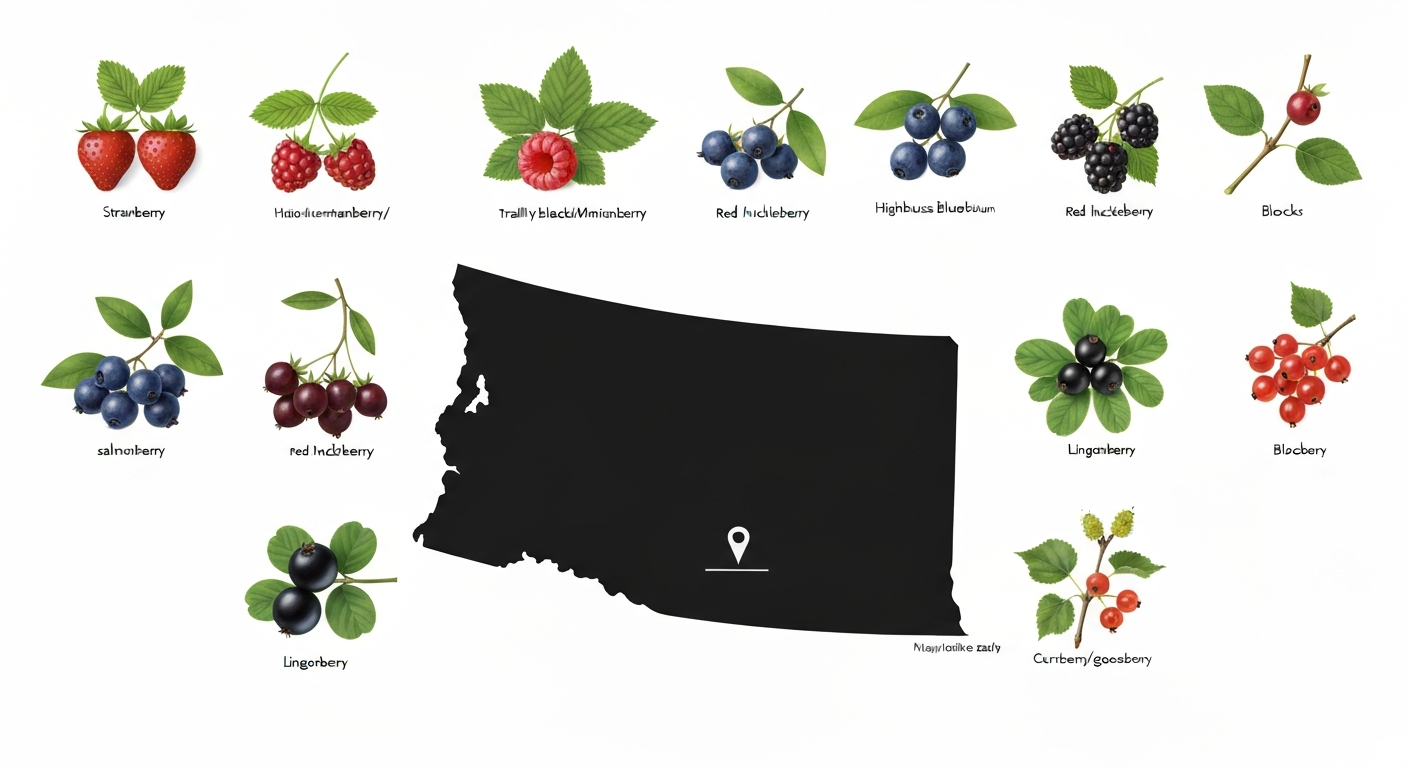
Washington State grows an impressive lineup of berries, both cultivated and wild: strawberries, raspberries, blackberries (including trailing types like Marionberry), highbush and half-high blueberries, huckleberries, salmonberries, thimbleberries, elderberries, currants, gooseberries, cranberries, lingonberries, serviceberries, and mulberries. Western Washington's mild, rainy maritime climate suits cane fruits, blueberries, and bog species perfectly. Eastern Washington's drier, sunnier continental climate is better for serviceberries, gooseberries, and heat-loving strawberries. And in the mountains, wild huckleberries dominate. No matter where you garden in the state, at least a half-dozen berry types will thrive with minimal effort.
What Berries Grow in Washington State: Guide by Region
Marcus Holloway
6 Aug 2026
Who this guide is for and what it covers
If you are a home gardener in Seattle trying to squeeze blueberries into a raised bed, a hobby farmer near Yakima wondering whether raspberries will handle the dry summers, or someone who just moved to the Olympic Peninsula and wants to know what grows wild out back, this guide is written for you. I have grown berries on both sides of the Cascades, and the single biggest lesson is that Washington is not one climate. It is several, and knowing which zone you are in changes everything. This article maps each major berry type to the part of the state where it genuinely thrives, explains what form each plant takes (bush, cane, vine, tree, or bog plant), walks through soil and pH needs, and shows you how to adapt your setup for smaller spaces. I also cover harvest timing across spring, summer, and autumn, because if you plan your variety selection right, you can have fresh berries from May through October.
The quick list: berries that grow in Washington State
Here is the full roster of cultivated and native berries you can grow or forage in Washington. This list comes from WSU Extension research and reflects what actually performs in Pacific Northwest conditions, not just what catalog descriptions promise.
- Strawberry (Fragaria × ananassa and native Fragaria virginiana / F. chiloensis)
- Raspberry (Rubus idaeus and PNW breeding selections)
- Blackberry, trailing types (including Marionberry and Olallie-derived cultivars)
- Himalayan blackberry (Rubus armeniacus — invasive and widespread but edible)
- Highbush blueberry (Vaccinium corymbosum hybrids) and half-high types
- Black/thinleaf huckleberry (Vaccinium membranaceum — wild, montane)
- Red huckleberry (Vaccinium parvifolium — wild, forest understory)
- Evergreen huckleberry (Vaccinium ovatum — native, coastal forest)
- Salmonberry (Rubus spectabilis — native, western lowlands and coast)
- Thimbleberry (Rubus parviflorus — native, both sides of Cascades)
- Elderberry (Sambucus nigra ssp. cerulea and S. racemosa)
- Currant and gooseberry (Ribes spp., including native and cultivated varieties)
- Cranberry (Vaccinium macrocarpon — commercial and home bogs, southwest coast)
- Lingonberry (Vaccinium vitis-idaea — cool maritime sites)
- Serviceberry / Saskatoon (Amelanchier alnifolia — eastern slopes and drier sites)
- Mulberry (Morus spp. — cultivated trees, microclimate dependent)
How berry plants actually grow: bushes, canes, vines, trees, and bog plants
Understanding a berry's growth form before you plant saves a lot of frustration. I once put a trailing blackberry too close to a fence and spent two summers untangling it. Each form has different spacing, pruning, and support requirements, and several of Washington's most popular berries span multiple forms within a single genus.
Upright bushes
Blueberries (highbush types grow 5 to 8 feet tall), elderberries (often 8 to 12 feet), serviceberry (multi-stem shrub to small tree), evergreen huckleberry, and currants and gooseberries all grow as self-supporting shrubs. They need annual pruning to remove old wood and keep fruiting productive, but they do not need trellising. In a home garden, blueberries planted in groups of two or three cross-pollinating varieties give you the best yields.
Cane fruits
Raspberries and upright blackberries grow on biennial canes: year-one canes (primocanes) are vegetative, year-two canes (floricanes) fruit and then die. You cut the spent floricanes to the ground each year after harvest. Everbearing raspberry varieties (like 'Cascade Bounty' or 'Heritage') can also be cut entirely to the ground in late winter to produce a single fall crop on new primocanes, which simplifies pruning considerably. Trailing blackberry types (Marionberry, Olallie) are also cane fruits but need a trellis system because their long, flexible canes do not stand upright.
Trailing and vining types
Trailing blackberries, including the Marionberry, sprawl aggressively and are best trained along a two-wire trellis. Himalayan blackberry, which you will encounter almost everywhere in western Washington, grows the same way but on a much more invasive scale. Strawberries send out horizontal runners rather than true vines, but they spread similarly and benefit from having runners directed or removed depending on whether you want a matted row or a hill system.
Trees and large shrubs
Mulberry grows as a true canopy tree that can reach 20 to 30 feet if left unpruned. Serviceberry (Amelanchier alnifolia) functions as a large multi-stem shrub or small tree, typically 6 to 15 feet. Both are low-maintenance once established and can serve double duty as shade or screening plants. Elderberry falls in a middle zone: fast-growing, shrubby, and often 10 feet or more in a single season under good conditions.
Bog and creeping plants
Cranberries are low, creeping vines that spread along the soil surface and produce fruit on short upright shoots. They require a saturated, very acidic (pH 4.0 to 5.0) growing medium and are traditionally grown in flooded bogs. Lingonberries are also low creeping evergreen plants with similar acid soil requirements, though they tolerate somewhat better drainage. Wild huckleberries (especially Vaccinium membranaceum) grow as upright shrubs in forest and subalpine settings, but they behave like highly specialized bog relatives in their soil chemistry requirements: they need extremely acidic, low-fertility, well-drained organic soils and are notoriously difficult to transplant from the wild.
Washington's climate zones: you need to know which side of the mountains you are on
The Cascade Range splits Washington into two fundamentally different growing environments. I garden in western Washington, and when I first tried growing serviceberries in the wet, shaded Puget Sound lowlands, they sulked. Moved one to a drier, sunnier spot in a raised bed and it took off. That experience illustrates the single most important principle for growing berries in this state: match the plant to the climate, not just the hardiness zone number.
Western Washington: maritime, Puget Sound, and Olympic coast
Western Washington is characterized by mild, wet winters (rarely below 15°F in lowlands), cool summers with low heat accumulation, and high rainfall from October through May. USDA hardiness zones run roughly from Zone 7b to 9a depending on elevation and proximity to water. The Olympic Peninsula gets 100 to 170 inches of rain per year in some spots; the rain shadow areas east of the Olympics (Sequim, parts of the San Juan Islands) can be surprisingly dry and sunny. This maritime climate is ideal for blueberries, raspberries, trailing blackberries, salmonberries, red huckleberries, evergreen huckleberries, lingonberries, cranberries (coastal southwest), elderberries, and strawberries. The challenge here is fungal disease pressure: botrytis, cane blight, and mildew love the same cool, damp conditions your berries do.
Eastern Washington: continental, Columbia Basin, and Cascade rain shadow
East of the Cascades, the climate flips: hotter summers (100°F days are common in the Columbia Basin), colder winters (Zone 4b to 6b depending on location), lower humidity, and much less rainfall (as little as 6 to 8 inches annually in the driest parts). Irrigation is essentially required for most berry production here. The upside is more sunshine, which concentrates sugars and reduces fungal pressure. Serviceberries, gooseberries, currants, strawberries, and haskaps (honeyberries) do particularly well in eastern Washington. Highbush blueberries struggle here without significant soil amendment and irrigation management, but half-high varieties bred for cold tolerance are more viable. Commercial raspberry and blackberry production occurs under irrigation in the Yakima Valley and Wenatchee areas.
Mountain zones: Cascades and the northeast highlands
At mid to high elevations in the Cascades and the Okanogan Highlands, you are in Zone 4 to 6 territory with short growing seasons, late frosts, and significant snowpack. This is huckleberry country. Vaccinium membranaceum (black huckleberry) dominates mountain openings, forest edges, and post-fire clearings from about 2,500 to 6,000 feet. Red huckleberry (V. parvifolium) appears at lower mountain elevations in shaded conifer forests. Thimbleberry thrives at these elevations on both sides of the divide. Thimbleberry (Rubus parviflorus) is native in Washington, commonly occurs in shady, moist forest edges and openings across low to mid elevations on both sides of the Cascades, and is distinguished by large, soft, thimble‑shaped berries and thornless canes, Wild berries, Washington State University Magazine (WSU) Wild berries — Washington State University Magazine (WSU). If you garden at mountain elevations, stick to short-season cold-hardy varieties of raspberries and strawberries, and plan your planting schedule around last-frost dates that can stretch into June.
Best berries by habitat and region
The table below maps Washington's four main growing habitats to the berry types most likely to succeed there, with notes on key variety choices and considerations.
| Habitat / Region | Best Berry Types | Key Considerations |
|---|---|---|
| Coastal / Olympic Peninsula (wet, mild) | Cranberry, salmonberry, evergreen huckleberry, red huckleberry, elderberry, strawberry | Bog conditions for cranberry; excellent for native species; high disease pressure on thin-skinned fruits |
| Puget Sound lowlands (maritime, moderate rain) | Highbush blueberry, raspberry, trailing blackberry (Marionberry), strawberry, lingonberry, currant, elderberry | Best all-around zone for cultivated berries; amend soil for blueberry pH; trellis trailing types |
| Cascade/mountain forested sites (cool, short season) | Black huckleberry (wild), red huckleberry, thimbleberry, serviceberry, cold-hardy raspberry | Wild harvest is primary option for huckleberry; cultivated berries need frost protection and short-season varieties |
| Eastern WA dry-river valleys and irrigated farmland (hot, dry) | Strawberry, serviceberry, gooseberry, currant, haskap/honeyberry, raspberry (irrigated), half-high blueberry | Irrigation essential; choose heat-tolerant and cold-hardy cultivars; fewer fungal issues |
Coastal and Olympic Peninsula sites
If you are near Grays Harbor, the Long Beach Peninsula, or the western Olympic coast, you are in prime cranberry territory. Washington has roughly 1,700 commercial cranberry acres concentrated around the Willapa Bay and Long Beach Peninsula area, and home growers in that zone can build a small cranberry bed in a lined raised bed with peat and sand. Salmonberry is basically a weed on the coast in the best possible sense: plant it once in a moist, partly shaded spot and it will fill in, produce salmon-pink to orange-red fruits in June, and support pollinators. Native evergreen huckleberry (Vaccinium ovatum) is slow but makes a beautiful, low-maintenance hedge with small, intensely flavored dark berries in late autumn.
Puget Sound lowlands
The Puget Sound lowlands are the sweet spot for cultivated berry production in Washington. This is where the state's commercial blueberry and raspberry industries concentrate (particularly in the Skagit, Whatcom, and Puyallup Valleys). For home gardeners here, highbush blueberries are probably the single highest-reward planting: buy two or three cross-pollinating varieties, amend your beds to pH 4.5 to 5.0, mulch heavily with wood chips or sawdust, and expect reliable harvests for decades. Raspberries like 'Cascade Bounty,' 'Cascade Harvest,' and 'Willamette' are bred specifically for western Washington and perform extremely well. The Marionberry, though its breeding originated in Oregon's Marion County, is widely planted in this region and produces one of the richest-flavored trailing blackberries you can grow.
Mountain and forested sites
For gardeners in foothills towns like North Bend, Darrington, or anywhere along the Cascade foothills, wild huckleberries are the big prize. Vaccinium membranaceum does not domesticate easily: attempts to transplant it from the wild almost always fail because it depends on specific soil fungi (mycorrhizae) that are nearly impossible to replicate in a garden setting. Your best bet is to wild-harvest from established mountain patches and focus your garden on thimbleberries (which transplant readily from suckers), cold-hardy strawberries, and short-season everbearing raspberries.
Eastern Washington: dry-river valleys and irrigated land
East of the Cascades, heat and cold tolerance matter more than rainfall management (you will be irrigating regardless). Serviceberry (Amelanchier alnifolia) is native to these drier eastern slopes and requires no irrigation once established, making it one of the lowest-effort berry plants in the state for this region. Gooseberries and currants are cold-hardy and productive with drip irrigation. If you are in the Wenatchee or Yakima area and want blueberries, switch to half-high varieties like 'Northblue' or 'Chippewa,' which handle Zone 4 winters better and tolerate slightly less acidic soil than highbush types. Strawberries, especially June-bearing types on drip irrigation with plastic mulch, are highly productive under the Columbia Basin's long sunny days.
When to harvest: seasonality, fruiting windows, and winter hardiness
One thing I love about Washington berry growing is that with thoughtful variety selection, you can stagger harvests across most of the calendar year. Here is how the seasons break down, and what to expect from cold-season hardiness. For related game-mechanics questions, like whether berries regrow during winter in Don't Starve, see the page titled "Do berries grow in winter don't starve" for a quick summary Do berries grow in winter in Don't Starve?. For gardeners curious about autumn-specific harvests, the topic of what berries ripen in fall overlaps with several of Washington's native species, particularly huckleberries and evergreen huckleberry. See what berries grow in autumn for a focused list of species and timing.
| Season | Berry Types | Approximate Harvest Window (Western WA) | Cold Hardiness Notes |
|---|---|---|---|
| Spring (early) | Salmonberry, strawberry (June-bearing starts) | May to mid-June | Salmonberry hardy to Zone 6; strawberry crowns hardy to Zone 4-5 with mulch |
| Early summer | Strawberry (peak), serviceberry, thimbleberry, red huckleberry, gooseberry | June to early July | Serviceberry hardy to Zone 3-4; thimbleberry hardy to Zone 4 |
| Midsummer | Raspberry, trailing blackberry (Marionberry), currant, highbush blueberry (early varieties) | July to early August | Raspberry hardy to Zone 3-4; Marionberry to Zone 6 (marginal in coldest eastern WA) |
| Late summer | Blackberry, blueberry (mid/late varieties), elderberry | August to September | Elderberry hardy to Zone 4-5; blueberry to Zone 4-5 depending on variety |
| Autumn | Black huckleberry, evergreen huckleberry, cranberry, lingonberry | September to October (huckleberry); October-November (cranberry) | Cranberry hardy to Zone 3; black huckleberry to Zone 4; lingonberry to Zone 3 |
| Year-round/winter interest | Evergreen huckleberry (berries persist), lingonberry (evergreen foliage) | Lingonberry may bear twice in mild years | Lingonberry hardy to Zone 3; evergreen huckleberry to Zone 7 |
For spring harvests specifically, salmonberry is the first significant native berry of the year in western Washington, often ripening before most cultivated fruits are even flowering. If you are gardening in similar cool-spring climates, planting salmonberry and early June-bearing strawberries side by side gives you a double wave of spring fruit. See our seasonal roundup on what berries grow in spring for a quick guide to early-fruiting species you can plant or forage. Autumn is huckleberry and cranberry season, and those harvests happen largely in wild or semi-wild settings unless you have built dedicated bog or mountain-garden systems.
Soil, drainage, and pH: matching conditions to what each berry actually needs
Getting soil chemistry right is the single factor most home gardeners skip, and it explains why blueberries planted in average garden soil just sit there looking miserable for years. Washington soils are variable: western Washington lowland soils tend to be naturally acidic (pH 5.5 to 6.5 in many areas), which is a head start for ericaceous plants, but eastern Washington soils are often alkaline (pH 7.0 to 8.0) due to low rainfall and mineral-rich parent material. Here is what each major category needs.
Bog and very-acid plants (pH 4.0 to 5.0)
Cranberries need pH 4.0 to 5.0 and consistently saturated or near-saturated soil. A practical home bog is a lined bed (use a pond liner or thick HDPE plastic) filled with a 50/50 mix of coarse sand and sphagnum peat moss. Keep it consistently moist but not stagnant. Lingonberries want the same pH range but tolerate better drainage than cranberries, making them easier to manage in a raised bed. Both plants are shallow-rooted and do not compete well with weeds, so a thick layer of pine needle or bark mulch is essential.
Ericaceous and acid-loving plants (pH 4.5 to 5.5)
Highbush and half-high blueberries, huckleberries, and evergreen huckleberry all need pH 4.5 to 5.5. If your soil tests higher (as eastern Washington soils often do), amend with elemental sulfur worked into the bed several months before planting. In western Washington, where soils are already somewhat acidic, you often only need to maintain pH with acidic mulches like wood chips or sawdust. Do not use lime or alkaline fertilizers on these plants. Use an ammonium sulfate or formulated acidic fertilizer. Soil in their native mountain habitats is extremely low in nutrients and high in organic matter: replicate this by building beds with a high proportion of composted wood products, not rich vegetable garden compost.
Moderately acid to neutral soils (pH 5.5 to 7.0)
Raspberries, blackberries, strawberries, elderberries, currants, gooseberries, and thimbleberries all fall into this more forgiving range. Good drainage is critical for all of them: wet feet through a long Pacific Northwest winter will rot cane fruit roots and strawberry crowns. In heavier clay soils common in parts of western Washington, building mounded beds or raised rows 8 to 12 inches above grade makes a significant difference. On the eastern side, irrigation management matters more than drainage since sandy or rocky soils drain fast.
Drought-tolerant and alkaline-adaptable species (pH 6.0 to 7.5)
Serviceberry, mulberry, and to some extent gooseberries tolerate a wider pH range and drier conditions once established. Serviceberry (Amelanchier alnifolia) native to eastern Washington's rocky slopes is genuinely drought-hardy after year two or three in the ground. Mulberry trees are similarly adaptable. These are the low-maintenance anchors of an eastern Washington berry garden.
Growing berries in containers, raised beds, and small spaces
Living in a townhouse in Bellevue for a few years taught me that you can grow a surprising quantity of berries without a proper yard. The key is matching the container size to the plant's root system and being honest about which species actually thrive in pots versus which ones just survive.
Blueberries in containers
Blueberries are one of the best container berries because their pH requirements are easy to control in a pot. Use a minimum 15-gallon container (half-barrel size or larger) per plant. Fill with a mix of 60% coarse peat moss or coir, 20% perlite, and 20% fine pine bark fines. Do not use regular potting mix, which usually has a pH of 6.0 to 6.5 and will stunt your plants. Half-high varieties like 'Top Hat' (which stays under 2 feet) or 'Northblue' are particularly suited to container life. Water consistently: blueberry roots are fibrous and shallow and will dry out faster in a pot than in the ground.
Strawberries in containers and hanging baskets
Strawberries are probably the most forgiving container berry. Day-neutral varieties like 'Albion' or 'Seascape' produce fruit repeatedly through the season rather than in one June flush, making them ideal for patio pots. A standard 12-inch pot will support one plant; a strawberry tower or 5-gallon strawberry jar can hold five or six. Use a standard well-draining potting mix with added slow-release fertilizer. In western Washington, day-neutral types in containers on a south-facing deck can produce from May through September.
Raspberries and blackberries in raised beds
Raspberries do not love deep containers because their root systems spread laterally. A 24-inch-wide, 18-inch-deep raised bed is workable for a row of three to four plants. Compact varieties like 'Raspberry Shortcake' (a dwarf thornless type bred for containers) can even go into large 15-gallon pots. Trailing blackberries like Marionberry need at least a 4-foot run of trellis even in a raised bed, so factor that into your small-space planning. Upright blackberries are easier in tight spaces.
Cranberry and lingonberry micro-bogs
You can absolutely build a backyard cranberry bog in a large half-barrel or a lined raised bed. I have seen excellent results with a 4-by-8-foot raised bed lined with pond liner, filled with a 50/50 sand and peat mix, and planted with three to four cranberry plants spaced 18 inches apart. Maintain soil moisture and fertilize lightly with an acid-specific fertilizer. Lingonberries in the same setup will produce two crops per year in mild western Washington winters. Both plants are evergreen and attractive enough to serve as ornamental ground covers in shaded corners of a deck or patio.
Currants and gooseberries in small gardens
Currants and gooseberries are underused in Pacific Northwest home gardens and they deserve more attention. They tolerate partial shade (unlike most fruiting plants), grow as compact bushes easily kept to 4 to 5 feet with annual pruning, and produce prolifically even in cooler summers. In a small backyard, a single black currant bush can yield 8 to 10 pounds of fruit per year. They can also be trained as espalier fans against a fence to save horizontal space. One important note: some Ribes plantings were historically restricted in Washington due to white pine blister rust concerns, so check current local regulations before purchasing, particularly if you are in a forested area with significant white pine populations.
Quick-reference: choosing the right berry for your Washington site
Use this checklist to narrow down your choices before you buy plants. Matching two or three of these criteria to what your site actually offers will save you more time and money than any single piece of advice in this guide.
- Identify your USDA hardiness zone and which side of the Cascades you are on. Western Zone 7-9 opens up blueberries, trailing blackberries, and lingonberries. Eastern Zone 4-6 steers you toward serviceberry, half-high blueberry, gooseberry, and cold-hardy raspberry.
- Test your soil pH before planting. Anything above pH 6.0 needs amendment for blueberries and cranberries. Most cane fruits and strawberries are forgiving between pH 5.5 and 7.0.
- Assess your drainage. Clay-heavy lowland soil needs raised beds or mounded rows for cane fruits and strawberries. Only bog species like cranberry want consistently wet conditions.
- Decide how much space you have. For under 50 square feet: strawberries, compact blueberry varieties, currants, lingonberry. For 100 to 300 square feet: raspberries, gooseberries, elderberry, full-size blueberry. For larger plots or trellised rows: trailing blackberries, Marionberry.
- Think about your harvest goals. For jam and preserving: blackberries, currants, elderberry, cranberry. For fresh eating: strawberries, raspberries, blueberries. For low-maintenance/native plantings: salmonberry, thimbleberry, serviceberry, elderberry.
- Plan for pollinators. Blueberries need at least two varieties with overlapping bloom times. Most Rubus fruits are self-fertile or largely self-fruitful but improve with cross-pollination.
- Consider wildlife pressure. Birds love blueberries and strawberries; netting is usually necessary. In eastern Washington, deer browse is a significant issue for young plantings of nearly everything on this list.
Recommended varieties by region and purpose
| Berry | Western WA Variety | Eastern WA Variety | Best Use |
|---|---|---|---|
| Highbush blueberry | Duke, Bluecrop, Draper, Elliott | Northblue, Chippewa (half-high) | Fresh eating, freezing, U-pick |
| Raspberry (summer) | Willamette, Cascade Bounty, Cascade Harvest | Cascade Bounty, Meeker (with irrigation) | Fresh, jam, freezing |
| Raspberry (everbearing) | Heritage, Autumn Bliss | Heritage, Caroline | Fall fresh eating, low-pruning system |
| Trailing blackberry | Marionberry, Olallie, Black Diamond | Less suited; try upright types instead | Jam, pies, fresh eating (western WA) |
| Strawberry (June-bearing) | Hood, Totem, Benton | Shuksan, Totem (with irrigation) | Fresh, jam, U-pick |
| Strawberry (day-neutral) | Albion, Seascape | Albion (with irrigation) | Extended season, containers |
| Gooseberry / Currant | Hinnonmaki Red (gooseberry), Ben Sarek (black currant) | Pixwell (gooseberry), Consort (black currant) | Jams, syrups, low-maintenance |
| Serviceberry | Smoky, Thiessen (ornamental/edible) | Smoky, Thiessen (well-adapted) | Fresh, pies, low-water landscape |
| Elderberry | Bob Gordon, Adams No. 2 | Bob Gordon, York | Syrup, jelly, medicinal |
Pests, diseases, and the most common problems in Washington berry gardens
Western Washington's damp climate means fungal diseases are your primary concern. Botrytis fruit rot (gray mold) hits strawberries and raspberries hard in cool, wet springs. The prevention strategy is simple but requires consistency: space plants for airflow, remove any rotting fruit immediately, avoid overhead irrigation, and apply a preventive copper or sulfur spray at first bloom if you have had problems in prior years. Cane diseases in raspberries (spur blight, cane blight) are managed by removing all spent canes promptly after harvest and not leaving them on the soil to overwinter.
In both eastern and western Washington, Spotted Wing Drosophila (SWD), an invasive fruit fly introduced from Asia, is now a serious pest on thin-skinned fruits like blueberries, raspberries, and cherries. Unlike native fruit flies, SWD females lay eggs in ripening (not just overripe) fruit. Monitor with baited traps and harvest frequently. Fine mesh exclusion netting is the most effective non-chemical management for home gardens. Eastern Washington gardeners also deal with spider mites in hot, dry conditions, particularly on strawberries and raspberries: a strong water spray on the undersides of leaves knocks mite populations back, and maintaining adequate irrigation reduces plant stress that makes infestations worse.
How to replicate natural conditions for hard-to-grow species
Some of Washington's most flavorful berries grow wild in conditions that seem impossible to duplicate at home. Here is my practical take on the three most commonly asked-about species.
- Black huckleberry (Vaccinium membranaceum): Do not dig from the wild. These plants depend on mycorrhizal fungi and will almost never survive transplanting. Instead, purchase tissue-cultured or nursery-propagated starts from a reputable PNW specialty native plant nursery. Plant in an extremely acidic (pH 4.5 or lower), low-fertility mix of coarse peat and aged wood chips in a north-facing or partly shaded spot. Water with collected rainwater if your tap water is alkaline. Be patient: huckleberries are slow, and a nursery plant may take three to five years to fruit reliably.
- Cranberry home bog: Use a pond liner in a raised bed or sunken container. Fill with 50% coarse horticultural sand and 50% sphagnum peat moss. Keep the medium consistently moist (not flooded except for frost protection in late autumn). Fertilize lightly in early spring with a diluted acid fertilizer. Oregon and Washington commercial cranberry operations irrigate aggressively; replicate this at small scale with drip or soaker lines.
- Salmonberry in a managed garden: Salmonberry spreads vigorously by runners and can take over a moist corner quickly. Contain it with root barriers sunk 12 to 18 inches into the ground or plant it where spreading is welcome (a moist ditch bank, a rain garden edge). It is genuinely low-maintenance once established and one of the earliest-fruiting native plants in the Pacific Northwest.
Basic planting and propagation steps for common Washington berries
- Test your soil pH and amend at least 8 to 12 weeks before planting for ericaceous species. Elemental sulfur takes time to react in the soil.
- Plant blueberries, cranberries, and lingonberries in spring or early fall; they establish best in mild, moist shoulder-season conditions.
- Plant bare-root cane fruits (raspberries, blackberries) in late winter to early spring while dormant. Soak roots for an hour before planting.
- Install trellis systems before planting cane fruits, not after. Getting posts and wires in before the canes grow saves damage to new growth.
- Propagate raspberries by digging rooted suckers from the edge of established beds in early spring. Propagate currants and gooseberries by hardwood cuttings taken in late winter.
- Mulch all berry plantings 2 to 4 inches deep with wood chips, sawdust (especially for acid-loving types), or straw (for strawberries) immediately after planting to conserve moisture and suppress weeds.
- Water new plantings consistently for the first two growing seasons. Even drought-tolerant species like serviceberry need supplemental water until roots establish.
- Contact your local WSU Extension office for region-specific planting calendars and cultivar trials data relevant to your county. The Skagit, Whatcom, and Yakima extension offices all maintain berry-specific resources.
Washington is one of the best berry-growing states in the country, and that extends to home gardens
Between the maritime west, the sunny east, and the wild mountain middle, Washington offers growing conditions for more berry types than almost any other state. For gardeners comparing regional options, see our roundup on what berries grow in Michigan for a useful contrast to Washington's varieties. The comparison with a neighboring state like Wyoming, which has a much shorter growing season and more extreme cold, highlights just how many options Washington growers have available. If you’re curious about what berries grow in Wyoming, see this concise guide to Wyoming-friendly berry species for comparisons and variety recommendations (internal ref: 421d2b50-dfe0-4c03-b02d-01f1e5942490). The key is not treating the state as a single climate. Western Washington gardeners have a different playbook than eastern Washington growers, and gardeners in the foothills have different options still. Once you know your zone, your soil's starting pH, and whether you are dealing with wet winters or dry summers, the right berries for your site become fairly obvious. Start with two or three well-matched varieties, get the soil chemistry right before planting, and you will likely be harvesting within the first or second season. Washington's climate does most of the heavy lifting. If you're wondering 'Does Knott's Berry Farm still grow berries?', there's a short note later in this guide addressing historic berry operations and heritage farms.
FAQ
What berries grow in Washington State?
Washington supports many cultivated and native berries: strawberries (Fragaria spp.), raspberries and blackberries (Rubus spp., including marion/hinged hybrids), blueberries and huckleberries (Vaccinium spp.), salmonberry and thimbleberry (native Rubus), elderberry (Sambucus spp.), currants and gooseberries (Ribes spp.), cranberries (V. macrocarpon), lingonberry (V. vitis‑idaea), evergreen huckleberry (V. ovatum), serviceberry/juneberry (Amelanchier spp.), and mulberry (Morus spp.).
Where in Washington does each berry do best (Western vs Eastern vs mountain zones)?
Western Washington (maritime/Puget Sound/Olympic): strawberries, highbush blueberries, lingonberry, evergreen huckleberry, salmonberry, thimbleberry, many raspberries and cultivated blackberries, cranberries in coastal bogs. Eastern Washington (continental/Columbia Basin/rain‑shadow): serviceberry, some raspberries and hardy strawberries, mulberries, currants/gooseberries and irrigated blueberries where soils and irrigation permit. Mountain and subalpine zones: wild huckleberries (Vaccinium membranaceum), thimbleberry and native raspberries in forest openings and burn areas. Microclimates matter—coastal fog belts favor acid‑loving Vaccinium; irrigated farmland can grow berries east of the Cascades with proper soil amendments.
What growth forms should I expect (bush, cane, vine, tree, bog plant)?
Typical forms: strawberries—low matted plants; raspberries/blackberries—canes (erect, semi‑erect or trailing); blueberries/huckleberries/lingonberries—woody shrubs; salmonberry/thimbleberry—brambles (thornless or thorny canes/shrub); elderberry/serviceberry—multi‑stem shrubs or small trees; currants/gooseberries—shrub; cranberries—prostrate bog vines; mulberries—small to medium trees.
When is harvest season for common berries in Washington?
General windows: strawberries—late spring to early summer; raspberries—late spring through summer (summer vs everbearing varieties extend season); blackberries/marionberries—mid to late summer; blueberries—mid to late summer; huckleberries—mid to late summer into early fall in higher elevations; salmonberry—spring to early summer; thimbleberry—early to mid summer; cranberries—fall (autumn harvest); serviceberry—late spring to early summer; elderberry—late summer to early fall. Winter hardiness varies by species and cultivar—choose zone‑appropriate types.
What soil, drainage and pH conditions do berries need?
Blueberries/lingonberries/huckleberries: acidic soils (pH 4.5–5.5), good organic matter, consistent moisture but well‑drained for cultivars; cranberries: very acidic (pH ~4), peaty bogs or constructed bogs with saturated but oxygenated conditions; raspberries/blackberries: well‑drained loam to sandy loam, pH ~5.5–6.5; strawberries: well‑drained, fertile soil pH ~5.5–6.5; currants/gooseberries/serviceberry/elderberry tolerate a range (pH ~5.5–7), prefer consistent moisture. In heavy clay or poorly drained sites, use raised beds, mounds or containers.
Which berry cultivars are recommended for Western vs Eastern Washington?
Western favorites: highbush blueberries (e.g., Duke, Bluecrop, newer PNW adapted varieties), everbearing raspberries and Marion/Olallie‑style blackberries for flavor, lingonberry and evergreen huckleberry for shade/acid soils, 'Stevens' cranberry in coastal bogs. Eastern/warm‑dry areas (with irrigation): cold‑hardy strawberries and raspberries, serviceberry (Amelanchier alnifolia cultivars), mulberry varieties adapted to local low‑winter chill, and irrigated blueberry cultivars on acid‑amended soils. For specific named cultivars, consult local extension lists—choice depends on chill hours, winter minimums and disease resistance.