
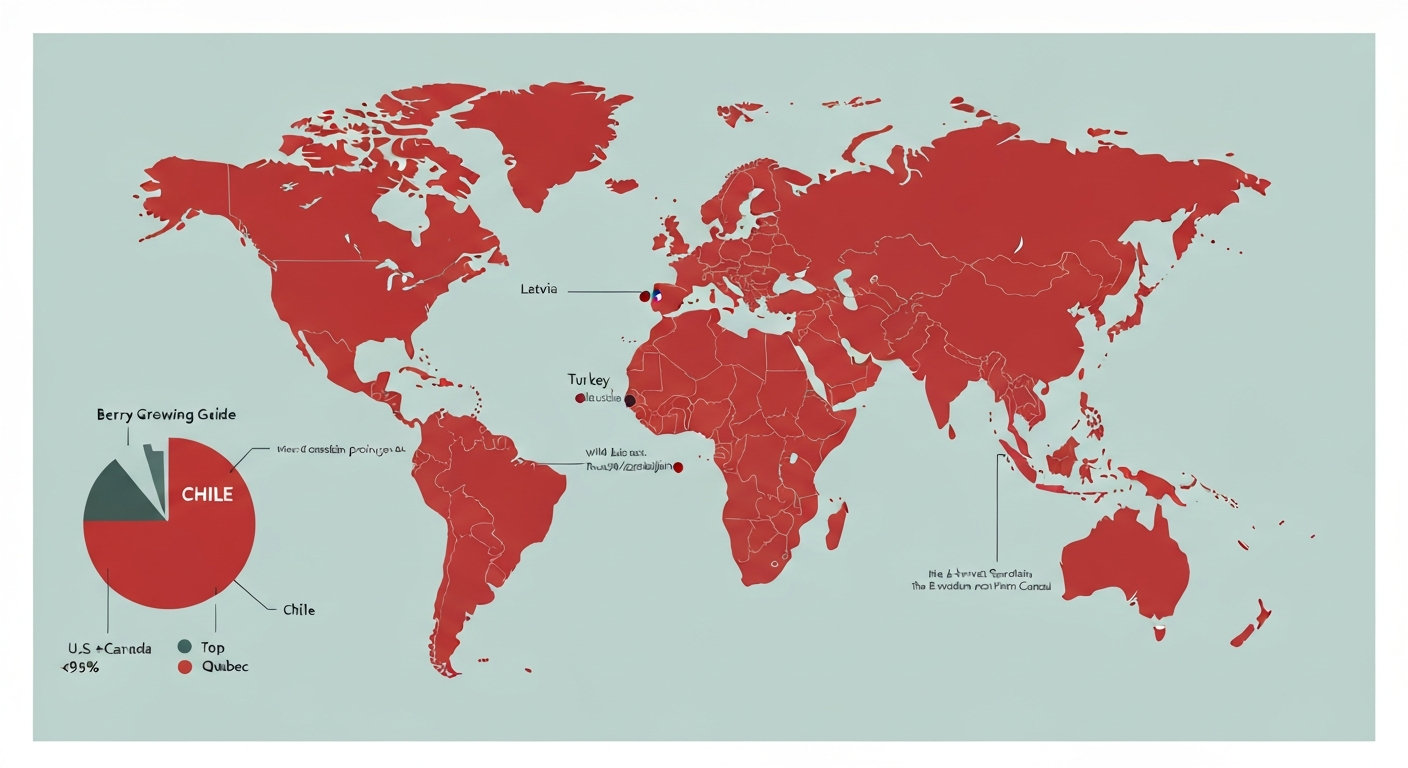
Cranberries are grown commercially in the United States, Canada, Chile, and parts of northern Europe, with the U.S. and Canada together accounting for roughly 95 to 99 percent of global production. The U.S. leads by a wide margin, followed by Canada, then Chile as the most significant Southern Hemisphere producer. Wild species also grow across northern Eurasia, Scandinavia, Russia, and the British Isles, but commercial cultivation outside North America and Chile is limited to small or experimental operations. If you are a home gardener, hobby farmer, or simply curious about where this fruit actually comes from, this guide walks through every producing country, explains why cranberries thrive where they do, and shows you how to replicate those conditions in your own backyard or on your patio. For a detailed country-by-country overview and practical growing guidance, see our guide on where do cranberries grow.
What Countries Grow Cranberries: Global Regions & Guide Tips
Which countries grow cranberries?
Commercial cranberry production is concentrated in a small number of countries. Wild species are far more widespread, spanning the entire boreal north. Here is a quick overview of both.
| Country / Region | Type of Production | Notes |
|---|---|---|
| United States | Large-scale commercial | Largest producer globally; ~62% from Wisconsin alone |
| Canada | Large-scale commercial | Second largest; Quebec, British Columbia, Ontario lead |
| Chile | Growing commercial sector | Principal S. American producer; irrigation-dependent |
| Latvia / Baltic states | Small commercial / experimental | Limited FAOSTAT-tracked production |
| Turkey / Azerbaijan | Experimental / minor | Small or trial-scale only |
| Russia / Siberia | Wild harvest + minor commercial | V. oxycoccos widely distributed |
| Scandinavia / Northern Europe | Wild harvest dominant | V. oxycoccos and V. microcarpum native here |
| British Isles | Wild only | Bog cranberry (V. oxycoccos) native |
| Alaska / northern Canada | Wild species native | V. oxycoccos, V. microcarpum, V. macrocarpon |
The cultivated species you find in supermarkets and Ocean Spray products is Vaccinium macrocarpon, the large American cranberry, native to eastern North America. The smaller bog cranberry species, Vaccinium oxycoccos and Vaccinium microcarpum, form a circumboreal complex found across northern Eurasia, Siberia, Scandinavia, and northern North America. These wild relatives are rarely harvested commercially, but they are important to know about if you are gardening in a cold European or northern Asian climate and wonder whether a related plant will survive.
The United States: still the world's biggest cranberry grower
The U.S. is the single largest producer of cranberries on the planet, and the numbers are genuinely impressive. In 2023, Wisconsin alone harvested 5.01 million barrels from around 19,100 acres, representing about 62 percent of total U.S. production. That one state outproduces most entire countries. Four other states round out virtually all of the remaining U.S. commercial acreage.
Key U.S. cranberry-producing states
- Wisconsin: largest producer by far, centered in the central and northern counties, with a flat glacial landscape and abundant water supply that suits engineered bogs perfectly
- Massachusetts: the historical heart of U.S. cranberry growing, particularly Cape Cod and Plymouth County; many family farms still operating with long-established beds
- New Jersey: significant commercial acreage in the Pine Barrens, where the naturally acidic, sandy soils are a near-perfect match for cranberry roots
- Oregon: production concentrated along the south coast (Coos and Curry counties); the mild, wet maritime climate extends the growing window
- Washington: smaller but established acreage in the coastal Long Beach Peninsula area, similar climate to Oregon's south coast
These five states account for essentially all U.S. commercial cranberry production. If you are in one of these regions and thinking about growing cranberries at home, you already have a significant climate advantage. Extension services in Wisconsin (UW-Madison), Massachusetts (UMass Cranberry Station), Rutgers (New Jersey), and Oregon State University all publish free, detailed cultivation guides worth bookmarking. For a state-by-state list of cranberry producers, see what states grow cranberries.
Canada: the second-largest producer and growing
Canada is a serious cranberry country. Agriculture and Agri-Food Canada reports approximately 207,351 metric tonnes produced across roughly 8,356 hectares in recent growing seasons, making it comfortably the world's second-largest producer. See Crop Profile for Cranberry in Canada (Fifth edition – 2023), Agriculture and Agri‑Food Canada for the source of these production and area figures blank" rel="noopener noreferrer">Crop Profile for Cranberry in Canada (Fifth edition – 2023) — Agriculture and Agri‑Food Canada. Canadian production is not evenly spread across the country; it clusters in three provinces and extends into a few Atlantic regions. For a focused guide on where cranberries grow in Canada, see our page on where cranberries grow in Canada for province-by-province details and growing regions.
Canadian provinces where cranberries are grown
- Quebec: the leading Canadian province for cranberry production, particularly in the Laurentides and Montérégie regions; Quebec has surpassed British Columbia in some recent years
- British Columbia: established commercial industry in the Lower Mainland (Fraser Valley), with mild winters and reliable precipitation
- Ontario: smaller but consistent commercial acreage, concentrated in the Muskoka and Simcoe County areas
- Atlantic provinces (Nova Scotia, New Brunswick, Prince Edward Island): smaller-scale and some wild-harvest production; growing interest in expanding commercial acreage
Canadian growers deal with harsher winters than most U.S. producers, which means winter flooding to protect vines from lethal cold snaps is not optional in many parts of Quebec and Ontario. If you are gardening in Canada and want to grow cranberries, the same general guidance applies as for cold-climate U.S. zones, but budgeting for frost protection infrastructure is worth it from the start.
Chile, northern Europe, and other producers
Chile built its cranberry industry from essentially nothing in the 1990s and is now the primary South American producer. Chilean operations, particularly in the Los Ríos and Maule regions, rely on engineered beds, intensive irrigation (both sprinkler and drip systems), and carefully managed soil amendments to compensate for the drier conditions compared to the natural bog habitats of eastern North America. Chilean fruit is often destined for juice concentrate and export markets. This is a good real-world example of something I will come back to later: cranberries can be grown outside their natural range if you engineer the right conditions.
In Europe, Latvia and other Baltic states appear in FAOSTAT-tracked cranberry production data, and there are small commercial and experimental operations in Turkey and Azerbaijan. Russia has vast wild populations of V. oxycoccos across Siberia and the boreal forests, with some wild-harvest tradition, but large-scale commercial cultivation of the American species (V. macrocarpon) is minimal. Scandinavia and the British Isles have their native bog cranberry (V. oxycoccos) growing wild in peatlands, but commercial production of marketable fruit comparable to what you buy in a bag has not taken hold there in any significant way.
Why cranberries grow where they do: bogs, marshes, and acid peat
Cranberries are not bog plants because they love standing water. A useful term to link here is swampy area where cranberries grow (the typical acidic peat bog habitat). They are bog plants because the combination of acidic, nutrient-poor, peaty soil and a shallow, controllable water table suits their shallow root system and suppresses competing vegetation that would otherwise crowd them out. In the wild, you find them growing on sphagnum moss mats, bog margins, and peat fens where the pH hovers between about 4.0 and 5.5. The water table sits close to the surface, keeping the root zone consistently moist without actually drowning the plants.
Commercial growers do not farm flooded bogs year-round. What you see in those famous harvest photographs, where the berries float in a flooded field, is a harvest technique. The beds are flooded briefly to loosen and float the berries for mechanical collection, then drained again. Outside of harvest and winter protection, commercial cranberry beds are not underwater. This distinction matters a lot if you are planning to try growing them at home.
Quick crossword answer: bog or marsh
If you landed here because a crossword clue asked for a 'place where cranberries grow,' the answer is almost certainly 'bog' (three letters) or 'marsh' (five letters). Both are botanically accurate. A bog is technically a peat-accumulating wetland fed mainly by rainfall and characterized by very low pH and low nutrient availability, which is exactly the natural habitat of V. macrocarpon and V. oxycoccos. A marsh is a broader term for wetland areas with standing or slow-moving water. In casual use, growers and crossword writers use both interchangeably for cranberry habitat.
Soil and climate requirements: what cranberries actually need
Getting the soil right is the single most important factor for home cranberry growing. Here is what the research and extension guidance consistently point to.
| Requirement | Target Range / Notes |
|---|---|
| Soil pH | 4.0 to 5.5 (ideally 4.5 to 5.0) |
| Soil type | Coarse sand rooting layer over peat or high-organic substrate |
| Water table | Shallow and controllable; roots need consistent moisture but not saturation |
| Sunlight | Full sun (at least 6 hours); shading reduces fruit set significantly |
| Winter chill | Requires cold dormancy; vines are cold-hardy but sensitive to late spring frosts during bud swell |
| Summer temperature | Moderate; extreme summer heat (above ~32°C / 90°F for extended periods) stresses plants |
| Annual rainfall / irrigation | Consistent moisture essential; dry climates need engineered irrigation systems |
The frost sensitivity is worth emphasizing. Cranberry vines themselves can survive cold winters without much trouble, and growers in Quebec manage just fine in very cold climates. The danger window is spring, when buds begin to swell and flowers open. At that stage, even a brief dip to -2°C (28°F) can kill a crop. That is why commercial growers run overhead sprinklers during frost events: a thin coat of ice actually insulates the buds at 0°C while air temperatures drop further. For home growers, tracking your last spring frost date carefully and choosing cultivars timed to open flowers after that date is essential.
Climate zones that work for cranberries
Cranberries are best suited to USDA Hardiness Zones 4 through 7. Zone 4 covers the coldest end of what most commercial production deals with (parts of Quebec, northern Wisconsin, Maine), and Zone 7 covers milder coastal areas like parts of Oregon and New Jersey. Some growers push into Zone 8 in coastal Pacific Northwest conditions, but summer heat and reduced chill hours become limiting factors further south or inland.
In European terms, this maps to temperate oceanic and continental climates across central and northern Europe, the British Isles, and Scandinavia. If you are growing in the UK, Germany, the Netherlands, or similar climates, the temperature regime is suitable. The challenge in those areas is usually soil pH and drainage rather than temperature. In Mediterranean climates and subtropical regions, cranberries are not a practical outdoor crop without significant climate control.
Can cranberries grow in dry areas?
This is one of the most common questions I get, and the honest answer is: not naturally, but yes with engineering. For a focused discussion, see do cranberries grow in dry areas (internal resource). Cranberries are not drought-tolerant plants. Their shallow roots and preference for a consistently moist root zone mean that unirrigated dry sites will stress or kill them. However, Chile proved that commercial production is possible in drier climates by using drip and sprinkler irrigation, engineered soil beds, and careful water management infrastructure. Chilean growers in the Maule region essentially built the bog conditions their plants needed from the ground up.
For home growers in dry or semi-arid climates, the same principle applies at a smaller scale. If you can keep the root zone consistently moist (not flooded, just reliably moist) through drip irrigation and mulching with sphagnum or wood chips, cranberries can survive in climates they would never occupy naturally. The extra work and water cost are real trade-offs you should factor in honestly before starting.
Building a backyard bog: step-by-step
You do not need a working farm or a flooded field to grow cranberries at home. A constructed bog bed in a sunny corner of your garden is all it takes. Oregon State University's guide Cranberries: A Nutrient Management Guide for South Coastal Oregon, Oregon State University Extension (EM‑8672) describes commercial bed construction using sand/peat rootzones over impermeable layers and recommends peat or sphagnum amendments, pH management, and sanding practices for establishment and renovation Cranberries: A Nutrient Management Guide for South Coastal Oregon — Oregon State University Extension (EM‑8672). I built my first one in a raised frame about 18 inches deep and it produced fruit within three years. Here is the method that works.
- Choose a sunny site with at least 6 hours of direct sun daily. Low spots that naturally retain moisture are ideal, but any site works if you control drainage.
- Excavate or build a frame 12 to 18 inches deep. Line the base and sides with a punctured pond liner or heavy plastic sheeting to slow drainage and keep the water table near the root zone. Punch a few small holes in the liner base so it drains slowly rather than turning into a stagnant pond.
- Fill the base 2 to 3 inches with coarse builder's sand for drainage.
- Prepare your growing mix: roughly 50 percent sphagnum peat moss and 50 percent coarse sand. Avoid standard potting mix or compost-heavy mixes; the pH will be too high and the texture too fine.
- Check and adjust pH. Sphagnum peat is naturally acidic, but verify with a pH meter and add elemental sulfur to lower it further if needed, targeting 4.5 to 5.0.
- Plant bare-root or potted cranberry transplants 12 to 18 inches apart in early spring. Firm the soil around roots and water in well.
- Mulch lightly with additional sphagnum moss or fine pine bark to retain moisture and suppress weeds.
- Water consistently to keep the root zone moist at all times. A soil moisture probe is useful. In summer, the bed should never fully dry out.
- In cold climates (Zone 5 and colder), flood the bed a few inches deep in late autumn once plants go dormant and temperatures drop consistently below freezing. This winter flood protects vines from desiccation and extreme cold. Drain in spring before bud swell.
- Expect very light production in year two and a meaningful harvest by year three to four.
Growing cranberries in containers and raised beds
Container growing works well for cranberries if you respect a few constraints. A pot that is too small will dry out too fast and overheat roots in summer. A glazed ceramic or plastic container at least 18 inches wide and 12 inches deep is a workable minimum; larger is better. Half wine barrels are a popular choice and give the roots enough volume to establish properly.
- Fill your container with the same 50/50 sphagnum peat and coarse sand mix described above. Do not use standard potting compost.
- Confirm pH is between 4.5 and 5.0 before planting. Retest each spring, as tap water can raise pH over time if your water supply is alkaline. Use rainwater or acidified water where possible.
- Plant one or two transplants per 18-inch container. Space them at least 8 to 10 inches apart to allow runners to spread.
- Water frequently, especially in summer. Container mixes dry out faster than in-ground beds. A self-watering container with a reservoir is genuinely helpful here.
- Fertilize sparingly with a fertilizer formulated for acid-loving plants (like those marketed for blueberries or rhododendrons). Over-fertilizing, especially with nitrogen, promotes leafy growth at the expense of fruit.
- In Zone 6 and colder, move containers to an unheated garage, shed, or sheltered spot for winter. The root ball in a container is far more vulnerable to freezing than roots in the ground. You want the plant to go dormant and stay cold but not frozen solid.
- Expect slower establishment than in-ground beds, but container plants can fruit well from year two or three onward.
The honest limitation with containers is water management. You are watering more often, and any lapses in a hot spell can set plants back significantly. If you travel frequently in summer or live somewhere very hot, containers require a reliable drip irrigation timer. That said, I have seen beautifully fruiting container cranberries on small patios in Zone 6, so the method is absolutely viable.
Cranberry production in Chile, India, and nontraditional regions
Chile is the clearest example of commercial cranberry production succeeding well outside the traditional North American belt. Starting from the 1990s, Chilean growers in the Los Ríos and Maule regions developed viable commercial operations by engineering their growing conditions rather than relying on natural bog environments. Today Chile exports cranberry products including juice concentrates and fresh fruit, primarily to international markets.
India is a different story. While there is genuine curiosity about growing cranberries in cooler highland regions of India (think the higher elevations of Himachal Pradesh or parts of the northeast), commercial cranberry cultivation in India is not an established reality as of 2026. For more detail on specific regions and experimental efforts, see our guide on where does cranberry grow in India. Vaccinium species do grow wild in parts of the Himalayas, but V. macrocarpon specifically requires a controlled moisture regime, very acidic soil, and sufficient winter chilling that most Indian sites cannot provide without intensive management. If you are in a cool highland zone in India and experimenting, it is worth trialing container plants with acidified peat mix, but expectations should be realistic: this is experimental territory, not established practice.
For other nontraditional regions, the Chilean model is the playbook: engineered beds, reliable irrigation, and rigorous pH management can extend cranberry growing into climates that would not naturally support it. The cost and infrastructure involved are the main barriers. Turkey and Azerbaijan have small-scale operations, and the Baltic states (Latvia in particular) appear in FAO production data, but none of these approach the scale or efficiency of North American producers.
How Ocean Spray and commercial cooperatives source their cranberries
Ocean Spray is structured as a grower-owned cooperative, not a single company growing cranberries on centrally owned land. For details on where Ocean Spray's member growers are located, see where does Ocean Spray grow their cranberries. Member growers, primarily located in Massachusetts, Wisconsin, New Jersey, Oregon, Washington, and several Canadian provinces, grow fruit on their own farms and deliver it to the cooperative. Ocean Spray then handles processing, marketing, and distribution. Membership involves both delivering fruit and sharing in the cooperative's financial performance.
This cooperative model means that when you buy Ocean Spray juice, the cranberries in it came from dozens to hundreds of individual family farms across those producing regions. Growers sign contracts and meet quality and delivery standards, but they own and manage their own land. The cooperative provides price stability that independent fruit growers often lack, which is one reason the model has held together for so long. If you are a hobby grower thinking about scale, the cooperative system is a useful thing to understand: it shows that even small regional producers can access processing and distribution infrastructure that makes their fruit commercially viable.
Concise answers to common cranberry location questions
Because these questions come up constantly and are closely related, here are direct answers to each.
| Search question | Direct answer |
|---|---|
| Where do cranberries grow? | Naturally in acidic peat bogs and wetland margins in northeastern North America; commercially in the U.S., Canada, and Chile |
| What states grow cranberries? | Wisconsin (largest), Massachusetts, New Jersey, Oregon, and Washington make up virtually all U.S. commercial production |
| Where do cranberries grow in Canada? | Quebec (leading province), British Columbia (Fraser Valley), and Ontario, with smaller production in Atlantic provinces |
| Do cranberries grow in dry areas? | Not naturally; possible with engineered irrigation and soil beds as demonstrated in Chile |
| Swampy area where cranberries grow? | A bog or marsh; specifically sphagnum peat bogs with a shallow, controllable water table |
| Where does Ocean Spray grow their cranberries? | Ocean Spray is a cooperative; member growers farm in Wisconsin, Massachusetts, New Jersey, Oregon, Washington, and Canadian provinces |
| Where does cranberry grow in India? | No established commercial production; cooler highland regions may support experimental trials but this is unproven at scale |
How to get started: cultivar choices and first-season tips
Choosing the right cultivar makes a real difference in home growing success. Here are the main options and what each suits.
- Stevens: the most widely planted commercial and home cultivar in North America; mid-season ripening, reliable yield, good flavor, and available from most specialist nurseries
- Early Black: one of the oldest cultivars, colors early (early September), suits shorter growing seasons in colder zones, lower yield than Stevens but dependable
- Howes: late-season ripening, stores exceptionally well on the vine and post-harvest, suited to Zone 5 and warmer
- Ben Lear: a Wisconsin selection with very early ripening and large fruit; good for Zone 4 gardens with short summers
- Crimson Queen and Mullica Queen (Rutgers hybrids): newer selections with higher yields and good flavor; Crimson Queen is particularly suited to fresh eating
Buy bare-root or potted transplants from a reputable berry nursery or your local extension service's recommended suppliers. Mail-order specialist nurseries in the U.S. typically ship in spring for bare-root stock. Avoid starting from seed; cranberry seeds have low germination rates and the resulting plants will take five or more years to produce meaningfully. Transplants are the only practical route for home growers.
In the first season, your main jobs are establishing soil pH, keeping moisture consistent, and not expecting a harvest. Let the runners spread and roots establish. A light trim of any excessively vigorous upright shoots in year two directs energy toward lateral spread and eventual fruit bud formation. Check with your local cooperative extension office or university extension service (UMass, UW-Madison, Rutgers, and Oregon State all have free cranberry growing publications) for region-specific timing and pest management notes. The fundamentals are the same everywhere, but frost dates, pest pressure, and cultivar recommendations vary enough by region that local guidance is worth the ten minutes it takes to find.
FAQ
What countries and regions grow cranberries commercially and in the wild?
Commercial production is concentrated in the United States (largest), Canada (second), and Chile (principal South American producer). Smaller commercial or experimental plantings occur in parts of northern/central Europe, the Baltics, Turkey, Russia, Azerbaijan and scattered trials elsewhere. Wild cranberry species (Vaccinium oxycoccos, V. microcarpum) occur across circumboreal northern Europe, Scandinavia, Russia, Alaska and northern Canada; Vaccinium macrocarpon is native to eastern North America.
Which U.S. states and Canadian provinces are main cranberry producers?
United States: Wisconsin (largest), Massachusetts, New Jersey, Oregon and Washington make up virtually all commercial acreage. Canada: Quebec is the largest cranberry province, with significant production also in British Columbia and Ontario.
What kind of habitat and soil do cranberries naturally prefer?
Cranberries naturally grow in acidic peat bogs, fens and bog margins with high organic matter. Typical recommendations for cultivated beds: acidic pH about 4.0–5.5, a peat‑rich medium with coarse sand for a rooting zone and good drainage, and a shallow, controllable water table (bog or managed irrigation).
What climate requirements and hardiness zones suit cranberries?
Cranberries need a cold period for dormancy and are adapted to cool, temperate climates (northern temperate/boreal). They tolerate harsh winters but are vulnerable to spring freezes during bloom. They are generally suited to USDA hardiness zones roughly 2–7 depending on cultivar and local microclimate; choose regionally adapted cultivars matched to chill/frost risk.
Is “bog” the crossword‑style short answer for where cranberries grow?
Yes. The common short answer in puzzles is “bog” (or “marsh”), which reflects their natural occurrence in peat bogs and marshy, acidic wetlands.
Can cranberries be grown in dry climates?
Yes, with engineered beds and irrigation. Commercial producers in drier regions (e.g., Chile) use constructed beds, sand/peat mixes, impermeable liners where needed, and controlled sprinkler or drip irrigation for crop water and frost protection. Effective water management and soil amendments are essential.