
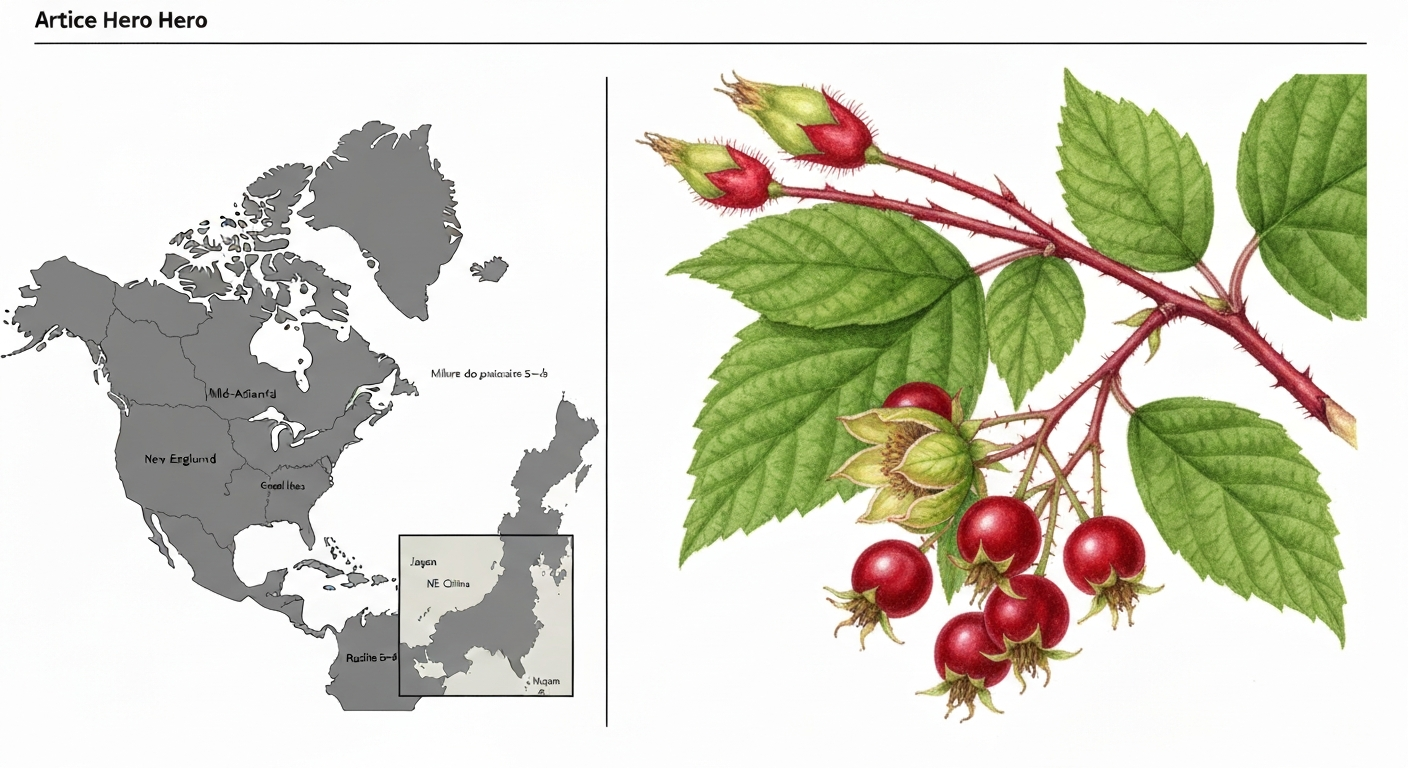
Wineberries (Rubus phoenicolasius) grow wild across much of the eastern United States, from Maine down through the Carolinas and west into Ohio and Tennessee, after being introduced from their native range in Japan, Korea, and northeastern China in the late 1800s. In cultivation, they thrive in USDA hardiness zones 5 through 8, though I've seen them survive pushing into zone 4 with a sheltered microclimate. If you're east of the Mississippi and live in a temperate climate with decent rainfall, there's a strong chance wineberries will grow very well for you. If you're in the arid West or deep South, you'll need to work harder to replicate their preferred conditions.
Where Do Wineberries Grow: Regions, Zones, and Planting Tips
Marcus Holloway
23 Jul 2026
Quick answer: where wineberries grow
Wineberries are naturalized across the eastern U.S. and parts of the Pacific coast, and cultivated wherever USDA zones 5 to 8 apply. They prefer moist, well-drained soil, partial to full sun, and disturbed or edge habitats such as forest margins, roadsides, and stream corridors. They fruit in midsummer, typically July through August in most of the Mid-Atlantic and Northeast. As a home grower, you can replicate those conditions in a prepared garden bed or a large container, as long as you stay within their climate tolerance and manage their vigorous spreading habit.
Native and naturalized range
The wineberry's native home is eastern Asia: Japan, Korea, and parts of northeastern China. It was brought to North America in the late 1800s, primarily as breeding stock for raspberry improvement and as an ornamental. It escaped cultivation quickly, and today it is listed as non-native or exotic across the U. The Invasive Plant Atlas of the United States lists wine raspberry: Rubus phoenicolasius as non‑native/exotic in the U.S., with county‑level records showing widespread naturalization particularly east of the Mississippi and in parts of the upper Midwest and Pacific coast wine raspberry: Rubus phoenicolasius — Invasive Plant Atlas of the United States. S., with county-level records confirming widespread naturalization throughout the Mid-Atlantic, New England, Appalachian, and Great Lakes states. Scattered records also exist along parts of the Pacific coast.
In Europe, wineberry has also naturalized in parts of the British Isles and western Europe, following similar patterns of ornamental escape. In North America, the states with the highest density of confirmed naturalized populations include Pennsylvania, Maryland, Virginia, West Virginia, New York, New Jersey, Ohio, and the Carolinas. The Invasive Plant Atlas of the United States and citizen-science platforms like iNaturalist both aggregate georeferenced records that are worth checking for your specific county before you plant, especially if local regulations apply.
USDA hardiness zones and climate tolerances
Wineberry is reliably winter-hardy down to approximately -20°F (-29°C), placing its cold-hardiness floor around USDA zone 5. The 2023 USDA Plant Hardiness Zone Map is the most current reference for translating that number into your local suitability. In practice, wineberry is most productive and trouble-free in zones 5 through 7, with zone 8 being workable in cooler, moister parts of that range such as the Blue Ridge foothills or the maritime Pacific Northwest.
On the heat side, wineberry dislikes prolonged drought and intense summer heat without shade relief. Zone 9 and above is generally too hot and dry in most of the U.S. for reliable outdoor production. Cold hardiness in zone 4 is possible but the canes can suffer significant tip dieback, which reduces your fruiting wood heading into each season. If you're in zone 4, give them a south-facing, sheltered slope and mulch the crowns heavily before your first hard freeze.
| USDA Zone | Winter Low (°F) | Wineberry Suitability | Notes |
|---|---|---|---|
| 4 | -30 to -20 | Marginal | Possible with wind shelter and heavy crown mulch; expect cane tip dieback |
| 5 | -20 to -10 | Good | Reliable if sited correctly; mulch recommended |
| 6 | -10 to 0 | Excellent | Core of the naturalized range; minimal winter protection needed |
| 7 | 0 to 10 | Excellent | Productive; watch for summer drought stress |
| 8 | 10 to 20 | Moderate | Works in cooler, moister microclimates; struggles in hot inland areas |
| 9+ | 20 to 30+ | Not recommended | Too hot and dry for most sites without intensive management |
Preferred habitats and microclimates
Wineberry is a classic edge-habitat plant. In the wild, it colonizes forest margins, roadsides, treefall gaps, riparian corridors, and any disturbed site where canopy cover has been reduced and light has increased. Research from Maryland's deciduous forests confirms that wineberry seedling recruitment is strongly tied to treefall gaps and canopy openings: the plant needs that burst of light to get established, though once rooted it can persist in lower-light understory conditions.
For your garden, this translates well. A sunny to partly shaded spot along a fence line, the edge of a woodlot, or the south-facing side of a hedge gives you the microclimate wineberry prefers. Slopes with good air drainage are beneficial because they reduce late-frost risk at blossom time and help prevent fungal problems during wet weather. Avoid low-lying frost pockets and sites with standing water. A north-facing slope in zone 5 is genuinely risky; a south-facing slope in the same zone is usually fine.
Soil requirements
Wineberry is tolerant of a wide range of soil textures, including sandy loam, silt loam, and clay-loam, but it performs best in well-drained, moist soils with decent organic matter content. The keyword here is well-drained: standing water and waterlogged roots will kill canes and invite crown rot. Mesic sites near streams are natural habitat, but those sites drain freely between rain events. If your soil is heavy clay, amend beds with compost before planting and consider a raised bed.
For pH, wineberry tolerates a mildly acidic to near-neutral range, roughly 5.5 to 7.0, which is similar to other Rubus species. I'd aim for 6.0 to 6.5 for the best nutrient availability. A soil test before planting is worth the small investment, both to check pH and to see where your phosphorus and potassium levels stand. Add sulfur to lower pH or lime to raise it, and work in several inches of compost regardless. Wineberry doesn't need high fertility, but it responds well to organic matter.
Light and exposure
For maximum fruit production, aim for at least 6 hours of direct sun per day. Wineberry will survive in part shade and I've seen naturalized patches fruiting respectably under 30 to 40 percent canopy cover, but berry size, quantity, and sweetness all improve with more sun. Full sun in a hot zone 7 or 8 summer may stress plants by mid-July if you don't keep soil moisture up, so a site with morning sun and afternoon shade can actually outperform a blistering south wall in warmer climates.
Avoid dense shade from tall trees or north-facing walls. In those conditions, primocanes (the first-year vegetative canes) grow long and leggy but never develop the vigor needed to become productive floricanes the following year. If your only available spot is partly shaded, thin the overhead canopy where possible and choose your sunniest gap.
Growth habit, cane structure, and spacing
Wineberry is a bramble with a biennial cane life cycle, exactly like a standard raspberry. First-year canes, called primocanes, emerge from the crown, grow vegetatively, and die back to a manageable length in fall. Second-year canes, called floricanes, produce flowers in late spring and fruit in midsummer, then die after fruiting. New primocanes replace them. This cycle repeats year after year from the same perennial root system.
What sets wineberry apart visually is those wine-red glandular hairs and bristly prickles that cover the canes, flower buds, and fruit calyxes. They're striking and unmistakable. Cane length ranges from about 1.5 feet in poor conditions to 9 feet (roughly 0.5 to 2.7 meters) in rich, sunny sites. They arch strongly and will root at the tip if the arching cane touches soil, a trait called tip-layering that makes propagation easy but also contributes to the plant's spread. Plan for 3 to 4 feet between plants and 6 to 8 feet between rows. A trellis or post-and-wire system keeps everything manageable and keeps fruit off the ground.
Container vs. in-ground growing
Growing wineberry in a container is genuinely viable and, in some situations, the smarter choice. I've kept plants in 15-gallon nursery containers for two full seasons while I decided where to put them permanently, and they produced fruit both years. Containers give you mobility, weed control, and most importantly, control over spread in areas where wineberry is regulated or unwanted. The downsides are increased watering frequency, more attentive fertilizing, and a somewhat smaller root zone that limits plant size and yield.
In-ground planting gives you the full productivity of the plant's sprawling root system and requires much less intervention once established. If you have the space, a suitable climate, and no invasive-species concerns in your area, in-ground is the better long-term option for yield. Use the checklist below to decide.
- Choose containers if: you live in zone 4 and want to overwinter pots in a cold garage; wineberry is listed as invasive in your state; your garden is small and you need to control spread; or you're in zone 8 and want to move plants to manage summer heat
- Choose in-ground if: you're in zones 5 to 7 with adequate rainfall; you have space for a dedicated berry bed with a trellis; you want maximum yield; or you're in an area where wineberry is not regulated and you have room to manage it
- Consider raised beds as a middle ground: better drainage than flat clay sites, more root volume than pots, and a physical boundary that slows tip-layer spread
Best planting time and step-by-step instructions
The best time to plant wineberry is early spring, as soon as the soil can be worked and while plants are still dormant or just breaking dormancy. In zones 5 and 6, that's typically March to mid-April. Fall planting (September to October) also works well in zones 6 and 7 because the soil is warm enough to establish roots before winter. Avoid planting during summer heat or when the ground is frozen.
Planting in the ground
- Choose a site with 6+ hours of sun, good drainage, and shelter from harsh wind
- Test your soil pH and amend to reach 6.0 to 6.5; work in 3 to 4 inches of compost to a depth of 12 inches
- Dig holes wide enough to spread roots without crowding, typically about 12 inches wide and 8 inches deep
- Set bare-root plants with the crown at soil level; potted transplants at the same depth they were growing
- Space plants 3 to 4 feet apart within rows, rows 6 to 8 feet apart
- Water thoroughly at planting and apply 3 to 4 inches of wood chip or straw mulch around the base, keeping mulch an inch or two away from the crown
- Install your trellis or post-and-wire system at planting time; retrofitting later disturbs roots
Planting in containers
- Select a container of at least 10 to 15 gallons with drainage holes; larger is better for multi-year production
- Fill with a mix of high-quality potting soil and 20 to 30 percent compost; avoid dense, peat-heavy mixes that dry out unevenly
- Plant at the same crown depth as for in-ground; firm soil gently around roots
- Place the container in full to part sun; on a hard surface, elevate on feet to allow drainage
- Water immediately and thoroughly; containers dry out faster than beds, so check moisture every 1 to 2 days during summer
- Add a short stake or small trellis panel inside the container to support arching canes
Propagation methods
Wineberry propagates readily by several methods, and honestly the plant is so vigorous that getting new plants is rarely the hard part. The more common challenge is limiting propagation to exactly where you want it.
Tip-layering (easiest, most reliable)
In late summer, take a long, flexible first-year cane and bend the tip down to the soil about 6 to 9 inches from the end. Bury the tip 3 to 4 inches deep and hold it in place with a stake or bent wire. By fall, roots will have formed at the buried tip. Sever the connection to the parent plant and either leave the new plant in place over winter or pot it up. This is my go-to method because it reliably produces rooted plants with essentially zero failure rate.
Hardwood and softwood cuttings
Hardwood cuttings taken from dormant first-year canes in late winter (6 to 8 inch sections, two or three nodes each) can be rooted in a mix of perlite and peat under consistent moisture. Success rates are decent but not as high as tip-layering. Softwood cuttings from actively growing tips in early summer root more quickly but need humidity control (a plastic bag tent works fine) to prevent wilting before roots form.
Root division
Established wineberry crowns can be dug and divided in early spring before growth begins. Use a sharp spade to cut sections with at least two to three healthy buds each, replant immediately, and water in well. This works best on plants that are at least two to three years old with a well-developed crown.
Seed propagation
Wineberry seeds require cold stratification for roughly 90 days at near-freezing temperatures before they'll germinate. You can sow fresh seeds outdoors in fall and let winter stratify them naturally, or refrigerate moist seeds in a plastic bag for three months before sowing indoors in late winter. Germination rates are variable and seedlings take longer to reach fruiting size than vegetatively propagated plants, so I only bother with seeds when I want a lot of plants or when I'm trying to select for a specific trait.
Early care and ongoing maintenance
For the first growing season, your main jobs are watering, weed suppression, and giving young canes something to lean on. Deep watering once or twice a week during dry spells is better than frequent shallow watering. Aim to keep soil consistently moist but not soggy, roughly the texture of a wrung-out sponge at a depth of 3 to 4 inches. Top up mulch as it breaks down, keeping a 3- to 4-inch layer around plants throughout the season.
Fertilizing wineberry is fairly low-key compared to many fruiting plants. A balanced, slow-release organic fertilizer (something like 5-5-5 or a compost topdress) applied in early spring as growth begins is usually sufficient. Avoid heavy nitrogen applications late in the season because they push soft, frost-vulnerable growth. In container culture, supplement with a dilute liquid fertilizer monthly during the growing season since nutrients leach out with frequent watering.
Pruning and trellis management
Wineberry pruning follows the same logic as any cane-fruiting raspberry. Right after harvest, cut all the floricanes (the canes that just fruited) to the ground. They're done and will only harbor disease and pests if left standing. Select the strongest four to six primocanes per plant to keep as your next year's fruiting wood, and cut out the rest. Tip the remaining canes at whatever height your trellis tops out, typically 4 to 5 feet, to encourage lateral branching and more fruiting buds.
A simple two-wire trellis works well: one wire at about 3 feet and a second at 5 feet, strung between posts set every 8 to 10 feet. Tie canes loosely to the wires as they grow. This keeps the planting open for air circulation, makes harvest much easier, and critically, it prevents canes from arching to the ground and tip-layering into your lawn or neighboring beds. If you're growing in a container, a single bamboo fan trellis or a folding tomato cage works fine for a compact plant.
Harvest timing, yield, and uses
Wineberries ripen in midsummer. In the Mid-Atlantic and Northeast, expect ripe fruit from late June through August, with peak harvest typically in mid-July. In cooler zones 5 and lower, harvest shifts toward late July and August. The fruit is ready when the sepals (those hairy, star-shaped coverings around each berry) open and fold back to fully expose the shiny, deep-red berry. Pick gently: the berries are softer than standard raspberries and bruise easily, so harvest into shallow containers.
Yield from a healthy, established in-ground plant in a good location can reach 3 to 6 quarts per plant per season, though I've seen vigorous plants in ideal zones 6 to 7 conditions produce even more. The flavor is sweet-tart with a distinct brightness that's a bit more honey-like than a standard red raspberry. They're excellent fresh, in jams and preserves, in baked goods, or frozen. The high moisture content means they don't hold in the fridge more than two to three days, so plan to use or freeze a large harvest quickly.
Pest and disease risks, and how to handle them
Wineberry is generally more disease-resistant than cultivated red raspberries, which is one reason it's appealing to low-spray home growers. That said, a few problems are worth knowing.
Key pests
- Spotted wing drosophila (SWD): the biggest pest concern for wineberry in much of the eastern U.S. The female SWD lays eggs inside ripening soft fruit; larvae hatch and ruin berries before harvest. Monitor with yellow sticky traps beginning in late spring and harvest frequently to minimize overripe fruit on the plant. Kaolin clay applications and fine netting over the planting can reduce infestation organically.
- Japanese beetles: adults skeletonize leaves in mid-summer. Hand-pick in the early morning when beetles are sluggish; avoid pheromone traps near the planting as they attract more beetles than they catch.
- Raspberry cane borers: adults girdle young canes; look for wilted cane tips and prune several inches below the damaged zone. Dispose of infested canes away from the garden.
- Aphids and spider mites: occasionally problematic in dry conditions. A strong blast of water or an insecticidal soap spray handles most infestations.
Common diseases
- Botrytis (gray mold): affects ripe and overripe fruit in wet weather. Improve air circulation with proper trellis and pruning; harvest frequently; avoid overhead irrigation.
- Orange rust: a fungal disease producing orange pustules on leaf undersides; infected plants cannot be cured and should be removed and destroyed. Plant in well-ventilated sites to reduce risk.
- Anthracnose: causes purple-centered, sunken spots on canes. Prune out infected canes, improve air circulation, and avoid wetting foliage when irrigating.
- Crown gall: bacterial infection causing gall tissue at the crown or roots. Purchase plants from reputable nurseries, inspect roots before planting, and destroy any affected plants.
Invasive potential, regulations, and ethical considerations
This is the part of the wineberry conversation that requires honesty. Wineberry is classified as invasive in multiple states, and in some areas it has spread aggressively into native forests, riparian corridors, and natural areas, displacing native plants. It spreads by prolific seed production dispersed by birds and mammals, and by vegetative tip-layering. Before you plant wineberry anywhere in the U.S., check your state's invasive species list and your local county regulations. Several states in the Mid-Atlantic and Southeast have formal listings; others have advisory or watch-list status.
The ethical position I take: if you're in a state where wineberry is listed as invasive, or if you live adjacent to natural areas, streams, or woodlands, the container option is not a compromise. It's the responsible choice. A container with no chance of cane tip-layering into surrounding soil, combined with regular fruiting-cane removal to minimize seeds, lets you grow and harvest wineberries without contributing to naturalization. If you're in the Pacific Northwest, Midwest, or areas with no current naturalized populations, planting in a managed garden bed is lower-risk but still warrants monitoring.
Containment and eradication for unwanted patches
If you have inherited a wineberry patch you don't want, or if you're managing naturalized growth in a natural area, the approach depends on patch size and your willingness to return multiple times. No single-treatment solution works because the root system resprouts and the seed bank persists.
Mechanical and cultural controls
- Cut all canes to the ground in late spring or early summer when the plant is actively growing and has invested maximum energy into new growth. This depletes root reserves faster than cutting during dormancy.
- Repeat cutting every four to six weeks throughout the growing season for at least two to three years. Root reserves are substantial and consistent repeated cutting is necessary to exhaust them.
- For small patches, dig out as much root mass as possible after cutting, removing even small root fragments. Work outward from the center of the patch.
- Mulch cleared areas with a smothering layer of cardboard and wood chips 4 to 6 inches deep to reduce light to any resprouts.
- Monitor edges of the treatment area for seedling recruitment from surrounding seed sources and pull or cut seedlings before they establish.
Herbicide options
For large infestations, especially those encroaching on natural areas, foliar application of a glyphosate or triclopyr herbicide to actively growing foliage in late summer (when the plant is translocating sugars to roots) is effective. The cut-stump method, applying concentrated triclopyr directly to freshly cut cane stumps, reduces off-target impact and works well in mixed plantings where you need to protect nearby native vegetation. Always follow label directions, check for proximity to waterways (triclopyr is restricted near water in some formulations), and be prepared for follow-up treatments in subsequent seasons.
Where to buy wineberry plants
Wineberry plants are sold by specialty fruit nurseries, small-scale online berry growers, and occasionally at native or edible-plant sales. Because wineberry is invasive in many states, some large national nurseries no longer stock it, which means you may need to search regionally. Look for vendors in your hardiness zone who can ship bare-root plants in early spring or container-grown plants in late spring.
When buying, inspect roots for crown gall (lumpy, irregular growths at the root crown), check canes for signs of disease, and verify the plant has been grown in certified disease-free or clean stock. Avoid purchasing from sellers who can't describe growing conditions or source. If you find someone locally with an established planting who is willing to share tip-layered starts, that's often the most economical and regionally appropriate source. Just confirm that sharing or receiving plant material is legal in your state given invasive species regulations.
Region-by-region planting tips and troubleshooting
Northeast (zones 5 to 6: New England, New York, Pennsylvania)
This is wineberry's sweet spot in North America. Summer temperatures are warm but not brutal, rainfall is generally adequate, and the plant is already naturalized across much of the region. Check your state's invasive status (New York and Pennsylvania both list it as invasive). Plant in full sun, mulch crowns for winter in zone 5, and harvest in July. Spotted wing drosophila is a significant pest here from mid-July onward: pick frequently and consider row cover or fine mesh netting over ripening fruit.
Southeast (zones 6 to 8: Virginia, Carolinas, Georgia, Tennessee)
Wineberry is naturalized across the Appalachian and piedmont areas of the Southeast and is listed as invasive in several states here. For cultivation, site plants where they get afternoon shade in zones 7 and 8 to reduce summer heat stress, keep irrigation consistent during dry spells, and harvest early in the morning when berries are cool. The season tends to arrive earlier here, with ripe fruit sometimes appearing by late June in zone 7. Invasive status in Virginia and the Carolinas warrants container growing near natural areas.
Midwest (zones 5 to 6: Ohio, Indiana, Illinois, Michigan)
Wineberry is established in parts of Ohio and scattered across the eastern Midwest, with fewer records further west. Zone 5 growing in northern Michigan or Wisconsin is viable with proper site selection and winter mulching. The continental climate means hotter summers and colder winters than coastal areas at the same zone number, so lean toward the more sheltered microclimate recommendations. Check state invasive lists, which vary across this region.
Pacific Northwest (zones 7 to 8: Oregon, Washington coast)
The maritime Pacific Northwest has the right temperatures and rainfall for wineberry, and there are scattered naturalized records along the coast. This region's mild, wet winters and moderate summers mimic the maritime climate of wineberry's native range better than most of the U.S. That's both good news for cultivation and a reason for caution about planting near natural areas. Container culture in an urban garden is a sensible choice here. Botrytis can be a bigger issue than in drier climates, so trellis and prune for maximum airflow.
Intermountain West and Arid Southwest (zones 4 to 8)
In the arid interior West, wineberry is not naturalized and the dry climate makes outdoor establishment difficult without supplemental irrigation. In zones 4 to 6 mountain communities with access to water, container or irrigated raised-bed growing is possible but higher maintenance. Drip irrigation, heavy mulching, and afternoon shade from structures or trees are all helpful. In the low desert (zones 8 to 9 in Arizona, Nevada, New Mexico), wineberry is not a practical choice; consider native currants or gooseberries instead.
Southern Canada (zones 4 to 6: British Columbia, Ontario, Quebec)
British Columbia's coast (zone 7 to 8) is genuinely suitable for wineberry with the same Pacific maritime notes as Washington and Oregon. In Ontario and Quebec (zones 4 to 6), the colder, more continental climate means winter protection is essential and cane survival into productive floricane status requires careful site selection. Mulch crowns in late October, choose south-facing exposures near walls or structures that retain heat, and plan for a slightly later harvest than Mid-Atlantic gardeners. Ontario growers should check provincial invasive species guidelines before planting.
Plant here, grow in a container, or control: a decision checklist
Use the following questions to land on the right next step for your specific situation.
- Is wineberry on your state or province's invasive species list? If yes, go to containers or skip it entirely.
- Do you live within a quarter mile of natural woodlands, stream corridors, or parks? If yes, containers only.
- Are you in USDA zones 5 to 7 with at least 6 hours of sun and reasonable summer rainfall? If yes, in-ground or raised beds are viable.
- Is your outdoor space smaller than about 100 square feet? Consider containers for easier management.
- Do you want maximum yield with minimal intervention? In-ground in zones 5 to 7 is your best path.
- Are you in zone 4 or zone 8? Site very carefully, expect more management, and consider containers as a fallback.
- Not sure if you'll like wineberries? Start with one container plant for a season before committing to a bed.
How wineberry compares to related berries
Wineberry sits within a broader world of brambles and lesser-known fruiting shrubs that may suit your garden better depending on your region and goals. For more on regional suitability and habitat preferences, see our guide on where do brambles grow. Here's how it stacks up against the berries most closely related to this topic.
| Berry | Best Zones | Growth Habit | Invasive Risk in US? | Best For |
|---|---|---|---|---|
| Wineberry (Rubus phoenicolasius) | 5 to 7 | Arching bramble cane, 3 to 9 ft | Yes, especially eastern US | Midsummer fresh eating and preserves; gardeners in naturalized range |
| Brambles (Rubus spp., native) | 3 to 8 (varies by species) | Arching or trailing cane | No (native species) | All regions; choose species native to your area for ecology and ease |
| Serviceberry (Amelanchier spp.) | 2 to 8 (varies) | Multi-stem shrub or small tree | No | Early-season fruit; excellent for cold zones 2 to 5; great for wildlife |
| Snowberry (Symphoricarpos albus) | 3 to 7 | Arching deciduous shrub | No | Ornamental and wildlife plant; fruit not edible for humans |
| Bilberry (Vaccinium myrtillus) | 3 to 6 | Low spreading shrub | No | Cool northern climates; moist, acidic soils; similar to blueberry but smaller |
| Bunchberry (Cornus canadensis) | 2 to 6 | Low ground cover, 4 to 8 inches | No | Cool woodland gardens; groundcover; small fruit with mild flavor |
| Damson plum (Prunus insititia) | 5 to 7 | Upright small tree/shrub | No | Jam and preserves; does well in zone 6 to 7 gardens with full sun |
If you're in zones 2 to 5 and want a low-maintenance early-season berry, serviceberry is a much better fit than wineberry and poses no invasive risk. If you also want to compare ranges and habitat, see our guide on where do snowberries grow for regional suitability and habitat notes. For details on where do serviceberry trees grow and how to plant them in your zone, see our guide to serviceberry range and care. If your site is a cool, acidic woodland in zones 3 to 6, bilberry or bunchberry will naturalize happily where wineberry would struggle or outcompete. For details on their range and preferred habitats, see where do bunchberries grow. Learn more about where bilberries grow. For gardeners who love the bramble habit and flavor but are concerned about invasive potential, native Rubus species (the native brambles of your region) give you a very similar experience with better ecological ethics. Damson plum is worth a look for zone 6 to 7 growers who want something with more structure and a long productive lifespan without the cane management overhead of any Rubus species. If you want specifics on where do damsons grow, see the damson distribution and hardiness guidance for zone recommendations and regional tips.
FAQ
What is a wineberry (Rubus phoenicolasius)?
Wineberry (Rubus phoenicolasius) is a bramble native to eastern Asia (Japan, Korea, parts of China). It is a perennial with biennial canes (first‑year vegetative primocanes, second‑year floricanes that fruit then die), distinctive red glandular hairs on canes and sepals, and glossy red aggregate fruits similar to raspberries.
Where is wineberry native and where has it naturalized?
Native range: eastern Asia (Japan, Korea, northeastern China). Naturalized: widely in eastern North America (especially east of the Mississippi), parts of the upper Midwest and Pacific coast, and scattered locations in Europe. In North America it is considered non‑native/exotic and has escaped cultivation in many areas.
Which USDA hardiness zones are suitable for wineberry?
Wineberry is winter‑hardy roughly in USDA zones 4–8 (tolerant of average minimums down to about zone 5/−20°F/−29°C in many reports). Local microclimate and winter protection can extend survival; check the 2023 USDA Plant Hardiness Zone Map for site‑specific suitability.
What habitats and site conditions do wineberries prefer?
They thrive in disturbed sites, forest and field edges, riparian corridors, roadsides, parks and canopy gaps. They prefer moist, well‑drained soils but tolerate sand, loam or clay and a range of pH from mildly acidic to near neutral. They establish best where light increases (gaps, edges) but can persist in shaded understory once established.
Should I plant wineberries in full sun, partial shade, or shade?
Wineberry does best with at least partial sun. Full sun to light afternoon shade usually yields best fruiting. In deeply shaded understories plants may survive but produce fewer flowers and fruits. For cultivation choose a sunny to dappled‑sun edge site or a container placed where it receives several hours of sun.
Do wineberries grow well in containers or are they better in the ground?
Both are possible. In‑ground planting suits long‑term production because of the perennial root system and suckering habit; it also allows wider spacing (canes spread 0.5–2.7 m). Containers work for patios/small gardens or where containment is desired to prevent spread — use a large, deep pot (18–24"+), high‑quality potting mix, regular watering and winter protection in colder zones.