Brambles grow almost anywhere in the UK and across temperate Europe: woodland edges, hedgerows, rough grassland, disturbed ground, coastal scrub, and the neglected corner of your garden you stopped mowing three summers ago. They thrive in most soils short of waterlogged clay or pure chalk, tolerate light shade but fruit best in full sun, and are hardy down to around -20°C. If you're in the British Isles or northern Europe, there's a very good chance brambles are already growing within a short walk of where you are right now.
Where Do Brambles Grow? Habitat, Spread, and Planting Tips
Marcus Holloway
27 Jun 2026
Brambles vs raspberries: what actually grows on a bramble plant
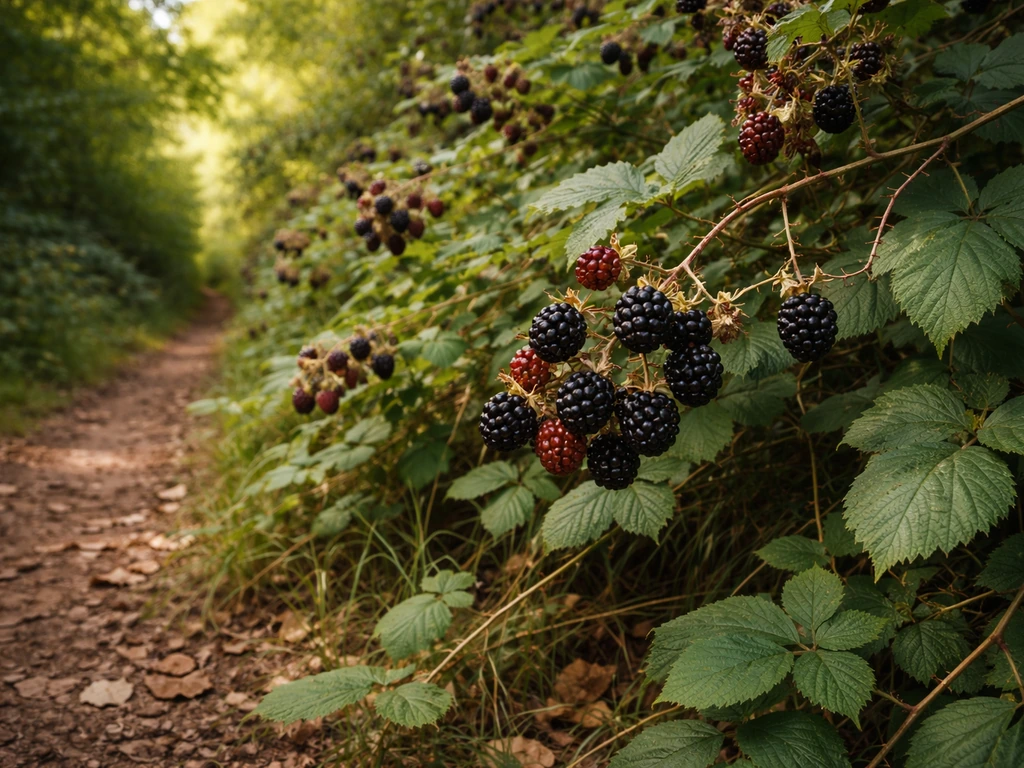
This is the question I get asked most. In UK botany, 'bramble' refers to Rubus fruticosus aggregate, which is a huge group of closely related microspecies (there are over 300 recognised in Britain alone) that all produce the classic blackberry-type fruit. The word 'bramble' and 'blackberry' are used almost interchangeably in everyday UK speech, and the fruit you pick from a bramble is a blackberry.
Raspberries are close relatives but a different plant: Rubus idaeus. They're in the same Rubus genus, so yes, they share the 'bramble family' broadly speaking, but when someone in the UK points at a thorny arching cane and says 'bramble,' they mean blackberry, not raspberry. The two look different up close: a ripe blackberry stays attached to its core (the receptacle) when you pick it, while a raspberry pulls away and leaves a hollow centre. If you're foraging in the wild and you pull the berry off the plant and it's solid all the way through, that's a blackberry from a true bramble. If it's hollow, it's a raspberry from Rubus idaeus.
There are also hybrid cane fruits like loganberries, tayberries, and boysenberries that sit between the two, but you're very unlikely to find those in the wild. They're garden hybrids grown deliberately, not naturalized roadside plants.
Where brambles grow naturally: habitats and soil in the UK and EU
The Woodland Trust describes bramble as a plant that 'grows almost anywhere,' and that's not an exaggeration. It's one of the most ecologically flexible native plants in Britain. That said, there are some patterns worth knowing if you're trying to locate them or replicate conditions.
Typical natural habitats
- Woodland edges and clearings: brambles love the transition zone between dense canopy and open ground where dappled or partial light reaches the floor
- Hedgerows: the most classically British bramble habitat, where they interweave with hawthorn, elder, and dog rose
- Rough grassland and verges: road verges, field margins, and set-aside land where grass has become coarse and competition is lower
- Disturbed ground: building sites, railway embankments, recently cleared scrub, burned heathland, and flood plains after disturbance
- Coastal scrub and clifftops: brambles are wind-tolerant and can establish on exposed coastal ground, especially in milder Atlantic climates like Cornwall, Wales, and western Ireland
- Urban wasteground and parks: any neglected urban green space in the UK will usually have brambles within a year or two
Soil and climate preferences
Brambles are not fussy, but they do have preferences. They do best on moderately fertile, free-draining soil with a slightly acidic to neutral pH (around 6.0 to 7.0). They cope with sandy or loamy soils well. Heavy, waterlogged clay is their main weakness: not because they can't survive it, but because root diseases set in and fruiting suffers badly. Very thin chalk soils over limestone also stress them, though you'll sometimes see them persisting on chalky verges in southern England. Across the EU, bramble-type Rubus species follow a similar pattern: widespread across France, Germany, the Low Countries, Scandinavia (milder coastal areas), the Iberian Peninsula, and into central and eastern Europe, always favouring that woodland-edge and scrub niche. Bunchberries grow in cool, moist conditions, typically in parts of northern forests and alpine or subarctic habitats where do bunchberries grow.
Climate-wise, Rubus fruticosus agg. is rated by the RHS as hardy to around -20 to -15°C, which covers virtually all of the UK and most of temperate mainland Europe. Summer heat matters more for fruiting: a warm, sunny July and August is what drives heavy crops. In the UK, the south and east consistently produce better wild harvests than Scotland or upland areas simply because of accumulated warmth.
Brambles in National Trust and managed land
If you've ever visited a National Trust or Woodland Trust property in England and Wales, you've almost certainly walked past bramble. These organisations manage a mix of ancient woodland, heath, meadow, and coastal land, and bramble appears naturally in nearly all of those habitats. In managed woodland, it's often cleared from paths but left in scrub zones specifically because it provides food and shelter for birds and small mammals. The blackberries it produces are one of the most widely foraged wild fruits in Britain, and many NT properties actively encourage responsible picking. If you're planning a foraging trip, late August through October is the reliable window across most of England, slightly earlier in the south, slightly later in sheltered spots.
How brambles actually grow: habit, spread, and seasons
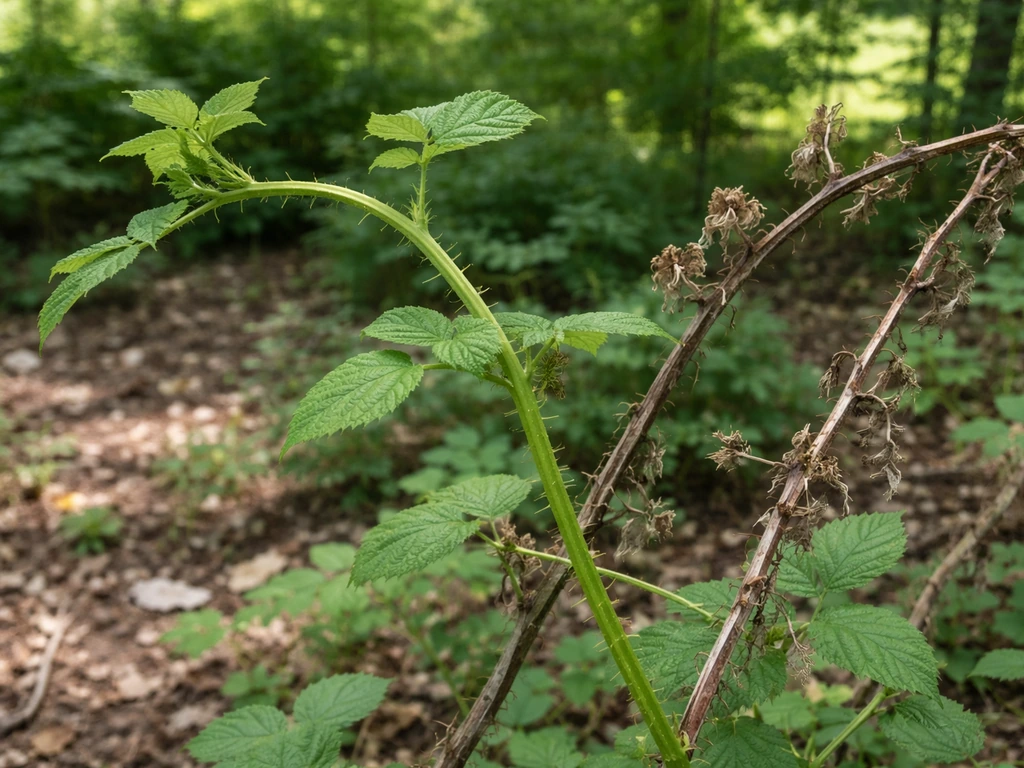
Understanding how a bramble grows is genuinely useful because it explains why they appear where they do, why they're so hard to remove once established, and how to get the best fruit from them in a garden.
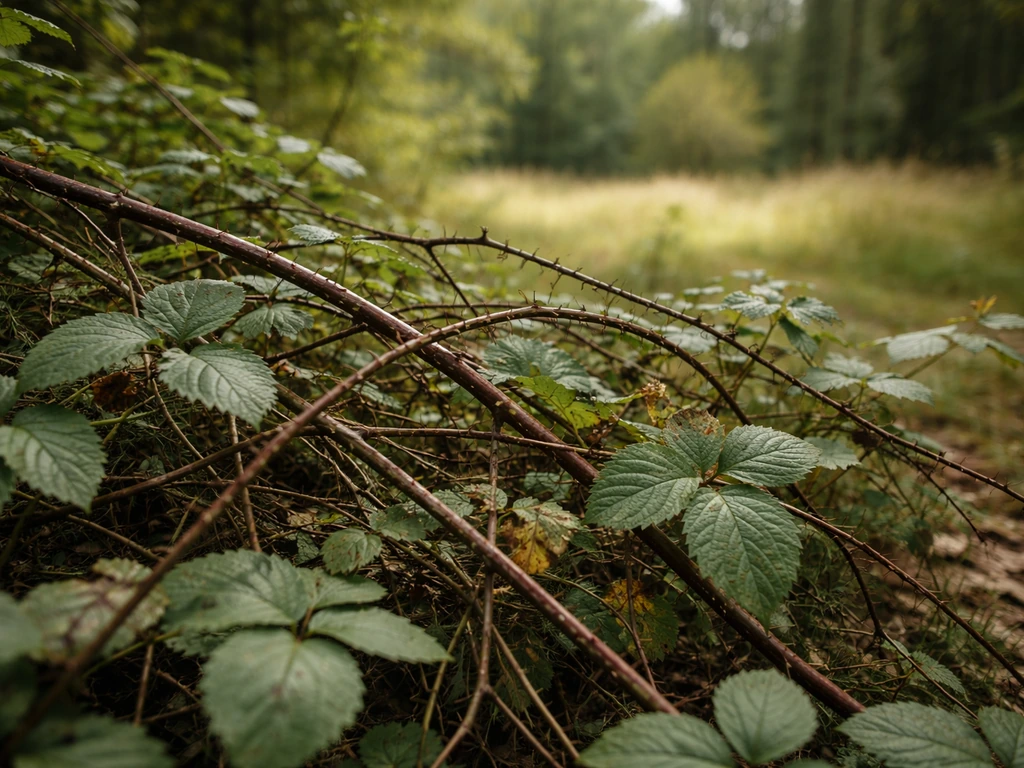
Brambles are perennial shrubs that grow on a two-year cane cycle. In the first year, a cane (called a primocane) shoots up, often reaching 2 to 4 metres, arching over at the tip. It produces leaves but no flowers or fruit. In the second year, that same cane (now called a floricane) produces side shoots, flowers, and then fruit. After fruiting, the floricane dies back. Meanwhile, new primocanes have been growing to replace it. This cycle keeps going indefinitely from the same root system.
The sneaky part of bramble spread is tip-rooting. When a long arching cane touches the ground, the tip roots itself and starts a new plant. That new plant then sends out its own canes, which arch, touch the ground, root, and repeat. A single bramble plant can colonise a significant area this way within a few seasons without anyone noticing until there's a dense thicket. I've watched a single plant at the edge of a veg patch extend itself about 3 metres over two summers purely through tip-rooting. The root system itself is also deep and persistent: even if you cut all the canes, the roots will re-shoot unless you dig them out or use a targeted treatment.
Seasonal timeline for brambles
| Season | What's happening |
|---|---|
| Late winter / early spring | Dormant roots begin pushing up new primocanes; old floricanes look dead and brown |
| Spring | Primocanes grow rapidly; leaves unfurl; floricanes from last year produce white or pale pink flowers |
| Early summer | Flowers open (great for pollinators); small green fruitlets form on floricanes |
| Late summer (Aug–Sept in the UK) | Berries ripen from red to deep glossy black; peak foraging and picking time |
| Autumn | Floricanes die back after fruiting; primocanes slow growth; tip-rooting consolidates new plants |
| Winter | Plant is largely dormant above ground; a good time to prune out dead floricanes |
Edible berries you can expect from brambles
The main edible fruit from a wild or garden bramble is the blackberry. In the wild, the flavour varies enormously between microspecies and individual plants: some are sweet and aromatic, others are seedy and tart. The best wild blackberries I've picked in the UK have come from south-facing hedgerows on sandy soil, where the fruit gets maximum sun and doesn't stay wet. Shaded, damp sites often produce watery, less sweet fruit even on a good year. Snowberries (sometimes called snowberry) grow best in moist but well-drained soil and can tolerate partial shade, often doing well in temperate regions.
Beyond wild blackberries, the same plant type (Rubus) gives you access to cultivated varieties in the garden with significantly better eating quality: 'Thornless Evergreen,' 'Chester Thornless,' 'Loch Ness,' 'Oregon Thornless,' and 'Black Satin' are popular UK garden choices. These are all selections or hybrids of the Rubus fruticosus group, so they grow and behave like brambles but with larger, sweeter, more consistent fruit and (where specified) thornless or near-thornless canes.
Wild raspberries (Rubus idaeus) also grow in the UK, mainly on upland slopes, moorland edges, and in open northern woodland, but they're a separate plant from brambles. If you're in Scotland or northern England and see a cane plant with hollow red fruit, that's almost certainly wild raspberry, not bramble. In the garden, raspberries are grown very differently from blackberries: they need a support structure, regular tying in, and full sun to crop reliably. Other Rubus relatives like dewberries (Rubus caesius) are found in the UK, growing low and sprawling on chalky or sandy ground, producing smaller, dusky blue-black fruit. Wineberries (Rubus phoenicolasius), which are closely related to brambles and raspberries, are an interesting comparison: they're a non-native ornamental cane fruit with distinctive red hairy stems and a sharp-sweet flavour, occasionally naturalised in parts of southern England.
How to find brambles growing near you
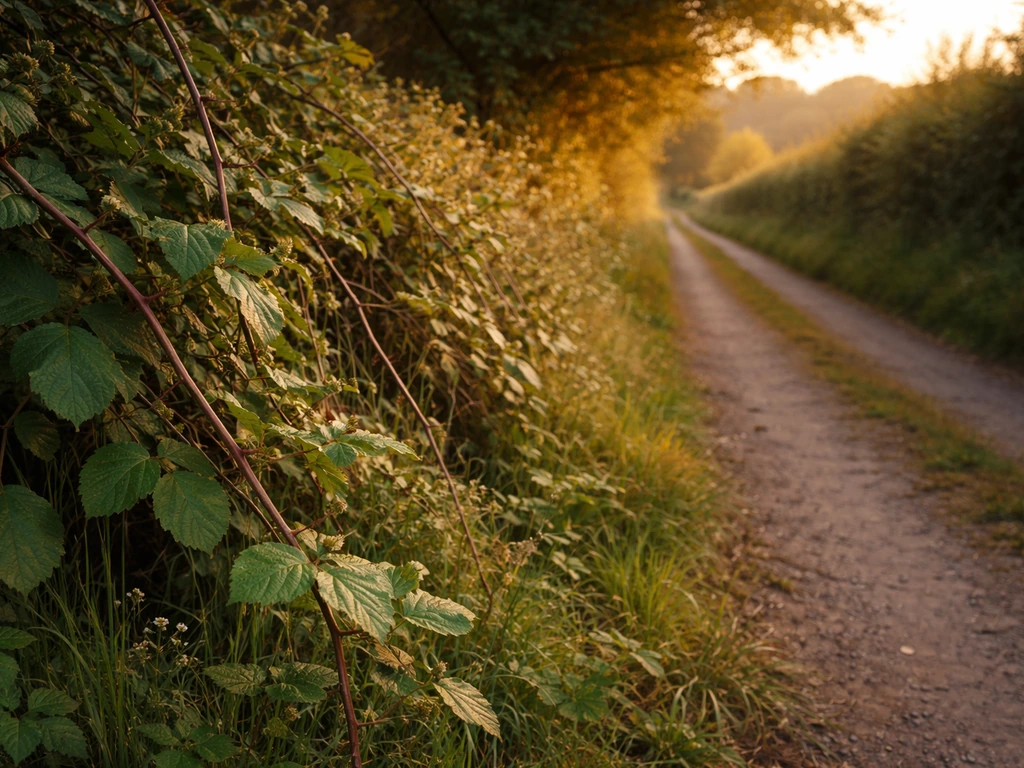
If you want to find wild brambles today, you don't need a detailed flora or a guided walk. You need to know what habitat to look at. If you are specifically wondering where do serviceberry trees grow, start by checking local soil, sun, and moisture conditions that match their native range what habitat to look at.
- Check south-facing hedgerows along field edges and country lanes. These are the single best place to find fruiting brambles in the UK. The hedge gives structure, the south aspect gives sun, and the disturbed soil at the base gives good establishment conditions.
- Walk the edges of any woodland or managed nature reserve. Bramble almost always colonises the open-canopy fringe where light gets through. National Trust and Woodland Trust properties often have excellent populations in their scrub zones.
- Look at railway embankments and road verges. Network Rail land and highway verges are not managed intensively, so bramble establishes freely. You'll often see huge thickets on embankments visible from train windows.
- Check any recently disturbed or set-aside ground near you. Construction sites, old allotments, cleared gardens: bramble is often one of the first woody plants to arrive.
- Use the UK's Countryside Survey data or apps like iNaturalist or the BSBI's Online Atlas to see recorded Rubus fruticosus agg. observations near your postcode. The BSBI atlas shows distribution down to 10km grid squares across Britain and Ireland.
- Check the time of year. You're reading this in late June 2026, which means bramble flowers are either open or just finishing, and green fruitlets are forming. The berries won't be ripe for harvest until August at the earliest in southern England, September for most of the UK.
Growing brambles successfully in your garden
Growing brambles in your garden is genuinely straightforward, but getting a reliable heavy crop means matching the conditions they naturally favour rather than fighting the plant.
Climate and hardiness
If you're in the UK or temperate EU (broadly RHS hardiness H7 down to -20°C), you can grow brambles without any winter protection. They're fully hardy. In hotter, drier Mediterranean climates, some cultivars struggle with summer drought and may need irrigation. In very exposed upland gardens, thornless cultivars can suffer more wind damage than traditional thorned types, so bear that in mind if you're above 200m in northern England or Scotland.
Soil and light
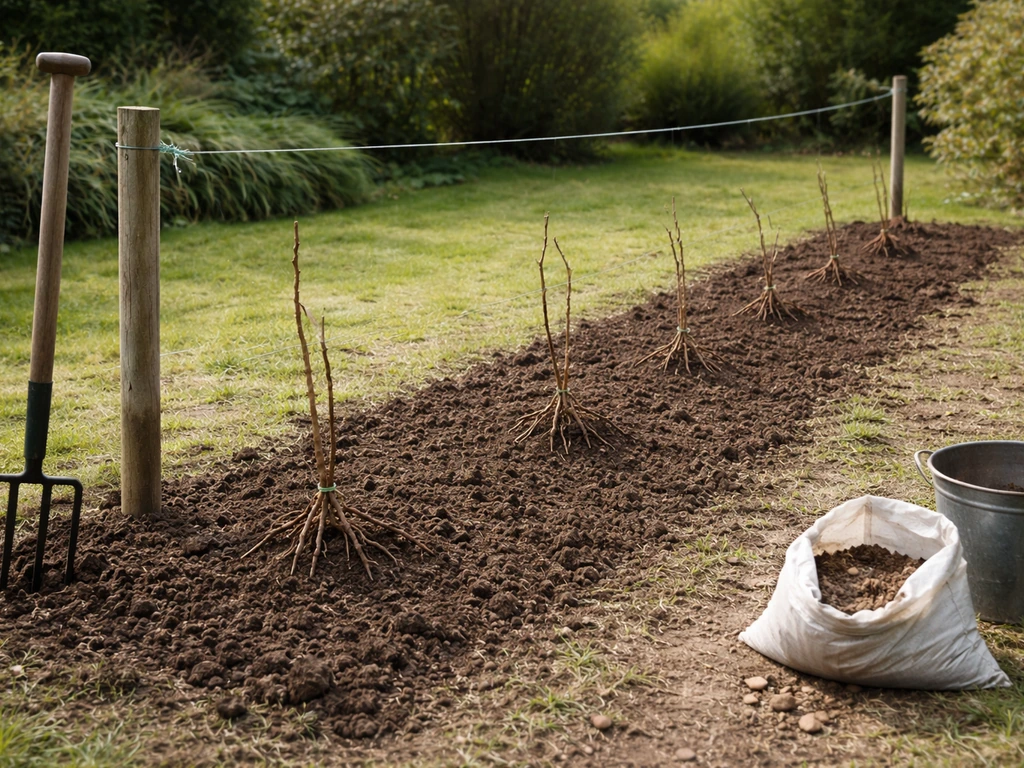
Brambles need free-draining, moderately fertile soil. If your soil is heavy clay, improve it with grit and organic matter before planting, or build a raised bed. They crop best in full sun (6+ hours a day during summer), though they'll survive in partial shade. Damsons are a different kind of plum, and the best place to find where they grow is sheltered, sunny spots with well-drained soil where do damsons grow. Shade reduces flower production and slows ripening, which often means sour or watery fruit. A south or west-facing fence, wall, or wire support is ideal for a trained garden plant.
Planting and spacing
- Plant bare-root canes in late autumn to early spring, or pot-grown plants any time the ground isn't frozen.
- Space plants 1.5 to 2 metres apart along a wire support system (3 or 4 horizontal wires between posts works well).
- Cut newly planted canes back to about 25cm above ground to encourage strong basal growth in the first season.
- Mulch around the base with bark or well-rotted compost to retain moisture and suppress weeds.
- Tie new primocanes to wires as they grow. Keep this year's primocanes on one side, last year's fruiting floricanes on the other, so you can easily identify and cut out the old canes after harvest.
Can you grow brambles in containers?
Yes, but with realistic expectations. A bramble in a large container (at least 40 to 50 litres) will fruit, but the canes will be shorter, the crop lighter, and you'll need to water consistently and feed with a potassium-rich fertiliser through summer. Thornless varieties work better in containers because the canes are easier to manage in a small space. I've had reasonable crops from 'Loch Ness' in a half-barrel planter on a south-facing patio. It's not the same yield as a garden-trained plant, but it's perfectly doable for someone with a courtyard or balcony. Repot every two or three years and refresh the compost to maintain productivity.
Recommended cultivars for UK and EU gardens
| Cultivar | Thorns | Fruit quality | Best for |
|---|---|---|---|
| Loch Ness | Thornless | Large, sweet, reliable | Small gardens, containers, beginners |
| Oregon Thornless | Thornless | Good flavour, ornamental foliage | Walls, fences, decorative use |
| Chester Thornless | Thornless | Very large fruit, late season | Extending the harvest into October |
| Waldo | Thornless | Compact, early | Smaller spaces and containers |
| Black Satin | Semi-thornless | Heavy cropper, slightly tart | Large gardens, productive hedging |
| Adrienne | Thorned | Excellent flavour | Flavour-first gardeners with space |
Common confusion and why your bramble isn't producing berries
The most common issue I hear from people is: 'My bramble plant has canes everywhere but no fruit.' Almost always, one of the following is the cause.
- You're only seeing first-year canes (primocanes): Brambles don't fruit on new canes. If you planted last year or cut everything back hard this spring, you won't see fruit until those canes become second-year floricanes next season. This is the single most frequent source of confusion.
- Too much shade: A bramble in heavy shade will produce lush green canes and very little fruit. If it's under or directly beside a large tree, it needs more light. Even moving it to a slightly more open spot makes a big difference.
- You cut out the wrong canes: If you pruned all the old-looking canes in spring without realising they were your fruiting wood, you've removed this year's crop. The dead-looking second-year canes are the ones that flower and fruit. Only remove them after they've finished cropping.
- Waterlogged or compacted soil: Poor drainage causes root stress and dramatically reduces fruiting. If the area puddles after rain, the bramble is surviving rather than thriving.
- Confused with a non-fruiting Rubus: Some ornamental Rubus species (like Rubus cockburnianus, the white-stemmed bramble) are grown for winter stem effect and produce small, inedible or very insipid fruit. If you inherited a mystery shrub, check whether it's an ornamental variety.
- Too young: A newly planted bramble will typically give a modest first crop in its second year and a full crop by year three. Patience is needed.
- Late frost damage to flowers: In an exposed or frost-prone garden, a late spring frost after flowers have opened will kill the blossom and wipe out that year's fruit. This is more common at altitude or in a frost pocket.
If you're trying to identify whether what you're looking at is actually a bramble at all, the key features are: arching thorned (or bristly) canes, compound leaves with three to five leaflets that are white or grey underneath, five-petalled white or pale pink flowers in early summer, and fruit that ripens from green to red to glossy black in late summer. If your plant matches that description but still isn't fruiting, work through the list above. If the fruit is hollow and red, you've got a raspberry, not a bramble. If it's small, dusky blue, and low-growing on chalk or sand, it may be a dewberry. Both are edible and worth picking, but they're not brambles in the strict UK sense. If you are wondering where a dewberry grows, it tends to favour low, sandy or chalky sites similar to the conditions described here for small, dusky-blue berries.
FAQ
Do brambles grow in shady places, or do they need full sun to show up at all?
They will establish in light shade, especially at woodland edges and hedgerows, but fruiting usually drops if they get less than about 4 to 5 hours of summer sun. If you are hunting for the tastiest berries, focus on south-facing hedges or any spot where the canes dry quickly after rain.
Why do I sometimes see brambles on chalky ground, when chalk is said to stress them?
Chalk can be a problem when the soil is thin and dries out fast or stays cold and wet at the same time. You may still see persistent brambles along chalk verges because there is often deeper pockets of soil, leaf litter, or extra moisture near tracks, banks, or hedge bases.
Are brambles the same as blackberries, and how can I be sure when foraging?
In everyday UK use, brambles mean the Rubus fruticosus group, and the fruit you pick is a blackberry. A quick check is the core, if the berry comes off leaving a hollow centre, it is likely raspberry, while a blackberry stays attached to the receptacle.
How do brambles spread so fast, and why do they keep coming back after cutting?
They spread mainly by tip-rooting, where an arching cane touches the ground, roots, and becomes a new plant. Cutting the canes only removes the top growth, the roots often re-shoot, so long-term control usually requires digging out rooted tips and treating or removing the root system rather than repeated mowing.
If my bramble has canes but no fruit, what is the most likely cause?
The most common cause is that the wrong canes are being removed, you typically need second-year canes for flowers and fruit, and they ripen on a time window from late summer. Another frequent issue is insufficient sun or overly wet, heavy soil that weakens flowering.
When is the best time to pick wild brambles if the season varies by location?
In most of England, late August to October is the dependable window, but sheltered and coastal sites can start a bit earlier while upland and colder northern areas can lag by weeks. Picking every few days near the end of the season helps because fruits ripen unevenly within the same thicket.
Can I grow brambles in a container, and what changes compared to planting in the ground?
Yes, but choose at least a 40 to 50 litre pot, expect fewer and shorter canes, and plan for consistent watering during summer. Use a potassium-rich feed through the growing season to support fruiting, and repot every 2 to 3 years to avoid nutrient depletion.
What soil pH and drainage matters most, and what should I do if my garden is heavy clay?
Drainage matters more than exact pH because waterlogged conditions encourage root disease and reduce fruiting. For clay, improve the planting area with grit and organic matter, or consider a raised bed so excess water can move away from the crowns.
Do thornless bramble varieties behave differently from traditional thorned ones?
They crop similarly, but thornless types are often easier to manage and may be preferred in gardens. In very exposed sites, some thornless selections can be more prone to wind damage, so a sturdier fence or trellis and tying in the canes can make a noticeable difference.
How can I tell if a low, spreading berry plant is a bramble or something else like a dewberry?
Dewberries tend to be lower and more sprawling, often producing small dusky blue-black fruits on sandy or chalky ground. If the plant has the distinctive arching cane form and the blackberry-style fruiting described for brambles, it is more likely Rubus fruticosus rather than a low cane relative.