
Nightshade berries grow across an enormous range of habitats, from shaded European woodland edges to weedy North American roadsides and garden beds. Depending on the exact species, you will find them in USDA hardiness zones 3 through 10, thriving on disturbed ground, streambanks, hedgerows, and even the back corners of vegetable gardens. If you are trying to figure out whether the berry-studded vine climbing your fence is a nightshade, or you want to understand the natural growing patterns so you can either cultivate or remove one responsibly, this guide covers each major species by native range, habitat, climate tolerance, and practical growing conditions. If you were actually looking for the song "Where Berries Grow" lyrics, see the page for Where Berries Grow lyrics for the full text.
Where Do Nightshade Berries Grow: Habitats, Regions & Growing Tips
Which plants actually count as "nightshade berries"
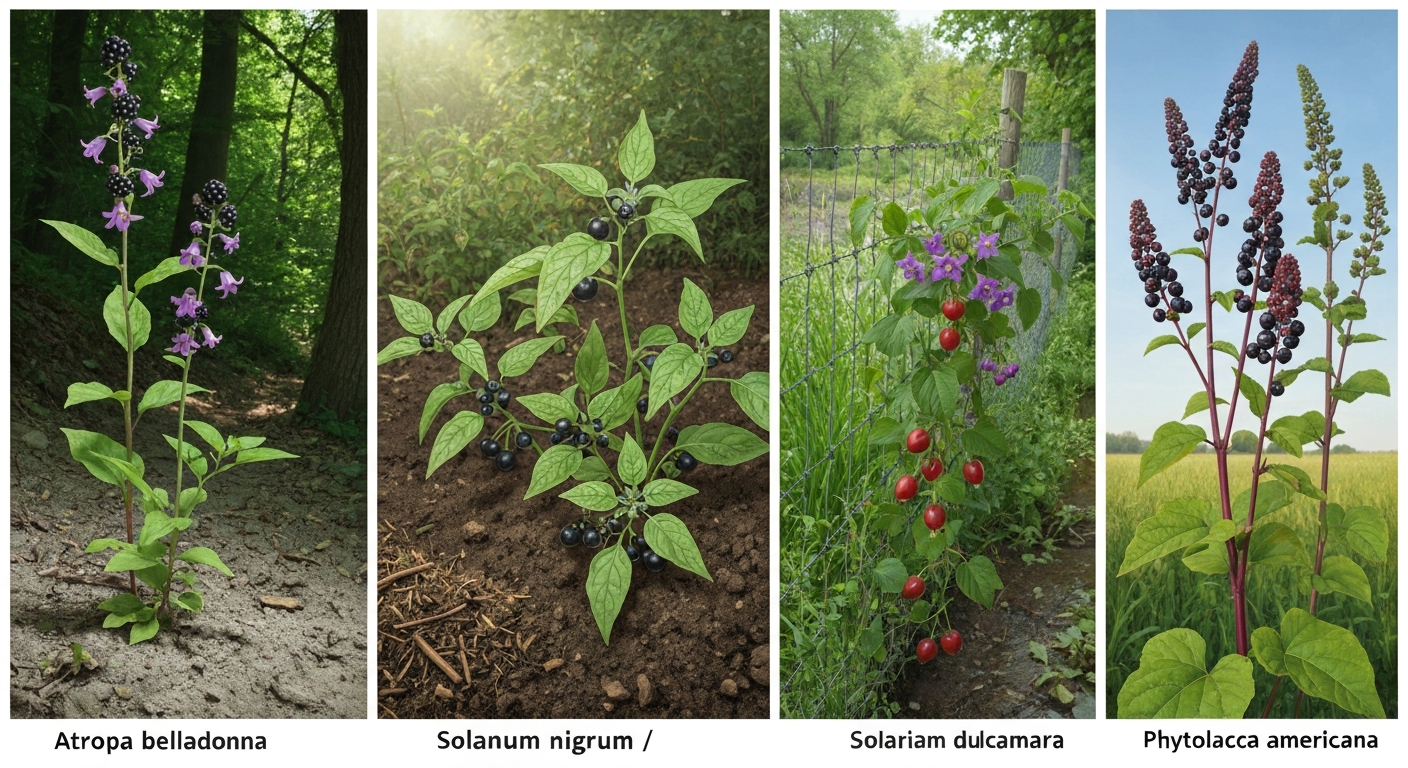
The name "nightshade" gets applied loosely to several unrelated plants, which causes real confusion for gardeners. The core group belongs to the Solanaceae family, but even within that family there are meaningful differences. Then there is pokeweed, which is not a Solanaceae member at all but is so commonly mistaken for a nightshade that it deserves a place in any honest guide on this topic.
- Atropa belladonna (deadly nightshade): a tall perennial with shiny black berries, native to Europe and temperate Asia, and the species most people mean when they say "deadly nightshade." Extremely toxic.
- Solanum nigrum (black nightshade): a sprawling annual or biennial with small black berries in clusters, found as a weed in gardens and disturbed soil across much of the world.
- Solanum americanum (American black nightshade / glossy black nightshade): closely related to S. nigrum and often treated as the same plant in casual conversation; pantropical to warm-temperate distribution, very weedy.
- Solanum dulcamara (bittersweet nightshade / climbing nightshade): a semi-woody vine with oval red-to-purple berries, introduced and widely naturalized across North America, common along streambanks and hedgerows.
- Phytolacca americana (pokeweed / pokeberry): not a true nightshade at all, but frequently confused with nightshade species because of its dark purple-black berries. Native to North America, toxic in most plant parts.
It is also worth mentioning a few plants that people sometimes lump into nightshade conversations without good reason. Beautyberry (Callicarpa) produces vivid purple berries on a deciduous shrub and is completely unrelated to nightshades. Miracle berry (Synsepalum dulcificum) is a tropical West African shrub with no botanical connection to nightshades whatsoever. If you landed here after searching for one of those, the growing conditions are quite different and worth reading about separately. If you want specific advice on cultivation, see our separate note on whether can you grow miracle berries in the US for U.S.-focused growing guidance. For details on where miracle berries grow and their tropical West African habitat and cultivation needs, see where do miracle berries grow.
Native ranges and where each species has spread
Understanding where a plant is native versus where it has been introduced helps you predict how aggressively it will self-seed and how difficult it will be to manage or establish. Here is the species-by-species picture.
Atropa belladonna (deadly nightshade)
Deadly nightshade is native to Europe, northwestern Africa, and temperate southwestern Asia. It is a classic plant of the temperate biome, documented in the wild across the UK, central Europe, the Mediterranean fringe, and into parts of western Asia. In North America it is not native, but Kew Science records naturalized occurrences in California, Illinois, Michigan, Missouri, New Jersey, and Washington. These populations are scattered and localized rather than forming dense infestations the way bittersweet nightshade does. Still, if you live in those states, it is possible to encounter a naturalized plant in a woodland edge or old garden site.
Solanum nigrum and Solanum americanum (black nightshades)
Black nightshade in the broad sense refers to a complex of closely related Solanum species that behave as opportunistic annuals or biennials across most of the world. Solanum nigrum is the European species, well documented by the RHS as a fast-growing annual found in woodland margins and cultivated or disturbed soil. Solanum americanum is the American equivalent, described by Kew Science as having a pantropical to warm-temperate distribution from Canada down through tropical and subtropical America and beyond. Both species are effectively cosmopolitan weeds that pop up wherever soil is broken, fertilized, and left briefly unshaded. I have pulled both from my own vegetable beds repeatedly, which tells you everything about how good they are at finding disturbed soil.
Solanum dulcamara (bittersweet nightshade)
This is the nightshade most North American gardeners are likely to encounter as a persistent vine. It is not native to North America; it was introduced from Europe and has naturalized across most U.S. states and many Canadian provinces. The U.S. Forest Service Fire Effects Information System (FEIS) reports confirmed occurrences in over 40 states, including California, Colorado, Florida, Illinois, Michigan, Minnesota, New York, Oregon, Pennsylvania, Washington, Wisconsin, and many more. It is most abundant in the eastern and north-central United States, the upper Great Lakes region, and the Pacific Northwest.
Phytolacca americana (pokeweed)
Pokeweed is the only species in this group that is actually native to North America. USDA Forest Service distribution records show it occurring across most eastern U.S. states and extending into parts of the West. blank" rel="noopener noreferrer">Iowa State University Extension describes it as a coarse, branched perennial common in waste areas, landscapes, and no-till agricultural fields. It produces racemes of white flowers that develop into the dark purple-black berries that often get mistaken for nightshade fruit. If you are exploring where wild berries grow in the eastern half of the country, a pokeberry cluster hanging from a tall burgundy-stemmed plant is one of the most recognizable sights of late summer. For a focused overview of where poke berries grow, see our page on where do poke berries grow.
Habitats and microclimates where nightshades actually thrive
Each species has a slightly different habitat fingerprint. Knowing these patterns helps you identify plants in the field and understand what growing conditions to replicate or avoid.
| Species | Primary Habitat | Soil Preference | Light | Moisture |
|---|---|---|---|---|
| Atropa belladonna | Shaded woodland edges, hedgerows, calcareous scrubland | Calcareous (chalky/limy), well-drained | Part shade to dappled light | Moderate; dislikes waterlogging |
| Solanum nigrum / americanum | Disturbed ground, garden beds, field edges, waste areas | Fertile, loose, moderately moist | Full sun to part shade | Moderate; tolerates brief dry spells |
| Solanum dulcamara | Streambanks, wetland margins, hedgerows, fence-rows, riparian corridors | Moist to wet, often rich | Part shade to full sun | Moist to wet; thrives near water |
| Phytolacca americana | Waste areas, pasture edges, roadsides, no-till fields, old gardens | Fertile, disturbed, often moist | Full sun to light shade | Moist to average; tolerates brief flooding |
A few patterns stand out across all species. Every nightshade in this group benefits from disturbed or open soil where competition from established vegetation is low. Bittersweet nightshade (S. dulcamara) is the outlier in terms of moisture, genuinely preferring wet riparian zones, while black nightshade and pokeweed are more flexible and can tolerate drier conditions once established. Deadly nightshade is the most specific: it really does prefer alkaline, calcareous soils in semi-shaded temperate woodland, which is one reason its naturalized range in North America stays limited compared to the others.
Hardiness and climate: which zones to watch for each species
The 2023 USDA Plant Hardiness Zone Map (based on 1991-2020 temperature normals) is the clearest reference for cold tolerance. Here is how each nightshade species maps onto those zones and the broader Köppen climate types.
| Species | USDA Hardiness Zones | Köppen Climate Types | Notes |
|---|---|---|---|
| Atropa belladonna | Zones 6-9 (core); survives to Zone 5 with protection | Cfb (temperate maritime), Dfb (humid continental), Csa/Csb (Mediterranean) | Perennial in its native European range; may behave as a half-hardy perennial in cooler U.S. climates |
| Solanum nigrum / americanum | Zones 4-11 as an annual; S. americanum perennial in Zones 9-11 | Broad: Cfa, Csa, Aw, Am; essentially cosmopolitan in warm to temperate climates | Germinates and completes cycle in one season across most of its range; S. americanum persists as a perennial in frost-free climates |
| Solanum dulcamara | Zones 3-10; most vigorous in Zones 4-7 | Dfb, Cfb, Cfa (humid continental, maritime, humid subtropical) | Tolerates dormant-season freezing well; FEIS reports comfortable at mean July temps around 72°F (22°C) but extends into warmer zones |
| Phytolacca americana | Zones 4-9; native perennial across eastern U.S. | Cfa (humid subtropical), Dfb (humid continental), Csa where moisture is adequate | Dies back to a massive taproot each winter; re-sprouts vigorously in spring |
From a practical standpoint, bittersweet nightshade (S. dulcamara) is the species most likely to become an unmanageable vine in Zone 4-7 gardens across the Midwest, Northeast, and Pacific Northwest. Black nightshade behaves more like a garden weed and is less persistent across winters in northern zones. Deadly nightshade is genuinely rare in North American gardens; if you want to grow it intentionally (for historical or botanical interest), you are essentially treating it as a tender perennial in most U.S. climates outside of the Pacific Northwest coastal strip.
Soil, sun, and moisture: what each nightshade actually needs
Most nightshade species are not fussy, which is exactly what makes them effective colonizers of disturbed ground. But there are meaningful differences if you are trying to cultivate them deliberately or manage them in an existing garden.
Soil
Deadly nightshade prefers calcareous (alkaline) soils with good drainage. If your garden has acidic, compacted, or waterlogged soil, A. belladonna will struggle. Amending with garden lime to raise pH toward 7.0-7.5 and ensuring sharp drainage will get you closer to its native conditions. Black nightshade (S. nigrum and S. americanum) is the opposite: it loves fertile, nitrogen-rich, loose soil, which is why it thrives in vegetable gardens where you have been adding compost. Bittersweet nightshade tolerates heavier, wetter soils and has no problem growing in clay near a drainage ditch. Pokeweed seems almost indifferent to soil type as long as it is reasonably fertile; it can push through compacted subsoil with its massive taproot.
Sun exposure
Deadly nightshade is happiest in dappled or partial shade, consistent with its woodland-edge native habitat. Bittersweet nightshade is flexible, growing in both full sun and partial shade, though it tends to fruit more heavily in sunnier positions. Black nightshade tolerates a wide range but grows fastest and fruits most in full sun to light shade. Pokeweed prefers full sun but will tolerate light woodland edge shade, especially when young.
Moisture
Bittersweet nightshade is the clear moisture lover of the group. FEIS data consistently links it to streambanks, wetland margins, and other moist riparian or disturbed-wet habitats. If you have a spot near a rain garden, pond edge, or drainage swale, this is the species that will colonize it aggressively. Black nightshade needs moderate moisture and does not like to dry out completely during the growing season, but it is much more drought-tolerant than bittersweet. Deadly nightshade sits in the middle, needing consistent but not excessive moisture. Pokeweed is reasonably drought-tolerant once its taproot is established, though it fruits best with adequate summer moisture.
Container vs. in-ground: making the right call
Most people grow nightshade species in-ground by accident rather than by choice, but if you are intentionally cultivating one of these plants for botanical or historical interest, the container-versus-in-ground decision matters a lot. For practical guidance on choosing garden sites and microclimates suited to berry-producing plants, see where to grow berries.
When containers or raised beds make sense
Containers are a smart choice for deadly nightshade (A. belladonna) in North American climates. In Zones 5 and colder, overwintering in a pot in a cool greenhouse or unheated basement lets you treat it as a perennial rather than starting from seed every year. A container also limits root spread and keeps this highly toxic plant physically separated from areas where children or pets play. A large pot (at least 12-15 gallons) with a well-draining alkaline mix, ideally one part perlite and two parts loam amended with garden lime, replicates its calcareous native soil reasonably well. Raised beds with amended alkaline soil are a middle ground if you want a more permanent planting without giving it free run of the garden.
For black nightshade, containers are rarely used intentionally since this is almost always a weed you are managing rather than growing. However, if you are studying seed germination behavior or keeping a botanical reference specimen, a large pot in full sun works fine with any standard potting mix enriched with a slow-release fertilizer.
When open ground is the right choice
Bittersweet nightshade (S. dulcamara) can be grown as a controlled ornamental vine in open ground in Zones 4-7, trained onto a trellis or fence along a wet site. Once established it will re-sprout from woody base stems each spring, so plan for annual cutting back. Pokeweed is almost always grown (or tolerated) in-ground because its deep taproot makes it essentially impossible to grow successfully in any pot smaller than a half-barrel. It is also very difficult to transplant once established, so if you allow it to self-seed in a location, treat that as a permanent spot.
Propagation and seasonal timing
Getting the timing right is the single biggest factor in successful propagation for all of these species, and each one has a slightly different approach.
Atropa belladonna
Deadly nightshade is typically grown from seed. The seeds have a hard coat and benefit from cold-moist stratification: wrap seeds in a damp paper towel inside a sealed bag and refrigerate for 4-6 weeks before sowing. Sow indoors 10-12 weeks before your last frost date under lights (seeds need warmth, around 65-70°F/18-21°C, to germinate after stratification). Germination is slow and sometimes erratic, so patience is essential. Transplant outdoors after all frost risk has passed, into a prepared site with limed, well-draining soil in partial shade. In the UK and similar temperate maritime climates, direct autumn sowing with natural winter cold as stratification works well.
Solanum nigrum and Solanum americanum
These are opportunistic annuals that mostly propagate themselves. If you are growing intentionally, surface-sow seeds in spring after soil has warmed to at least 60°F (15°C). Seeds need light to germinate, so press them onto the soil surface rather than burying them. In warm climates (Zone 8 and above), S. americanum can be direct-seeded year-round in frost-free periods. No stratification is needed. If managing as a weed, the key is to remove plants before berries ripen, since a single plant can produce dozens of bird-dispersed seeds.
Solanum dulcamara
Bittersweet nightshade propagates readily from both seed and stem cuttings. FEIS reports laboratory germination rates of 61-98% for freshly collected seeds without stratification under light, which means fresh seed is highly viable. Seeds are bird-dispersed (birds eat the berries and deposit seeds in new locations), so natural spread happens fast. For deliberate propagation, collect ripe berries in late summer or fall, clean the seeds, and either sow immediately outdoors in fall (natural cold stratification over winter) or store dry and cold-stratify in a refrigerator for 4-6 weeks before spring sowing. Stem cuttings taken in early summer root easily in moist potting mix. Most seedlings emerge in spring.
Phytolacca americana (pokeweed)
Pokeweed reproduces almost entirely by seed. According to Iowa State University Extension, seeds are the primary means of spread. The seeds benefit from cold stratification and are naturally dispersed by birds that eat the purple-black berries. For home propagation, sow seeds in fall directly in the ground (they will stratify naturally over winter and germinate in spring), or cold-stratify in a refrigerator for 60-90 days and start indoors 6-8 weeks before last frost. Once germinated, pokeweed grows fast. The challenge is transplanting: even young seedlings develop a taproot quickly, so transplant as early as possible or start in deep pots to minimize root disturbance. Do not expect to move an established plant successfully.
Safety: toxicity, identification, and handling
This is the section I feel most strongly about including because the attractiveness of these berries to children and pets is real and the toxicity is serious. Every species covered in this guide has toxic fruit to some degree.
- Atropa belladonna: all parts are highly toxic. Even a small number of berries (as few as 3-5) can be fatal to a child. The berries are shiny, black, and somewhat sweet-tasting, which makes accidental ingestion a genuine risk.
- Solanum nigrum and Solanum americanum: toxic, especially unripe green berries. Ripe black berries are sometimes eaten in some regions after cooking (and some sources describe certain varieties as edible), but raw unripe fruit causes nausea, vomiting, and neurological symptoms. Do not forage without expert identification.
- Solanum dulcamara: all parts toxic, with berries containing solanine and related alkaloids. Berries are especially dangerous because they ripen gradually from green to orange-red to purple, and children are attracted to the colorful clusters. Wear gloves when handling the vine and wash hands after contact.
- Phytolacca americana (pokeweed): roots are the most toxic part, but berries are also toxic raw, particularly to children and pets. Birds can eat them safely (birds have different metabolic pathways), but humans and pets cannot. Do not handle roots without gloves; the toxins are absorbed through skin abrasions.
A practical rule for foragers and gardeners: if you are not certain of your identification, do not taste any dark berry in the Solanum or nightshade family. The berry clusters of bittersweet nightshade are often growing near other edible wild plants (elderberries, wild grapes) and the resemblance to inexperienced eyes is enough to cause mistakes. If you have children or pets and you find any of these plants established in your garden, removal before berries ripen is the safest approach.
How nightshade growing conditions compare to other berry types
One of the things I find genuinely useful about understanding nightshade habitats is that it puts other berry species into perspective. Nightshades as a group occupy a very different ecological niche from, say, olallieberries (a blackberry hybrid suited to the cool coastal climates of California and Oregon) or miracle berries (a tropical West African plant that needs humid, frost-free conditions year-round and is challenging to grow in most of the U.S. without a heated greenhouse). Pokeweed, which is often lumped into the nightshade conversation, is in fact more ecologically similar to elderberry in terms of its disturbed-ground, full-sun preferences and bird-attracting fruit. Understanding which category your target plant falls into, tropical fruit shrub versus temperate woodland weed versus riparian vine, saves a lot of failed plantings.
A quick region-by-region guide for U.S. growers
Based on everything above, here is how the nightshade picture looks across the major U.S. growing regions.
| U.S. Region | Most Likely Nightshade Species to Encounter | Growing Notes |
|---|---|---|
| Northeast and New England (Zones 4-6) | Solanum dulcamara (common), S. nigrum (garden weed), Phytolacca americana (roadsides) | S. dulcamara thrives along stream edges and hedgerows; pokeweed is a vigorous roadside perennial; black nightshade appears in vegetable beds summer through fall |
| Midwest / Great Lakes (Zones 4-6) | Solanum dulcamara (very common), Phytolacca americana, S. nigrum | Upper Great Lakes is one of the densest S. dulcamara regions per FEIS; pokeweed common in waste ground; watch for both in disturbed riparian zones |
| Southeast (Zones 7-9) | Solanum americanum (common garden weed), Phytolacca americana (abundant), S. dulcamara in upper South | S. americanum behaves as a near-perennial in warmer zones; pokeweed is prolific in pastures and roadsides; A. belladonna not naturally present |
| Pacific Northwest (Zones 7-9 coastal, colder inland) | Solanum dulcamara (widespread), S. nigrum, occasional A. belladonna naturalization in WA and CA | S. dulcamara is well-established and invasive in WA and OR; cool, moist maritime climate (Cfb) closely matches A. belladonna's European native habitat |
| Southwest and California (Zones 8-11) | Solanum americanum (warm areas), S. dulcamara (coastal CA), occasional A. belladonna naturalization in CA | S. americanum thrives in warm disturbed ground; S. dulcamara confined to moister coastal and riparian zones; dry inland areas too hot and dry for most nightshade species |
| Mountain West / High Plains (Zones 4-7) | Solanum dulcamara (riparian zones), S. nigrum (disturbed ground, lower elevations) | Nightshade presence correlates with water availability; look for S. dulcamara along irrigation ditches and creek corridors; pokeweed less common in this region |
If you are in the Pacific Northwest and dealing with a persistent vine along a wet fence line, bittersweet nightshade is almost certainly what you have. If you are in the Southeast and a large-leafed perennial with purple-black berry clusters is appearing in your pasture every summer, that is pokeweed. And if you are in the Mid-Atlantic or New England and a sprawling plant with small black berries keeps reappearing in your vegetable beds no matter how many times you pull it, black nightshade is the culprit. Knowing the species gives you the right removal strategy and helps you assess the actual risk level for your situation.
FAQ
What plants are commonly called “nightshade berries” and which produce toxic fruit?
Several unrelated species are commonly called nightshades. True deadly nightshade (Atropa belladonna) produces shiny black toxic berries and is native to Europe, NW Africa and SW Asia. Black nightshades (Solanum nigrum group, including Solanum americanum) and bittersweet/climbing nightshade (Solanum dulcamara) produce small black or red berries; many Solanum fruits are toxic or of variable edibility and should not be eaten unless positively identified. Pokeweed (Phytolacca americana) has purple-black clusters often confused with nightshades but is a different genus; pokeberries are also toxic when raw. When in doubt, assume berries are poisonous—keep children and pets away.
Where are deadly nightshade (Atropa belladonna) and the common Solanum nightshades native or naturalized?
Atropa belladonna is native to temperate Europe, parts of NW Africa and SW Asia and is primarily a temperate woodland-edge species; it has been reported as naturalized in pockets of North America (e.g., some U.S. states). Solanum dulcamara (bittersweet/climbing nightshade) and members of the S. nigrum complex (black nightshade/S. americanum) are nonnative in North America but widely naturalized—S. dulcamara occurs in most U.S. states and many Canadian provinces, while S. nigrum/americanum are common across disturbed ground in temperate to subtropical regions. Phytolacca americana (pokeweed) is native to much of North America.
What habitats and climates do these species prefer?
General habitat preferences: - Atropa belladonna: shaded to semi-shaded woodland edges, often on calcareous or well-drained soils in temperate climates. - Solanum dulcamara: moist habitats—streambanks, wetlands, hedgerows, fence-rows and other riparian or disturbed moist sites; tolerates temperate to some subtropical climates. - Solanum nigrum/americanum: disturbed ground, garden beds, field edges and fertile, moderately moist soils; opportunistic in temperate and warm regions. - Phytolacca americana: waste areas, pastures, edges, no‑till fields and other disturbed fertile soils, common in temperate to warm regions. Use USDA hardiness zones and Köppen climate types to match local conditions (USDA ARS plant hardiness map and Köppen maps are good references).
Can home gardeners intentionally grow nightshades (for ornament or study)?
Yes, but choose species carefully and follow safety rules. Some gardeners grow Atropa belladonna or Solanum species for historical/ornamental reasons, but because many are toxic you should avoid edible gardens. For controlled cultivation, provide species-appropriate habitats: Atropa needs shaded, cool, well-drained, slightly alkaline soils; Solanum dulcamara likes moist supports to climb and partial sun; S. nigrum/americanum tolerate full sun to part shade and average garden soils. Always label plants, fence or isolate them from children/pets and consider local regulations (some species are invasive in parts of the U.S.).
How do I propagate or control Solanum dulcamara and other nightshades?
Propagation: Solanum seeds germinate easily—bird-dispersed fruits contain many viable seeds that typically germinate in spring; many seeds germinate without stratification under light. Sow fresh seed in spring in moist seed-starting mix or allow natural seedbank to recruit. Cuttings root readily for S. dulcamara. Control: because they thrive in disturbed, moist areas and are bird-dispersed, control focuses on removing fruiting plants before seeds set, pulling seedlings, mowing/mechanical removal, and improving site drainage or mulching to suppress seedlings. For large infestations consult local extension for herbicide recommendations and follow label instructions.
What soil, light and moisture conditions should I provide if I want to cultivate a species safely?
Site guidance by species: - Atropa belladonna: partial to full shade, well‑drained loam, neutral to slightly alkaline pH, moderate moisture but not waterlogged; USDA zones generally temperate. - Solanum dulcamara: partial sun to shade; consistently moist, fertile soil; benefits from structures to climb; tolerates wetter sites. - Solanum nigrum/americanum: full sun to partial shade; fertile, moist to moderately dry garden soils; easily grows in containers. - Phytolacca americana: full sun to light shade; fertile, moist to moderately dry soils. In containers use a high-quality potting mix, adequate drainage and water to match species preference. Always isolate toxic species from food crops and living areas.