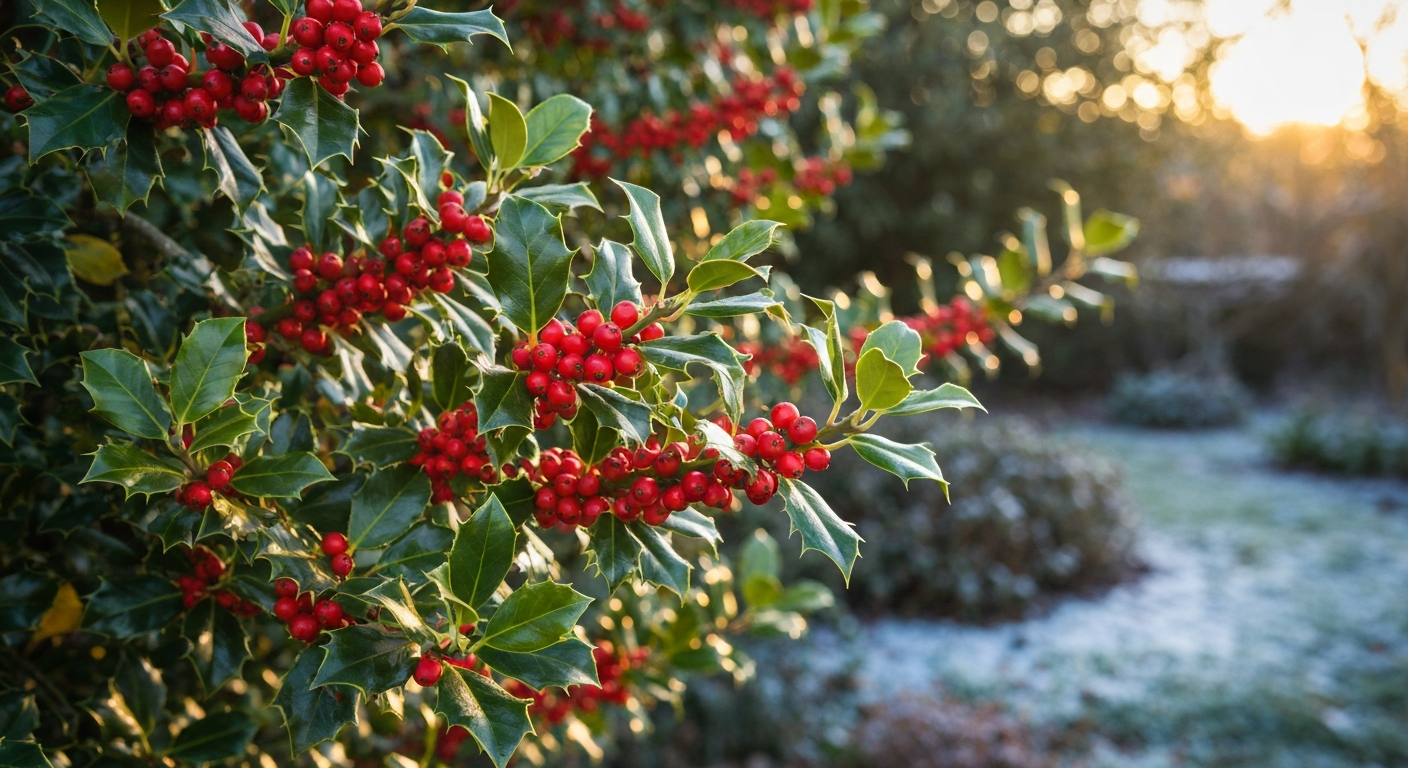
Holly plants flower in spring, typically between April and June depending on species, and the berries that form from those flowers ripen from late summer into fall, then persist on the plant well into winter. That long window from October through February is when most gardeners think of holly berries, but the real work happens months earlier in the season. For more detail on timing, see when do berries grow. If flowering or pollination goes wrong in spring, there are no berries come December, no matter how well you care for the plant afterward.
When Does Holly Grow Berries: Timing, Care & Troubleshooting.
Marcus Holloway
5 Aug 2026
How holly berries actually form
Holly berries are technically drupes, small fleshy fruits with a hard seed inside. The process starts with flowering. Learn more about how do berries grow. In spring, female holly plants open small, often inconspicuous flowers (greenish-white on American holly, white to pinkish on Meserve hybrids) that need to be pollinated by pollen from a nearby male holly. For more on Meserve hybrids and recommended male/female cultivars such as 'Blue Prince' (male) and 'Blue Princess' (female), see blank" rel="noopener noreferrer">Ilex × meserveae (Blue Holly) | North Carolina Extension Gardener Plant Toolbox. Bees, bumblebees, flies, and other insects carry that pollen across; while wind does move some holly pollen, insect visitation is really the primary transfer mechanism. Once a flower is successfully pollinated, it begins developing into a small green fruit. Those fruits swell through summer, then color up, usually turning bright red (or occasionally yellow or orange depending on cultivar) as fall arrives. On winterberry (Ilex verticillata), you can see dramatic color appear on the bare stems by October or November. On evergreen types like American holly or English holly, the red berries pop against the glossy green leaves from fall onward and commonly hold on the plant well into late winter.
One thing I have learned through personal trial and error is that cold, rainy springs are the enemy of a good berry set. Bees need ambient temperatures of roughly 50°F (about 10°C) or warmer to forage actively. If your holly happens to bloom during a cold, wet stretch in April or early May, pollinating insects stay home and far fewer flowers get fertilized. Late spring frosts are even worse because they can kill open flowers outright. A warm, calm spring with plenty of bee activity is the single biggest natural variable driving how many berries you'll see that fall.
Season-by-season and region-by-region expectations
Where you garden shapes every step of the holly berry timeline. Regional climate mapping sources such as NOAA / NCEI U.S. Climate Normals (1991–2020) provide baselines used to relate bloom and fruiting windows to local growing conditions. Hollies cover a wide hardiness range, but the timing of flowering, ripening, and berry persistence all shift based on your climate. Here is roughly what to expect across common USDA zones:
| USDA Zone / Region | Typical Bloom Window | Berries Ripen | Berry Persistence |
|---|---|---|---|
| Zones 5–6 (Upper Midwest, New England, Great Lakes) | Late May–June | September–October | November through January or February |
| Zones 6–7 (Mid-Atlantic, Piedmont, Pacific Northwest) | Late April–May | October–November | December through February or later |
| Zones 7–8 (Southeast, Lower South, PNW coast) | April–early May | October–November | December through winter; can persist into March |
| Zones 8–9 (Gulf Coast, mild West Coast) | March–April | September–October | Fall through early spring; heat may shorten persistence |
In the Pacific Northwest, English holly (Ilex aquifolium) is widely grown commercially precisely because the mild, moist winters keep berries looking fresh and glossy well into the holiday season. In Zones 5 and 6, winterberry holly steals the show: it drops its leaves in fall and the bare red-studded stems look almost surreal against the first snow. Further south in Zone 7 and 8, American holly tends to be the backbone plant, with berries starting to color in October and staying attractive through the coldest months. If you're wondering where do holly berries grow, consult the regional guide to see which species thrive in your area.
Species-specific timing: the common Ilex types
Not all hollies behave on the same schedule. Getting the timing right means knowing which species you are actually growing. Here is a breakdown of the most common garden types:
| Holly Species / Type | Bloom Time | Berry Color | Ripening Window | Hardiness Zones | Notes |
|---|---|---|---|---|---|
| Ilex verticillata (Winterberry) | May–June | Red, orange, or yellow (by cultivar) | Late summer–fall; peak October–November | Zones 3–9 | Deciduous; berries show best on bare stems; prefers moist soils |
| Ilex opaca (American Holly) | April–June | Bright red | Fall; persists well into winter | Zones 5–9 | Evergreen tree; berries stay on plant through winter |
| Ilex aquifolium (English Holly) | Late April–May | Bright red | Fall; persists several months | Zones 6–9 | Widely grown in Pacific Northwest; spiny leaves; can naturalize |
| Ilex × meserveae (Meserve/Blue Holly) | Spring (April–May) | Vibrant red | Fall; persists through winter | Zones 4–9 | Cold-hardy hybrid; 'Blue Princess' (female) + 'Blue Prince' (male) |
| Ilex cornuta (Chinese Holly) | Spring | Red; large clusters | Fall–winter | Zones 7–9 | Some cultivars (e.g., 'Burfordii') can produce without a male |
| Ilex crenata (Japanese Holly) | Spring–early summer | Black | Late summer–fall | Zones 5–8 | Berries are small and black; primarily grown as a hedge plant |
One important practical note: newly planted hollies take time to produce berries. For a virtual-gardening comparison, see how long do berry bushes take to grow in Bloxburg. Most nursery-grown garden hollies begin fruiting in around 3 to 4 years after planting. For more on timelines for berry development, including how long do berries take to grow rust, see our detailed guide. If you just put a young plant in the ground this spring and there are no berries by fall, that is completely normal. If you're asking how long do berries take to grow in Emerald, most nursery-grown garden hollies begin fruiting in around 3 to 4 years after planting. Be patient and focus on establishing good roots first.
Male and female plants: the most common reason you get no berries
Hollies are dioecious, which means individual plants are either male or female, not both. Only female plants produce berries, but they need a male plant nearby to supply pollen. This is the single most common reason gardeners end up with a beautiful holly shrub and zero berries. I have met plenty of growers who had no idea their lone 'Blue Princess' was sitting in the garden waiting for a male that was never there.
For Meserve hollies, the classic pairing is 'Blue Prince' (male) with 'Blue Princess' (female). For winterberry, the picture is a bit more nuanced because cultivars bloom at different times. Early-blooming female cultivars need an early-blooming male like 'Jim Dandy,' while later-blooming females pair better with 'Southern Gentleman.' Matching bloom time between your male and female is just as important as having both sexes in the first place.
How to tell male from female hollies
- Female flowers have a small, round, green center (the developing ovary) with tiny petals surrounding it. Male flowers have prominent stamens with yellow pollen and a shrunken, non-functional center.
- Check the plant tag or cultivar name: many named hollies explicitly label sex, such as 'Blue Prince' (male) or 'Blue Princess' (female).
- If you have an untagged mystery holly, wait until it blooms in spring and examine the flowers with a hand lens or phone camera.
- If your holly has never produced berries despite being several years old, assume it is either male or was sold without a compatible pollinator.
Planting ratios and distance
You do not need a one-to-one ratio of males to females. Extension guidance generally recommends one male plant for every 6 to 10 female plants. In favorable conditions with active insect pollinators, a single male can effectively pollinate up to around 20 female plants if it is planted within about 40 feet. In practice I would not push that upper limit in a home garden; one male for every 5 to 6 females placed 30 feet or less away gives more reliable results. The male does not have to be the same species in every case, but it must bloom at the same time as the female, so always confirm bloom-time compatibility before buying.
Site, soil, and light: the conditions that drive berry set
Even a perfectly planted male-female pair will disappoint you if the site is wrong. Holly berries depend on good flowering, and good flowering depends on the right growing conditions throughout the year. Here is what matters most:
Light
Full sun to light partial shade produces the heaviest flowering and therefore the best berry set. As shade increases, flower production drops off noticeably. I have a winterberry growing under the canopy edge of a large oak and it produces maybe a third of the berries that a nearby specimen in full sun does. For most garden hollies, aim for at least 6 hours of direct sun per day. Part shade is workable, but deep shade will reliably give you poor berry production year after year.
Soil
Most evergreen hollies, including American holly, English holly, and Meserve hybrids, prefer moist, well-drained, slightly acidic soil with a pH around 4.5 to 6.0. Compacted or alkaline soils will show up as yellowing leaves (chlorosis) and reduced vigor, both of which hurt berry production. Winterberry is the outlier here: it is one of the few ornamental shrubs that actively tolerates poorly drained and even seasonally wet soils, which makes it excellent for rain gardens, low spots, and areas near water features. Drought stress in summer can cause early fruit drop before berries have a chance to fully ripen, so consistent moisture matters right through the fruiting season.
Container growing
Compact holly cultivars can be grown in large containers, which is a practical option for gardeners with limited space or challenging native soils. Use a quality acidic potting mix, choose a container at least 18 to 24 inches wide for dwarf types, and remember you still need both a male and a female plant (or at least a male nearby). Container hollies dry out faster than in-ground plants, so consistent watering through the growing season is especially critical for good fruit retention.
Step-by-step seasonal care to get a great berry display
- Plant in fall or early spring: set both a male and a compatible female holly in a full-sun to part-shade spot with amended, slightly acidic, well-drained soil. Space them within 40 feet of each other, ideally closer (20 to 30 feet) for reliable pollination.
- Water through the first two growing seasons: newly planted hollies need regular watering (roughly 1 inch per week) until established. Drought stress early in life delays fruiting.
- Fertilize lightly in early spring (before new growth): use an acid-forming fertilizer formulated for hollies, rhododendrons, or azaleas. Avoid high-nitrogen feeds in late summer, which push soft new growth at the expense of flower bud development.
- Mulch around the root zone: a 2- to 3-inch layer of shredded bark or pine straw conserves moisture, moderates soil temperature, and slightly acidifies the soil as it breaks down. Keep mulch a few inches back from the trunk.
- Support pollinators during bloom (April to June): avoid spraying pesticides while the holly is in flower. Even light insecticide use during bloom can kill or deter the bees responsible for transferring pollen between your male and female plants.
- Monitor soil moisture through summer: fruit development runs from late spring through early fall. Consistent moisture prevents early berry drop. If summer is dry, water deeply every 7 to 10 days rather than watering shallowly and often.
- Assess berry display in fall: if berry set is light, review whether your male and female bloom at the same time, whether pollinators were active during bloom, and whether the planting got enough sun. This diagnosis shapes what you change for next year.
Pruning without losing next year's berries
This is where a lot of gardeners accidentally undo a whole season of good work. Holly flower buds form on wood grown the previous season. That means the branches growing right now in summer carry the buds for next spring's flowers, which in turn produce next fall's berries. If you prune heavily in late summer or fall, you are cutting off exactly those flower buds and guaranteeing a poor berry crop the following year.
The safest window for pruning most garden hollies is late winter to very early spring, just before new growth begins. At that point you can shape the plant, remove crossing branches, or bring down an overgrown specimen, and the cuts will be replaced by vigorous new growth that will carry that season's flower buds. If you want to harvest berry-laden branches for holiday decorating (which is one of the great joys of growing holly), cut them in late fall or early winter when the berries are at their peak. Think of that harvest as your annual pruning; just do not take more than about one-third of the plant at once.
What to avoid and when
- Do not prune heavily in late summer or fall: this removes the flower buds that would produce next year's berries.
- Avoid shearing evergreen hollies into tight geometric shapes every year: repeated shearing removes flowering wood and steadily reduces berry production over time.
- Skip the renovation prune in spring if the plant is about to bloom: if buds are already swelling in April, hold off until after flowering and fruit set are complete, or wait until late winter next year.
- Do not remove the male plant once established: a common mistake when tidying up a garden is taking out a 'non-productive' shrub that turns out to be the pollinator for every female holly in the yard.
Troubleshooting: why your holly isn't making berries
If you have an established holly that reliably fails to fruit, work through this checklist before assuming something is wrong with the plant itself: For a concise, step-by-step guide on growing berry-producing shrubs (useful if you're adapting container or small-space techniques), see Stacklands: how to grow berry bush.
- Only one sex present: confirm whether your plant is male or female. A lone female with no male pollinator nearby will never fruit. A lone male looks identical to a female outside of bloom.
- Bloom times do not overlap: if you have both sexes but chose cultivars that bloom weeks apart, effective pollination rarely occurs. Confirm that your male and female open flowers at the same time.
- Plant is too young: hollies under 3 to 4 years from planting often do not flower yet. Give a young plant more time before troubleshooting.
- Late spring frost hit the flowers: a hard freeze during bloom kills open flowers. If you had a late freeze this past spring, that alone explains a poor berry year.
- Poor spring weather suppressed pollinators: a cold, wet bloom period keeps bees inactive. Nothing you can do in that situation except hope for better weather next year.
- Too much shade: if the plant gets fewer than 4 hours of direct sun, move it or remove competing shade.
- Heavy pruning at the wrong time: if you pruned in summer or fall, you likely removed the flower buds. Shift pruning to late winter.
- Soil pH too high: alkaline soil causes nutrient deficiencies that weaken flowering. Test your soil and acidify if pH is above 6.5.
Wildlife, harvest, and a quick note on toxicity
Holly berries are a valuable wildlife food source in winter, especially for birds like cedar waxwings, American robins, and mockingbirds who strip the berries from winterberry stems in particular. If you want to preserve berries for holiday display or cut branches for arrangements, harvest before the birds find them in earnest, typically in November for most zones. A word of caution: holly berries are toxic to humans and pets if eaten. The red color is eye-catching to children, so plant with that in mind near play areas or place containers out of reach.
Getting holly to deliver that classic berry display really comes down to three things working together: the right male-female pairing with overlapping bloom times, a site with adequate sun and appropriate moisture, and a pruning habit that respects where next season's flower buds are forming. Nail those three and you will have branches heavy with red berries every fall, reliably and without much drama.
FAQ
Short answer: when do holly plants produce berries?
Most garden hollies flower in spring (roughly April–June) and, if pollinated, set fruit that ripens from late summer through fall and commonly persists into winter. Exact timing varies by species and climate—berries are usually visible by fall and often remain through the holidays.
How does timing vary by species (common Ilex types)?
Ilex verticillata (winterberry): blooms late spring; berries color by late summer–fall and often persist on leafless stems through winter. Ilex opaca (American holly) and Ilex aquifolium (English holly): spring flowers, fruit ripens in fall and commonly persists into winter. Ilex × meserveae (Meserve hybrids): spring bloom, fall-ripening berries; many named hybrids have paired male/female cultivars.
How does climate / USDA zone affect when I’ll see berries?
Warmer zones advance spring bloom (earlier flowering and therefore earlier fruit development), while cooler zones delay bloom. In mild-winter, long-growing-season areas (USDA zones 7–9) you’ll see flowers earlier (earlier spring) and berries by early fall; in colder zones (4–6) bloom is later and berries may color later in fall but still typically persist into winter. Late-spring frost or a cool rainy spring can reduce pollination and lower berry set regardless of zone.
How long after planting will a holly produce berries?
Nursery-grown hollies commonly begin fruiting in about 3–4 years after planting if they’re mature enough and are the correct sex (female) and have a compatible male nearby. Some larger species or stressed plants may take longer.
Do I need a male plant to get berries?
Yes for dioecious hollies (most common garden hollies like winterberry and many evergreen hollies): female plants produce berries only if pollen from a male plant reaches their flowers. Plant at least one compatible male within 40 feet (practical guidance ranges from 1 male per 6–20 females depending on layout and insect activity) and choose male/female cultivars that flower at the same time.
How do I pick compatible pollinizers (male/female pairs)?
Use nursery or extension cultivar recommendations — many popular pairs are documented (for example, Meserve hybrids often sold as 'Blue Prince' = male and 'Blue Princess' = female). For winterberry, choose males listed as compatible (e.g., 'Jim Dandy', 'Southern Gentleman') and match early/late bloom timing. Ensure bloom overlap and plant males within insect foraging distance (~30–40 feet) of females.