
Cranberries can technically be grown in South Africa, but it takes real effort and the right location. There is no commercial cranberry industry here, and for good reason: most of the country is too warm in winter, too alkaline in soil, and too dry to replicate the cold, boggy, acidic conditions these plants demand. That said, South African nurseries do sell Vaccinium macrocarpon plants, and growers in high-altitude interior regions or with the patience to build a raised bog bed can get them to survive and even fruit on a small scale. Going in with honest expectations is the key.
Do Cranberries Grow in South Africa? Practical Growing Guide
Marcus Holloway
4 Aug 2026
Can cranberries grow in South Africa? The quick answer
Yes, with significant caveats. Cranberries will grow in South Africa in a narrow set of conditions: high-altitude inland sites with genuine cold winters, engineered acidic soil, and reliable moisture management. In the Western Cape lowlands, the Karoo, the Northern Cape, or KwaZulu-Natal coast, the honest answer shifts firmly to no without extraordinary intervention. Even in the most favorable South African spots, you are looking at a hobby or trial crop, not a reliable fruiting orchard. The main barriers are insufficient winter chilling hours in most regions, naturally alkaline or neutral soils that need heavy amendment, and the absence of the peat-bog infrastructure that commercial production depends on.
Cranberry biology: what kind of plant are you actually dealing with?
Cranberries belong to the genus Vaccinium, the same family as blueberries, bilberries, and huckleberries. The species most relevant to cultivation is Vaccinium macrocarpon, the American or large cranberry, which is the source of virtually all commercial production and most nursery plants sold worldwide, including the potted plants available from South African suppliers like Berries for Africa and Horti.co.za. There is also Vaccinium oxycoccos, the small or European cranberry, which is hardier and more compact but far less productive.
In the wild, V. macrocarpon is a low, creeping, evergreen vine. It does not grow upright like a bush and it does not produce fruit on a tree. The vines spread horizontally, rooting as they go, rarely exceeding 20 cm in height. Stems are wiry and thin, leaves are small and leathery, and the berries hang from upright fruiting stems called uprights that shoot vertically from the horizontal runners. Understanding this growth habit matters because it tells you exactly what kind of growing environment the plant is trying to find: a cold, wet, acidic, low-nutrient bog where it can spread out freely without competition from taller plants.
Wild cranberries grow across northeastern North America, from the Great Lakes region up through Canada, in naturally occurring peat bogs and wetlands. Commercial varieties like Stevens, Ben Lear, Early Black, Pilgrim, and Mullica Queen were selected and bred from this wild stock over the last century, mostly by USDA ARS programs, Rutgers University, and the University of Wisconsin. There are active breeding programs working to develop lower-chill and more heat-tolerant varieties through interspecific crosses with species like V. darrowii, but commercially viable low-chill cranberry cultivars are not yet widely available. For now, if you are planting in South Africa, you are almost certainly working with standard high-chill V. macrocarpon genetics.
What cranberries actually need to thrive
Winter chill: the biggest hurdle
Cranberries need a substantial period of cold to break dormancy and set fruit properly. Published figures vary depending on which chill model you use, but a widely cited target from UMass Extension, the leading cranberry research institution in the US, is around 1,500 chill hours below 7 degrees Celsius. Some sources put the minimum closer to 1,000 hours, and some research reviews cite values around 1,200 hours for V. macrocarpon under the standard hours-below-7-degrees model. The exact number shifts when you switch to the Richardson (Utah) or Dynamic model, both of which are commonly used in South Africa's temperate-fruit industry. The Dynamic model tends to give higher effective chill accumulations in mild winters, which can make marginal sites look better on paper than they perform in practice. South African researchers at institutions like Infruitec have developed their own adaptations of the Utah model for local use. For planning purposes, treat 1,200 to 1,500 chill hours below 7 degrees Celsius as your target, and be conservative.
Temperature, frost, and seasonal timing
Cranberries tolerate hard frost in winter and actually need freezing temperatures to accumulate chill properly. They are damaged, however, by late spring frosts during flowering and early fruit set, which is a real risk in high-altitude inland South Africa. Summer temperatures during fruit development should ideally sit in the 18 to 24 degree Celsius range. Extended periods above 30 degrees Celsius during fruiting stress the plant and reduce yield. This rules out most of South Africa's hot interior summers, except at elevation where nights are reliably cool.
Soil: acid, organic, and shallow
Cranberries need a soil pH between 4.0 and 5.5, ideally closer to 4.5. This is genuinely acidic, roughly the same pH as strong black coffee. Most agricultural soils in South Africa run neutral to alkaline: ARC/ISCW soil surveys document pH values of 7.0 to 8.9 in many interior irrigation districts. Bringing that down to 4.5 requires elemental sulfur applications, and the process is slow. Soil bacteria must oxidize the sulfur to sulfuric acid, which can take months, and repeated applications are often necessary. The rootzone itself should be a mix of peat and coarse sand, with the active root system concentrated in the top 10 to 20 cm. Deep, heavy, clay soils are incompatible. You are essentially building a specialized substrate, not amending an existing garden bed.
Water: consistent moisture without waterlogging
Cranberries need consistent soil moisture throughout the growing season. In commercial bog systems this is managed with engineered ditches, dikes, and pumps, with periodic flooding used for both harvest and frost protection. At a home-garden scale you are looking at drip irrigation or hand-watering to keep the peat-sand rootzone evenly moist, never bone dry and never sitting in stagnant water. Water quality matters too: high-pH tap water or borehole water will gradually push your soil pH up, undoing your acidification work. If your local water is alkaline, irrigating through a rain-acidification system or using collected rainwater is a practical solution.
Bog cranberries vs upland cranberries: two very different systems
Most people picture cranberries growing in flooded red bogs, and that image comes from the harvest method: commercial growers flood the bogs in autumn and the buoyant berries float to the surface for mechanical collection. But cranberries do not actually grow underwater. The flooding is a management tool, not their habitat. There are two main cultivation systems and they have meaningfully different requirements.
| Feature | Bog (Traditional) System | Upland System |
|---|---|---|
| Soil base | Deep peat over sand, engineered bed | Sandy, organic-rich, shallower bed |
| Water management | Engineered ditches, dikes, pumps, periodic flooding | Drip or overhead irrigation, no flooding |
| Infrastructure cost | Very high (commercial scale) | Lower, more accessible for small growers |
| Frost protection | Flooding or sprinkling | Sprinkling or frost cloth |
| Harvest method | Wet (flooding) or dry pick | Dry hand-pick or mechanical |
| Feasibility for SA home growers | Impractical except as small raised bed simulation | More realistic at raised-bed or container scale |
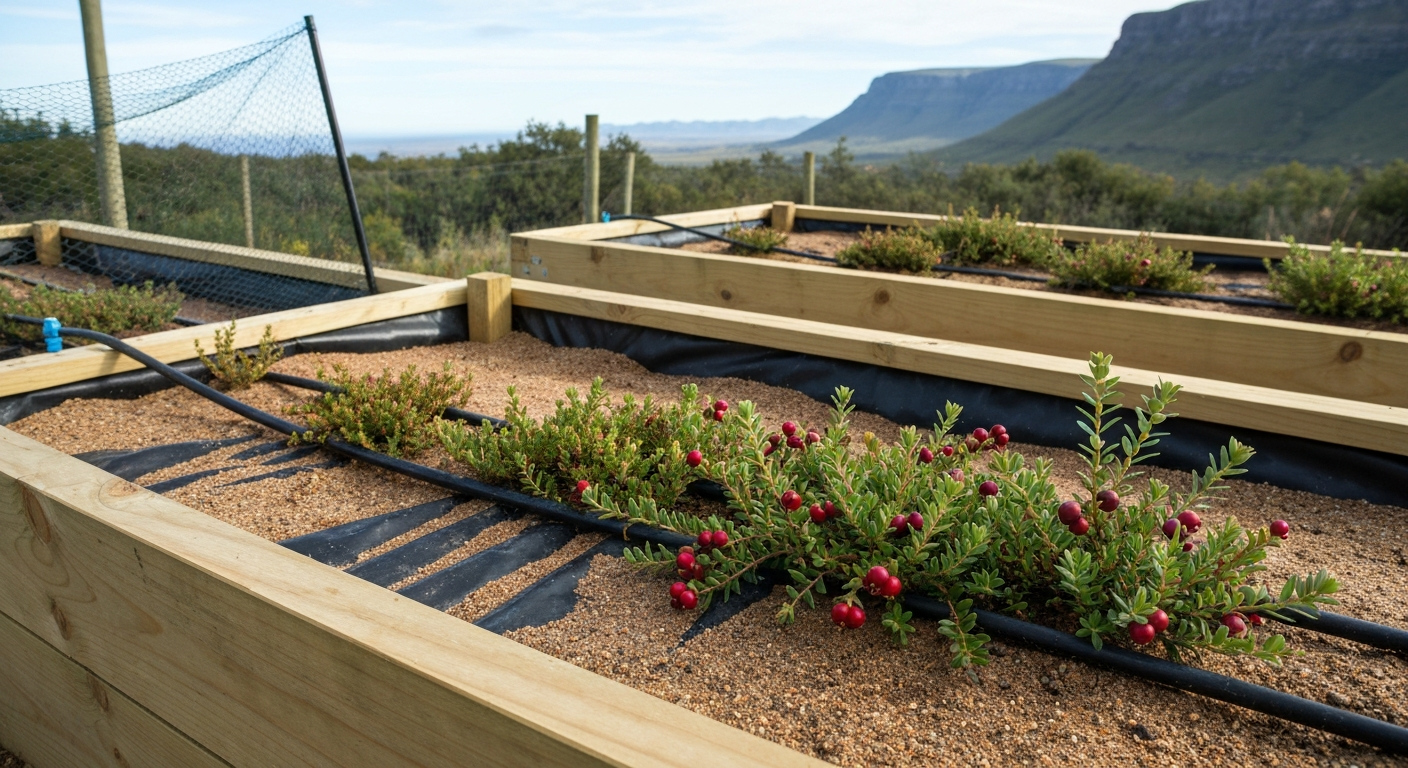
For South African home growers, the upland-inspired approach is far more practical. You build a raised bed or use a container with a peat-sand mix, manage irrigation carefully, and skip the flood infrastructure entirely. You lose the wet-harvest spectacle but gain a manageable system. A small raised bog bed, essentially a lined wooden or brick enclosure filled with a peat-sand mix and kept consistently moist with drip irrigation, is the closest realistic simulation of bog conditions without engineering a wetland in your garden.
How South Africa's regions actually measure up
I want to be straight with you here: most of South Africa is not well suited to cranberry production, and the reasons are consistent across the country's main growing regions. Let me walk through the honest assessment.
| Region | Winter Chill Accumulation | Soil pH | Summer Heat | Overall Cranberry Suitability |
|---|---|---|---|---|
| Western Cape coast (Cape Town, Stellenbosch) | Low (approx. 550-650 Utah units, Villiersdorp/Ladismith data) | Often acidic in fynbos but variable | Moderate | Poor without major soil amendment; chill insufficient for reliable fruiting |
| Ceres / Kouebokkeveld (WC interior) | Higher than coastal WC; best-measured chill in WC fruit studies | Variable, needs amendment | Moderate | Marginal; best Western Cape option for trials |
| Highveld (Free State, high Gauteng) | Better: mean July min ~2.4°C, 13-14 ground frost days | Neutral to alkaline in many areas | Hot summers at lower elevations | Possible with soil amendment; summer heat is a constraint |
| High-altitude Mpumalanga / Limpopo escarpment | Cold winters at altitude | Varies; needs testing | Cooler summers at elevation | Best prospects in SA; still requires engineered acidic rootzone |
| KwaZulu-Natal coast | Very low | Variable | Hot and humid | Not suitable |
| Northern Cape / Karoo | Some cold nights but dry and often alkaline | Alkaline | Very hot | Not suitable |
| Eastern Cape (inland, high elevation) | Moderate chill possible | Needs amendment | Moderate | Marginal; worth trialing in cooler pockets |
The high-altitude escarpment areas of Mpumalanga and Limpopo, places like Lydenburg (Mashishing), Machadodorp, and the Sabie area, come closest to meeting cranberry chill requirements. The Highveld in the Free State also has real cold winters, with the South African Weather Service recording mean July minimum temperatures around 2.4 degrees Celsius and roughly 13 to 14 ground frost days in long-term records. That cold is genuinely useful. The problem is that these regions pair cold winters with hot summers, and Highveld soils are frequently neutral to alkaline. Ceres in the Western Cape is the most-cited cold site in WC fruit-chill research, but field measurements from the Campoy et al. study in the South African Journal of Botany put Villiersdorp and Ladismith at only about 650 and 550 Utah chill units respectively in the 2007 to 2008 season, which falls well short of V. macrocarpon requirements. Ceres accumulates more, but how much more varies by season.
Compared to regions where cranberry growing is more established, South Africa faces compounding challenges. Growers in Ireland benefit from cool, moist Atlantic climates with naturally acidic peaty soils. California's coastal growing pockets have specific microclimates that some Vaccinium species tolerate. For comparison, see the discussion on whether cranberries grow in California (do cranberries grow in California). Texas growers face similar heat constraints to South Africa's Highveld, and Australia shares some of South Africa's challanges in warmer states while its cooler southern zones are more promising. For a useful comparison of how growers cope with heat and chill challenges, see can you grow cranberries in Texas. For a focused comparison of Australian growing conditions and regional advice, see can you grow cranberries in Australia. South Africa's unique combination of strong summer heat, limited chill in accessible regions, and naturally alkaline interior soils makes it one of the harder environments for cranberry cultivation globally.
Which cultivars to consider for South African trials
Because commercial low-chill cranberry cultivars do not yet exist on the market, your cultivar choices are limited to standard V. macrocarpon varieties. Among the commercial cultivars documented in extension literature, Early Black is consistently noted as earlier-maturing and slightly less demanding in terms of season length, which could be an advantage in South Africa's shorter cold-window sites. Stevens is the most widely planted commercial variety globally and a reasonable benchmark for trials. Ben Lear fruits early and is vigorous, making it another candidate for growers with marginal chill accumulation. Mullica Queen is a newer, high-yielding variety that some growers in warmer US zones have had some success with.
If you can source V. oxycoccos, the small European cranberry, it is worth trialing in high-altitude South African sites. It is hardier and more compact, though its berries are small and yields are low. It may tolerate marginal conditions better than V. macrocarpon. The active Vaccinium breeding programs at Rutgers and USDA ARS are working on interspecific hybrids with reduced chilling requirements using V. darrowii genetics, but these are not commercially available to home growers yet. Keep an eye on that space over the next five to ten years.
- Early Black: earlier fruiting, slightly shorter season requirement, good starting point for marginal sites
- Stevens: most widely grown globally, vigorous, reliable benchmark for any trial
- Ben Lear: early maturity, strong vigor, worth including in a multi-variety trial
- Mullica Queen: newer, high-yielding, some reports of resilience in warmer-end growing conditions
- V. oxycoccos (small cranberry): hardy, lower-yielding, better suited to very cold high-altitude sites
Finding the right spot: site selection and microclimate tips
If you are serious about trialing cranberries in South Africa, site selection is where you can meaningfully improve your odds. Cold air pools in low-lying areas on clear nights, so a hollow or valley bottom at high altitude will accumulate more chill than a slope or ridge at the same elevation. This is counterintuitive if you are used to frost-avoiding advice for citrus or subtropical crops, but for cranberries you want the cold, not away from it.
Aspect matters for summer temperature management. In South Africa, a south-facing slope (shaded from the harshest afternoon sun) will run cooler in summer than a north-facing one, reducing heat stress during fruit development. Partial shade from a deciduous tree or structure on the north and west sides of your planting can meaningfully drop midday temperatures by several degrees. If you are growing in containers, you can physically move plants into shade during heat waves above 32 degrees Celsius.
Wind is destructive to the shallow cranberry root system, so a sheltered site or a simple windbreak is valuable, especially on the exposed Highveld. Proximity to a clean, low-pH water source is important: if you can collect rainwater, that is ideal for irrigation. Check your borehole or municipal water pH before committing to a site, because persistent alkaline irrigation water will fight every effort you make to acidify the rootzone.
Growing cranberries in the ground: a step-by-step guide for South Africa
In-ground cranberry cultivation in South Africa is only realistic at sites with genuine cold winters, specifically the high-altitude escarpment areas and cold Highveld pockets described above. Even there, you are building an artificial rootzone rather than planting into existing soil. Here is a practical sequence I would follow.
- Test your soil and water: Send soil samples to a lab for pH, organic matter content, and texture before you do anything else. Test your irrigation water pH too. This gives you a baseline and tells you how much amendment is needed.
- Select and prepare the bed area: Choose a sheltered, south-facing or level site with cold air pooling potential. Mark out a bed no deeper than 30 cm, which is more than enough for the 10 to 20 cm active rootzone. A raised bed framed with sleepers, bricks, or timber is ideal because it gives you full control over the fill.
- Line the bed: Line the base and sides with a waterproof membrane (heavy-duty pond liner is ideal) but pierce the base at intervals for drainage. You want moisture retention but not waterlogging.
- Build the rootzone: Fill with a mix of approximately 60 percent peat (or good-quality peat substitute like coconut coir mixed with composted bark) and 40 percent coarse washed sand. Aim for a final bed depth of 20 to 25 cm of this mix.
- Acidify the rootzone: Before planting, incorporate elemental sulfur at approximately 100 to 150 grams per square meter and mix thoroughly. Wet the bed and wait four to six weeks before planting, then retest pH. Repeat sulfur applications until you reach pH 4.5 to 5.0. This step cannot be rushed.
- Plant the vines: Plant rooted cuttings or nursery plants in late winter to early spring (August to September in South Africa), spacing them 30 to 45 cm apart. Plant at the same depth they were in the pot. Water in well with acidified or rainwater.
- Mulch the surface: Apply a 3 to 5 cm layer of pine bark, pine needle mulch, or acidic wood chip to conserve moisture, suppress weeds, and maintain surface acidity.
- Set up drip irrigation: Cranberries need consistent moisture. Install drip lines or soaker hose along the rows and irrigate to keep the rootzone evenly moist but not saturated. In South Africa's dry winter regions, light watering continues through dormancy to prevent desiccation.
- Fertilize cautiously: Use an acid fertilizer formulated for ericaceous plants (similar to what you'd use for blueberries) at low rates. Cranberries are not heavy feeders and overfertilizing, especially with nitrogen, promotes excessive vegetative growth at the expense of fruit. Apply once in spring as growth begins.
- Prune selectively: In the first two years, allow runners to spread and establish. From year three, lightly prune any dead uprights and excess runners in late winter to maintain bed coverage without overcrowding. Heavy pruning reduces yield.
- Manage late frost risk: If a late frost is forecast after flowering begins (typically October to November), cover the bed overnight with frost cloth. Remove it during the day to allow pollinator access.
- Harvest: Cranberries ripen in late summer to autumn (February to April in the Southern Hemisphere). Ripe berries are deep red, firm, and bounce when dropped, the classic float test works in a bucket of water. Hand-pick or use a hand-rake. Expect modest yields in years one and two, with better production from year three onward once the vines are established.
Container growing: for growers outside the cold zones
If you are in the Western Cape, KwaZulu-Natal, or another region with insufficient outdoor chill accumulation, containers offer a partial workaround. Use large pots (40 litres or more) filled with the same peat-sand mix, acidify to pH 4.5, and grow the plants outside through the cooler months to accumulate whatever chill your location offers. The honest truth is that in Cape Town or Durban, you are unlikely to accumulate enough chill hours for reliable fruiting even in containers, but the plants can survive as ornamentals and may produce occasional fruit in a good cold year. A cold greenhouse or cold room that can hold temperatures of 2 to 7 degrees Celsius for 8 to 12 weeks in winter is a more reliable solution if you are serious, though it is high-effort for a small harvest.
Pests and diseases to watch for in South African conditions
South Africa does not have the established cranberry pest complex of North America, which is actually an advantage. The main threats in a South African garden context are fungal diseases favored by the consistently moist rootzone: Phytophthora root rot is the biggest risk if drainage is inadequate, and Botrytis (grey mould) can attack flowers and young fruit in humid conditions. Keeping the surface mulched, ensuring the bed does not waterlog, and providing good air circulation around the plants manages most of this risk. General garden pests like aphids and spider mites may visit the foliage; standard organic controls (neem oil, insecticidal soap) work fine. Birds will take ripe berries aggressively, so netting is worth the effort as harvest approaches.
Better-adapted berry alternatives for South African growers
I will always encourage a curious grower to try something difficult, but I also think you deserve a straight recommendation: if you want a productive berry garden in South Africa, there are species far better matched to your climate that will reward your effort far more reliably than cranberries. For comparison, see what berries grow in Ireland to learn which cool‑climate species thrive in temperate maritime zones.
- Blueberries (Vaccinium corymbosum and V. ashei hybrids): southern highbush and rabbiteye cultivars bred for low-chill conditions perform well in the Western Cape and Highveld; South Africa has an established commercial blueberry industry and home-garden cultivars are widely available
- Cape gooseberry (Physalis peruviana): native to South America but naturalized and widely grown across South Africa; productive, low-maintenance, and well-adapted to a wide range of South African conditions
- Strawberries (Fragaria x ananassa): cultivated widely across South Africa, with short-day and day-neutral varieties available for different regions
- Mulberries (Morus species): extremely well-adapted to South African conditions, productive, and tolerant of alkaline soils
- Gooseberries and currants (Ribes species): do well in cooler, higher-altitude areas; European gooseberry and blackcurrant perform in the Western Cape and escarpment regions
- Raspberries (Rubus idaeus): perform in higher-altitude, cooler South African sites with the right low-chill cultivar selection
Cranberries are genuinely one of the more demanding berry crops to grow outside their native range. If you are committed to the challenge, the high-altitude escarpment and cold Highveld pockets of South Africa offer the most realistic chance at success. Build your acidic raised bed carefully, source your plants from a reputable South African nursery, choose an early-maturing cultivar like Early Black or Ben Lear, and be patient with the three-year establishment period. Just go in knowing that this is a trial crop requiring ongoing pH management, careful irrigation, and some luck with the chill season, not a guaranteed harvest every year.
FAQ
Do cranberries grow in South Africa?
Yes — cranberries (mostly Vaccinium macrocarpon) can be grown in South Africa at small scale by home gardeners and hobby growers where local conditions or microclimate meet their needs. Commercial‑scale production is not established in SA because cranberries require a combination of substantial winter chill, very acid, organic rootzones and specific water/bed construction that are uncommon or costly to replicate across most SA regions.
What are the key biological and climatic requirements of cranberries?
Cranberries are low, perennial Vaccinium vines with shallow roots concentrated in the top ~10–20 cm of the rootzone. They need: reliable winter chilling (literature commonly cites ~1,000–2,500 chill hours depending on model; many extension sources recommend ~1,200–1,500 hours to be safe), cool summers (hot extremes stress vines), very acid soil (optimal pH ~4.0–5.5), high organic matter (peat or peat‑like rootzone), excellent drainage/aeration, and a dependable water supply for irrigation and, in bog systems, for flood/harvest/frost protection.
How do chill‑hour requirements translate to South African conditions?
Chill totals depend on the chill model used (Utah, daily‑positive/Infruitec, Dynamic). Many coastal Western Cape lowlands accumulate far fewer chill hours than higher‑altitude interior Highveld pockets. Some cooler pockets (mountain valleys like parts of Ceres or highveld areas with mean July Tmin ≈2–3°C) can approach useful chill totals. Home growers should calculate local chill using a daily‑positive or Dynamic model and expect that many coastal and lowland sites will not meet the common ~1,200–1,500‑hour target without artificial chilling or cultivar selection.
Which South African regions are most suitable for growing cranberries?
Most suitable are the coldest, highest‑chill pockets: high altitude Highveld areas and some inland mountain valleys (for example parts of Ceres and similar colder microclimates). Coastal Mediterranean lowlands (Cape Town, lowland Western Cape, KwaZulu‑Natal coast) are generally marginal for high‑chill V. macrocarpon unless using protected microclimates, refrigeration/chill treatments, or low‑chill experimental hybrids.
What are the main challenges to growing cranberries in South Africa?
Primary constraints are insufficient winter chill at many sites, naturally neutral to alkaline soils requiring heavy acidification, lack of native peat (need for peat or substitutes), the need for shallow engineered rootzones and reliable water management, and limited locally bred low‑chill cultivars. Converting soil pH and building peat/sand beds is feasible but input‑intensive.
Which cultivars should South African growers consider?
Commercially common cultivars include 'Stevens', 'Ben Lear', 'Pilgrim', 'Early Black' and 'Mullica Queen'. Because chilling and heat tolerance vary by cultivar, select cultivars known for lower chill or proven performance in milder maritime climates if available. For marginal sites, consider trialing garden nursery material, wild V. oxycoccos (bog cranberry) or experimental low‑chill interspecific hybrids where accessible. Always start with a few plants to evaluate local performance.