
You can grow cranberries in Texas, but it takes real effort and honest expectations. This is not a plant that naturally belongs in your backyard in Dallas or Houston. Cranberries are native to cold, boggy northern climates and they need acidic, peaty, wet soil, a sand cap, and somewhere between 1,000 and 1,500 chill hours per year to flower and fruit reliably. Most of Texas gets nowhere near that. However, with a constructed or container-based bog, careful cultivar selection, and some creative overwintering tactics, gardeners in the cooler corners of the state, think the Texas Panhandle, the Hill Country at elevation, or the far northeast, have a real shot. Gardeners in the lower Rio Grande Valley or coastal zones south of Houston are fighting thermodynamics, and I'll be straight with you about that.
Can You Grow Cranberries in Texas? Site Guide & Methods
What cranberries actually need to thrive
Before mapping Texas onto cranberry requirements, it helps to understand what the plant genuinely needs. Vaccinium macrocarpon (the large American cranberry) evolved in cool, acidic sphagnum peat bogs across the northeastern US and Canada. It is a low, creeping vine that spreads via runners, not a bush. Its roots are extraordinarily shallow, living in the top 6 to 12 inches of the soil profile, and they depend on a very specific chemical and physical environment.
Chill hours
Cranberries need a substantial period of cold dormancy each winter. Under natural daylengths of around 8 to 9 hours, research from UMass Amherst's Cranberry Station found that roughly 1,000 hours below 45°F was sufficient for normal flowering. Under continuous darkness in lab conditions, that figure climbed to about 2,500 hours. A practical working target used by most growers is 1,000 to 1,500 chill hours per season, though the exact number shifts by cultivar, plant age, and which chilling model you use. Textbook and academic overview chapters on Vaccinium note typical chill requirements for Vaccinium macrocarpon of roughly 1,000–1,500 chill hours, while emphasizing variation by cultivar, plant age, and chilling model used blank" rel="noopener noreferrer">Vaccinium (academic overview / book chapter citing cultivar/chill data). There are three common approaches: the simple Chilling Hours model (counting hours between 32°F and 45°F), the Utah model (which weights warm spells negatively), and the Dynamic model (chill portions). The Dynamic model performs better in warm climates with variable winters, so if you are evaluating a Texas site, use it rather than the simple hour count. For reference, the same cultivar 'Stevens' accumulated about 600 chill hours in Oregon versus about 1,800 hours in Massachusetts using the simple model, proof that these numbers vary enormously by site and method.
Soil pH and substrate
Cranberries are among the most pH-demanding plants you will encounter. Commercial bog surveys show average surface soil pH of 4.4 to 4.6, with more than 85% of sites falling between pH 4.0 and 5.0. UMass recommends targeting pH 4.0 to 5.0 for mineral soils with low organic matter, and pH 4.5 or below for soils with more than 5% organic matter. Most Texas soils are alkaline, often pH 7.0 to 8.5 in central and west Texas, which means you cannot simply amend existing ground and expect success. You need to build a completely separate rooting environment.
Water needs and salinity
Cranberries need consistently moist, well-aerated root zones, not flooded year-round, but never drought-stressed. Irrigation water should have a pH around 5.5 to 7.0 and an electrical conductivity below 1.5 mS/cm. Cranberries are genuinely salt-sensitive; elevated soil salinity from hard water, fertilizer over-application, or saline groundwater reduces both growth and yield measurably. In much of West Texas and the southern plains, irrigation water is moderately saline, test your source before you invest in a cranberry setup.
Texas climate zones and where cranberries have any realistic chance
Texas spans USDA Plant Hardiness Zones roughly 6b in the high northern Panhandle through zones 9b and 10a along the lower Rio Grande and Gulf Coast. That is an enormous range, and the cranberry's needs only comfortably align with the colder northern end. The 2023 USDA PHZ map and the PRISM 30-year climate normals (1991–2020) confirm what most Texas gardeners already feel in their bones: winters south of roughly I-20 are too short and too mild for reliable chill accumulation.
| Texas Region | Approx. USDA Zone | Estimated Chill Hours (simple model) | Cranberry Feasibility |
|---|---|---|---|
| Texas Panhandle (Amarillo area) | 6b–7a | 1,000–1,400+ | Best chance in-ground or constructed bog |
| North Texas (Dallas/Fort Worth) | 7b–8a | 600–900 | Container/bog with cultivar selection; marginal |
| East Texas (Piney Woods) | 8a–8b | 500–750 | Container only; challenging |
| Texas Hill Country (700–2,300 ft) | 7b–8b | 500–900 | Elevated sites improve odds; container recommended |
| Central Texas (Austin/San Antonio) | 8b–9a | 300–500 | Very difficult; not recommended |
| Houston/Gulf Coast | 9a–9b | 200–350 | Not practical |
| Lower Rio Grande Valley | 9b–10a | <200 | Not feasible without refrigeration |
The Panhandle is genuinely the sweet spot. Amarillo sits around USDA zone 7a and regularly accumulates chill hours in the range that cranberries need. Gardeners there can attempt a small constructed bog with reasonable optimism. In Dallas or Fort Worth (zone 7b–8a), you are likely getting 600 to 900 chill hours in most winters, which sits at the low edge. A warm December or February can wipe out that margin entirely. In Austin and south, I would redirect your energy to berries that are actually suited to the climate, I cover those alternatives at the end of this article.
Site-selection checklist for Texas gardeners
Before committing materials and time, walk through these questions for your specific location. A site that ticks every box is rare in Texas, but this tells you where to compensate.
- Check your USDA zone using the interactive USDA PHZ map with your ZIP code — zone 7a or colder is the realistic threshold for in-ground attempts.
- Pull your nearest PRISM or NOAA station data for winter temperature hours below 45°F — you want at least 1,000 accumulated hours. If your station doesn't reach that most years, plan for container culture with cold storage assistance.
- Test your tap water or well water pH and EC before buying a single plant. Target pH 5.5–7.0 and EC below 1.5 mS/cm. High sodium or chloride means you need reverse osmosis or a rainwater catchment system.
- Test your native soil pH — not because you'll grow cranberries in it, but because you need to understand how strongly alkaline your underlying soil is before it contaminates a raised bog or container system.
- Assess your site for afternoon shade in summer. Texas summer heat (often 95–105°F) is brutal for cranberry vines; a spot with dappled afternoon shade from a tree or structure will reduce heat stress significantly.
- Identify your lowest elevation point on the property. Cranberry roots need internal drainage; a flat or slightly raised area where you control water level is ideal. Low spots that flood with runoff will drown roots in oxygen-depleted water.
- Consider proximity to a water source. Cranberries need consistent moisture. Hand-watering a bog daily through a Texas August is miserable — plan for drip irrigation from the start.
- Evaluate frost risk in spring. Late frosts in March or April can damage cranberry blossoms. In the Panhandle, this is a real concern and may require frost cloth on hand.
Three ways to grow cranberries in Texas
There is no single approach that works for every Texas grower. Your zone, your water, and your willingness to build infrastructure all determine the right path. Here is a quick comparison before the step-by-step methods.
| Method | Best for | Upfront effort | Best Texas region | Yield potential |
|---|---|---|---|---|
| Constructed bog | Dedicated hobby farmers with space and budget | High — liner, peat, sand, irrigation | Panhandle, North Texas | Moderate if chill is met |
| Container culture | Most home gardeners; easier climate control | Moderate — containers, media, drip setup | Any region with winter chill access | Low to moderate per plant |
| Protected environment (greenhouse/shade house) | South/Central Texas growers wanting to experiment | High — structure + refrigeration for chill | Central Texas and south | Low; experimental only |
Constructed bog method, step by step
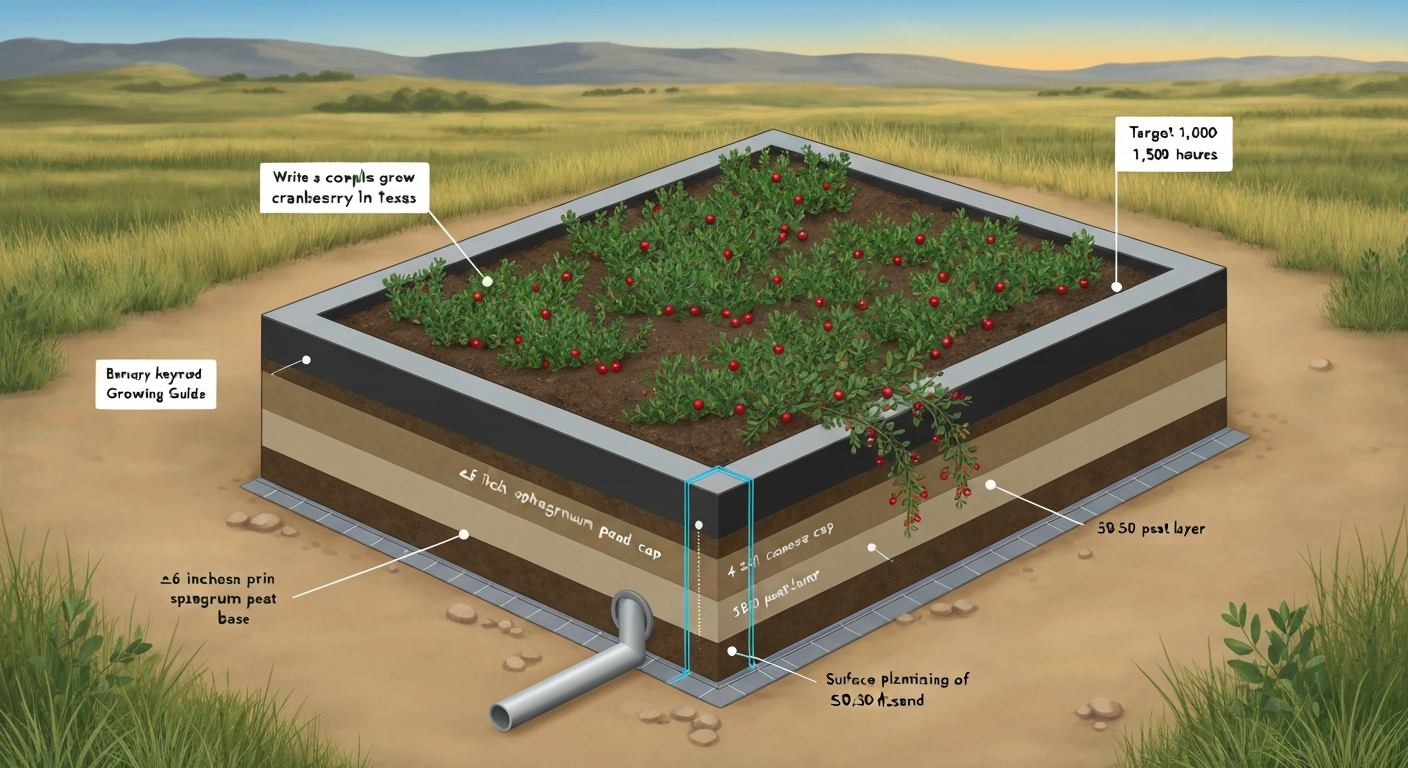
A constructed bog mimics the layered peat-and-sand structure of a commercial cranberry bed. USDA‑ARS technical summaries describe commercial cranberry beds as peatlands modified with an artificial sand cap, typically with about 0.3–1.0 m of sand over the peat USDA‑ARS: peat overlain by ~0.3–1.0 m of sand. Commercial bogs use roughly 0.3 to 1.0 meters of sand over native peat, with water-control structures for flooding and drainage. At home scale, you are essentially building a lined raised bed with a very specific substrate. Here is how I approach it.
- Choose a site at least 4 feet wide and as long as space allows, with full morning sun and afternoon shade if possible. Mark out the perimeter.
- Excavate 18 to 24 inches deep. This depth accommodates drainage, the peat layer, and the sand cap.
- Line the excavation with a thick pond liner (45-mil EPDM works well) to create a water-retaining but manageable structure. Fold the edges up and over a wooden or brick border at least 6 inches. The liner is not meant to hold a permanent flood — it slows percolation and keeps your acidic substrate from mixing with Texas alkaline soil and groundwater.
- Install a 2-inch perforated drain pipe at the base of the liner running to a standpipe at one end. This allows you to control the water level — raising it in summer to keep roots moist, lowering it in winter and during aeration periods.
- Add a 6-inch base layer of sphagnum peat moss. Thoroughly wet the peat before laying it; dry peat is hydrophobic and resists wetting for weeks.
- Top the peat with a 4 to 6-inch layer of coarse sand. Use sand with a particle size of 0.5 to 2.0 mm, with more than 70% coarse fraction and less than 3% silt or clay. Do not use beach sand (too fine, too saline) or builder's sand (often too fine and variable).
- For the final planting layer, use a 50: 50 blend of sphagnum peat and coarse sand approximately 4 to 5 inches deep. This mirrors the simulated-bog research protocols used at Rutgers and other cranberry stations.
- Test and adjust pH of the completed substrate to 4.0 to 4.5 using sulfur or an acidifying amendment. Allow 4 to 6 weeks for sulfur to react before planting; retest before you put any plants in.
- Install drip irrigation at the surface level. Set emitters for each plant or use a soaker line running the length of the bed.
- Plant rooted cranberry cuttings or plugs in spring after your last frost date, spaced 12 to 18 inches apart. Vines will fill in over 2 to 3 seasons via runners.
- Mulch lightly between plants with a thin layer of pine bark fines (keep pH-neutral or acidic mulch only — no wood chips from alkaline species).
Container and raised-bed culture, step by step
For most Texas home gardeners, containers or small raised beds are more practical than a full constructed bog. You get better control over pH, you can move plants to a cooler spot in winter, and startup costs are lower. Research container trials have used 5-gallon setups with a layered peat-and-sand mix successfully for multi-year studies, so the method is well documented.
- Choose containers at least 12 to 16 inches in diameter and 10 to 12 inches deep. Cranberry roots are shallow — 8 to 12 inches of rooting medium is all they need — but depth also provides thermal buffering. Half-barrel planters, large plastic nursery containers, or fabric grow bags all work.
- Drill drainage holes in the base if not already present. Do not use saucers that hold standing water unless you are intentionally managing a high water table by hand.
- Layer the container: start with 2 to 3 inches of sphagnum peat, then fill the remainder with a 60:40 mix of sphagnum peat to coarse horticultural sand (0.5–2.0 mm particle size). Avoid perlite-heavy mixes — cranberries prefer the water retention of peat.
- Test media pH after wetting thoroughly. Target pH 4.0 to 4.5. If your media reads pH 5.5 or above, incorporate elemental sulfur at label rate and wait 3 to 4 weeks before retesting.
- Use acidified water or rainwater to irrigate. If your tap water is pH 7.5 or higher, add a small amount of white vinegar (start with 1 tablespoon per gallon and test the result) or use an acid injector. Always verify EC remains below 1.5 mS/cm.
- Plant one rooted cranberry plant per 12-inch container or space plants 12 inches apart in a larger raised bed. Plant at the same depth as the nursery plug.
- Set up drip emitters or a soaker line. During the Texas growing season (late spring through early fall), plan for watering every 1 to 2 days to keep the peat moist but not waterlogged.
- Position containers where they get morning sun and afternoon shade in summer. Concrete patios and full-sun exposure in July will cook the shallow roots — elevated heat is one of the main killers of container cranberries in Texas.
- In winter, move containers to the coolest outdoor spot available — ideally against a north-facing wall or under a tree canopy that still allows cold air to settle. You need the plant exposed to cold, not protected from it.
Managing irrigation and water in a Texas climate
Commercial cranberry operations flood bogs for harvest and winter protection, but you almost certainly will not replicate that at home scale in Texas. What matters more for the backyard grower is consistent soil moisture, appropriate water chemistry, and drought resilience, because Texas summers are brutal and water restrictions are common in many municipalities.
For constructed bogs, use the standpipe water-control structure to maintain the water table at roughly 8 to 12 inches below the sand surface during the growing season. You are keeping the peat moist without saturating the root zone above it. In peak summer heat (July and August in Texas), you may need to raise the water table slightly higher, to 6 to 8 inches below the surface, to compensate for evapotranspiration. Lower the water table in late fall and early winter to allow roots to harden off properly.
For containers, run drip emitters on a timer. In summer, every-other-day deep watering is typical; in cooler months, scale back to twice weekly. Always water until you see runoff from the drainage holes, partial watering concentrates salts in the root zone over time, which is damaging. During drought advisories, prioritize cranberries over ornamentals but consider whether the effort is justified relative to the yield you're getting.
Test your irrigation source at least once per season for pH and EC. Well water quality in Texas varies enormously by county, some Hill Country wells run at EC 2.0 mS/cm or above, which is above the safe threshold for cranberries. Rainwater harvesting is genuinely the best irrigation source for cranberries in Texas: it arrives naturally soft, acidic, and low in dissolved salts.
Overwintering and chill strategies for Texas
This is the hardest part of growing cranberries in Texas, and I will not sugar-coat it. If your location does not naturally accumulate around 1,000 hours below 45°F during winter, you need a workaround, or you need to reconsider your crop.
Natural chill, Panhandle and North Texas
In the Texas Panhandle, most winters deliver adequate natural chill. Amarillo averages temperatures below 45°F for substantial portions of November through February. Site your bog or containers where cold air settles (low spots, north-facing exposures) and avoid areas warmed by thermal mass like south-facing brick walls. Let the plants experience cold naturally, do not protect them from frost unless temperatures are dropping below 10°F for extended periods, which is unusual but possible during extreme cold events.
Marginal chill zones, Dallas to the Hill Country
Here you are working with 600 to 900 chill hours in a typical winter, which is below the safe threshold. Three tactics help. First, select cultivars known to perform with lower chill requirements (more on that below). Second, elevate the site if possible, even a 500-foot elevation gain in the Hill Country can add 100 to 200 chill hours annually. Third, use containers so you can move plants to unheated but cold structures (garages, sheds, or cool greenhouses) during warm spells in December and January that would otherwise interrupt chill accumulation. An unheated garage in Dallas can hover around 35 to 45°F on winter nights, which is exactly the chill range you need.
Artificial chill, Central Texas and south
South of roughly San Antonio, natural chill is so limited that some growers resort to cold-storage chilling: container plants are moved into a domestic refrigerator or a dedicated cool room and held at 35 to 45°F for 6 to 8 weeks during what would normally be winter. This works on a very small scale (a few pots) and is genuinely used for other difficult-to-chill fruit plants. It is labor-intensive and the yields are rarely worth the effort, but if you are determined, it is technically feasible. The bigger practical challenge south of Austin is summer heat damage, which compounds the difficulty.
Planting-to-harvest timeline and seasonal calendar for Texas
Cranberries are a long-term investment. Even under ideal conditions, you should not expect a meaningful harvest until year 3, and full production from a small home bog typically comes in years 4 to 5. Here is a realistic calendar for Texas growers, broken into first-year establishment and ongoing steady-state management.
| Season/Month | First-Year Tasks | Steady-State Tasks |
|---|---|---|
| Late winter (Jan–Feb) | Build bog or prepare containers; source and amend substrate; test pH | Monitor water table; check for frost damage on new growth tips |
| Spring (Mar–Apr) | Plant rooted cuttings after last frost; set up drip irrigation; mulch lightly | Watch for late frosts protecting flower buds; apply sulfur if pH has drifted above 5.0 |
| Late spring (May) | Monitor for establishment; water every 1–2 days as temps rise | Hand-pollination or introduction of pollinators if bee activity is low |
| Summer (Jun–Aug) | Keep peat consistently moist; shade afternoon sun; watch for pests | Maintain water table; watch for fungal disease in humid East Texas; fertilize lightly with acidic fertilizer |
| Fall (Sep–Oct) | Allow runners to establish; reduce watering slightly | Harvest ripe berries (red, firm); lower water table to allow hardening off |
| Winter (Nov–Feb) | Expose plants to cold naturally; do not protect unless below 10°F | Allow chill accumulation; move containers to coldest safe outdoor spot; do not fertilize |
In year one, your only goal is establishing a healthy root system and encouraging runner spread. Year two, runners should be filling the bed and you may see a handful of flowers, do not expect significant fruit yet. Year three is when you start to see real fruiting, assuming chill was adequate. In the Panhandle under a well-built bog, year 3 to 4 berry set can be genuinely exciting. In Dallas or East Texas, be prepared for inconsistency depending on how mild each winter turns out to be.
Cultivar recommendations for Texas conditions
Not all cranberry varieties are equal when it comes to chill tolerance and heat performance. Unfortunately, cultivar-specific low-chill cranberry breeding is not as advanced as it is for blueberries or peaches, so options are limited. That said, a few varieties are worth considering.
- Stevens: The most widely grown commercial cultivar in North America. Productive and reliable in cooler regions, but it is one of the higher-chill-demand varieties. Best suited to the Texas Panhandle where natural chill is adequate. Oregon trials of Stevens accumulated around 600 chill hours under the simple model — suggesting it can fruit with less than the Massachusetts standard, but it performs best with 1,000+ hours.
- Ben Lear: An early-ripening variety (September in northern zones) that may be slightly more forgiving of marginal winters. It is widely available from nurseries and worth trying in North Texas.
- Early Black: An heirloom variety known for early maturity and good flavor. Less commonly sold but available through specialty cranberry nurseries. Its earlier dormancy break may be either an advantage or a risk depending on your last frost date.
- Pilgrim: A later-ripening large-berried cultivar — not ideal for Texas because its longer season runs into heat stress. Better for the Panhandle than anywhere south.
- For warmer zones (Central Texas and south): There are no commercially available warm-adapted cranberry cultivars that I am aware of for this climate zone. Hobbyists in these areas may experiment with wild collected material from southern edge populations, but this is genuinely exploratory territory.
For sourcing plants, look for rooted cuttings or plug plants from specialty berry nurseries in the Pacific Northwest or Northeast. Some mail-order nurseries ship bare-root cuttings in spring. Avoid purchasing plants from general garden centers that sell generic 'cranberry' without cultivar identification, you have no way to know what you are getting. Local Texas nurseries rarely stock cranberries, so plan to order online in January or February for spring delivery.
Pests, diseases, and common problems in Texas
Texas cranberry growers face a different pest and disease pressure than New England commercial operations. Here are the problems most likely to affect you.
- Root rot (Phytophthora cinnamomi and related species): The biggest disease risk in Texas. Warm, poorly aerated soil is ideal for Phytophthora. Maintain good drainage in your bog or container, never let water stand above the sand surface for extended periods in summer, and avoid over-watering. Prevention is the only realistic strategy — there is no good curative treatment for established root rot.
- Mummy berry (Monilinia oxycocci): A fungal disease that causes infected berries to shrivel and fall. Common in commercial operations, less common at home scale but possible in humid East Texas. Remove and destroy mummified fruit; do not compost it. Copper-based fungicides applied at early bloom can reduce infection.
- Cranberry fruitworm and tipworm: Caterpillar pests that damage developing fruit and growing tips. Bt (Bacillus thuringiensis) sprays applied at bloom and again after petal fall are effective and low-impact. Monitor for hollowed-out or prematurely reddened berries.
- Spider mites: A serious problem in hot, dry Texas summers. Mites thrive when cranberry vines are heat-stressed. Maintain moisture, provide afternoon shade, and knock back mite populations with strong water sprays or insecticidal soap if populations escalate.
- pH creep: Not a pest, but one of the most common cultural problems. Texas water and soils naturally push pH upward over time. Test your substrate pH every spring and correct with elemental sulfur or an acidifying fertilizer. If pH climbs above 5.5, plants will show yellowing, poor growth, and reduced fruit set — classic iron chlorosis from pH-induced nutrient lockout.
- Heat scorch: Extended temperatures above 95°F cause tip die-back and leaf scorch on cranberry vines. Afternoon shade cloth (30 to 50% shade rating) significantly reduces this in Texas summers.
- Salt accumulation: In containers especially, repeated irrigation with moderately hard water concentrates salts over time. Flush containers thoroughly every 4 to 6 weeks with low-EC water (rainwater is ideal) to leach accumulated salts.
Realistic yield and maintenance expectations
I want to be direct here because inflated expectations are the fastest way to get frustrated and abandon a project. A mature, well-managed small home cranberry bog (say, 4 by 8 feet) in a good chill zone like the Panhandle might yield 2 to 4 pounds of berries in a good year from year 4 onwards. A single container plant in a marginal zone might produce a handful of berries, or nothing at all in a warm winter year. These are not commercial yields, and cranberries will never replace your Thanksgiving supply from the grocery store unless you build something at a much larger scale.
The maintenance commitment is real: pH monitoring two to three times per year, consistent irrigation through Texas summers, pest scouting, annual substrate checks, and attention to water quality. If you enjoy the process and the challenge of growing something unusual, cranberries in Texas can be a genuinely interesting project. If you are primarily motivated by fruit yields, redirect that energy toward blueberries, blackberries, or other berries that naturally thrive in your zone, I cover the best alternatives below.
How Texas compares to other regions for cranberry growing
Comparing Texas to other warm or temperate regions puts the challenge in perspective. California's northern coast and higher-elevation inland valleys share some similarities with North Texas, adequate chill in the mountains, marginal chill in the Central Valley, and the same container and constructed-bog approaches that apply in Texas work there too, though California growers benefit from less extreme summer heat in coastal areas. For more detail on regional suitability and practical tips for growers there, see do cranberries grow in California. In contrast, Ireland's Atlantic climate delivers mild, moist winters with moderate but consistent chill accumulation and naturally acidic upland soils, making it genuinely better suited to cranberry culture than most of Texas without the substrate engineering. For more on comparable crops and what berries grow in Ireland, see that guide. If you wonder can you grow cranberries in Ireland, consult region-specific guidance comparing Ireland's chill hours and naturally acidic soils to cranberry requirements. South Africa's situation is roughly comparable to southern Texas: most of the country is too warm and too dry for cranberries without substantial infrastructure, and the same alternatives apply. For a focused discussion, see do cranberries grow in South Africa for regional details and practical options. If you are asking can you grow cranberries in Australia, the same constraints apply there: sufficient winter chill and the ability to provide an acidic, peaty root substrate are the primary limiting factors. The key takeaway for Texas growers comparing notes with other warm-climate regions is that chill hours and substrate pH are the universal constraints, everywhere, without exception.
Better alternatives: berries that actually thrive in Texas
If the cranberry requirements sound like too much work for your zone, you are not missing out on homegrown berries, Texas has excellent options that take far less engineering. These are the ones I recommend as practical cranberry alternatives, depending on your region.
| Berry | Best Texas Regions | USDA Zones | Why it works |
|---|---|---|---|
| Southern highbush blueberry | East Texas, North Texas, Hill Country | 7–9 | Bred for low-chill climates; acidic, well-drained soil; reliable yields |
| Rabbiteye blueberry | East Texas especially | 7b–9a | Drought-tolerant once established; lower chill than highbush; very productive |
| Blackberries (thornless varieties) | Statewide | 6–9 | Extremely heat-tolerant; productive with minimal inputs; Texas superstar fruit |
| Muscadine grapes | East and Central Texas | 7–9 | Native to the American South; disease-resistant; low maintenance |
| Dewberries | Statewide (native) | 6–10 | Native Texas ground-trailing vine; minimal care; spring fruit |
| Strawberries (day-neutral varieties) | Statewide as cool-season annual | 6–10 | Grown as a fall/winter annual in Central and South Texas; highly productive |
Rabbiteye blueberries are genuinely the closest thing to a bog-berry alternative for Texas. They need acidic soil (pH 4.5 to 5.5), tolerate summer heat far better than cranberries, and produce prolifically in East Texas conditions. Southern highbush varieties like 'Sunshine Blue' and 'O'Neal' work in zones 7 and 8 with significantly less infrastructure than a cranberry bog demands.
Where to get plants and next steps
If you are going ahead with cranberries, here are the concrete next steps. Contact the Texas A&M AgriLife Extension Service for your county, they can provide soil test analysis and connect you with local horticultural staff who know your specific microclimate. For plants, search for specialty cranberry nurseries in Massachusetts, Oregon, or Wisconsin; many ship rooted cuttings in spring. Order by February for April delivery. For water testing, many county extension offices offer basic irrigation water quality testing, or you can use a private lab.
If you are comparing your Texas situation to another warm-climate region, whether you have connections in California, are reading this from Australia, or are curious about how Ireland's conditions stack up, the same core questions apply everywhere: does your winter deliver 1,000+ chill hours, and can you build and maintain a genuinely acidic, peaty root environment? Those two questions answer almost everything else.
FAQ
Short verdict — can you grow cranberries in Texas?
Yes, but only in limited Texas locations or with deliberate adaptations. Cranberries can be grown where winter chill and site conditions meet their needs (cool winters, sufficient chill accumulation, acidic low‑fertility substrates and reliable water control). In much of Texas, natural winter chill is insufficient for reliable flowering and yields without mitigation (site selection, high‑elevation/cool microclimates, or artificial chill and protected/container culture). Successful small‑scale production is possible with constructed bogs or container/simulated‑bog systems and careful management.
Checklist to judge a specific Texas site (quick decision points)
1) USDA zone/elevation: locate your ZIP on the USDA map — cooler zones (roughly USDA 6b–8a) or higher elevations have better odds. 2) Winter chill: estimate typical annual chill using local PRISM or station data and convert with a chosen model (Dynamic model recommended for warm/winter‑fluctuating climates); look for effective chill roughly in the 1,000±500 chill‑hour/portion range depending on cultivar. 3) Minimum winter temps: frequent nightly minima in the 30–45°F range during late fall–winter are important. 4) Water: access to fresh, low‑salinity irrigation and ability to hold and drain water (pond, lined bed, or containers). 5) Soil: ability to build/maintain very acidic (pH ~4.0–4.5) peat/sand substrate or ericaceous container mix. 6) Microclimate controls: sites with cool nights, shade from afternoon heat, north‑facing slopes, or near large water bodies that moderate temperature help. If you can’t meet most items, consider alternative acid‑loving berries.
How important is winter chill, and how to assess it in Texas?
Cranberries need substantial winter chill to break dormancy and set flowers; literature cites typical cultivar requirements around ~1,000–1,500 chill hours (model dependent). Use local climate normals (PRISM) or station data to calculate chill with an appropriate model — the Dynamic (chill portions) model performs better in warm/variable winters than simple 32–45°F chill‑hours. Evaluate historical winters for duration and frequency of minima between ~30–51°F and consider daylength timing because photoperiod affects chill effectiveness. If your site consistently records low chill by these measures, expect poor flowering without artificial chill or protected culture.
Two practical ways to grow cranberries in Texas — overview
1) Constructed/lined bog (best for hobby farms with water access): build a peat/organic base with an engineered liner/hardpan, add coarse sand cap, and install water control for winter/harvest flooding and drainage. 2) Container/simulated bog (best for home gardeners & warm sites): deep containers (8–12" rooting depth) with layered ericaceous media (peat/peat substitute + coarse sand or horticultural grit) and irrigation; containers allow relocation for winter chill or refrigeration and avoid need for large water control structures.
Step‑by‑step: constructed bog basics for Texas (small hobby scale)
1) Site: choose cool microclimate with access to clean, low‑salinity water and flat area. 2) Liner: install an impermeable liner or compacted clay hardpan to separate bed from groundwater and to allow water control. 3) Base: place ~20–30 cm (8–12") of decomposed peat/organic layer as rooting zone. 4) Sand cap: cover with coarse sand (0.5–2.0 mm particle size) of 3–8 cm initially for establishment; commercial bogs use thicker sand caps over years. 5) Planting: space runners or plugs per cultivar guidance (e.g., 12–18" between plants in rows). 6) Water control: install inlet/outlet structures to allow bed saturation, drainage, and occasional flooding for frost/harvest. 7) pH and fertility: target soil pH 4.0–4.5; use ericaceous fertilizers and avoid lime. 8) Management: annual sanding (small amounts), pest scouting, and monitor salinity and nutrient levels. Note: constructed bogs require substantial materials and labor; consider containers if resources are limited.
Step‑by‑step: container/simulated bog method for Texas gardeners
1) Container size: use deep pots/planters with 8–12" rooting depth (5+ gallon or larger). 2) Media: layer ~2–3" coarse peat or acid ericaceous mix, then 3–4" coarse sand, then a 4–6" upper layer of 50:50 peat:sand or ericaceous potting mix with coarse grit for drainage. 3) pH target: adjust mix to pH ~4.0–4.5 (acidic fertilizers or elemental sulfur in small amounts can lower pH over months). 4) Planting: set one crown/plug per container or multiple smaller plants if space allows with 12" spacing equivalent. 5) Water: keep media consistently moist but not saline; use low‑salt water and avoid high soluble salts. 6) Chill strategy: move containers outdoors to cold location for natural chill if your site gets adequate chill; if not, overwinter containers in an unheated garage, cellar or use refrigerated storage to accumulate chill hours (see chilling guidance). 7) Spring: return to full sun after budbreak; provide fertigation with ericaceous fertilizer. 8) Advantages: portability, lower material needs, and easier experiment/control of chill and water.