
Yes, you can grow cranberries in Ireland, and honestly the Irish climate is better suited to them than most people expect. Ireland's cool, wet summers, mild winters, and naturally acidic soils in many regions tick most of the boxes cranberries need. The catch is that you have to replicate their very specific soil and moisture conditions at a small scale, because simply planting them in the ground and hoping for the best rarely works. Get the setup right, however, and cranberries will thrive in an Irish garden.
Can you grow cranberries in Ireland? Guide for home growers
Marcus Holloway
22 Jul 2026
Decision checklist for Irish growers
Before you commit time and materials, run through these requirements honestly. Cranberries are not difficult plants once established, but the upfront preparation is specific. If you can check every box below, you are a realistic candidate for a productive cranberry patch.
- Site: Full sun for at least 6 hours a day. South or south-west facing is ideal in Ireland. Cranberries tolerate some afternoon cloud but fruit production drops sharply in deep shade.
- Soil/substrate: You will need to build or buy an acidic medium. Target pH 4.0 to 5.5. Most Irish garden soil is not acidic enough without amendment, even in the west.
- Water: Constant, consistent moisture throughout the growing season. The root zone must never fully dry out. A water butt, drip line, or reliable hose access is non-negotiable.
- Drainage paradox: Despite needing moisture, roots sitting in stagnant water rot quickly. You need moisture-retentive but not waterlogged conditions, which means a controlled setup.
- Time to first harvest: Expect 2 to 3 years before a meaningful berry crop. Year one is establishment, year two is vine spread, year three typically delivers your first real pick.
- Commitment: Cranberries are long-lived perennials (commercial beds are managed for decades), but they require annual pH checks, weed management, and moisture monitoring. This is a multi-year relationship.
- Space: A 1 square metre bed is enough to get started and produces a useful harvest. Containers of 38 to 45 cm diameter work too, though yield per plant is lower.
Ireland's climate and how well it suits cranberries
Ireland's 30-year climate averages (1991 to 2020, Met Éireann) describe a cool temperate maritime climate with mean annual temperatures ranging from about 9 to 11°C and annual rainfall between roughly 750 mm in the drier east to well over 2,000 mm in parts of Connacht and Munster. For cranberries, this is broadly good news. The plants are native to northern temperate bogs, evolved in exactly this kind of cool, moist, frost-punctuated climate.
Chilling requirement is one metric worth flagging. Cranberries need a sustained period of cold (generally below 7°C) to break dormancy and set fruit reliably. Irish winters deliver this comfortably, with most inland stations recording several weeks of temperatures well below that threshold. Coastal locations in the south-west, particularly around Cork and Kerry, are slightly warmer in winter, but still cold enough to satisfy cranberry dormancy needs without issue.
Summer temperatures are the main constraint worth watching. Commercial cranberry production in North America typically occurs in regions with warm summers (Massachusetts, Wisconsin, Oregon), where July highs regularly push 25 to 28°C, driving rapid fruit development. Irish summers are cooler: average July maxima are around 18 to 20°C across most of the country. This means slower fruit ripening, so early-season cultivars that can set and ripen a crop in a shorter warm window are a better choice than late-maturing varieties.
Microclimates matter a lot in Ireland. A south-facing raised bed against a brick wall in Dublin or a sheltered garden in Wexford or Kilkenny will be meaningfully warmer during the growing season than an exposed west-facing site in Galway or Donegal. If you are in the midlands or eastern counties, you have a small but real advantage in summer heat accumulation. Western and northern growers can compensate with polytunnel edges or heat-retaining walls, but outdoor growing is still viable with the right cultivar.
Frost statistics from Met Éireann show that ground frosts can occur from October through to April in inland areas, with coastal sites seeing fewer frost days overall. Late spring frosts (April) are the most damaging to cranberry uprights once they break dormancy, so having flood irrigation or a fleece cover ready in April is wise insurance.
The two cranberry types: which one is right for your garden?
Not all cranberries are the same plant, and choosing the right species for your setup makes a significant difference to how hard you have to work.
Large-fruited American cranberry (Vaccinium macrocarpon)
This is the supermarket cranberry. V. macrocarpon produces the large, commercial-quality fruits most people picture. It grows as a low, trailing woody vine that spreads by stolons across a substrate surface, with upright flowering and fruiting shoots. It is fully cold-hardy in Ireland and has been trialled in parts of Central and Eastern Europe with cultivars like 'Pilgrim', 'Stevens', 'Ben Lear', and 'Early Black' performing well. The trade-off is that it demands more precise soil, moisture, and pH management than its European cousin. It also takes longer to establish a productive carpet of vines.
European bog cranberry (Vaccinium oxycoccos)
V. oxycoccos is native to northern Europe and, in fact, grows wild in Irish bogs and wet heathland. Vaccinium oxycoccos (European/bog cranberry) is native and widespread across northern Europe and is adapted to wet, acidic peatland conditions, it can be easier to establish in boggy/wet garden features and in raised beds mimicking fens/peat bogs than large‑fruited V. macrocarpon blank" rel="noopener noreferrer">Vaccinium oxycoccos is native and widespread across northern Europe and is adapted to wet, acidic peatland conditions.. It is a much smaller, more delicate-looking plant with tiny round leaves and thin, wiry stems, producing small, slightly tart red berries. Because it evolved in exactly the conditions Ireland offers naturally, it establishes more easily, tolerates wetter and more variable conditions, and is genuinely forgiving for a first-time grower. The berries are smaller and less fleshy than V. macrocarpon, but they are still useful in the kitchen and the plant is far less demanding.
| Feature | V. macrocarpon (American) | V. oxycoccos (European bog) |
|---|---|---|
| Berry size | Large, commercial-grade (15 to 22 mm) | Small (6 to 10 mm) |
| Vine habit | Trailing with upright shoots, spreads by stolons | Thin, wiry creeping stems |
| Hardiness in Ireland | Fully hardy | Fully hardy, native to region |
| Ease of establishment | Moderate, needs prepared substrate | Easy, tolerates natural bog conditions |
| pH tolerance | 4.0 to 5.5, strict | 4.0 to 5.5, similar but more forgiving |
| Water needs | High, consistent moisture required | High, naturally bog-adapted |
| Time to harvest | 2 to 3 years | 1 to 2 years |
| Best use | Dedicated bog bed or raised bed | Bog garden feature, naturalistic planting |
My honest recommendation: if you want the full cranberry sauce experience and are willing to build a proper growing setup, go with V. macrocarpon using a cultivar like 'Ben Lear' or 'Stevens'. If you want something easier and more naturally at home in an Irish garden, V. oxycoccos is a satisfying plant to grow and a great introduction to the Vaccinium family.
Soil, pH, water: the non-negotiables
Cranberries are ericaceous plants, meaning they need genuinely acidic conditions to absorb nutrients properly. The target pH range is 4.0 to 5.5, with most extension guidance from UMass Cranberry Station and Wisconsin research trials pointing to an optimum around 4.5 to 5.2. Above pH 5.5, plants start showing chlorosis (yellowing leaves caused by iron deficiency) and performance drops noticeably. Standard Irish garden soil, unless it is already over a deep peat profile, tends to sit at pH 6.0 to 7.0 in most cultivated gardens, so you will almost certainly need to build a dedicated growing environment rather than amend in place.
The substrate itself should mimic natural bog conditions: high in organic matter, free of lime, moisture-retentive but not compacted. Ericaceous compost blended with perlite or coarse horticultural grit works well for raised beds and containers. A thin surface layer of coarse horticultural sand (about 2 to 3 cm) helps anchor stolons and keeps the root zone from crusting or compacting. Avoid using garden compost made from lime-loving kitchen scraps, mushroom compost, or anything containing chalk.
Water management is where most home growers either succeed or fail with cranberries. The roots sit very close to the surface (typically within the top 15 to 20 cm of substrate) and have no deep taproot to draw on during dry periods. In a constructed bed, you are aiming for consistent, near-surface moisture throughout April to October. During a dry Irish summer, which does happen, particularly in the east and midlands, you may need to water every 2 to 3 days. Drip irrigation or a soaker hose connected to a water butt is the most consistent approach.
A note on peat and bog habitats in Ireland
This is worth pausing on, because Ireland has a complicated relationship with peat. Irish bogs are some of the most ecologically important habitats in Europe, and many are protected. The idea of using garden peat to simulate a bog feels ironic when you know it comes from exactly the kind of habitat cranberries naturally inhabit. I would encourage Irish growers to avoid buying bagged horticultural peat where possible and instead use peat-free ericaceous compost, composted bark, or pine needle mulch to create the acidic conditions cranberries need.
Peat-free ericaceous composts are now widely available from Irish garden centres and perform well for Vaccinium plants. Composted pine bark acidifies effectively over time and improves soil structure. Sulfur chips can be used to lower pH of a substrate that is slightly too high, working gradually over several months. Using these alternatives is not just an environmental choice; it is also better horticulture, since modern peat-free mixes are more consistent and less variable than raw peat in pH and structure.
Growing option A: building a small backyard bog
A constructed bog bed is the closest you can get to natural cranberry conditions in a home garden. It takes a weekend to build and lasts for many years. Here is how to set one up.
- Choose your site: Full sun, at least 6 hours daily. A south-facing spot away from large tree roots is ideal. Minimum size is 1 square metre; 2 to 3 square metres gives a meaningful yield.
- Excavate: Dig down 30 to 35 cm. Remove all existing soil. This depth gives you room for the liner, drainage layer, substrate, and a sand surface mulch.
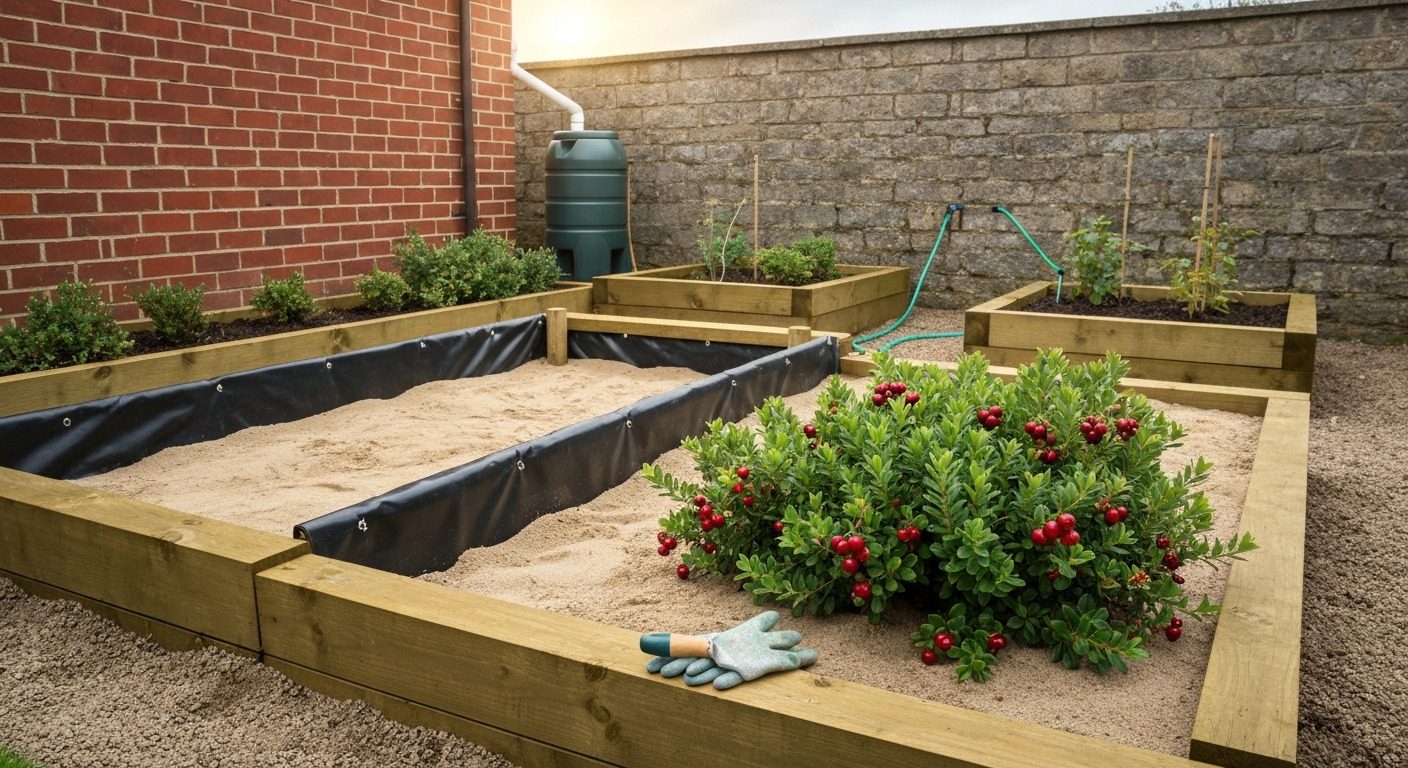
- Line the bed: Use a heavy-duty butyl rubber pond liner or thick black polythene (200 micron minimum). Lay it into the excavation, leaving it uncut at this stage. Critically, pierce drainage holes every 20 to 25 cm across the base using a garden fork or skewer. You need retained moisture, not standing water, so this step prevents bog-out in wet Irish winters.
- Add a drainage base: Place a 3 to 5 cm layer of coarse horticultural grit or washed pea gravel at the base over the liner.
- Mix and fill your substrate: Combine 70% peat-free ericaceous compost with 30% coarse horticultural grit or perlite. Fill to within 5 cm of the top. Firm gently but do not compact.
- Check and adjust pH: Test the substrate pH with a digital meter or test kit. Aim for 4.5 to 5.0. If above 5.5, incorporate sulfur chips at the rate recommended on the packet and retest after 4 to 6 weeks.
- Add a sand surface layer: Spread 2 to 3 cm of coarse horticultural sand over the surface. This mimics commercial sand management, helps anchor stolons, and reduces weed germination.
- Plant your cranberries: Space plug plants or pot-grown vines at 30 to 45 cm apart. Plant at the same depth as the nursery pot. Water in with rainwater (tap water in Ireland is often limed and can raise pH over time).
- Mulch edges: Pin the liner trim and edge the bed with timber sleepers, brick, or stone to keep the substrate contained and prevent surrounding soil from contaminating the pH zone.
- Water and monitor: Keep substrate consistently moist from planting through to the first autumn. Check pH annually each spring using a meter pushed into the substrate. Adjust with sulfur or water-in iron sulphate solution if pH drifts above 5.5.
Growing option B: raised beds for cranberries
A raised bed gives you better drainage control and is easier to manage pH and moisture in, particularly if your garden has heavy clay underneath or limited space. It also warms up faster in spring, which matters for ripening in cooler Irish locations. Here is the step-by-step setup.
- Build or source a raised bed: Timber (untreated hardwood or larch), stone, or brick all work. Aim for a bed depth of at least 25 to 30 cm above ground level. Width should not exceed 120 cm so you can reach the centre without stepping in.
- Line the interior: Use a pond liner or heavy polythene on the inside walls and base to prevent pH contamination from surrounding soil and to slow drainage just enough to retain moisture. Pierce the base with drainage holes as described in Option A.
- Fill with the acid mix: Use the same 70/30 ericaceous compost and grit blend. For a raised bed, you can also add 10 to 15% composted pine bark for additional acidity and long-term structure.
- Test your pH before planting: Raised beds in particular can vary in pH depending on compost batch. Check and adjust to 4.5 to 5.0 before any plants go in. Getting this right at the start saves considerable trouble later.
- Plant at correct root depth: Cranberry roots are shallow. Do not plant deeper than 15 cm. Spread the roots gently, firm lightly, and apply the sand surface mulch over the whole bed.
- Install irrigation: A simple soaker hose laid across the bed surface, connected to a water butt filled with rainwater, is the most effective watering system for a raised cranberry bed. Set it to run for 20 to 30 minutes every 2 to 3 days during dry periods from May to September.
- Space and cultivar: For a raised bed of 1 by 1.5 metres, plant 6 to 8 plug plants of V. macrocarpon spaced 30 to 40 cm apart. 'Ben Lear' or 'Stevens' are the most available in European nurseries and perform well in cooler climates.
- Ongoing care: Each spring, top-dress with a thin layer of fresh ericaceous compost and a new sand surface mulch where the old layer has degraded. Remove weeds by hand: do not hoe or fork through the surface as this damages the shallow stolons. Feed with a half-strength liquid ericaceous fertiliser once in May and once in June.
Cultivar choice and where to source plants in Ireland
In Ireland, sourcing cranberry plants requires a little more effort than popping to the local garden centre. Most larger garden centres stock ericaceous Vaccinium plants (blueberries and bilberries are common), but named cranberry cultivars are less reliably stocked. A few online Irish and UK specialist nurseries carry V. macrocarpon cultivars, particularly in spring (March to May). Look for 'Ben Lear', a reliable early-season cultivar with good cold tolerance and large fruit suited to cool European climates. 'Stevens' is another strong choice: a mid-season variety with consistently good yield that has featured in several European trial reports. 'Early Black' is an older heritage cultivar with smaller berries but good flavour and disease resistance worth considering.
One important note: when buying plants, particularly rooted cuttings or plug plants sourced from mainland Europe, be aware that Diaporthe vaccinii (formerly Phomopsis vaccinii) is a regulated pathogen affecting Vaccinium species, causing twig blight, fruit rot, and upright dieback. It is listed as a concern by EPPO (European and Mediterranean Plant Protection Organization), and plants imported via the ornamental or plants-for-planting trade have been flagged as a risk pathway. Buy from reputable nurseries with healthy stock certificates and inspect plants on arrival. Any plants with blackened or shrivelled stems or rotted fruit tissue should be rejected.
Planting schedule and routine care through the year
| Month | Task |
|---|---|
| March | Prepare and pH-test bed or raised container. Order plants if not already done. |
| April | Plant out once risk of hard frost has passed (late April for inland areas). Water in with rainwater. Apply sand mulch. |
| May to June | Water consistently during dry spells. Apply ericaceous liquid feed at half strength. Hand-weed carefully. |
| July to August | Monitor moisture daily in warm weather. Watch for signs of chlorosis (pale yellow leaves indicate pH drift). Flowers appear and require insect pollination. |
| September to October | Harvest when berries are deep red and firm. Pick by hand or a soft rake motion. Stop fertilising. |
| October to November | Apply fresh thin layer of ericaceous compost as a top-dress after harvest. Tidy runners that have spread beyond the bed edge. |
| December to February | Dormant period. In very exposed gardens, cover with fleece if prolonged hard frost is forecast. Check pH in late February ahead of the new season. |
Pests, diseases, and common problems in Irish conditions
In Irish conditions, the most common problems I have encountered with Vaccinium plants are not disease-driven but environmental: pH drift (usually upward if tap water is used regularly), waterlogging in winter if drainage holes are too few, and slug damage to young shoots in spring. Slugs are, of course, an Irish grower's constant companion, and cranberry uprights emerging in April are vulnerable. A ring of copper tape around the bed edge, or a light application of organic slug pellets, deals with this effectively.
Powdery mildew and botrytis (grey mould) can affect plants in poor airflow conditions, particularly if the bed is against a wall with limited air circulation. Spacing plants correctly and not overwatering the foliage (water at the base rather than overhead) prevents most cases. As noted above, Diaporthe vaccinii is worth being aware of, though it is not currently widespread in Ireland. Good nursery hygiene and inspecting plants on arrival is the main preventive step.
Harvest expectations: what yield can you realistically expect?
Realistic expectations matter here. A 1 square metre bog bed with 4 to 6 V. macrocarpon plants, properly established over 2 to 3 years, will typically yield between 500 g and 1.5 kg of berries in a good season in Irish conditions. That is enough for a few batches of sauce and a tart or two, not a commercial operation. By years 4 and 5, as vines spread fully across the bed, yield increases noticeably. A 3 square metre bed can eventually produce 3 to 5 kg annually once fully established, which is a genuinely useful home harvest.
How Ireland compares to other cranberry-growing regions
Ireland's cool, moist climate gives it a real advantage over warmer or drier regions when it comes to cranberries. Growing cranberries in Texas or California, for example, runs into the opposite problem: summer heat and low natural rainfall make moisture management and temperature regulation extremely difficult without significant irrigation infrastructure, and those climates often exceed the heat tolerance of cranberry vines during flowering and fruiting. See our guide on growing cranberries in Texas for specific advice on the heat and irrigation challenges growers face there. South Africa and Australia present even greater challenges, as summers there are hot and dry in most regions and the chilling requirement for dormancy is hard to satisfy without elevation. Ireland, by contrast, delivers chilling, rainfall, and mild growing temperatures naturally, which is why the setup challenge here is about soil chemistry rather than climate compatibility. Do cranberries grow in South Africa? Read our short guide on cranberries in South Africa for climate- and cultivar-specific advice and whether home growing is realistic there. If you’re asking do cranberries grow in California, see the regional comparison for how its hot, dry summers make cranberry culture much more challenging than in Ireland.
Easier alternatives if cranberries feel like too much work
Cranberries are not for every Irish garden, and there is no shame in deciding the setup is more than you want to commit to right now. Ireland grows a remarkable range of berries with far less preparation. Blueberries (also Vaccinium, specifically V. corymbosum and V. angustifolium hybrids) share cranberry's acid soil requirement but are easier to manage in containers and significantly more forgiving of occasional moisture lapses. Blackcurrants, redcurrants, gooseberries, and raspberries all thrive in Irish conditions with very little fuss and produce far larger yields per square metre in the early years. For growers specifically interested in native berries with minimal intervention, sloes (Prunus spinosa), elderberries (Sambucus nigra), and bilberries (Vaccinium myrtillus) are all at home in Ireland and worth exploring.
If the Vaccinium family appeals to you, starting with blueberries in a large ericaceous container is an excellent stepping stone. Once you have the hang of managing acidic substrate and consistent moisture, stepping up to a cranberry bog bed feels much more natural. There is more information on what berries grow well in Ireland across this site, covering a wide range of species suited to different Irish garden types and conditions.
FAQ
Can you grow cranberries in Ireland (home gardeners and hobby farmers)?
Yes — but with caveats. Bog‑type cranberries (Vaccinium oxycoccos) are readily suited to wet, acidic sites in Ireland and are easiest for gardeners. Large‑fruited American cranberries (Vaccinium macrocarpon) can be grown successfully on a small scale if you provide an acidic, moisture‑controlled substrate, consistent irrigation and some frost/water management. Success depends on site, pH control (≈4.0–5.5), water availability and realistic expectations of yield and labour.
Short decision checklist for Irish growers: should I try cranberries?
Yes if: you can maintain very acidic soil (pH 4.0–5.5), can keep roots constantly moist or create a small bog/lined bed or large container, accept low initial yields and extra water management, and want a challenging, niche crop. Probably not if: you only want low‑maintenance fruit, have neutral/alkaline soil and can't amend pH, lack reliable water or are concerned about using peat for environmental reasons.
Which cranberry species should I choose in Ireland?
For easiest results choose Vaccinium oxycoccos (bog/European cranberry) — native to northern Europe and hardy in wet acidic peatland, good for bog features, containers or pond edges. If you want larger fruits and are prepared for more work, try Vaccinium macrocarpon (American/large cranberry) cultivars known to perform in cool climates (examples used in trials: 'Pilgrim', 'Stevens', 'Ben Lear', 'Early Black').
What soil and pH do cranberries need?
Cranberries require strongly acidic, organic substrate. Target pH ≈4.0–5.5 (optimal ≈4.5). Use a peat‑rich or ericaceous mix amended to that pH; avoid lime. If pH creeps above ~5.5 you risk chlorosis and poor growth.
How much water do cranberries need and how is it managed?
They are moisture‑loving and water‑sensitive: keep the rootzone constantly moist but not stagnant unless you have a constructed bed designed for shallow managed water. Commercial practices (winter flood, late‑water spring floods, harvest/winter floods) are water‑intensive; for home systems, maintain steady moisture with irrigation/drip, occasional shallow flooding for hardening or frost protection if feasible, and use liners for sunken beds or sealed raised beds/containers to control water level.
Can I build a small backyard peat/acid bog for cranberries? Materials and setup plan?
Yes. Materials: pond liner or heavy duty builder’s membrane, edging timbers or raised bed frame, acidic peat/sphagnum or ericaceous compost, coarse horticultural sand (surface layer), drainage/overflow pipe, irrigation/drip lines, pH test kit, garden lime‑free fertilizers for ericaceous plants. Setup (summary): 1) Choose sunny, sheltered site. 2) Excavate ~15–30 cm depth for small bog or build a raised, lined box (min 30–45 cm deep for comfort). 3) Line with pond liner, add drainage/overflow. 4) Fill with a peat/ericaceous mix; top with 2–5 cm coarse sand layer. 5) Plant cranberries 30–60 cm spacing for V. macrocarpon or closer for V. oxycoccos. 6) Install irrigation and monitor moisture/pH.