
The best berries to grow in New Jersey are highbush blueberries, strawberries (June-bearing and day-neutral types), summer and fall-bearing raspberries, and thornless erect blackberries. Soil Management Plan for P.E. Marucci Center for Blueberry and Cranberry Research, Rutgers Cooperative Extension notes that Rutgers cranberry breeding and cultivar work: Rutgers Marucci Center maintains large cranberry germplasm collections, runs replicated trials and has released/partnered on cultivars suited to NJ conditions (Rutgers works with Ocean Spray & USDA‑ARS on cultivar evaluation and fruit‑rot resistance breeding) Soil Management Plan for P.E. Marucci Center for Blueberry and Cranberry Research — Rutgers Cooperative Extension. These four cover almost every yard size, soil type, and skill level in the state, and they all perform reliably across NJ's USDA zones 6a–7b with the right site prep. If you have a wetter, acidic corner of your yard, highbush blueberries are your anchor crop. If you want the fastest reward, strawberries produce in their first or second season. Raspberries and blackberries fill the summer-to-fall harvest gap and require surprisingly little space if you trellis them properly.
Best Berries to Grow in NJ: Top Varieties, Timing & Care
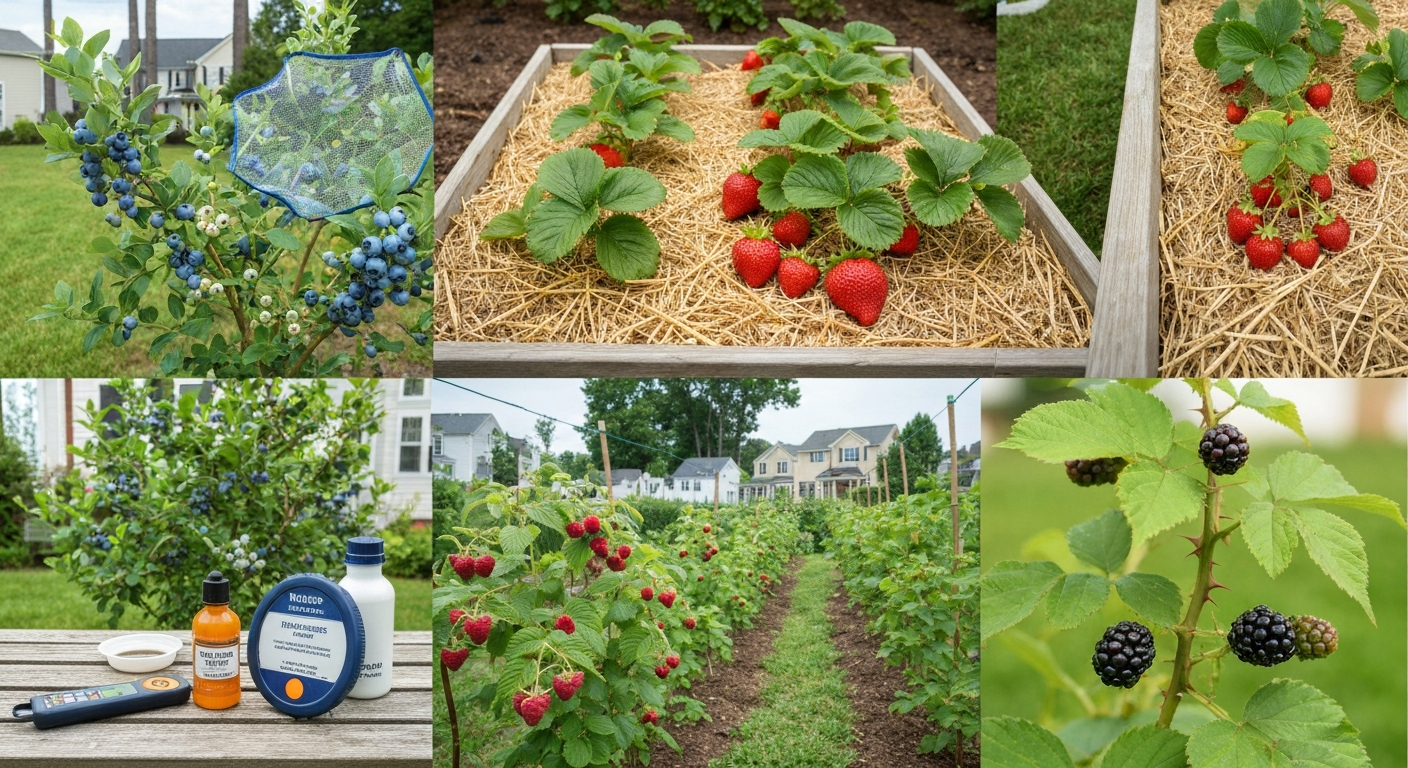
The best berries for New Jersey at a glance
Before getting into the details of each crop, here is the short list I'd hand any NJ gardener who asked me where to start. These are ranked by how reliably they perform across most of the state, how forgiving they are for beginners, and how much fruit a home gardener can realistically expect.
- Highbush blueberry (Vaccinium corymbosum) — the flagship NJ berry; thrives in the state's naturally acidic soils, especially in the Pinelands and coastal plain
- June-bearing and day-neutral strawberry (Fragaria × ananassa) — fastest producer, huge range of cultivars, works in beds or containers
- Summer- and fall-bearing raspberry (Rubus idaeus) — productive in zones 5–7, easy to propagate, harvest stretches from July into October with the right mix
- Thornless erect blackberry (Rubus fruticosus complex) — large fruit, less maintenance than thorny types, excellent for small farms and larger home plots
- Lowbush or half-high blueberry — perfect for cooler NW highlands or container growing in smaller yards
- Cranberry (Vaccinium macrocarpon) — only for true bog or very wet, acidic sites; specialty crop with real NJ heritage
- Elderberry (Sambucus spp.) — big yields for large properties, very low maintenance once established
- Currants and gooseberries (Ribes spp.) — underused in NJ, excel in cool, shadier spots where other berries struggle
How to choose the right berries for your NJ site
Choosing the wrong berry for your site is the single biggest mistake I see home gardeners make. A blueberry planted in alkaline clay soil will limp along for years producing almost nothing, while the same plant in a properly amended raised bed ten feet away would thrive. Before you buy a single transplant, think through four variables: yard size and sun exposure, soil drainage and pH, wildlife pressure, and how you plan to use your harvest.
Yard size and sun
All of the top four berries need at least six hours of direct sun daily. If your yard has more shade than that, elderberries and currants are more tolerant. For small yards under 500 square feet of growing space, strawberries in raised beds and blueberries in large containers are your most space-efficient options. Raspberries and blackberries need a trellis run of at least 10–15 feet to be worth the setup, so they suit mid-size suburban lots and larger. Highbush blueberries grow 5–8 feet tall and wide at maturity, so account for that spread when spacing, you will want at least two plants for cross-pollination, which means a minimum footprint of roughly 8–10 feet of bed length.
Soil drainage and pH
Drainage and pH are the two factors that determine whether blueberries and raspberries succeed or fail in NJ. Blueberries demand a soil pH of 4.5–4.8, which is acidic enough that you almost certainly need to amend unless you are in the Pinelands or a naturally sandy, acidic coastal-plain soil. Strawberries prefer a more moderate pH of 6.0–6.5. Raspberries and blackberries sit in the middle, preferring well-drained loam at pH 5.5–6.5. If you have heavy clay or spots that hold water, plan on raised beds or mounded rows before you plant anything. Send a soil sample to the Rutgers Soil Testing Laboratory ([email protected]) before you start amending, a $20 test saves you a lot of guesswork and wasted sulfur.
Wildlife pressure and use
Deer, birds, and spotted-wing drosophila (SWD) are the three biggest wildlife threats in NJ berry gardens. If deer pressure is high in your area, thornless erect blackberries and highbush blueberries under bird netting are more manageable than open raspberry rows. Birds will target blueberries and strawberries heavily right at peak ripeness, so budget for exclusion netting from day one. For fresh eating, strawberries and raspberries are hard to beat. If you want to make jam or freeze large quantities, highbush blueberries and blackberries give you more fruit per square foot once established.
New Jersey's climate and soils: what matters for berries
New Jersey is a surprisingly diverse state for a small one. For gardeners near the state line, see our companion piece on what berries grow in Pennsylvania for cultivar and timing notes that often mirror NJ conditions. The USDA 2023 Plant Hardiness Zone Map puts most of the state in zones 6a–7b. The northwestern highlands (Sussex, Warren, Passaic counties) are cooler, typically zone 5b–6a, with last frost dates that can stretch into late May. Central and southern NJ (Burlington, Ocean, Atlantic, Cape May) are zone 6b–7b, with milder winters and a frost-free window that opens earlier in spring. The coastal areas around Cape May are the warmest in the state and can support some low-chill southern highbush blueberry cultivars alongside the standard northern highbush varieties. For most of the state, your chilling-hour accumulation (the hours below 45°F that trigger dormancy break) sits between 800 and 1,200 hours per year, which is plenty for all the standard highbush blueberry cultivars and all raspberries.
New Jersey's soils split into two broad categories relevant to berry growing. The Pinelands and coastal plain (roughly south and east of I-195) are sandy, naturally acidic, and often low in organic matter, almost ideal for blueberries with minimal amendment. The Piedmont and highlands in the north and west tend toward heavier, less acidic soils, sometimes with clay content that needs drainage improvement for raspberries and blackberries. Whatever region you are in, check your actual pH before planting. I have seen 'naturally acidic' Pinelands sand come back at pH 5.5 and need work before blueberries will thrive.
Coastal microclimates along the Jersey Shore and in South Jersey add another wrinkle: milder winters mean slightly less chilling, but also warmer springs that can break dormancy early and expose blossoms to late frosts. Strawberry growers in these areas often use floating row covers in April to protect open blossoms from a late cold snap. In the northwest, the concern flips, a later last frost means you need cold-hardy cultivars and should hold off on planting bare-root strawberries until the soil is consistently workable.
New Jersey berry planting calendar
Timing varies enough across NJ's zones that a single planting date does not work for everyone. The table below gives month-by-month windows for the main berry types, split by region. 'Early' refers to South Jersey and coastal areas (zones 6b–7b); 'Late' refers to the northwest highlands (zones 5b–6a). Bare-root stock should go in as early as the soil is workable (not frozen or waterlogged). Potted stock from a nursery can go in slightly later and is generally more forgiving of timing.
| Berry | Bare-Root Window (Early/South NJ) | Bare-Root Window (Late/NW NJ) | Potted Stock Window | Notes |
|---|---|---|---|---|
| Highbush Blueberry | Late March – early April | Mid April – early May | April – June | pH must be 4.5–4.8 before planting; pinch flowers year 1–2 |
| Strawberry (June-bearing) | Late March – April | Late April – mid May | April – May | Set crown at soil level; mulch with straw after planting |
| Strawberry (Day-neutral) | Late March – April | Late April – mid May | April – June | Can also plant in late summer (Aug) for fall harvest |
| Raspberry (Summer) | Late March – April | Late April – May | April – June | Plant dormant canes; trellis before canes emerge |
| Raspberry (Fall/Primocane) | Late March – April | Late April – May | April – June | Mow all canes to ground in late winter for simplest management |
| Blackberry (thornless erect) | Late March – April | Late April – May | April – June | Needs trellis or post support; full production by year 2–3 |
Highbush blueberries: NJ's signature home-garden berry
Highbush blueberries feel practically native to New Jersey, and in many ways they are. The state's commercial blueberry industry is centered in the Pinelands, and home gardeners throughout NJ benefit from the same acidic, sandy soils and humid summers that make the region productive. In my experience, blueberries are the most rewarding long-term berry planting you can make in NJ, slow to establish, yes, but a well-managed highbush plant can produce for 20–30 years.
Where highbush blueberries thrive in NJ
Highbush blueberries grow as multi-stemmed deciduous shrubs, typically reaching 5–8 feet tall. They need full sun, at least six hours daily, and strongly acidic, well-drained soil. In NJ's coastal plain and Pinelands, the native soil pH is often already in the 4.5–5.5 range, requiring only modest sulfur amendment. In Piedmont and highland soils, which tend toward pH 6.0 or higher, you will need to lower pH significantly before planting, work granular sulfur into the bed at least six months before your target planting date if possible. Acidification takes time, and planting into unamended soil at pH 6.5 is one of the fastest ways to watch a blueberry fail slowly.
Recommended cultivars for New Jersey
Rutgers and the University of Maryland Extension both provide cultivar guidance for the Mid-Atlantic, and their recommendations for NJ conditions overlap closely. For extending your harvest window, plant an early, a mid-season, and a late variety. All standard highbush cultivars need roughly 800–1,000 chilling hours, which NJ meets comfortably in most years.
| Cultivar | Season | Chill Hours (approx.) | Notes |
|---|---|---|---|
| Duke | Early | 800–1,000 | High yield, consistent, widely used in commercial and home settings; good fresh flavor |
| Bluecrop | Mid | 800–1,000 | Reliable mid-season workhorse; large berries, good disease tolerance |
| Elizabeth | Mid-late | 800–1,000 | Rutgers flavor favorite; excellent for fresh eating |
| Darrow | Late | 800–1,000 | Large fruit, tart-sweet; noted by Rutgers for outstanding flavor |
| Chandler | Late | 800–1,000 | Very large berries, excellent for u-pick and fresh market; UMD notes strong Mid-Atlantic performance |
| Elliott | Very late | 800–1,000 | Extends the season into August; tarter flavor, good for processing and freezing |
Always plant at least two different cultivars with overlapping bloom times for cross-pollination. Blueberries are not strictly self-sterile, but cross-pollinated plants consistently produce larger berries and higher yields. 'Duke' and 'Bluecrop' bloom close together and make a reliable pairing. For coastal South Jersey or warmer zone 7b pockets, the University of Maryland's 2026 cultivar guide also notes some low-chill southern highbush options (200–300 chill hours) like 'Ventura' if you are in a zone that occasionally sees mild winters, though standard northern highbush performs well throughout the state.
Soil pH, bog vs. raised bed, and planting
The Rutgers target for blueberry soil pH is 4.5–4.8, with soil organic matter in the 2–5% range. Work in aged pine bark, peat moss, or composted sawdust to raise organic matter in sandy soils. In clay or poorly drained areas, build mounded or raised beds at least 18 inches high rather than fighting poor drainage. Rutgers specifically recommends hill or mound plantings to avoid any standing water around the root zone, which blueberries cannot tolerate despite their acidic-soil requirements. True bog conditions (waterlogged, anaerobic) are better suited to cranberries. Blueberries want moist but aerated soil. Purchase two-year-old rooted cuttings or potted stock when possible, they establish faster than smaller liners. Rutgers recommends purchasing two‑year rooted cuttings or potted stock, planting in spring after soil pH is adjusted, removing flowers during the first 1–2 years to encourage root development, and pruning annually in late winter (see FS1299: PYO Blueberries & FS750: Establishing Blueberries in the Home Garden (Rutgers NJAES) for cut‑by‑age pruning steps). Space plants 3–4 feet apart within a row and 9–10 feet between rows. Pinch off all flower buds in year one and most in year two to redirect energy into root development. It feels painful, but blueberries that are allowed to fruit heavily in year one rarely develop the root system needed for long-term productivity.
Container blueberries for small NJ yards
Container growing is a genuine option for blueberries, not just a novelty. University of Maryland Extension recommends containers at least 24 inches deep and 24–30 inches wide for mature plants, filled with a 50:50 mix of potting soil and peat moss. Moisten the mix before planting because dry peat is notoriously hard to rewet once it dries out. Keep the growing medium consistently moist but not saturated, and protect containers from winter wind and temperature swings, uninsulated pots in a NJ winter can freeze solid and kill roots that would otherwise survive in-ground. Moving containers into an unheated garage or wrapping them in burlap through January and February is good insurance. Still plant two varieties for cross-pollination; staggering them in separate containers works fine as long as they bloom at the same time.
Propagation, pruning, and fertilizing
Highbush blueberries are most easily propagated from hardwood cuttings taken in late winter before bud break. Cut 6-inch sections from one-year-old wood, stick them in a perlite-peat mix, and keep them in a cold frame or sheltered spot. Rooting takes 6–8 weeks. For most home gardeners, buying potted plants is more practical. Prune annually in late winter (late February to mid March in NJ before bud swell), removing crossing canes, dead wood, and oldest canes (more than 6 years old) to encourage new fruiting wood from the base. Fertilize with an ammonium-based nitrogen source, blueberries take up nitrogen in the ammonium form, not nitrate. Ammonium sulfate is the standard recommendation from Rutgers. Apply in early spring and again after fruit set, but go light: over-fertilizing blueberries, especially in their first few years, causes more problems than under-fertilizing.
Common pests and diseases in NJ blueberry plantings
- Spotted-wing drosophila (SWD): the most serious pest for late-season cultivars; female SWD lays eggs in ripening fruit, larvae hatch inside berries. Monitor with vinegar traps from mid-July onward; harvest frequently and refrigerate promptly; netting is the most effective non-chemical barrier
- Birds: robins, mockingbirds, and starlings can strip a bush in a day. Install bird netting before berries color up, not after you notice them disappearing
- Mummyberry (Monilinia vaccinii-corymbosi): the most common fungal disease in NJ blueberries; causes blighted shoot tips in spring and shriveled 'mummy' fruit at harvest. Remove mummified fruit from the ground; apply a labeled fungicide at bud break if you have had past infections
- Blueberry maggot (Rhagoletis mendax): similar damage to SWD; monitor with sticky yellow traps from late June; more common in commercial-density plantings
- Phytophthora root rot: occurs in poorly drained or overwatered soils; best controlled by mounded/raised planting and never letting roots sit in water
Harvest window and yield expectations
With 'Duke', 'Bluecrop', and 'Elliott' planted together, you can realistically harvest fresh blueberries from mid-July through late August in central NJ, and from early July through late August in southern NJ. A mature highbush blueberry plant (5–7 years old, well-managed) yields roughly 5–10 pounds of fruit per season. A planting of six plants, two early, two mid, two late, can produce 30–60 pounds of fresh fruit per year, more than enough for fresh eating, freezing, and jam-making. Do not expect meaningful harvest in year one or two; productive yield typically begins in year three to four.
Strawberries: the fastest payoff in the NJ berry garden
Strawberries are the entry point for most NJ home gardeners, and for good reason. You can plant bare-root crowns in April and be eating berries by June of that same year with June-bearing types, or by late summer with day-neutral types. They are also the most versatile berry for small spaces: a raised bed, a hanging basket, or a simple mounded row all work.
Site selection and bed types
Strawberries prefer a slightly acidic, well-drained site at pH 6.0–6.5. Avoid planting in areas where tomatoes, peppers, or eggplant grew recently, these crops share soilborne diseases (especially verticillium wilt) that can devastate strawberry beds. A south-facing raised bed or mounded row in full sun is ideal. In heavy or wet soils, raise your beds at least 6–8 inches to improve drainage. Matted-row systems (plants spaced 24–36 inches apart and runners allowed to fill in) are the traditional approach for June-bearers. Day-neutrals, which produce continuously rather than in one concentrated June flush, do better in a hill system with plants 12–24 inches apart and runners removed to keep energy going into fruit.
Recommended cultivars for NJ
Rutgers NJAES publishes a regularly updated home-garden cultivar list for strawberries with disease resistance ratings. The following are among their recommendations, chosen for NJ conditions and flavor quality.
| Cultivar | Type | Season/Habit | Notable Traits |
|---|---|---|---|
| Earliglow | June-bearing | Very early | Excellent flavor, good red stele resistance; smaller fruit but consistently rated top for taste |
| AC Wendy | June-bearing | Early | High yield, good flavor; performs well across Mid-Atlantic zones |
| Annapolis | June-bearing | Early | Large fruit, moderate disease resistance; reliable in NJ conditions |
| Flavorfest | June-bearing | Mid | Outstanding flavor; newer release with strong NJ performance |
| Rutgers Scarlet | June-bearing | Mid | Rutgers release; excellent flavor, good disease resistance for NJ home gardens |
| Allstar | June-bearing | Mid-late | Very large fruit, good yield, moderate disease resistance |
| Jewel | June-bearing | Late | Excellent fresh eating quality, popular in Mid-Atlantic |
| Albion | Day-neutral | Continuous | Very large, firm fruit; excellent flavor; tolerates heat better than most day-neutrals |
| Tristar | Day-neutral | Continuous | Good disease resistance, reliable yield; strong NJ performer |
| Tribute | Day-neutral | Continuous | Similar to Tristar; consistent producer through summer heat |
Planting bare-root crowns and potted starts
Bare-root crowns are the most cost-effective way to plant strawberries and are widely available from NJ nurseries and mail-order suppliers in March and April. The critical detail is planting depth: the crown, the point where roots meet leaves, must sit exactly at soil level, not buried and not too high. Planted too deep, the crown rots; planted too shallow, it dries out. I have seen both kill entire beds. Potted transplants from a nursery are more forgiving of timing but cost more per plant. Amend your bed with compost before planting to improve drainage and organic matter, then water in well. Mulch around plants with clean straw (not hay, which carries weed seeds) to retain moisture, moderate soil temperature, and keep fruit clean. In June-bearing beds, renovate immediately after the harvest flush, mow foliage back to about 4 inches, thin plants to the strongest runners, and fertilize lightly to encourage fall regrowth. Replant entirely after three years for best production.
Container strawberries
Strawberries are well-suited to containers, window boxes, and hanging baskets. For day-neutral types specifically, a container on a sunny deck can produce fruit from June through October with minimal fuss. Use a quality, well-draining potting mix, water consistently (containers dry out fast in NJ summer heat), and fertilize lightly every two to three weeks with a balanced liquid fertilizer. Container strawberries do not overwinter reliably in NJ because pots freeze solid, either bring them into an unheated garage in November or treat them as annuals and replant each spring.
Propagation, pests, and diseases
Strawberries propagate easily from runners, the horizontal stems that emerge after fruiting and produce daughter plants at their nodes. Pin runners to the soil with a U-shaped staple or bent wire, let the daughter plant root over 4–6 weeks, then sever the runner. This is how you expand a June-bearing bed organically. For day-neutrals managed in a hill system, remove most runners to keep production concentrated. The main pests in NJ strawberry beds are slugs (worse in wet springs and mulched beds, use iron phosphate bait or diatomaceous earth), birds (netting is the most reliable solution), and SWD in late-season plantings. Verticillium wilt and red stele (Phytophthora fragariae) are the most serious diseases, both are soil-borne and persist for years, so choose resistant cultivars like 'Earliglow' and 'Tristar' if you have had past problems, and rotate your bed location every 3–4 years.
Harvest and yield expectations
June-bearing strawberries deliver one concentrated harvest over 2–3 weeks in June in central NJ (late May in South Jersey). A mature June-bearing bed of 25 plants can yield 15–25 quarts in that window. Day-neutral types produce smaller individual flushes but keep going from late spring through the first fall frost, often totaling a similar amount over a full season. For most home gardeners, a mix of a few June-bearers for the big jam-making harvest and a few day-neutrals for ongoing fresh eating is the ideal setup.
Raspberries: summer and fall harvest across NJ
Raspberries are one of the most productive berries per square foot you can grow in NJ, and they are surprisingly tough. I have seen raspberry patches survive neglect that would kill most garden plants. That said, the difference between a well-managed row and a chaotic tangle is significant in terms of both yield and pest pressure. Understanding cane habit is the starting point.
Cane habit, types, and support
Raspberries grow from a perennial root system that sends up new canes each year. Summer-bearing (floricane) raspberries produce fruit on second-year canes (floricanes) that grew the previous season. Fall-bearing or everbearing (primocane) types fruit on the tips of first-year canes in late summer and fall, and if you leave those canes in place, they will produce a smaller summer crop lower on the same cane the following year. For simplicity at home, many NJ gardeners mow all primocane raspberry canes to the ground in late winter and harvest just the fall crop, easier management, still excellent yields. All types need support: a two-wire trellis system with posts at each end of the row and wires at 2 feet and 4 feet off the ground keeps canes upright and fruit accessible.
Recommended cultivars for NJ
- Boyne: summer-bearing, excellent cold hardiness for NW NJ highlands; good flavor, reliable producer
- Latham: summer-bearing; one of the most cold-hardy red raspberries, widely grown in NJ; productive but moderate flavor
- Killarney: summer-bearing; large, firm fruit with good flavor; reliable Mid-Atlantic performer
- Heritage: fall-bearing (primocane); the standard fall raspberry for NJ home gardens; productive, reliable, widely available
- Caroline: fall-bearing; larger and better flavored than Heritage; excellent for fresh eating
- Anne: fall-bearing yellow raspberry; sweet, mild flavor; novelty variety that performs well in NJ zones
- Josephine: fall-bearing; very large fruit, excellent flavor; strong NJ performance in trials
Site, soil, and planting
Raspberries need well-drained soil at pH 5.5–6.5 and full sun. They are more tolerant of heavy soils than blueberries, but standing water around roots causes crown rot quickly. If your soil drains slowly, mound your rows 6–8 inches above grade. Incorporate compost before planting to improve structure. Plant bare-root canes in early spring, cutting them back to 6 inches at planting to encourage new growth from the base. Set plants 2–3 feet apart in the row, with rows spaced 8–10 feet apart to allow air circulation and equipment access. Erect your trellis before or immediately after planting so you are not fighting canes later.
Training, pruning, and propagation
For summer-bearing types, prune out all fruited floricanes at the base immediately after harvest. Thin remaining first-year canes to the 4–6 strongest per plant. In late winter, tip those remaining canes to about 4.5 feet to encourage lateral branching and more fruit-bearing nodes. For fall-bearing types managed for a single fall crop, simply mow everything to the ground in late February or early March before growth resumes. Raspberries spread naturally by root suckers that emerge around the base and along the row. Dig and transplant suckers in early spring to expand your planting or share with neighbors. Tip-layering, bending a long cane tip to the ground and covering with soil in late summer, produces a rooted new plant by fall, a technique that works especially well with fall-bearing types.
Container raspberries
Raspberries can grow in large containers (15–20 gallon minimum) but need consistent moisture and fertilization since they are heavy feeders. Fall-bearing primocane types are more practical for containers because you can mow them back in late winter without worrying about saving floricanes. Use a well-draining potting mix, water frequently in summer, and apply a balanced slow-release fertilizer in spring. Container raspberries in NJ can survive winter if you move the pot to a sheltered location or mulch the roots heavily.
Pests, diseases, and harvest
SWD is the primary insect pest of raspberries in NJ, particularly for fall-bearing types harvested in August and September when SWD populations peak. Harvest frequently, every two to three days at peak, and remove any overripe fruit immediately. Raspberry cane borer and Japanese beetle are nuisances but rarely cause serious yield losses in home gardens. Phytophthora root rot is the most serious disease threat in wet or poorly drained sites. Orange rust (Phragmidium rubi-idaei) can appear as orange pustules on cane undersides; remove and destroy affected canes. A mature, well-managed raspberry row of 10 plants can produce 10–20 pounds of fruit per season depending on the cultivar and management. Summer-bearing types deliver fruit in July; fall-bearing types peak in August and September in central NJ.
Blackberries and thornless varieties: big fruit for NJ home plots
Blackberries are underused in NJ home gardens, and I think it is largely a reputation issue, people assume all blackberries are sprawling, thorny thickets that take over a yard. Thornless erect cultivars are genuinely manageable with a simple trellis and annual pruning, and they produce large, sweet fruit that few other home-grown berries can match in size. They are also well-suited to small hobby farm settings where you want volume without a lot of per-plant fussing.
Bramble habit: trailing vs. erect types
Blackberries fall into two main habit categories. Trailing types (sometimes called dewberries) have long, arching canes that need substantial trellis support and are generally less winter-hardy, not ideal for NJ's zone 5b–6a northwest. Erect and semi-erect types have stiffer, more upright canes that are easier to manage and more cold-hardy. For NJ home gardens and small farms, thornless erect and semi-erect cultivars are the clear choice. They still benefit from a trellis for support at fruiting weight, but they will not sprawl across your entire yard if you prune them properly.
Recommended cultivars for NJ
- Triple Crown (semi-erect, thornless): very large fruit, excellent flavor, high yield; best thornless choice for most NJ conditions; needs a sturdy trellis
- Chester (semi-erect, thornless): excellent cold hardiness, consistent producer; good for NW NJ highlands; slightly smaller than Triple Crown but very reliable
- Natchez (erect, thornless): early season, extremely large fruit; excellent flavor; slightly less cold-hardy, better suited to zones 6b–7b in South Jersey
- Ouachita (erect, thornless): upright habit, productive; good disease resistance and heat tolerance for warmer NJ sites
- Apache (erect, thornless): large, sweet fruit; erect habit makes it one of the easier types to manage without trellising in smaller gardens
- Arapaho (erect, thornless): early ripening, compact habit; good choice for smaller plots or container trials
Site, soil, planting, and trellising
Blackberries prefer well-drained loam at pH 5.5–6.5 and full sun. Like raspberries, they tolerate a wider pH range than blueberries and are more adaptable to NJ's varied soils. Avoid low spots where water pools. Incorporate compost before planting to improve organic matter, especially in sandy coastal plain soils where blackberries can dry out quickly. Plant bare-root canes in early spring, 3–4 feet apart within rows and 10 feet between rows. A simple T-trellis with two horizontal wires at 3 feet and 5 feet provides all the support semi-erect types need. For true erect types like 'Apache' or 'Arapaho', a single wire at 4 feet is often sufficient. Train new primocanes loosely as they grow, tying them to the upper wire to keep the row tidy.
Pruning cycles and propagation
Blackberries follow the same floricane/primocane cycle as summer-bearing raspberries: canes grow vegetatively in year one (primocanes), produce fruit in year two (floricanes), then die. Remove all fruited floricanes at the base immediately after harvest in July or August. This opens up the row for the new primocanes and greatly reduces disease pressure. In late winter, tip primocanes back to 3–4 feet for erect types to encourage lateral branching and more fruit-bearing shoots. Blackberries propagate readily from tip-layering: in late summer, bend the tip of a vigorous primocane to the ground, bury the tip 3–4 inches deep, and it will root by fall. Dig and transplant in early spring. Root cuttings (2–4 inch sections of pencil-thick root, planted horizontally 2 inches deep) also work well in spring.
Container options
Erect thornless blackberries can grow in large containers (20–25 gallon), though their vigorous growth makes them more demanding than strawberries or even blueberries in pots. If you go this route, choose compact erect types like 'Arapaho' or 'Apache', water daily in summer, fertilize monthly with a balanced granular fertilizer, and plan to repot or divide every two to three years. Container blackberries in NJ need the same winter protection as container blueberries, move to a sheltered, unheated space or mulch the pot heavily to prevent roots from freezing solid.
Pests, diseases, and harvest expectations
SWD is a significant concern for blackberries, as it is for all soft-skinned berries in NJ from mid-summer onward. Harvest every two to three days at peak, remove overripe fruit, and use fine-mesh exclusion netting if SWD has been a problem in previous seasons. Orange rust is a serious fungal disease that appears as bright orange pustules on leaf undersides in spring, it is systemic and there is no cure, so remove and destroy infected plants entirely. Double blossom (rosette disease) is another blackberry-specific fungal issue; prune out distorted, rosette-like growth immediately. Anthracnose and cane blight are managed by removing old canes promptly and keeping the canopy open for air circulation. A planting of six to eight mature plants (year two and beyond) can yield 10–20 pounds of fruit per season for a home gardener, with 'Triple Crown' and 'Chester' typically at the higher end of that range. Blackberries ripen in NJ from late July into August, filling the gap between summer raspberries and fall raspberry crops.
Simple planting plans for common NJ yard sizes
Not every NJ gardener has room for all four berry types, and that is fine. For gardeners in nearby states with different climates, see our guide to the best berries to grow in Tennessee for region-specific cultivar and timing advice. Here are three realistic setups scaled to common yard sizes.
| Yard Type | Recommended Planting | Expected Output |
|---|---|---|
| Small yard / patio (under 200 sq ft growing space) | 2 blueberries in 24"+ containers (e.g., Duke + Bluecrop), 12 day-neutral strawberries in a raised bed or window boxes | 5–10 lbs blueberries; fresh strawberries June through September |
| Mid-size suburban lot (200–500 sq ft growing space) | 4–6 highbush blueberries in amended raised bed, 20–25 June-bearing strawberries in matted row, 6–8 fall-bearing raspberries on one trellis run | 20–40 lbs blueberries; 15–20 qts strawberries; 10–15 lbs raspberries |
| Large suburban lot or hobby farm (500+ sq ft growing space) | 6–10 highbush blueberries (staggered seasons), 25+ strawberries (mix June-bearing and day-neutral), 10–15 raspberries (mix summer and fall), 6–8 thornless erect blackberries on T-trellis | 50–100+ lbs combined berry harvest across June–September |
Local resources every NJ berry grower should know
Before you amend a single square foot of soil, get a Rutgers Soil Test. For gardeners comparing nearby states, see what berries grow in Virginia for cultivar and climate differences that may be relevant to the Mid-Atlantic. Mail a sample to the Rutgers Soil Testing Laboratory with a completed Soil Test Questionnaire (available on their website) and you will receive pH, nutrient levels, and crop-specific recommendations tailored to what you tell them you are growing. The email is [email protected] and the cost is minimal. This is the most useful $20 you can spend before planting berries.
Your county Rutgers Cooperative Extension (RCE) office is the next stop. County agents can tell you the average last-frost date for your specific area (these vary meaningfully across NJ's diverse counties), recommend local nurseries, and connect you with Master Gardener volunteers who can walk through site-specific issues. For blueberry and cranberry research specifically, the Rutgers P.E. Marucci Center in Chatsworth (Burlington County) is the primary NJ research hub, they run replicated cultivar trials, maintain germplasm collections, and produce extension fact sheets that are freely available on the NJAES website. Rutgers NJAES publications FS097 (strawberries), FS750 and FS1299 (blueberries) are worth downloading before you plant.
For cultivar selection guidance beyond what your county RCE can provide, the University of Maryland Extension's 2026 blueberry cultivar guide (FS-2025-0777) covers 40+ highbush varieties with chilling-hour ranges and Mid-Atlantic performance data that applies directly to NJ conditions. The USDA's 2023 Plant Hardiness Zone Map has a ZIP-code lookup tool that gives you your exact zone, which matters when comparing cultivar cold-hardiness ratings. If you want to go deeper on chilling-hour accumulation at your specific location, the Midwestern Regional Climate Center (MRCC) Vegetation Impact Program provides custom chilling-hour maps for the Mid-Atlantic that are genuinely useful for matching blueberry cultivar requirements to your site. For guidance on what berries grow in Georgia and region-specific cultivar recommendations, see the Georgia berry guide.
If you are growing berries in neighboring states and want to compare notes, the guidance for Pennsylvania and Virginia conditions overlaps meaningfully with northern NJ zones, while growing practices for North Carolina and Georgia are more relevant to the warmer end of South Jersey's zone 7b climate.
FAQ
What are the best berries to grow in New Jersey (USDA zones ~5–7) for home gardeners and hobby farmers?
Top choices for NJ: 1) Highbush blueberry (Vaccinium corymbosum) — best overall for home gardens and small farms; 2) Strawberries (June‑bearing and day‑neutral) — versatile, quick yields; 3) Raspberries (summer‑bearing floricane and fall‑bearing/primocane) — good for hedgerows and small-scale production; 4) Thornless blackberries (erect types) — high yield, easier management; 5) Lowbush/half‑high blueberries and container blueberries — for small yards and acidic containers; 6) Cranberries — only if you have a true wet/bog site or specialty plot; 7) Elderberry — productive for preserves and pollinators; 8) Currants/gooseberries — tolerant of cooler NJ pockets; 9) Lingonberry — low, acid‑soil groundcover or container option.
Which specific cultivars perform well in New Jersey for each berry type?
Blueberries: 'Duke' (early), 'Bluecrop' (mid), 'Elliott' (late); flavor favorites in trials include 'Elizabeth', 'Darrow', 'Chandler' — select mixes with overlapping bloom. Strawberries: June‑bearers — 'Earliglow', 'Allstar', 'Rutgers Scarlet'; Day‑neutrals/everbearers — 'Albion', 'Tribute', 'Tristar', 'Jewel'. Raspberries: summer (floricane) — 'Latham', 'Killarney'; fall/primocane — 'Heritage', 'Polana'.Blackberries: thornless erect — 'Triple Crown', 'Apache', 'Navaho'. Low/half‑high blueberries: 'Northblue', 'Northcountry', 'Patriot'.Cranberry: use Rutgers‑tested cultivars from Marucci Center or nursery stock suited to bogs (consult local extension).Elderberry: 'Adams', 'Johns'.Currants/gooseberries: 'Consort' (red currant), 'Invicta' (gooseberry).Choose cultivars with chill‑hour and disease resistance suited to your NJ zone and microclimate.
How do I match berry choices to New Jersey climate and soil types?
General rules: Blueberries and lingonberries require strongly acidic soils (target pH 4.5–4.8). Strawberries and currants prefer near‑neutral (pH 6.0–6.5). Raspberries and blackberries tolerate pH 5.5–6.5 but need well‑drained soils. Cranberries need a bog/wet site with peat/sandy organic medium and consistent water management. Check your county’s USDA Zone (NJ ranges ~5–7) and local chill‑hours; pick cultivars whose chill‑hour requirements match your location. Use Rutgers Soil Testing Lab to confirm pH and fertility before planting.
When and how should I plant berries in New Jersey (bare‑root vs potted timing)?
Planting calendar: Blueberries — spring planting after ground thaws and soil workable (adjust pH months ahead); bare‑root or 1–2‑yr container stock in early spring. Strawberries — plant in spring after last frost (southern NJ mid‑April; northern higher elevations late April–May); use certified disease‑free bare‑root or potted runner plants. Raspberries/blackberries — plant bare‑root or potted in early spring; fall planting possible in mild coastal areas. Cranberries — establish beds in spring; site prep (bog construction) occurs in preceding months. Tip: order bare‑root stock in winter for spring delivery and plant promptly.
What are recommended site selection and soil amendment steps for blueberries in NJ?
Site: full sun (6–8+ hrs), good air circulation, well‑drained but moisture‑retentive soils; avoid heavy clay that puddles. Soil prep: test pH (Rutgers lab). Lower pH to 4.5–4.8 using elemental sulfur applied months ahead per soil test rates. Incorporate 2–4 in. of peat moss or well‑aged pine bark to increase organic matter and acidity; create raised hills/mounds if drainage is poor. Use ammonium‑based fertilizers (e.g., ammonium sulfate) per extension recommendations; install drip irrigation and mulch 2–4 in. with pine bark or pine needles to conserve acidity and moisture.
How should I amend soil and choose a site for strawberries, raspberries, and blackberries in NJ?
Strawberries: full sun, well‑drained loam, pH 6.0–6.5; add compost to improve structure, avoid fresh manure; plant on raised beds if soil is heavy. Raspberries/blackberries: full sun to part‑shade, pH 5.5–6.5, excellent drainage; incorporate compost and possibly sand into tight soils; raspberries prefer a fertile row with a weed‑free strip. Avoid planting berries where solanaceous crops or strawberries with Verticillium history have been grown recently. Always perform a soil test and address nutrient deficits per Rutgers recommendations.