
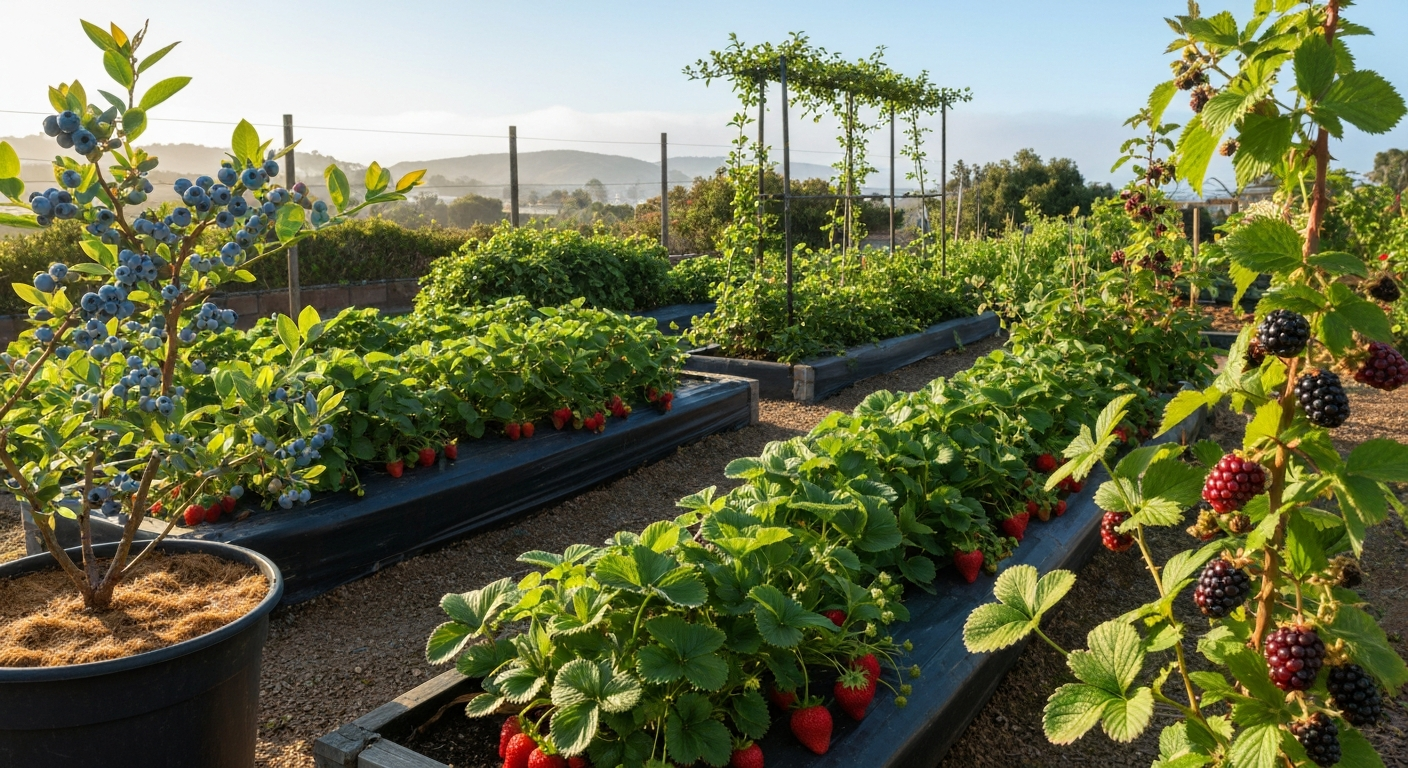
Strawberries, blackberries, boysenberries, and low-chill southern highbush blueberries are the best berries to grow in San Diego. Day-neutral strawberry varieties like Albion and Seascape produce fruit almost year-round on the coast, thornless blackberries like Navaho and Natchez thrive inland and coastal alike, and low-chill blueberry cultivars like Sharpblue and Sunshine Blue handle San Diego's mild winters with only 150 to 250 chill hours required. Elderberries and raspberries are workable too, especially in cooler coastal spots or with afternoon shade. Gooseberries and currants struggle here and generally aren't worth the effort.
Best Berries to Grow in San Diego: Top Varieties & Care
Marcus Holloway
26 Jul 2026
The best berries for San Diego, ranked
Not every berry on this list is equal effort. I've ranked them roughly from easiest and most rewarding down to the more demanding or situational picks. If you're just starting out, strawberries and blackberries are where I'd put your first season's energy. If you want a quick place to start, see a short guide on what berries can I grow in my garden for easy, climate-appropriate options. For a quick shopping and variety checklist, see the top 10 grow your own berries and currants.
- Strawberries (day-neutral): Albion, Seascape, San Andreas — long harvest windows, coastal and inland, container-friendly
- Blackberries and boysenberries: Navaho, Natchez, Ouachita, Arapaho, Triple Crown, boysenberry (trailing) — productive, vigorous, well-suited to San Diego heat and sun
- Blueberries (southern highbush, low-chill): Sharpblue, Sunshine Blue, Misty, O'Neal, Emerald — need soil work but extremely rewarding in containers or raised beds
- Elderberries: Blue Elderberry (Sambucus mexicana/nigra) — native-adjacent, drought-tolerant once established, low maintenance
- Raspberries (warm-climate types): Bababerry, Autumn Bliss, Heritage — prefer cool coastal zones or afternoon shade; honest effort required
- Gooseberries and currants: possible in cooler inland elevations, but generally poor performers in San Diego lowlands — not recommended for most sites
Specific variety notes
For strawberries, Albion is my go-to: firm fruit, strong disease resistance, and it keeps producing from spring through fall. Seascape is nearly as good and handles heat a bit better. For blueberries, Sharpblue and Sunshine Blue are the two most commonly recommended cultivars for coastal Southern California, both sitting in the 150 to 250 chill-hour range. See Blueberries (varieties & notes), UC ANR Master Gardener resources for recommended southern‑highbush and rabbiteye cultivars for California coastal and southern areas, including Sharpblue, Sunshine Blue, Misty, O’Neal, and Emerald Blueberries (varieties & notes) — UC ANR Master Gardener resources. Planting two different southern highbush varieties improves cross-pollination and berry size noticeably. For blackberries, Navaho is erect and thornless, making it easy to manage in a smaller garden. Natchez gives you bigger fruit if you have the space for a semi-erect plant. Boysenberries, the trailing Rubus hybrid with deep SoCal history thanks to Knott's Berry Farm, still grow beautifully on a coastal trellis.
Growth form and natural habitat: what each berry wants
Understanding how a berry grows in the wild helps you set it up correctly at home. Each growth form, trailing vine, erect cane, woody shrub, or bog plant, comes with specific requirements you'll need to replicate, at least partially, to get a productive plant.
| Berry | Growth Form | Natural Habitat | What to Replicate |
|---|---|---|---|
| Strawberry | Low-growing runner/crown | Open meadows, forest edges | Raised beds or containers, good drainage, full sun |
| Blackberry / Boysenberry | Arching cane (erect to trailing) | Woodland margins, disturbed ground | Trellis support, well-drained soil, full sun |
| Raspberry | Upright cane | Cool forest edges, moist slopes | Afternoon shade or coastal site, consistent moisture |
| Blueberry (southern highbush) | Woody multi-stem shrub | Acidic bogs and sandy woodlands | Very acidic soil (pH 4.5–5.5), high organic matter, good drainage |
| Elderberry | Large multi-stem shrub/small tree | Streambanks, open woodland | Deep watering when young, then mostly self-sufficient; full to part sun |
| Gooseberry / Currant | Dense deciduous shrub | Cool, moist mountain forests | Cool temperatures, high humidity — rarely achievable in SoCal lowlands |
Blueberries are the trickiest because their natural bog and sandhill habitat is so far from San Diego's alkaline, clay-prone soils. You're not just growing a plant here, you're rebuilding a soil ecosystem. That's why containers and raised beds filled with an acidic peat or coco-coir mix are the standard approach in Southern California. Strawberries, on the other hand, are naturally adapted to open, fast-draining ground, which is why they thrive in raised beds and pots and perform poorly in compacted or waterlogged soil.
San Diego microclimates and chill hours: matching your site to the right variety
San Diego is not one climate. The difference between a garden in Del Mar and one in El Cajon or Ramona can mean 20 to 30 more chill hours per winter and noticeably cooler summers. Getting this right is probably the single most important factor in variety selection, especially for blueberries and raspberries.
Coastal zones (Del Mar, La Jolla, Ocean Beach, Encinitas)
Coastal San Diego sits in USDA Zone 10a to 10b, with mild summers rarely exceeding the low 80s and winters that barely dip below 40°F. The marine layer keeps summer temperatures moderate but also means overcast mornings, higher humidity, and compressed chill accumulation. Coastal sites typically accumulate 200 to 400 chill hours in a given winter depending on the year, using the traditional below-45°F model. That's enough for Sharpblue, Sunshine Blue, Misty, and O'Neal blueberries, day-neutral strawberries, boysenberries, and most thornless blackberries. Raspberries actually do better on the coast than anywhere else in the county.
Inland valleys (El Cajon, Santee, Escondido, Fallbrook)
Inland valleys get hotter summers, often hitting the 90s and occasionally triple digits, and cooler winters that can drop to the upper 20s during a cold snap. Chill accumulation is generally higher here, sometimes reaching 400 to 600+ hours in a cold year at elevation, which opens up a broader range of blueberry and raspberry varieties. The downside is that summer heat stresses raspberries and makes afternoon shade practically mandatory. Blackberries and elderberries handle inland heat well. For blueberries, Emerald and O'Neal perform solidly in warmer inland conditions alongside Sharpblue.
Mountain and foothill zones (Julian, Palomar, Pine Valley)
At elevations above 2,500 feet, chill hours increase substantially. Julian regularly accumulates 800 or more chill hours, which is enough for standard northern highbush blueberries, most raspberry varieties, and even gooseberries or currants. If you're gardening at elevation in San Diego County, your options expand significantly and you're closer to Bay Area berry-growing conditions than to coastal San Diego.
UC Davis recommends using the Dynamic Model (measured in chill portions) for California chill calculations, as it more accurately accounts for warm-day effects that can cancel accumulated chill. The UC Davis chill calculator lets you plug in your nearest weather station and get a season-end estimate. For most coastal and valley San Diego sites, verify you're hitting the minimum before investing in varieties that need 700-plus chill hours.
Soil, pH and watering: getting the foundation right
General soil conditions in San Diego
San Diego County soils vary widely. Coastal areas tend toward sandy loams with decent drainage and moderate organic matter. Inland valleys often have heavier clay or silty clay loam soils that drain poorly and compact easily. Many sites across the county have slightly alkaline to neutral pH in the range of 6.5 to 7.5 or higher. This is workable for blackberries, strawberries, elderberries, and raspberries, but it's fundamentally incompatible with blueberries without significant amendment. The USDA NRCS Web Soil Survey is the best free tool to check your specific parcel's soil type and drainage class before you dig.
Blueberries: serious soil acidification required
Blueberries need pH 4.5 to 5.5, high organic matter, and excellent drainage. In San Diego, trying to acidify native ground soil is usually a losing battle since the surrounding soil and water (often alkaline) continuously push pH back up. The practical solution endorsed by UC ANR is to grow blueberries in containers or raised beds filled with a purpose-built acidic mix: 50 to 60 percent peat moss or coconut coir, 20 to 30 percent aged bark or wood chips, and 10 to 20 percent perlite. Avoid compost-heavy mixes, which can buffer pH too high. Elemental sulfur can be worked in to lower pH, but in containers the acidic planting mix is the main tool. Acidifying fertilizers like ammonium sulfate and iron sulfate help maintain pH over time. Test soil pH every spring with an inexpensive meter.
Watering and mulching
San Diego's dry summers mean supplemental irrigation is non-negotiable for almost every berry. Drip irrigation is the recommended delivery method because it keeps foliage dry, which reduces fungal disease pressure significantly. Strawberries prefer consistent moisture without waterlogging: about 1 to 1.5 inches per week during fruiting. Blueberries are sensitive to both drought and overwatering, so drip emitters at the root zone set to run two to three times per week during summer is a reliable approach. Blackberries and elderberries are more drought-tolerant once established but appreciate deep watering every 7 to 10 days during the heat of summer. A 3 to 4 inch layer of wood chip or straw mulch around all berries conserves moisture, moderates soil temperature, and suppresses weeds. For blueberries, pine bark mulch adds a modest pH benefit as it decomposes.
Containers, raised beds and in-ground planting
One of the advantages of gardening in San Diego is that mild winters mean most berries can stay in containers year-round without cold damage. Containers give you full control over soil chemistry, which is particularly valuable for blueberries. Here's what I recommend by berry type:
| Berry | Best Planting Method | Minimum Container Size | Soil Mix Notes |
|---|---|---|---|
| Strawberry | Raised bed, container, or in-ground | 1–2 gallon per plant (or strawberry tower) | Standard potting mix with good drainage; pH 5.5–6.5 |
| Blueberry | Container or raised bed strongly preferred | 15–25 gallon per mature plant | 50–60% peat/coir, 20–30% bark, 10–20% perlite; pH 4.5–5.5 |
| Blackberry / Boysenberry | In-ground preferred; raised bed works | 15+ gallon if containerized | Well-drained garden soil with compost; pH 5.5–7.0 |
| Raspberry | Raised bed or in-ground with amended soil | 15+ gallon | Loamy, well-drained; added organic matter; pH 5.5–6.5 |
| Elderberry | In-ground preferred | 25+ gallon (if containerized) | Native or amended garden soil; pH 5.5–7.0; tolerates heavier soil |
| Gooseberry / Currant | Raised bed in cooler inland/mountain sites only | 15+ gallon | Rich, moisture-retentive soil; pH 6.0–6.5 |
For raised beds, a depth of at least 12 inches is adequate for strawberries, but blueberries benefit from 18 to 24 inches to accommodate root depth and buffer against pH fluctuations from underlying native soil. Line the bottom of blueberry beds with a weed barrier (not plastic) to slow pH creep from below, but ensure water can still drain freely. In-ground blackberries and elderberries do well in most San Diego soils if you amend the planting hole with compost and ensure drainage is adequate: no standing water after rain.
Trellising, spacing and support systems
Caneberries, trailing and erect blackberries, boysenberries, and raspberries all need some form of support. Getting the trellis in before planting is much easier than retrofitting it after canes start growing.
Trellis types and spacing by berry
- Erect blackberries (Navaho, Arapaho, Apache): T-bar or single-wire trellis at 4 to 5 feet height; plant 3 to 4 feet apart in row, rows 8 to 10 feet apart
- Semi-erect blackberries (Natchez, Triple Crown): two-wire trellis at 3.5 and 5.5 feet; plant 5 to 8 feet apart in row, rows 10 to 12 feet apart
- Trailing boysenberries: two or three horizontal wires at 3, 4.5, and 5.5 feet; fan or weave canes along wires; plant 6 to 8 feet apart
- Raspberries: two-wire V-trellis or single-post system at 4 to 5 feet; plant 2 to 3 feet apart in row, rows 8 to 10 feet apart
- Blueberries: no trellis needed; space 4 to 5 feet apart for southern highbush varieties to allow good airflow
- Strawberries: no trellis; raised bed spacing 10 to 12 inches apart in a grid, or 12 to 18 inches in rows
For a small backyard, a simple T-bar trellis made from two 5-foot wooden or metal posts with a horizontal 2x4 cross-piece and two runs of 12 to 14 gauge galvanized wire handles erect and semi-erect blackberries cleanly. For trailing boysenberries, I attach canes to horizontal wires using soft plant ties after harvest, which keeps the fruiting canes accessible and the new primocanes organized. Don't let trailing canes touch the ground: it invites disease and makes harvest miserable.
Pruning and training by berry type
Pruning is where a lot of home gardeners lose confidence, but it's genuinely simple once you understand the logic. Most caneberries fruit on second-year wood (floricanes) while first-year canes (primocanes) are just growing. You're always removing what fruited and training what hasn't yet. The exception is everbearing raspberries, which can fruit on first-year canes in fall.
Strawberries
- After the first big flush of harvest (typically spring), cut back old, tired leaves to the crown, leaving the growing point intact.
- Remove runners aggressively if you want productive crowns rather than a spreading mat. Root a few runners each year to replace 2 to 3 year old parent plants.
- In late summer (August to September), renovate the bed: cut foliage back to about 1 inch above the crown, thin crowns to 10 to 12 inches apart, fertilize lightly, and resume watering.
- Replace day-neutral plants every 2 to 3 years as productivity declines.
Blackberries and boysenberries
- During the growing season (spring and summer), tip primocanes (new canes) at 3 to 4 feet for erect types and 5 to 6 feet for semi-erect types to encourage lateral branching and more fruiting wood.
- Immediately after harvest (June through August for most San Diego plants), cut all floricanes (the canes that just fruited) down to the ground. These will not fruit again.
- Thin remaining primocanes to the 4 to 6 strongest per plant or per linear foot of row; remove weak, spindly growth.
- In late winter (January to February), shorten lateral branches on trained floricanes to 12 to 18 inches. This is your crop for the coming season.
- For boysenberries, weave or tie new primocanes along the trellis wires after harvest to organize the coming season's fruiting canes.
Raspberries
- For summer-bearing types: cut all floricanes to the ground after harvest. Thin primocanes to 4 to 6 per plant. Tip canes at trellis height.
- For fall-bearing (everbearing) types like Heritage: you can cut all canes to the ground in late winter for a single large fall crop, or leave some second-year canes for a smaller early crop followed by the fall flush.
- In San Diego's warm inland sites, expect reduced raspberry performance in hot summers. Heavy pruning and a shaded, mulched root zone help significantly.
Blueberries
- Year 1 and 2: remove all flower buds so the plant channels energy into root and structure development. I know it's painful, but skipping this step leads to weak plants.
- Year 3 onward: remove dead, damaged, or crossing branches in late winter (January to February, before new growth starts).
- Every 3 to 5 years, remove one or two of the oldest, thickest canes at the base to stimulate new productive growth from the crown.
- Keep the center of the shrub open for airflow. Avoid heavy summer pruning.
Elderberries
- Cut the entire plant back to about 12 inches in late winter every 2 to 3 years to rejuvenate it and prevent the shrub from becoming too large or woody.
- Remove dead or damaged canes annually after harvest (late summer through fall).
- Elderberries grown as ornamental shrubs can be pruned more lightly; those grown for fruit production benefit from heavier, regular renewal cuts.
Pollination: what you need to know
Strawberries and blackberries are self-fertile, so a single plant will produce fruit. Blueberries are technically self-fertile in most southern highbush cultivars, but cross-pollination between two different varieties dramatically improves berry size and yield. Plant at least two different cultivars within 10 to 20 feet of each other. Sharpblue and Sunshine Blue are commonly paired for this reason and both have overlapping bloom times. Elderberries also benefit from cross-pollination, so two shrubs of different named varieties or local ecotypes improve fruit set. Raspberries are self-fertile.
Common pests and diseases in San Diego berry gardens
Spotted-wing drosophila
Spotted-wing drosophila (SWD) is the pest that worries me most with blueberries, raspberries, and late-season strawberries. Unlike regular fruit flies, the female SWD has a serrated ovipositor that lets her lay eggs inside ripening fruit, not just overripe or damaged fruit. UC IPM confirms it's established in all California counties. The most reliable controls are: harvest fruit frequently (daily during peak ripeness), remove overripe or damaged fruit immediately, and use fine mesh insect netting (less than 1 mm mesh) over fruiting plants. For organic growers, spinosad-based sprays (such as Entrust, which is OMRI-listed) are effective when timed to adult flight periods and applied in the early morning or evening to reduce bee exposure.
Botrytis fruit rot and fungal diseases
Botrytis cinerea (gray mold) and anthracnose are the primary fungal threats, especially in coastal San Diego where marine layer humidity is high. Both diseases thrive when foliage and fruit stay wet. The main prevention strategies from UC IPM are simple: use drip irrigation instead of overhead watering, improve airflow through pruning and proper plant spacing, remove infected berries and plant debris immediately, and avoid overly dense planting. Mulching under strawberries keeps soil-splash (a key infection pathway) to a minimum. In prolonged wet or foggy periods, a copper-based fungicide or sulfur spray can be used preventively on blueberries and caneberries.
Other pests to watch for
- Aphids: common on new strawberry and caneberry growth; knock off with water or use insecticidal soap
- Spider mites: a problem in hot, dry inland summers; overhead misting and proper irrigation reduce pressure; predatory mites are an effective biological control
- Crown moth / root weevils: occasional in strawberries; rotate planting sites every 2 to 3 years
- Gophers and squirrels: real issues in San Diego, especially inland; hardware cloth lining under raised beds and wire cages for in-ground plants are practical deterrents
- Birds: net blueberries and elderberries as fruit ripens; these two crops attract the most bird pressure
Planting and seasonal care calendar
| Month(s) | Key Task |
|---|---|
| September to October | Plant or transplant strawberries (bare-root or plugs) for winter-spring harvest. Plant blueberries from nursery containers. |
| October to November | Apply compost and mulch around all berry beds before winter rains. Reduce irrigation frequency. |
| November to January | Chill accumulation period for blueberries. Minimal active work. Prune blueberries in January before growth resumes. |
| January to February | Prune blackberries and boysenberries (shorten laterals). Plant bare-root blackberries, raspberries, and blueberries. |
| February to March | Strawberries begin flowering. Apply light balanced fertilizer to all berries as growth resumes. Set up trellises if not already in place. |
| March to June | Primary harvest window for strawberries and early blackberries. Monitor for SWD and aphids. Keep harvesting frequently. |
| June to August | Blackberry and boysenberry main harvest. Remove fruited floricanes immediately after harvest. Manage summer irrigation carefully. |
| July to September | Elderberry harvest. Raspberry fall crop (everbearing types). Renovate strawberry beds in August. |
| August to September | Plant new strawberries for the fall season. Train primocanes to trellises. |
| Year-round (coastal) | Day-neutral strawberries fruit nearly continuously; fertilize lightly every 4 to 6 weeks during active production. |
Propagation and sourcing tips
For strawberries, buy certified virus-indexed starter plants whenever possible. UC Davis Foundation Plant Services (UC FPS) produces foundation material for many major California-bred cultivars including Albion, Seascape, San Andreas, and Chandler. Licensed California nurseries sell plugs and bare-root plants sourced from this clean material, and it's worth seeking out. Virus-infected strawberry plants look fine for a year or two but gradually decline in productivity. I learned this the hard way after propagating my own runners from an old bed.
Blueberries are best purchased as 1 to 2 gallon nursery container plants from a reputable local nursery. Check the label carefully for variety name and chill-hour requirements. Many large garden centers in San Diego stock Sharpblue and Sunshine Blue, and specialty nurseries often carry Misty, O'Neal, and Emerald. For blackberries and boysenberries, bare-root plants available January through March are the most economical option. Boysenberry plants can be harder to find and may require ordering from a specialty online nursery. Raspberries: look specifically for warm-climate adapted varieties like Bababerry or fall-bearing types like Heritage. Elderberries can be grown from hardwood cuttings taken in winter with excellent success rates, and Blue Elderberry (Sambucus mexicana) is sometimes available from California native plant nurseries.
Quick troubleshooting guide
| Symptom | Likely Cause | Fix |
|---|---|---|
| Blueberry leaves yellowing (interveinal chlorosis) | pH too high, iron or manganese unavailable | Test pH; apply iron sulfate or acidifying fertilizer; switch to acidic container mix |
| Strawberries fruiting poorly after year 2 | Plant age and virus accumulation | Replace plants with certified virus-indexed material every 2 to 3 years |
| Blackberry canes dying back in sections | Botrytis or cane blight | Prune out affected canes to clean wood; improve airflow; avoid overhead watering |
| Raspberries wilting in summer heat | Heat stress, inadequate moisture | Add afternoon shade, deep mulch, and consistent drip irrigation |
| Soft or wormy fruit at harvest | Spotted-wing drosophila | Harvest daily; use SWD traps to monitor; net plants; apply spinosad if pressure is high |
| Blueberry flowers but no fruit | Insufficient cross-pollination or chill hours not met | Add a second different variety nearby; verify chill accumulation with UC Davis calculator |
| Elderberry not fruiting | Single-plant isolation or too much shade | Add a second variety nearby; move to a sunnier site |
How San Diego compares to other California regions
If you've read guides aimed at the Bay Area or Central Coast, some of the variety recommendations will overlap but the details matter. The Bay Area generally has more chill hours than coastal San Diego, which allows a slightly broader blueberry and raspberry variety selection. Florida, by contrast, is even lower-chill than San Diego and relies on a similar set of southern highbush blueberry cultivars, though the humidity and rainfall profiles are entirely different. For specific cultivar recommendations and Florida-focused growing tips, see a guide to the best berries to grow in Florida. San Diego's dry summers and mild, nearly frost-free winters actually create a unique window where strawberries produce nearly year-round on the coast, which is genuinely unusual among North American gardening climates. That's a real advantage worth taking full advantage of.
FAQ
Short answer: Which berries grow best in San Diego and nearby Southern California for home gardeners and small-scale growers?
Best bets are strawberries (day‑neutral varieties), low‑chill southern‑highbush blueberries (Sharpblue, Sunshine Blue, Misty, O’Neal, Emerald), warm‑climate blackberries and boysenberries (thornless erect: Arapaho, Apache, Navaho; trailing boysen/Olallie types for cooler coast), warm‑adapted raspberries (autumn‑fruiting ‘Heritage’ type and selected warm‑climate selections), and elderberries (Sambucus nigra/S. caerulea). Gooseberries and currants are usually marginal except in cool inland pockets. These choices reflect chill‑hour limits, heat tolerance, and proven performance in SoCal microclimates.
How do the major berry types grow (growth form) and which natural habitats do they prefer?
Strawberries: low perennial ground‑covers or short crowns (day‑neutral vs June‑bearing); prefer full sun and well‑drained, fertile soils. Blueberries: shrubs (southern highbush are multi‑stemmed shrubs); naturally in acidic, organic soils (boggy not required). Blackberries/boysenberries/raspberries: cane‑forming brambles—erect, semi‑erect, or trailing vines/rambling canes; naturally colonize edges and disturbed soils with good drainage. Elderberries: multi‑stemmed shrubs/small trees favor moist sites and riparian edges. Bog plants: true bog berries (cranberry) are not suitable for most San Diego sites.
What chill‑hour guidance should I use for San Diego microclimates and where can I get accurate numbers?
San Diego is low‑chill; coastal sites often accumulate <100–200 chill hours while inland foothills may reach 200–400. Use the Dynamic Model (chill portions) for best results—UC Davis UCANR chill calculators and local NOAA/WRCC station normals are the authoritative sources. Match cultivars labeled as low‑chill or suitable for southern California (often ~150–300 chill hours or low chill‑portions) for coastal yards; inland cooler microclimates can support slightly higher‑chill varieties.
Soil, pH, and watering basics by berry type for San Diego
Strawberries: well‑drained loam, pH 5.5–6.5, regular moisture (avoid waterlogging). Blueberries: acidic, high‑organic (pH 4.5–5.5); raised beds/containers with peat‑based or composted pine bark mixes and frequent, moderate irrigation. Blackberries/Raspberries/Boysenberries: well‑drained soils, pH 5.5–7.0, prefer consistent moisture but tolerate drier soil than blueberries; avoid poorly drained clay pockets. Elderberries: tolerate heavier/moister soils, pH 5.5–6.5, need more water during establishment and fruiting. In San Diego, plan irrigation to supply consistent moisture in summer/autumn and reduce during winter rains.
Container, raised‑bed and in‑ground options — pot sizes and soil mixes
Strawberries: 6–12" deep containers or 12" raised beds; use rich potting mix with good drainage and compost. Blueberries: minimum 15–20 gallon per plant (18–24" root ball) for shrubs; mix equal parts peat/compost/pine bark or a commercial ericaceous mix; topdress acidity amendments as needed. Blackberries/Raspberries: 5–15 gallon containers for single plants (larger for multiple canes); raised beds 18–24" wide and 12–18" deep with amended loam. Elderberries: minimum 15–20 gallon container or a 4–6' in‑ground planting area. Always ensure containers have good drainage and use mulch to conserve moisture.
Trellising, spacing and pruning basics for each berry type
Strawberries: no trellis; space 12–18" for June‑bearing, 8–12" for day‑neutral; renovate June‑bearing after harvest. Blueberries: space 4–6' between bushes; light formative pruning in late winter/early spring to remove weak or crossing branches. Blackberries: erect/semi‑erect cultivars 3–4' between plants on rows 8–10' apart; use two‑ or three‑wire trellis to support primocanes and fruiting floricanes; prune floricanes after fruiting and tip primocanes in summer. Trailing boysenberries need stronger trellis and wider spacing. Raspberries: summer‑fruiting types fruit on second‑year canes—remove floricanes after harvest; primocane (fall) types are mown to ground in late winter. Elderberries: space 6–10', cut back a third of older wood yearly to encourage vigor.