
Strawberries, blueberries, blackberries, raspberries, and caneberry hybrids like boysenberries and loganberries all grow exceptionally well in the Bay Area, with the right variety matched to your microclimate. Southern highbush blueberries such as O'Neal and Sunshine Blue, ever-bearing strawberries like Seascape and Albion, and thornless blackberries including Triple Crown are some of the strongest performers you can plant right now. The Bay Area's mild winters, coastal fog, and wide temperature variation from hillside to valley mean a single 'best berry' list doesn't quite work, but this guide breaks it all down by where you actually live and garden.
Best Berries to Grow in Bay Area: Top Varieties & Guide
Marcus Holloway
25 Jul 2026
Who this guide is for and how to use it
This guide is written for home gardeners and hobby growers anywhere in the San Francisco Bay Area, from foggy Pacifica to hot Brentwood, who want to know which berries will actually produce, not just survive. I've grown berries across several Bay Area microclimates and learned the hard way that a blueberry thriving in a Santa Cruz hillside garden can sulk in a San Jose backyard without serious soil work. Use the climate map section to identify your microclimate first, then go straight to the ranked list and species profiles. If you're wondering what berries you can grow in your garden, consult the ranked list and species profiles to match varieties to your site what berries can i grow in my garden. If you're a container gardener, every section notes whether container growing is viable. If you're comparing Bay Area choices to southern California or Florida, brief comparison notes throughout will help you understand what makes this region's berry growing genuinely different.
The Bay Area is not one climate, here's your microclimate map
The Bay Area spans USDA hardiness zones roughly 9a through 10b, but hardiness zones alone don't tell you what berries will thrive. What actually matters for berry growing is a combination of chill hours (the accumulated time below 45°F that triggers dormancy), summer heat, fog frequency, and soil type. PRISM climate data and NOAA station normals reveal just how dramatically these factors change across short distances. PRISM Climate Group, Data Explorer & 1991–2020 normals provides high-resolution gridded climate datasets and an interactive Data Explorer with 4‑km and 800‑m 1991–2020 normals and point time‑series useful for mapping Bay Area microclimates PRISM Climate Group — Data Explorer & 1991–2020 normals.
Coastal fog belt (San Francisco, Pacifica, Half Moon Bay, coastal Marin)
This zone gets persistent summer fog, rarely exceeds 70°F in summer, and accumulates roughly 400 to 700 chill hours annually. That's enough for low-chill southern highbush blueberries, strawberries, and many caneberries, but not enough for northern highbush blueberries or most raspberries without site selection tricks. The fog suppresses fungal disease pressure somewhat but also limits ripening of heat-loving varieties. Strawberries are almost perfect here. Botrytis gray mold is your main disease concern when fog lingers through June.
Bay-influenced urban pockets (Oakland, Berkeley, San Jose urban core, South Bay suburbs)
Urban heat island effects mean these gardens often accumulate 600 to 900 chill hours while staying frost-free. South-facing walls and paved surfaces push summer temperatures into the mid-to-upper 80s°F, which helps ripen blackberries and boysenberries. Southern highbush blueberries and low-chill varieties like Sharpblue do well in containers here, where you can control the acidic soil pH they demand. Strawberries and elderberries thrive with minimal fuss.
Inland valleys (Napa, Sonoma Valley, Santa Clara Valley inland edges, Livermore, Brentwood)
Inland valleys regularly see summer highs above 90°F and accumulate 800 to 1,200 or more chill hours, making them the Bay Area's best zones for northern highbush blueberries, raspberries, and blackberries. The Brentwood area especially, with its agricultural soils and warm summers, produces excellent caneberries and strawberries commercially. Water demand is higher here, and the CIMIS ETo zone data shows reference evapotranspiration roughly double that of the coast, so drip irrigation is essential. The California Irrigation Management Information System (CIMIS) and the DWR/UC ETo reference‑zone map provide statewide reference evapotranspiration (ETo) zones used to group Bay Area microclimates for irrigation scheduling and water‑demand estimates.
Cooler inland hills (East Bay hills, Santa Cruz Mountains, Marin highlands)
Elevations above 500 to 1,000 feet often accumulate 900 to 1,400 chill hours, fog drip supplements rainfall, and summers stay cooler than nearby valleys. These sites suit northern highbush blueberries, red and white currants, gooseberries, and even tayberries very well. Drainage on hillside sites can be excellent or poor depending on clay content, so check your NRCS Web Soil Survey data before digging.
How berries grow: a quick visual guide to plant forms
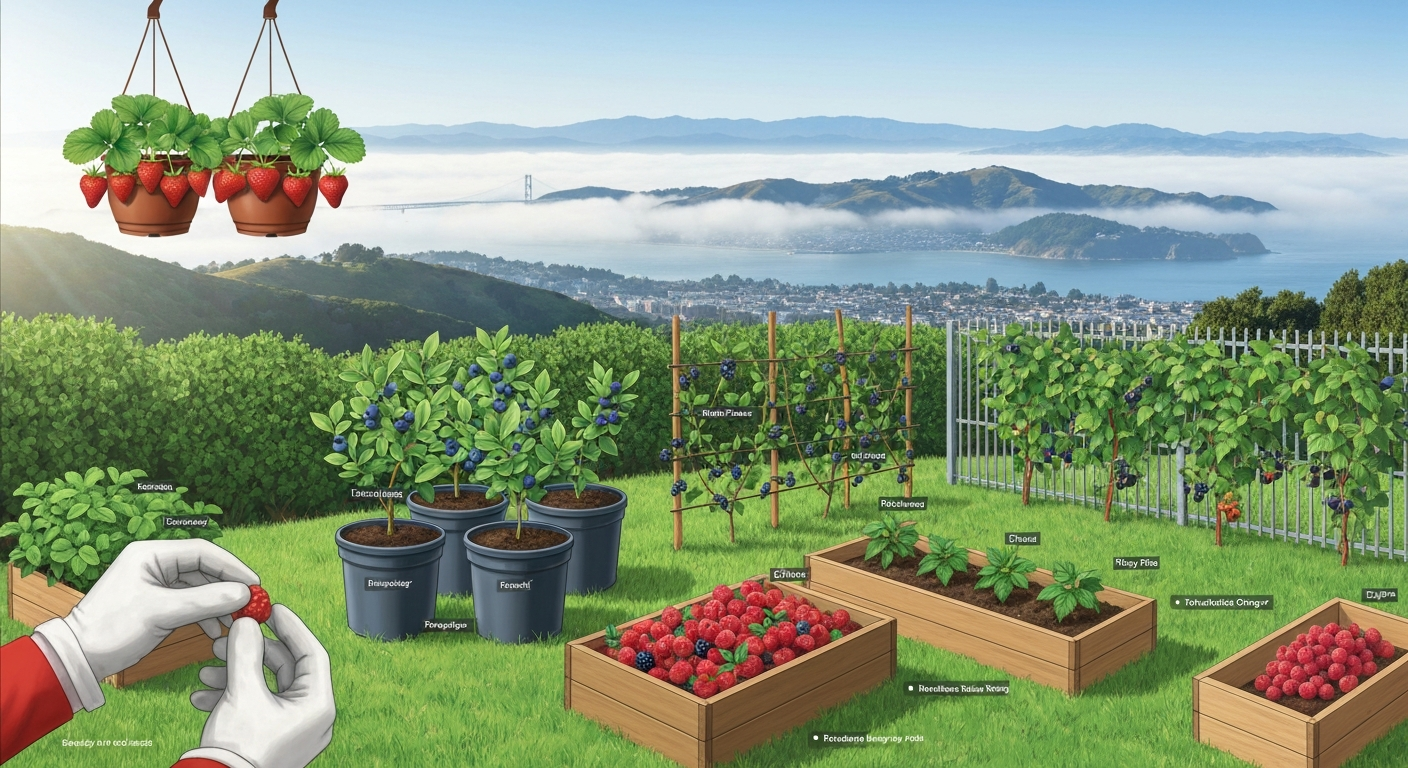
Before you pick a berry to plant, it helps to understand how it physically grows, because that determines your space needs, trellising, and care approach. Bay Area berries fall into a handful of distinct growth forms.
| Growth Form | Examples | Space / Support Needed | Container-Friendly? |
|---|---|---|---|
| Bush / Shrub | Blueberries, gooseberries, currants, elderberries | 2–8 ft spread; no trellis needed | Yes (large containers for blueberries) |
| Canes (biennial) | Raspberries, blackberries, boysenberries, loganberries, tayberries | Trellis or fence; 6–12 ft canes | Possible (15–30 gal minimum) |
| Stolons (runners) | Strawberries | Ground cover or raised bed; spreads laterally | Yes (8+ inch depth minimum) |
| Bog / Wetland plant | Cranberries | Low creeping mat; requires saturated, acidic media | Yes (with bog container setup) |
| Vine (true) | None of the listed species are true vines, but caneberries arch and can be trained vine-like | Trellis helpful for arching canes | Partially |
Caneberries are sometimes called vining but they're really arching biennial canes, first-year canes (primocanes) grow and establish, second-year canes (floricanes) flower and fruit, then die back. Understanding this cycle is the key to pruning them correctly, which I'll cover in the care section.
Ranked: the best berries to grow in the Bay Area
This ranking is based on how reliably each berry produces across the widest range of Bay Area conditions, ease of establishment, soil flexibility, and what I've seen actually work in local gardens over years of trial and error. For a quick shortlist of region-tested varieties, see the Top 10: Grow Your Own Berries and Currants guide for concise rankings and planting tips. For a concise overview of top performers across Bay Area microclimates, see our guide to the best berries to grow. A berry that only thrives in one narrow microclimate ranks lower than one that performs across the region with modest care.
- Strawberries — the easiest, most reliable Bay Area berry for almost every microclimate and container or in-ground. Ever-bearing types produce spring through fall.
- Blackberries — vigorous and high-yielding across coastal and inland sites; thornless varieties like Triple Crown and Apache remove the main reason people avoid them.
- Blueberries — excellent results with variety matching (southern highbush for mild/coastal sites, northern highbush inland); pH management is non-negotiable but achievable.
- Boysenberries and Loganberries — these Bay Area-born hybrids love the climate they were developed in; loganberries especially suit cool coastal sites.
- Raspberries — better suited to cooler inland hills and valleys with 700+ chill hours; primocane-fruiting types give you a second chance if spring crops underperform.
- Currants and Gooseberries — underused but outstanding in cooler Bay Area spots and East Bay hill gardens; low maintenance once established.
- Elderberries — native-adjacent, drought-tolerant once established, and productive even in part-shade urban gardens; dual-use for fruit and wildlife habitat.
- Tayberries — a raspberry-blackberry cross that performs beautifully in coastal and hill sites; lesser known but worth the hunt for the right nursery.
- Cranberries — possible with a purpose-built bog container; not a casual planting, but very satisfying if you put in the setup work.
- Gooseberries (standalone note) — California has had restrictions on some Ribes species due to white pine blister rust; check current local regulations before planting.
Best berries matched to your specific Bay Area microclimate
| Microclimate | Top Berry Picks | Varieties to Try | Watch Out For |
|---|---|---|---|
| Coastal fog belt | Strawberries, Loganberries, Tayberries, Low-chill blueberries | Seascape strawberry, Sharpblue blueberry, Loganberry (thornless) | Botrytis gray mold, slow ripening in dense fog |
| Urban pockets (Oakland, San Jose) | Blackberries, Boysenberries, Strawberries, Southern highbush blueberries | Triple Crown blackberry, Boysenberry, Albion strawberry, O'Neal blueberry | Spotted-wing drosophila, drainage in clay soils |
| Inland valleys (Napa, Livermore, Brentwood) | Raspberries, Blackberries, Northern highbush blueberries, Elderberries | Heritage raspberry, Apache blackberry, Duke blueberry, Adams elderberry | Heat stress on raspberries, high irrigation demand |
| Cooler inland hills (East Bay hills, Santa Cruz Mtns) | Currants, Gooseberries, Northern highbush blueberries, Tayberries, Raspberries | Consort currant, Pixwell gooseberry, Bluecrop blueberry, Tayberry | Drainage on clay hillsides, late frost pockets |
Species profiles: soil, water, chill, and container guidance
Strawberries
Strawberries spread via stolons (runners) and are the Bay Area's most forgiving berry. Ever-bearing varieties like Seascape and Albion produce flushes from spring through October. June-bearing types like Chandler give one heavy spring crop. They want well-drained, slightly acidic soil (pH 5.5 to 6.5) and at least 6 hours of sun. In containers, 8 inches of depth is the practical minimum; strawberry pots, hanging baskets, and raised beds all work. Irrigate consistently, dry spells produce small, seedy fruit. Renovate June-bearing patches by mowing or cutting back foliage immediately after harvest to reinvigorate plants. Replace all plants every 2 to 3 years to prevent disease buildup. Spotted-wing drosophila (SWD) is the main pest challenge; fine netting at ripening is the most effective defense.
Blueberries
Blueberries are shrubs, growing 2 to 6 feet tall depending on variety. They are the most pH-demanding berry you'll grow: the target is pH 4.5 to 5.5, with 4.8 to 5.2 being ideal. Bay Area soils are typically neutral to alkaline, so this is not optional maintenance, it's the difference between a plant that thrives and one that slowly yellows and dies. Plant in large containers (25 gallons or more) using a mix of roughly one-third fine pine bark, one-third peat moss, and one-third ericaceous potting soil. Work elemental sulfur into in-ground beds and retest annually. For coastal and mild urban sites, choose southern highbush varieties: O'Neal, Sharpblue, Sunshine Blue, and Misty need only 150 to 500 chill hours. For inland valleys and hills where chill hours exceed 700 to 800, northern highbush varieties like Duke and Bluecrop produce heavier crops. Always plant at least two varieties for cross-pollination. Blueberries need consistent moisture but excellent drainage, they will not tolerate waterlogged roots.
Raspberries
Raspberries are biennial cane plants that prefer cooler sites with 700 to 1,000+ chill hours, inland valleys and Bay Area hill gardens are your best bets. They want slightly acidic, fertile, well-drained soil (pH 5.5 to 6.5) and consistent moisture, especially during fruit development. In the Bay Area's hottest inland spots, afternoon shade and a thick organic mulch reduce heat stress significantly. Red varieties like Heritage (primocane-fruiting, so it produces in fall on first-year canes) and Summer-bearing Willamette are well-proven in cooler parts of the region. Train canes to a two-wire trellis system at 3 and 5 feet. In 15 to 20 gallon containers, raspberries will produce but need diligent watering and feeding. SWD is a serious raspberry pest; time harvests early in the morning when fruit is cool and firm, and pick every other day during peak season.
Blackberries
Blackberries are among the most adaptable and productive caneberries for the Bay Area. They tolerate more heat than raspberries, need fewer chill hours (roughly 200 to 700 hours depending on variety), and grow vigorously in both coastal and inland sites. Thornless varieties Triple Crown and Apache are the top recommendations for home gardens, they're far easier to manage than thorned types. Olallieberry, a California-bred blackberry hybrid, is another excellent choice especially in the coastal central California range. Soil pH tolerance is more forgiving (5.5 to 7.0), though organic matter and good drainage still matter. Blackberries can be grown in 15 to 30 gallon containers but will be more productive in-ground with a solid trellis system. Prune all floricanes to the ground immediately after harvest; tip-prune primocanes at 3 to 4 feet to encourage lateral branching and more fruiting wood.
Boysenberries and Loganberries
These are Bay Area originals in every meaningful sense. The boysenberry was developed in Napa County and the loganberry was bred in Santa Cruz, both are natural fits for the region's climate. They're raspberry-blackberry crosses (with dewberry heritage in the boysenberry's case) that grow as semi-trailing canes reaching 6 to 8 feet. Loganberries especially prefer cooler coastal and foothill sites; boysenberries tolerate more heat and do well in urban and valley gardens. Both fruit abundantly with minimal fuss, tolerate a range of soils at pH 5.5 to 7.0, and are excellent candidates for training along a fence or low trellis. Thornless forms are available and make garden life considerably easier.
Gooseberries
Gooseberries are dense, thorny (usually) shrubs that prefer cool, moist sites, the East Bay hills, Marin highlands, and Santa Cruz Mountains suit them well. They tolerate partial shade better than most berries, making them useful under taller trees. Soil pH 6.0 to 6.5 is ideal. Note that some Ribes species have historically been restricted in California due to white pine blister rust regulations; Pixwell and Poorman are commonly available varieties, but verify current California Department of Food and Agriculture regulations for your county before purchasing. Gooseberries rarely need supplemental irrigation once established on cooler hillside sites.
Currants
Red, white, and black currants share gooseberry's preference for cool, moderately moist conditions and partial shade tolerance. They're outstanding in cooler Bay Area hill gardens where other berries struggle. Red Lake (red currant) and White Imperial (white currant) are reliable producers. Black currants are less common in Bay Area nurseries but worth seeking out, they have higher vitamin C content and a bolder flavor. Same Ribes regulatory notes apply as with gooseberries. Currants are compact enough (4 to 5 feet) to work well in large containers and respond well to open-center pruning to maintain airflow and reduce powdery mildew.
Elderberries
Elderberries are large, fast-growing native shrubs (Sambucus mexicana is the California native species; Sambucus nigra cultivars like Adams and Bob Gordon are the more commonly fruited varieties) that produce heavily with minimal care. They tolerate a wide range of soils, including clay, and handle some drought once established, which is practically unheard of among berries. They grow to 8 to 15 feet in good conditions and are not really container plants. Plant two different cultivars for best fruit set. Elderberries fruit on new wood, so cut back hard each late winter. The flowers are as useful as the fruit for making cordials and syrups. Raw elderberries contain compounds that can cause nausea; always cook the fruit before eating.
Tayberries
Tayberries are a raspberry-blackberry cross bred in Scotland, and they perform remarkably well in cooler Bay Area coastal and hill sites that approximate their original climate. The fruit is large, dark red-purple, and intensely flavored, sweeter than a loganberry with less tartness. They grow as semi-erect trailing canes to 6 to 8 feet and need a simple trellis. Soil and care needs are similar to other caneberries (pH 5.5 to 6.5, well-drained, consistent moisture). Tayberries are less commonly stocked than blackberries, so check specialty nurseries or online bare-root suppliers. A single well-established tayberry plant can produce 10 to 15 pounds of fruit per season in a good year.
Cranberries
Cranberries are low, creeping bog plants that spread via runners, and yes, you can grow them in the Bay Area, but not casually. They need constantly moist to saturated, strongly acidic (pH 4.0 to 5.0) growing media and full sun. They are not suited for in-ground planting in typical Bay Area soils without a complete bog-container setup. Fruit production requires patience: plants rarely fruit heavily until their third or fourth year. The coastal and cooler hill zones of the Bay Area provide the cool summers cranberries prefer, hot inland valleys are not suitable. Stevens and Ben Lear are proven varieties with good commercial production records, and both perform at smaller scales in home bog setups.
Practical planting: site selection, soil prep, pH and drainage
Choosing and preparing your site
Almost all berries want at least 6 hours of direct sun daily. Strawberries and caneberries tolerate 4 to 5 hours at a production cost; currants and gooseberries will manage with 3 to 4 hours. Before you dig, look up your parcel on the NRCS Web Soil Survey to understand what you're working with: clay-heavy soils drain slowly and warm up late in spring, sandy loam drains fast but needs more frequent watering, and native Bay Area clay soils are often alkaline, exactly the opposite of what blueberries want.
- Test your soil pH using an inexpensive meter or a county extension mail-in test before planting anything.
- For blueberries, lower pH to 4.8 to 5.2 by incorporating elemental sulfur into the planting bed months before planting; how much you need depends on starting pH and soil texture, but 1 to 2 lbs per 10 square feet is a common starting point for alkaline Bay Area soils.
- For caneberries, strawberries, and currants, work 3 to 4 inches of compost into the top 12 inches of soil to improve drainage in clay and water retention in sandy soil.
- Build raised beds (10 to 12 inches high minimum) for any area with slow-draining clay or seasonal waterlogging — most caneberry root rot problems I've seen in Bay Area gardens trace back to poor drainage, not incorrect pH.
- For in-ground blueberries in clay-heavy soil, dig a hole twice as wide as the root ball, backfill with the acidic pine bark/peat/ericaceous mix described in the species profile, and mound slightly above grade to ensure drainage.
- Mulch all plantings with 2 to 3 inches of wood chips or pine needles; this conserves moisture, suppresses weeds, moderates soil temperature, and (for acid-loving plants) gradually lowers pH as it breaks down.
Irrigation planning
Bay Area water districts including SFPUC, EBMUD, and Sonoma Water all publish irrigation guidelines and offer rebates for drip systems and smart ET-based controllers, check your local utility before installing anything, both for rebate opportunities and current water-use restrictions. Drip irrigation is strongly preferred over overhead watering for berries, as wet foliage promotes Botrytis and powdery mildew. In CIMIS ETo Zone 4 (inland Bay Area valleys), water demand for berries during summer peaks at roughly 5 to 7 gallons per square foot per month; in coastal Zone 1 to 2 areas, that figure drops considerably due to fog and lower temperatures. Container plants dry out faster than in-ground plantings; in summer heat, large blueberry containers may need watering every two to three days.
Container vs. in-ground: a quick decision checklist
Container growing solves most of the Bay Area's soil challenges at the cost of more frequent watering and repotting every few years. In-ground planting is more productive long-term but requires upfront soil work. Here's how to decide:
- Choose containers if: your native soil is alkaline clay (common in Bay Area), you're renting, you have a patio or balcony only, or you want to grow blueberries without major bed construction.
- Choose in-ground if: you have well-draining, amendable soil, you want maximum long-term yields from caneberries or elderberries, or you're planning a permanent established planting.
- Blueberries: 25-gallon minimum containers, repot every 4 to 5 years as roots fill the pot.
- Blackberries and raspberries: 15 to 30-gallon containers work but require very consistent watering; productivity is lower than in-ground.
- Strawberries: excellent in containers as shallow as 8 inches; hanging baskets, strawberry pots, and window boxes all work well.
- Cranberries: container bog setup is actually the recommended approach for most home gardeners (see next section).
- Elderberries: not practical in containers; plant in-ground only.
Seasonal care: pruning, feeding, and a basic year-round calendar
| Season | Task | Which Berries |
|---|---|---|
| Late winter (Jan–Feb) | Cut elderberries back hard; prune spent floricanes on caneberries to ground; apply dormant-season sulfur spray for fungal disease prevention | Elderberries, caneberries |
| Early spring (Feb–Mar) | Amend soil pH; plant bare-root caneberries and blueberries; set out strawberry starts; fertilize blueberries with acidifying fertilizer (ammonium sulfate) | All types |
| Spring (Mar–May) | Train new caneberry primocanes to trellis; tip-prune blackberry primocanes at 3–4 ft; apply balanced organic fertilizer to all established plants; watch for aphids and mites on new growth | All types |
| Summer (Jun–Aug) | Harvest strawberries, blackberries, boysenberries, blueberries; pick every 2–3 days to deter SWD; keep drip irrigation consistent; net fruiting plants against birds and SWD | All fruiting types |
| Late summer (Aug–Sep) | Harvest raspberries (primocane types); cut out exhausted floricanes post-harvest on summer-bearing raspberries; propagate strawberry runners | Raspberries, strawberries |
| Fall (Oct–Nov) | Plant new strawberry runners; divide and replant crowded currant/gooseberry clumps; reduce irrigation as temperatures drop; mulch root zones | Strawberries, currants, gooseberries |
| Winter (Dec–Jan) | Minimal watering for dormant plants; check container blueberries for root crowding; order bare-root plants for late winter planting | All |
Pests and diseases to know
The UC Statewide IPM program is the definitive reference for Bay Area berry pest management, and the guidance there is practical and regularly updated. The three most important challenges you'll face are spotted-wing drosophila (SWD), Botrytis gray mold, and root rot from poor drainage.
- Spotted-wing drosophila (SWD): affects all soft-skinned berries; the female lays eggs inside ripening fruit, and larvae hatch inside. Harvest early and frequently, use fine insect netting over fruiting plants (1-mm mesh or finer), and remove overripe fruit promptly. Spinosad-based sprays are effective when applied on a 5 to 7 day schedule during peak flight periods.
- Botrytis gray mold: a fungal disease favored by the Bay Area's coastal fog and cool, humid conditions. Avoid overhead watering, maintain airflow through pruning, and remove infected fruit immediately. Preventive copper or sulfur fungicide applications at bloom can help in high-risk fog-belt sites.
- Root rot (Phytophthora): the most common reason caneberries and blueberries die in Bay Area gardens. Almost always caused by poor drainage combined with heavy watering. Raised beds and drip irrigation prevent most root rot problems before they start.
- Powdery mildew: affects gooseberries, currants, and occasionally raspberries in warm, dry spells. Open-center pruning and good airflow are the best preventives; sulfur sprays are effective if caught early.
- Root weevils (on blueberries and strawberries): adults notch leaf margins; larvae damage roots. Beneficial nematodes applied to moist soil in spring and fall are an effective organic control.
Simple propagation for the berries you love
Most Bay Area home gardeners don't need to start from seed, and I'd rarely recommend it except for elderberries (which grow easily from hardwood cuttings). Here's the fastest propagation method for each berry type:
- Strawberries: pin runners (stolons) to small pots of moist potting mix in late summer; sever from the mother plant after 3 to 4 weeks when rooted. The easiest propagation in the garden.
- Blueberries: softwood cuttings taken in late spring, dipped in rooting hormone and stuck in a 50/50 peat and perlite mix under humidity. Takes 6 to 8 weeks to root and 1 to 2 years to produce fruit.
- Caneberries (blackberries, boysenberries, loganberries): tip layering in late summer — bend a long cane tip to the ground, bury the tip 4 to 6 inches deep, and it will root by fall. Sever and transplant the following spring.
- Raspberries: divide and transplant rooted suckers from the base of established plants in late winter.
- Currants and gooseberries: hardwood cuttings 8 to 10 inches long taken in winter, inserted directly into the garden or pots; most root reliably with no hormone needed.
- Elderberries: hardwood cuttings 8 to 12 inches long taken in winter; root readily with basic propagation care.
How to build a cranberry bog (and other special-condition beds)
Building a home cranberry bog
Commercial cranberry bogs, as documented by the UMass Cranberry Station, use engineered perched water tables, sand root zones, dike systems, and water control structures. You don't need all of that at home, but you do need to replicate the key conditions: constantly moist to saturated, strongly acidic rooting media, and consistent moisture control. Here's a practical container bog recipe that works in Bay Area coastal and hill gardens:
- Use a large, watertight container with no drainage holes — a half wine barrel lined with a heavy-duty pond liner works well, as does a 15 to 20-gallon plastic tub.
- Fill with a mix of 60 to 70 percent coarse horticultural peat moss and 30 to 40 percent acid washed horticultural sand (not play sand, which can be alkaline). Target pH 4.0 to 5.0; test before planting and adjust with sulfur if needed.
- Plant cranberry plugs or rooted cuttings (Stevens and Ben Lear are reliable cultivars) 12 inches apart across the surface.
- Keep the growing medium consistently moist — not flooded at all times, but never dry. In summer, this may mean watering every 1 to 2 days in the Bay Area's inland areas. Coastal sites can go 3 to 4 days between watering.
- Fertilize lightly with an acid-specific fertilizer at half the recommended rate in spring. Cranberries are adapted to nutrient-poor conditions and will burn with heavy feeding.
- Expect your first serious fruit crop in year 3 to 4 as the mat fills in. Patience is genuinely required here.
Building fast-draining beds for Mediterranean-style berries
On the opposite end of the spectrum, elderberries and gooseberries on Bay Area hillsides can suffer from clay-induced poor drainage during winter rains. For these plants and for caneberries planted in heavy soils, build a mounded fast-draining bed by mixing the native soil roughly 50/50 with coarse compost and horticultural grit or perlite, then mounding the planting area 8 to 12 inches above grade. This creates the sharp drainage these plants need during wet Bay Area winters without requiring a full raised-bed frame. Adding a French drain below the planting area helps on persistently wet hillside sites.
How Bay Area growing compares to other California regions
If you're curious how your Bay Area garden compares to other parts of California, the differences come down to chill hours, summer heat, and humidity. San Diego (Southern California) has very low chill hours, typically under 300 hours at sea level, and hotter, drier summers, which limits it mostly to the lowest-chill strawberry varieties, rabbiteye and southern highbush blueberries, and heat-tolerant blackberries. For specific recommendations, see a regional guide to the best berries to grow in San Diego. Florida presents a completely different challenge: high humidity, fungal disease pressure year-round, and essentially no chill hours, demanding the most extreme low-chill varieties available. For readers in Florida, see our guide to the best berries to grow in Florida for low‑chill, disease‑resistant varieties and humidity management tips. The Bay Area sits in a genuinely sweet spot for berry diversity, cooler than San Diego but milder than inland Central Valley, with enough microclimate variation that most temperate berries can find a site somewhere within an hour's drive. The one thing we don't have is the cold, reliably frozen winters that make northern highbush blueberries and northern-bred raspberries truly effortless, you'll need to choose your site and variety carefully to compensate.
FAQ
What climate datasets are required to map Bay Area microclimates for berry selection?
High‑resolution gridded normals (PRISM 4‑km/800‑m 1991–2020), station‑based 30‑year normals (NOAA NCEI), fog/low‑cloud indices (Torregrosa et al. or similar), and local ETo/CIMIS zones to estimate evapotranspiration and irrigation demand.
Which sources provide reliable chill‑hour and heat‑unit (GDD) data for matching berry cultivar requirements to microclimates?
PRISM gridded time series and NOAA station normals for temperature; published chill/GDD calculators and extension summaries (e.g., OSU, UC Davis) and local CIMIS/NWS station records for validation.
What soil and site data are essential before recommending berry types or planting methods?
NRCS Web Soil Survey (SSURGO) for texture, drainage, depth and pH; county soil surveys and local nursery/extension soil tests for specific parcel results to decide in‑ground vs. raised/containers.
Which extension and university resources are authoritative for cultivar recommendations and variety trial results?
UC ANR/County Master Gardener publications, UC Davis Fruit & Nut Research trial reports, CRFG local chapter trial notes, and other state extension trial summaries (e.g., OSU for chill guidance).
What sources should be consulted for species‑ and cultivar‑specific cultural needs (soil pH, drainage, root habits, container sizing)?
UC ANR crop pages (blueberries, caneberries), university container‑gardening guides (UMD, NC State, OSU), and nursery/breeder datasheets that list root habit, mature size and container recommendations.
How should pest and disease risks for Bay Area berries be researched?
UC IPM crop‑specific pages for caneberries and blueberries, UC extension disease/pest publications, and local extension/Master Gardener reports on common regional pests (SWD, botrytis, root weevils, mites).