
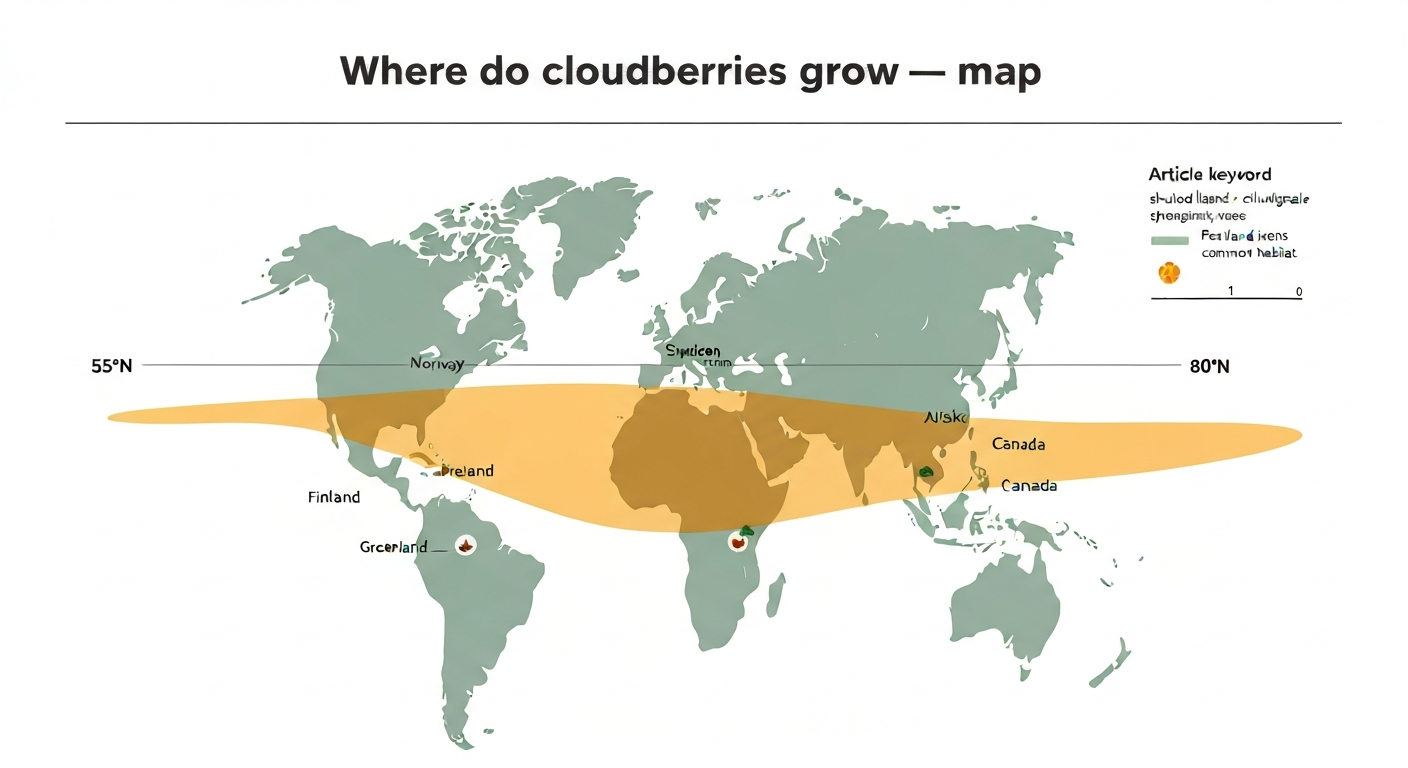
Cloudberries grow naturally in a circumpolar band across the Arctic and boreal zones, roughly between 55°N and 80°N latitude. For a focused overview, see the guide on where does cloudberry grow for details on its circumpolar distribution and regional cultivation notes. That means northern Scandinavia, Finland, Iceland, Scotland, most of Canada, Alaska, Greenland, and subarctic Russia are all fair game. In the lower 48 U.S. states, you'll only find wild plants in scattered populations in Maine, Minnesota, and New Hampshire. If you're standing outside that band, growing cloudberries is possible but it demands serious effort to recreate their preferred conditions: acidic Sphagnum peat, cool summers, and long summer daylight hours.
Where Do Cloudberries Grow? Map, Range & Growing Guide
Marcus Holloway
12 Jul 2026
Where cloudberries grow: the quick picture
Rubus chamaemorus is what botanists call a circumpolar species. It doesn't respect national borders; it follows climate and soil type. The simplest way to think about its range is to draw a belt around the top of the globe starting roughly at the latitude of Edinburgh or southern Alaska, then push north toward the Arctic Ocean. Everywhere within that belt that has peat bogs, wet tundra, or waterlogged heath, you have a reasonable chance of finding cloudberries. Outside that belt, wild plants essentially disappear except for a handful of relic populations in northeastern North America.
- Latitude range: primarily 55°N to 80°N
- Native continents: Europe, Asia, North America
- Key countries: Norway, Sweden, Finland, Iceland, UK (Scotland), Russia, Greenland (Denmark), Canada, USA (Alaska and three northeastern states)
- Preferred substrate: Sphagnum-dominated peat bogs and tundra peatlands
- USDA hardiness zone equivalents: Zones 1 through 4 (very cold winters required)
How to read a cloudberry distribution map
If you pull up occurrence data from GBIF or iNaturalist for Rubus chamaemorus, the dots cluster heavily across Fennoscandia (Norway, Sweden, Finland), northern Russia, and the Canadian boreal forest. The density of dots in Norway and Finland reflects both genuine abundance and the fact that those countries have active citizen-science communities and well-documented herbarium records. Don't interpret a sparse dot-cluster in, say, northern Labrador as meaning cloudberries are rare there. It often just means fewer people are out there recording observations.
When reading any cloudberry range map, pay attention to three things. First, look at whether the map is showing native native occurrence or cultivated records (GBIF mixes both, though most cloudberry records are wild). Second, note whether the map uses presence-only point data or shaded range polygons. Point data from GBIF's species occurrence download is more granular and reliable for precision gardening questions, while shaded polygons give a better general sense of the full range. Third, check the date filter: many herbarium records date from the 1800s or early 1900s, and some southern-fringe populations may have shifted or disappeared as habitats changed.
For a practical interpretation: if your location falls inside the shaded zone and you have access to or can create acidic peat conditions, the map is telling you this plant can thrive. If you're just outside the shaded zone (think southern Ontario, the UK midlands, or the northern U.S. Great Lakes region), you may be in marginal territory where climate can work but you'll need to compensate with microclimate management. If you're south of the shaded zone entirely, the map is giving you an honest warning.
Natural range by country and region
Here's a detailed breakdown of where cloudberries are documented across their native circumpolar range. I've compiled this from NatureServe, Flora of North America, GBIF occurrence data, and Kew's Plants of the World Online.
Europe
- Norway: Widespread across all northern counties; one of the densest wild populations globally; commercial wild harvest is culturally significant
- Sweden: Common across Norrland (northern Sweden), Lapland, and into the Scandinavian mountain range
- Finland: Present throughout the country with highest density in Lapland; Finland is the largest commercial producer of wild-harvested cloudberries
- Iceland: Found in highland bogs and coastal heathlands throughout the island
- Scotland (UK): Disjunct populations in the Scottish Highlands, particularly in the Cairngorms and Grampian peatlands; considered conservation-sensitive at this southern range edge
- Baltic states (Estonia, Latvia, Lithuania): Present in raised bog systems; Latvia has been the subject of cultivation studies on natural peatland restoration
- Russia: Massive range across the Kola Peninsula, Karelia, Siberia, and the Russian Far East; among the largest cloudberry territory on Earth
North America
- Alaska (USA): Widespread across tundra, coastal bogs, and interior boreal zones; the University of Alaska Fairbanks Extension documents cloudberry as a key subsistence berry
- Canada: Native across nearly all provinces and territories; confirmed in British Columbia (northern), Alberta (northern boreal), Saskatchewan, Manitoba, Ontario, Quebec, Newfoundland and Labrador, New Brunswick, Nova Scotia, Prince Edward Island, Yukon, Northwest Territories, and Nunavut
- Maine (USA): Native populations documented in peatland systems; NatureServe gives it a state rank indicating it is present but regionally rare at this southern limit
- Minnesota (USA): Known from northern lake-country bogs and peatlands
- New Hampshire (USA): Small disjunct populations in highland bogs
- Greenland (Denmark): Found across Arctic and sub-Arctic coastal and inland tundra zones
Asia
- Russia (Asian portion): Extends east through the Urals into western and central Siberia, then to the Russian Far East including Kamchatka and Chukotka
- Japan (Hokkaido): Disjunct populations documented in mountain bogs and subalpine peatlands; represents the eastern Asian range limit
- Northeastern China and Korea: Scattered, peripheral populations near the Russian border zones
The habitats cloudberries actually call home
I've spent time in Finnish Lapland in late July when the cloudberry harvest is in full swing, and the one thing that strikes you immediately is how consistently wet everything is underfoot. Cloudberries are not a dry-hillside plant. They live in ombrotrophic bogs, which are peatlands fed almost entirely by rainfall and snowmelt rather than groundwater. The dominant plant community in these bogs is Sphagnum moss, and that moss does a lot of heavy lifting: it acidifies the soil, retains extraordinary amounts of moisture, and creates the slow-rotting organic layer that builds up into peat over centuries.
Beyond classic raised bogs, cloudberries also appear in blanket bogs (especially in Scotland and Iceland), palsa mires (permafrost-influenced peatlands across northern Canada and Siberia), tundra heath mosaics where peat accumulates in low-lying areas, and wet mountain meadows at subarctic elevations. The common thread is always waterlogged, acidic, organic-rich soil with minimal mineral nutrient input. These plants are adapted to nutritional poverty and don't want the rich, amended garden soil you'd use for strawberries.
In terms of microhabitat within a bog, cloudberries tend to do best on hummocks and slightly elevated peat surfaces rather than in the lowest, most permanently flooded hollows. The water table sits close to the surface but the plant's crown and foliage stay above the water line. That distinction matters enormously if you try to recreate bog conditions in a container or raised bed.
Climate and daylight: what latitude bands actually mean for cloudberry
Cloudberries need long, cool summers and cold winters. That's not just a poetic description; it's a specific climate envelope that excludes most of the temperate world. Landscape-scale species distribution models and climate-envelope analyses identify cloudberry (Rubus chamaemorus) as cold‑adapted and project southward range contractions and local abundance declines under warming scenarios Cloudberry is cold‑adapted and projected to contract at southern range edges under warming. In Köppen climate classification terms, they're primarily at home in Dfc and ET zones (subarctic and tundra climates), with some presence in Dfb zones (humid continental with warm summers) at the southern range edge. From a USDA hardiness standpoint, they're fully adapted to Zones 1 through 3 and can manage Zone 4 with some protection. Zone 5 and warmer is genuinely problematic, not because of winter cold (the plant handles brutal cold) but because of summer heat and insufficient winter chill patterns.
Photoperiod is the piece most gardeners overlook. Cloudberries flower and fruit in response to the very long days of Arctic summer: 18 to 24 hours of daylight in June and July. This extreme photoperiod is thought to be important for proper flowering initiation and pollinator activity. As you move south into Zone 4 or 5 territory, summer days are shorter, and this can suppress flowering even if temperature and soil conditions look right. Practically, this is one reason why cloudberry cultivation consistently underperforms at latitudes below about 55°N, even when soil and climate conditions seem adequate on paper.
| Climate Factor | Ideal Range | Marginal Range | Not Suitable |
|---|---|---|---|
| USDA Hardiness Zone | Zones 1–3 | Zone 4 | Zone 5 and warmer |
| Köppen Climate | ET, Dfc | Dfb (cool) | Cfb, Dfb (warm), Cfa |
| Mean Annual Temperature | Below 3°C (37°F) | 3–6°C (37–43°F) | Above 6°C (43°F) |
| Summer High Temperature | Below 20°C (68°F) | 20–24°C (68–75°F) | Above 24°C (75°F) |
| Latitude | Above 60°N | 55–60°N | Below 55°N |
| Winter Minimum | Well below -20°C (-4°F) | -15 to -20°C (5 to -4°F) | Above -10°C (14°F) |
Soil requirements: pH, moisture, texture and organic matter
Cloudberry soil requirements are some of the most specific of any cultivated berry. A Latvian habitat study measuring actual peat pH under wild cloudberry populations found values ranging from 2.68 to 3.32. Cultivation research broadly recommends targeting a pH of 3.5 to 4.5 for garden or field planting. To put that in perspective: blueberries, which are already considered acid-lovers, prefer pH 4.5 to 5.5. Cloudberries want soil nearly a full pH unit more acidic than that. Standard garden soil sitting at pH 6.5 to 7 is essentially toxic territory for cloudberries.
Texture and organic matter are just as important as pH. Cloudberries grow in peat, which is almost entirely decomposed or partially decomposed organic matter with very low mineral content. The substrate holds moisture like a sponge while still allowing some drainage from the surface layer. For garden cultivation, the recommended approach is to use Sphagnum peat moss as the primary growing medium, ideally sourced from acidified sources rather than the limed horticultural peat sold at many garden centers. Mixing in live or dried Sphagnum moss helps maintain the acidic buffer over time.
Water table management is critical. Productive natural cloudberry peatlands typically have the water table sitting around 40 to 50 cm below the surface. Too deep and the plants drought-stress; too high (permanently flooded) and root oxygen is depleted. In container or raised-bed setups, a drainage layer at the base combined with consistent watering to keep the peat moist but not saturated mimics this naturally. Peat depth also matters: trials cite at least 0.5 to 1 meter of peat depth as favorable for establishment and longevity.
- Target pH: 3.5 to 4.5 (wild plants often found at 2.7 to 3.3)
- Substrate: Sphagnum peat moss as primary medium; avoid limed or composted bark mixes
- Moisture: Consistently moist, never waterlogged; water table 40–50 cm below surface in natural systems
- Organic matter: Very high; peat or peat-equivalent (not compost or manure-based mixes)
- Mineral content: Low; these plants are adapted to nutrient-poor conditions
- Drainage: Moderate; surface drainage is needed but substrate must stay uniformly moist
What grows alongside cloudberries: plant community and ecological context
Understanding cloudberry's ecological neighbors is genuinely useful for replicating its conditions, because those neighbors are indicator species. If the plants around your chosen site (or the plants you associate with your growing medium) match this community, you're in the right ballpark. Conversely, if you're trying to establish cloudberries and struggling, looking at whether any of these associates are growing nearby is a useful diagnostic.
In Fennoscandian and Baltic raised bogs, cloudberry's most consistent companions are Sphagnum mosses (especially Sphagnum fuscum and S. magellanicum), crowberry (Empetrum nigrum), bog rosemary (Andromeda polifolia), cotton grass (Eriophorum vaginatum), and dwarf birch (Betula nana). In North American boreal peatlands, you'll commonly find it alongside labrador tea (Rhododendron groenlandicum, formerly Ledum groenlandicum), leatherleaf (Chamaedaphne calyculata), black spruce (Picea mariana), and various Sphagnum species. Lingonberry (Vaccinium vitis-idaea) is a nearly ubiquitous companion across the full range, sharing almost the same pH and moisture preferences.
From a practical standpoint, if you're building a bog bed for cloudberries, planting it alongside lingonberry or wild bog rosemary is ecologically coherent and gives you a productive companion plant that won't compete aggressively for the same niche. Cotton grass is a beautiful and ecologically honest indicator plant that also thrives in peat bogs and doesn't crowd out cloudberry.
Can you grow cloudberries where you live? A regional suitability guide
This is the question I get most often, and I'll be honest with you: cloudberries are one of the more challenging berries for most home gardeners to grow successfully. For step-by-step guidance and a regional suitability check, see can you grow cloudberries. For practical, step-by-step guidance on attempting boreal and bog-adapted berries outside their native range, see the guide can you grow berries in grounded. For a fun aside on fictional cultivation, see can you grow berries in Valheim for tips specific to that game's mechanics. That's not to say it's impossible outside the natural range, but the further south you go, the more you're fighting the plant's fundamental needs. Here's a practical checklist you can use alongside any distribution map to assess your actual suitability.
Step 1: Check your latitude and hardiness zone
If you're above 60°N and in USDA Zone 3 or colder, you're in the sweet spot. The map is essentially giving you a green light, provided you can source the right soil materials. If you're between 55°N and 60°N (Zone 4 territory: think southern Scandinavia, the UK Scotland, southern Alaska, much of southern Canada), you're in marginal but workable territory. Below 55°N, including most of the lower 48 U.S. states, the UK outside Scotland, and central Europe, you're looking at a genuine uphill battle. Summer heat accumulation is usually the limiting factor, not cold.
Step 2: Assess your soil and water situation
If you have naturally occurring peat or bog soil on your property, you have a significant head start. Get a pH reading: if it's already sitting at 3.5 to 4.5, you may be able to plant directly with minimal amendment. If your soil is standard garden loam at pH 6 to 7, you'll need to build a dedicated bog bed using Sphagnum peat as the primary medium, acidify it with elemental sulfur if needed, and manage irrigation carefully to keep it consistently moist without waterlogging.
Step 3: Consider container growing as a workaround
Container growing in large tubs or half-barrels filled with Sphagnum peat is a viable approach for Zone 4 to 5 gardeners who want to try cloudberries without committing to a full bog bed conversion. The advantage is that you control pH and moisture precisely. The drawback is that containers dry out faster than in-ground bogs, and cloudberries are slow to establish: don't expect fruit before year three or four, and only if you have both male and female plants (most cultivated varieties are not hermaphrodite, though Finland's 'Nyby' cultivar is a notable exception).
Step 4: Source plants, not seeds
Propagating cloudberries from seed is genuinely difficult. Seeds have deep physiological dormancy requiring extended cold stratification, and even with scarification or gibberellic acid (GA3) treatment, germination rates in normal conditions are low. See the review Cloudberries, The Northern Gold (research compilation citing seed stratification and tissue‑culture work) for experiments showing extended cold stratification, scarification or GA3 treatments can relieve dormancy and that tissue‑culture/growth‑regulator media often produce much higher germination than plain media blank" rel="noopener noreferrer">Cloudberries — The Northern Gold (review/compilation citing seed stratification and tissue-culture work). The practical approach is to source rhizome divisions, ideally from named cultivars developed for your region. Norwegian cultivars Fjellgull (female) and Fjordgull (female), paired with male pollinators Apollen or Apolto, are the most well-documented options and have been used in peatland cultivation trials in both Europe and Canada. For North American growers, Canadian clones selected from local provenances may outperform Scandinavian cultivars.
Step 5: Plan for a multi-year establishment period
A Canadian cultivation trial using rhizome sectioning and fertilization reported treated plots yielding around 52 kg per hectare in year four, compared to roughly 11.5 kg per hectare in untreated control plots. That gives you a sense of both the time frame and the realistic yield ceiling. For a small garden patch, expect a modest but prized harvest rather than commercial quantities. Cloudberries fruit once per year, flowering shortly after snowmelt and ripening in July to August at high latitudes.
Regional suitability summary
| Region | Natural Range? | Garden Cultivation Difficulty | Key Limiting Factor |
|---|---|---|---|
| Northern Norway, Sweden, Finland | Yes (core range) | Low to Moderate | Sourcing good rhizome stock |
| Iceland, Scotland (Highlands) | Yes (native) | Moderate | Oceanic humidity helps; short growing season |
| Southern Scandinavia, Baltic states | Marginal/yes | Moderate | Warmer summers; maintain soil acidity |
| Alaska, Yukon, NWT, Nunavut | Yes (core range) | Low to Moderate | Cold winters fine; soil prep still needed |
| Most of Canada (boreal provinces) | Yes | Moderate | Soil sourcing and water management |
| Maine, Minnesota, New Hampshire | Disjunct populations | Moderate to Hard | Summer heat; pH management critical |
| UK (outside Scotland), Germany, Netherlands | No (mostly) | Hard | Summer warmth; photoperiod too short |
| Most of lower 48 U.S. states | No | Very Hard | Summer heat; latitude too low for reliable flowering |
| Central and Southern Europe | No | Extremely Hard/Not Recommended | Climate incompatibility; heat and light |
If you're in the 'Very Hard' or 'Not Recommended' zones, it's worth exploring whether lingonberry or bog bilberry (Vaccinium uliginosum) might satisfy the same culinary niche with far more realistic growing prospects in your climate. Both share cloudberry's affinity for acidic, moist soils and produce berries with a similar tart, boreal character. The goal is always to match the plant to your place, and sometimes the best answer a map can give you is a gentle redirect.
One last note for foragers considering wild harvest: in many Scandinavian and Finnish regions, cloudberry picking in the wild is governed by customary right (Everyman's Right), but picking from private land without permission is restricted in Norway specifically because of the commercial value of the crop. In North America, rules vary by province, territory, and land ownership status, so check local regulations before harvesting wild populations, particularly in the relic populations of Maine, Minnesota, and New Hampshire where populations are small and conservation-sensitive.
FAQ
Where do cloudberries (Rubus chamaemorus) grow naturally?
Cloudberries have a circumpolar distribution across Arctic and boreal regions. Naturally occurring populations are found in northern Europe (Norway, Sweden, Finland, Iceland, parts of the UK/Scotland and the Baltic states), across northern and subarctic Russia and Greenland, in northern Asia (including Hokkaido and some NE Asian localities), and in North America (Alaska, most Canadian provinces and territories, with disjunct populations in northern U.S. states such as Maine, Minnesota and New Hampshire).
How can I view or make a map showing where cloudberries occur?
Use occurrence datasets from GBIF for downloadable point data and density mapping, and supplement with citizen-science records (e.g., iNaturalist) and regional floras (NatureServe, Flora of North America) for administrative-level presence. Combine occurrence CSVs with a GIS (QGIS or online tools) to plot points and create heat/density layers; filter by date to show recent vs historical records and overlay habitat (peatland) or climate layers (Köppen, USDA hardiness) for context.
What habitats do cloudberries prefer in the wild?
Cloudberries typically occupy Sphagnum-dominated bogs, peatlands, bog hummocks, and tundra/heath mosaics. They favor ombrotrophic or acidic minerotrophic peat with a high but not permanently flooded water table, often forming clonal patches on hummocks or raised peat areas.
What climate and daylight conditions do cloudberries need?
Cloudberries are cold-adapted and tied to high-latitude conditions: cool mean annual temperatures and long summer daylight at high latitudes help flower and fruit development. They are typical of Arctic–boreal climates (tundra and subarctic Köppen types). In practical gardening terms, they do best where winters provide reliable chilling and summers are cool to mild; they are unlikely to thrive in warm temperate or Mediterranean climates without strong microclimate manipulation.
What soil pH, moisture and substrate do cloudberries prefer?
They prefer strongly acidic, organic-rich peat soils. Reported peat pH in natural stands ranges commonly from about 2.7 up to ~4.5; many cultivation guides recommend a target pH ~3.5–4.5. Moisture: a high water table is important—productive sites typically have the water table close to the surface but not permanently flooded (examples suggest roughly 40–50 cm below surface in productive peatlands).
What plants are commonly associated with cloudberry in their habitat?
Common associates include Sphagnum mosses (bog-forming species), cotton grasses (Eriophorum spp.), dwarf shrubs (Empetrum, Vaccinium spp.), sedges, and other peatland specialists. The habitat mosaic often includes hummocks and hollows with differing moss and dwarf shrub composition.