
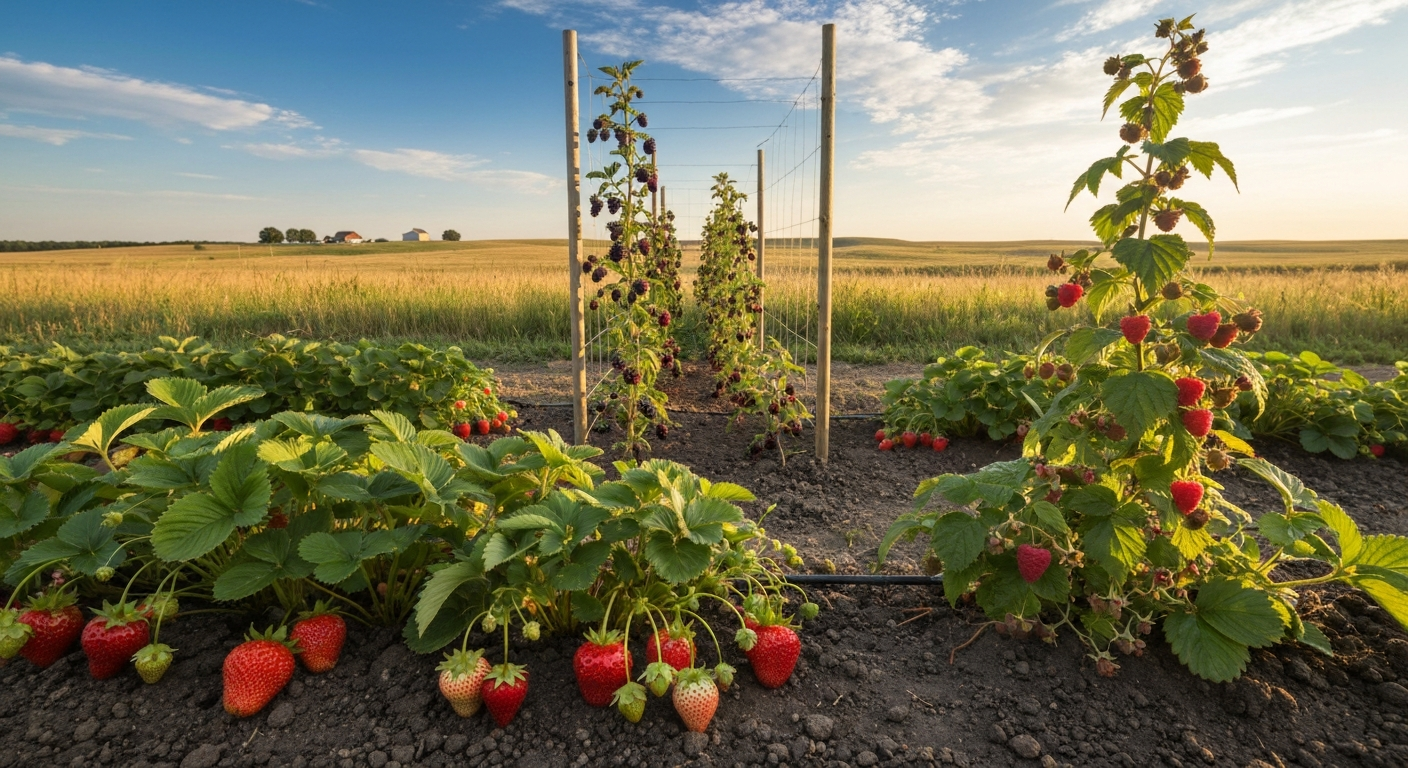
Strawberries, blackberries, and raspberries are the three most reliable berries to grow in Kansas for home gardeners. All three thrive across most of the state when you match the right variety to your region, prep your soil before planting, and give them decent drainage. If you're in eastern Kansas, you have the most options, you can push further into raspberries and even experiment with highbush blueberries with significant soil prep. Western Kansas growers should stick with heat-tolerant strawberry varieties and erect blackberries that can handle drier, more alkaline conditions. The rest of this guide walks you through each crop in detail so you can pick the right berry for your yard and get it in the ground confidently.
Best Berries to Grow in Kansas: Top Picks & Quick Guide
Marcus Holloway
27 Jul 2026
What this guide covers and who it's for
This is a practical, region-specific guide for Kansas home gardeners, hobby farmers, and anyone curious about growing their own fruit. Whether you're in the Flint Hills, the High Plains, or the Southeast corner of the state, the berries that succeed in your garden depend heavily on your local climate, your soil's pH and drainage, and which varieties you choose. I've grown strawberries and blackberries in central Kansas and have spent years testing what works and what doesn't across different conditions. This guide draws on that experience plus guidance from K-State Research & Extension to give you variety recommendations, planting timing, soil prep, care routines, and troubleshooting for Kansas's top-performing berries. I'll also flag which berries are impractical here (I'm looking at you, cranberries) so you don't waste a season finding out the hard way.
Quick answer: top berries for Kansas at a glance
If you want a fast reference before diving into the details, here are the berries that consistently deliver across Kansas, why they work, and what to watch for.
| Berry | Best Region in Kansas | Growth Habit | Difficulty | Why It Works |
|---|---|---|---|---|
| Strawberry | Statewide | Low groundcover, runners | Easy | Heat-tolerant varieties handle Kansas summers; widely adapted |
| Blackberry (erect) | Statewide, especially east/central | Upright canes, 4–6 ft | Easy–Moderate | Drought-tolerant once established; native-adjacent species |
| Raspberry | East and north-central Kansas | Upright canes, 4–5 ft | Moderate | Fall-bearing types beat heat; struggles in far west |
| Elderberry | Statewide | Multi-stem shrub, 8–12 ft | Easy | Native to Kansas, extremely adaptable |
| Aronia (Chokeberry) | East to central Kansas | Dense shrub, 3–6 ft | Easy | Cold-hardy, drought-tolerant, excellent for pollinators |
| Currants & Gooseberries | Northeast Kansas | Compact shrub, 3–5 ft | Moderate | Prefer cooler Zone 5–6 conditions in the northeast |
| Blueberry (highbush) | Far east Kansas only, with soil prep | Woody shrub, 4–6 ft | Hard | Needs pH 4.5–5.5; most Kansas soils require heavy amendment |
Cranberries are not practical in Kansas. They require bog conditions with consistently moist, highly acidic, sandy-peaty soil that simply doesn't occur naturally here and is nearly impossible to replicate cost-effectively in a home garden. Serviceberry (Amelanchier) is worth a mention as a dual-purpose native shrub that produces edible berries and does well in Kansas, but it's covered in detail in related regional guides. For a nearby-state comparison of varieties, soil prep, and climate-specific tips, see our guide to the best berries to grow in Minnesota.
Kansas climate and growing zones: east, central, and west
Kansas is a bigger state than most people give it credit for, and the climate swings dramatically from one end to the other. The 2023 USDA Plant Hardiness Zone Map places the state in roughly Zone 5a/5b in the northwest, Zone 6 across the central portion, and Zone 7 in warmer pockets of the southeast. That range means a blueberry variety that winters fine in Coffeyville might be marginal in Colby, and a heat-tolerant blackberry that thrives in Dodge City might struggle to bear fruit on a cool-season schedule in Atchison.
The climate differences go beyond winter cold. The northeast and parts of central Kansas fall under a humid continental classification with reasonable rainfall (around 35–40 inches annually in some areas), while western Kansas grades into semi-arid steppe with under 18 inches per year in the High Plains. The far southeast touches on humid subtropical conditions, giving it a longer frost-free season but also more humidity that can drive fungal disease. The median last spring frost date near Manhattan, Kansas is around April 15, giving roughly 183 frost-free days, and that figure shifts earlier as you move southeast and later as you move northwest.
Summer heat is a real constraint. Kansas regularly sees strings of 95–100°F days in July and August, which stress cane fruits like raspberries during berry development. In western and central Kansas, growers also face strong winds that accelerate moisture loss from both soil and plants, making drought-tolerant varieties and deep mulching more important than almost anywhere else in the Midwest. If you're comparing notes with gardeners in neighboring states, keep in mind that Missouri gardeners (just to the east) have a meaningfully wetter and milder climate, while Iowa gardeners deal with colder winters but more consistent rainfall. For gardeners east of Kansas, see our guide on the best berries to grow in Missouri for specific variety and site recommendations tailored to Missouri's milder, wetter climate. For specific variety recommendations and climate-adjusted advice, see our guide to the best berries to grow in Iowa.
Site and soil fundamentals for Kansas berry gardens
Most berries want full sun (at least 6–8 hours of direct light daily), good drainage, and a soil pH in the 6.0–6.8 range. Kansas soils are highly variable, you'll find loam to silt-loam in the east, heavier clay soils in parts of the central region, and sandier or shallower soils in the west. Many native Kansas soils contain calcium carbonate in subsurface horizons, which buffers the soil toward neutral or alkaline pH. That's manageable for strawberries, blackberries, and elderberries, but it's a serious obstacle for blueberries.
Get a soil test before you plant anything
I can't stress this enough: test your soil before you amend it. K-State's Soil Testing Lab is the right resource here. K‑State Turf & Landscape, soil testing lab procedures and test recommendations emphasizes testing both soil and irrigation water (if used) and lists recommended analyses (pH, Bray/Mehlich P, K, organic matter, nitrate, salinity/EC and exchangeable sodium where relevant) to guide nutrient and salinity/sodicity management for berry plantings K‑State Turf & Landscape — soil testing lab procedures and test recommendations. Pull 12–20 cores from the root zone (about 4–6 inches deep), mix them into a composite sample, and submit it for analysis. The standard test will return pH, phosphorus, potassium, organic matter, and in areas with known salinity concerns, it may be worth requesting electrical conductivity (EC) and exchangeable sodium measurements. Strawberries are among the more salt-sensitive small fruits, so if you're on a site in central or western Kansas with saline or sodic soil history, get that EC data before planting. It's a small investment that saves a lot of frustration.
pH targets and how to hit them
Strawberries, raspberries, blackberries, elderberries, currants, and aronia all perform well in a pH of about 5.8–6.8. If your soil is too alkaline, incorporate elemental sulfur before planting. Virginia Tech Extension guidance suggests roughly 0.75 lb of elemental sulfur per 100 square feet to lower pH by one unit on sandy soils, with higher rates needed on heavier soils. For blueberries specifically, WSU Extension recommends 1–3 lb of sulfur per 100 square feet on lighter soils and 2–5 lb per 100 square feet on heavier soils, incorporated into the top 8 inches at least a year before planting. If your pH creeps back up after establishment, reapplications of about 2–3 oz per plant can help. For soils that are too acidic (uncommon in Kansas but possible in long-cultivated garden beds), lime brings pH up. Agricultural lime (calcium carbonate) is the standard amendment; your soil test report will specify the exact rate.
Drainage, organic matter, and general soil prep
Raised beds or slightly mounded rows fix drainage problems in heavy clay soils and are particularly useful for strawberries and raspberries, which rot quickly in waterlogged ground. Work 2–4 inches of compost into the planting area to boost organic matter and improve both drainage and water retention. For blueberries, sphagnum peat moss or coarse pine bark (1–2 cubic feet per plant) incorporated into the planting hole is standard practice alongside sulfur to create the acidic, organic-rich root environment they need.
Planting calendar and seasonal checklist for Kansas
K-State Research & Extension recommends preparing berry sites in fall or winter with soil tests and amendments so the planting area is ready for early spring installation. Here's a compact seasonal reference for Kansas berry gardeners.
| Season / Month | Tasks |
|---|---|
| Fall (Sept–Nov) | Collect soil samples and submit to K-State Soil Testing Lab; incorporate sulfur or lime based on results; add compost to planting beds; plan trellis systems; order bare-root plants for spring |
| Winter (Dec–Feb) | Review cultivar lists (K-State MF1028); prepare trellises and raised bed frames; apply dormant mulch to established beds; prune dormant canes on raspberries and blackberries |
| Early Spring (Feb–Apr) | Plant bare-root strawberries, raspberries, and blackberries as soon as soil is workable (typically March–April in central Kansas); set out transplants after last frost risk passes; remove winter mulch from strawberries gradually |
| Late Spring (May–June) | Monitor irrigation as temperatures climb; apply straw mulch around strawberries; thin runners; begin training raspberry and blackberry canes to trellis; watch for aphids and spotted wing drosophila |
| Summer (July–Aug) | Harvest blackberries and summer-bearing raspberries; maintain deep watering (1–1.5 in/week) during heat; renovate June-bearing strawberry beds after harvest; apply summer mulch to conserve moisture |
| Early Fall (Sept–Oct) | Harvest fall-bearing (primocane) raspberries; plant new strawberry beds; apply balanced fertilizer to established cane fruits; begin reducing irrigation as temperatures drop |
| Late Fall (Nov) | Mulch strawberry beds with 3–4 in of straw after first hard freeze (late November for most of Kansas); cut back floricanes on raspberries and blackberries; note any disease or pest sites for next year's management |
Strawberries in Kansas
Strawberries are the most accessible berry crop for Kansas gardeners, full stop. They're low-growing perennial groundcovers that spread by runners, produce fruit in their second year from bare-root planting, and can be grown in beds, raised planters, or containers with equal success. The main challenge in Kansas is the combination of spring temperature swings (late frosts can kill open blossoms) and intense summer heat that shortens the harvest window.
Best locations and regional suitability
Strawberries perform well statewide, but east and central Kansas offer the best natural conditions with more reliable spring rainfall and adequate organic matter in the soil. Western Kansas growers can absolutely succeed with strawberries, but expect to irrigate consistently and mulch heavily to moderate soil temperature and conserve moisture.
Recommended varieties for Kansas
K-State Research & Extension's MF598 and MF1028 publications are your best local variety guides. For June-bearing types (large single crop in late spring), 'Earliglow' is a reliable early producer with excellent flavor and good disease resistance. 'Allstar' produces mid-season and handles Kansas heat reasonably well. 'Chandler' is popular where a big harvest window is the goal. For day-neutral types that produce smaller but more continuous crops through summer and fall, 'Seascape' and 'Albion' have performed well in Kansas trial gardens. Everbearing types like 'Ozark Beauty' are forgiving for beginners.
Planting timing and spacing
Plant bare-root June-bearing strawberries in early spring, typically March through early April in central Kansas, as soon as the soil can be worked. Space plants 18 inches apart in rows 3–4 feet apart if you're using the matted-row system (letting runners fill in), or 12 inches apart for a spaced-row approach. Set the crown at soil level, too deep and the plant rots; too shallow and the roots dry out. I've lost more plants to improper crown depth than to any disease.
Water, fertilizer, and mulch
Strawberries need about 1–1.5 inches of water per week, either from rain or drip irrigation. Overhead watering late in the day increases fungal disease risk, so morning irrigation or drip systems are worth the setup cost. Apply a balanced fertilizer (10-10-10 or similar) at planting per label rates, then a light side-dress of nitrogen after harvest. Mulching is critical in Kansas: apply 3–4 inches of clean straw after the first hard freeze in late November to protect crowns and roots through winter. Remove it gradually in spring as temperatures warm, leaving some mulch between rows to suppress weeds and retain moisture during summer.
Propagation via runners and renovation
Strawberries spread naturally by sending out runners that root and form daughter plants. For June-bearing beds, K-State recommends renovating the bed right after harvest, mow off the foliage, narrow the rows to about 12 inches, thin plants to 4–6 inches apart, fertilize, and water well. This resets the bed and encourages vigorous new growth for next year's crop. Beds typically remain productive for 3–4 years before replanting.
Containers and small-space options
Strawberries are excellent container plants. A 12–16 inch pot holds 2–3 plants comfortably, and hanging baskets or strawberry towers work well on patios where ground space is limited. Use a well-draining potting mix, water more frequently than you would in-ground (containers dry out faster in Kansas heat), and bring containers into an unheated garage or shelter for winter if temperatures will drop below 20°F.
Pests, diseases, and harvest tips
The most common Kansas strawberry problems are gray mold (Botrytis) in wet springs, strawberry root weevil, and occasional spotted wing drosophila pressure during harvest. Good air circulation, morning watering, and keeping mulch from direct contact with crowns reduce fungal risk significantly. Harvest strawberries when fully red and slightly soft, ideally in the morning before heat builds. They do not ripen further off the plant, so don't pick early hoping they'll color up on the counter.
Raspberries in Kansas
Raspberries are doable in Kansas, but they demand more from you than strawberries or blackberries. The key issue is summer heat: raspberries set and ripen fruit best below about 85°F, and Kansas routinely blows past that in July and August. The workaround that actually works is growing fall-bearing (primocane-fruiting) varieties, which produce their main crop in September and October when temperatures cool back down.
Cane types: summer-bearing vs. fall-bearing
Raspberries produce on two types of canes. Floricanes are second-year canes that bear fruit once in summer, then die. Primocanes are first-year canes that, in fall-bearing varieties, produce a crop at their tips in September and October of their first year, then can optionally produce a smaller summer crop on the lower portion the following year before being cut out. For Kansas, primocane (fall-bearing) varieties are the recommended choice because they sidestep the worst heat of summer and produce reliably. Summer-bearing floricane types can work in northeastern Kansas (Zone 5–6) where summers are slightly more moderate, but they're a gamble in central and western Kansas.
Regional suitability in Kansas
Northeastern Kansas, including areas around Atchison, Leavenworth, and the far northeast corner, gives raspberries the best chance due to higher humidity, slightly cooler summer nights, and Zone 5–6 winters that keep the canes conditioned. Central Kansas growers (Manhattan, Salina, Wichita) can succeed with fall-bearing types if they provide afternoon shade, deep mulch, and consistent irrigation. Western Kansas is challenging for raspberries due to heat, wind, and alkaline soils, and I'd honestly steer most western Kansas growers toward blackberries or elderberries instead.
Top varieties for Kansas
- 'Heritage' (fall-bearing, red): the workhorse variety for Kansas; extremely reliable, good flavor, widely recommended by K-State Extension
- 'Caroline' (fall-bearing, red): larger berries than Heritage, slightly earlier, performs well in central Kansas
- 'Anne' (fall-bearing, yellow): a novelty option with sweet flavor, same care as red primocane types
- 'Autumn Britten' (fall-bearing, red): excellent for eastern Kansas, large fruit, good disease resistance
- 'Boyne' (summer-bearing, red): one of the better summer types for northeast Kansas, very cold-hardy (Zone 3)
Planting, trellis, and pruning
Plant bare-root canes in early spring (March–April in most of Kansas) in a sunny, well-drained spot. Space plants 2–3 feet apart in rows 8–10 feet apart. Raspberries need a trellis: a simple T-bar or two-wire system (wires at 30 inches and 48 inches height) keeps canes upright, improves air circulation, and makes harvesting much easier. For fall-bearing varieties managed for a single fall crop, cut all canes to the ground in late winter, this is the simplest management approach and what I do. For a double-crop system, leave canes after the fall harvest, prune out the dead tip that fruited, and let the lower portion fruit the following summer before cutting those floricanes out after they bear.
Irrigation, propagation, pests, and harvest
Raspberries need 1–1.5 inches of water per week consistently, especially during fruit development. Drip irrigation is strongly preferred over overhead watering to reduce cane disease. Raspberries propagate readily through suckers (new canes arising from the root system), simply dig and transplant them in early spring. The main pests in Kansas are Japanese beetles (which can be severe), spider mites during hot dry spells, and raspberry crown borer. Spur blight and cane blight are fungal diseases that worsen with poor air circulation and overhead watering. Harvest raspberries when they pull free from the receptacle with no resistance, which in fall-bearing types means September through hard frost. They are delicate and should be refrigerated immediately.
Blackberries in Kansas
Blackberries are arguably the best-adapted cane fruit for Kansas conditions. Native wild blackberries grow across eastern Kansas without any help at all, which tells you a lot about their toughness. Cultivated varieties offer larger fruit, better disease resistance, and in many cases, a thornless option that makes picking dramatically more pleasant. I've grown 'Apache' erect blackberries in central Kansas for years, and outside of one brutal late freeze that caught the blossoms open, they've been remarkably low-maintenance.
Trailing vs. erect types: which to choose for Kansas
Erect blackberries produce stiff, self-supporting canes 4–6 feet tall and are the right choice for most Kansas gardens. They're more cold-hardy, more drought-tolerant, and easier to manage than trailing types. Semi-erect types (like 'Triple Crown') grow larger and need a trellis but produce very high yields and good flavor. Trailing blackberries (like 'Marion') are less cold-hardy and better suited to the Pacific Northwest than Kansas winters, skip them unless you're in the warmest part of the southeast corner of the state and are willing to provide winter protection.
Where blackberries perform best in Kansas
Blackberries do well across eastern and central Kansas with minimal fuss. In western Kansas, the combination of alkaline soils, wind, and low humidity is more challenging, but heat-tolerant erect varieties can still produce if you amend soil, mulch heavily, and irrigate. The southeast quadrant of Kansas, particularly around Pittsburg, Parsons, and Columbus, is prime blackberry country, with warm, somewhat humid conditions similar to the Ozark region where blackberries are grown commercially.
Recommended varieties for Kansas
K-State Research & Extension's MF720 fact sheet highlights several varieties well-suited to Kansas conditions.
| Variety | Type | Thorns | Notes for Kansas |
|---|---|---|---|
| 'Apache' | Erect | Thornless | Large fruit, good heat tolerance, excellent for central and east Kansas |
| 'Navaho' | Erect | Thornless | Smaller but sweet fruit, upright habit, good disease resistance |
| 'Shawnee' | Erect | Thorny | Heavy producer, large fruit, widely adapted across Kansas |
| 'Triple Crown' | Semi-erect | Thornless | Very high yields, needs trellis; best in east Kansas |
| 'Chester' | Semi-erect | Thornless | Good for jam production, reliable in eastern Kansas; needs trellis |
Planting, trellis systems, and pruning
Plant bare-root blackberries in early spring (March–April) in full sun with well-drained soil at a pH of 5.8–6.8. Space erect types 3–4 feet apart in rows 8–10 feet apart. Semi-erect types need 5–6 feet between plants. Erect varieties can be grown without a trellis, but a simple single-wire trellis at 30–36 inches helps after tip-pruning. Tip-prune erect blackberry primocanes (new canes) at 36–48 inches height in summer to encourage lateral branching, which increases next year's fruit production. After harvest, remove the floricanes (the ones that just fruited) at ground level, they won't produce again and removing them improves air circulation. For semi-erect types, a T-bar trellis with two wires works well.
Winter protection in Kansas
Erect thornless varieties like 'Apache' and 'Navaho' are rated to Zone 5–6 and generally survive Kansas winters without extra protection in most of the state. In northwestern Kansas (Zone 5a), it's worth mounding soil or wood chips lightly around the crown base as extra insurance. Semi-erect types and any trailing varieties should have their canes bundled and laid on the ground, then covered with straw or a frost blanket through the coldest months. The bigger risk in Kansas isn't deep winter cold, it's late spring freezes that catch open blackberry blossoms, which can wipe out most of the crop. Watch the forecast in April and May and be ready to cover plants with row fabric if a freeze is predicted after bloom opens.
Pests, diseases, and harvest tips
The main pest pressure on Kansas blackberries is Japanese beetle, which can skeletonize leaves in July. Hand-picking in the morning (when beetles are sluggish) or neem oil applications can manage light infestations. Spotted wing drosophila has become a growing concern for soft fruits at harvest. On the disease side, orange rust is the most serious blackberry disease in Kansas, infected plants show bright orange spore masses on the undersides of leaves and must be removed and destroyed immediately, as there is no cure and it spreads. Double blossom (rosette) is a fungal disease causing distorted, ruffled blooms; remove affected growth promptly. Blackberries ripen over 2–3 weeks in July and into August in most of Kansas, and should be harvested when fully black and pulling free easily. Unlike raspberries, ripe blackberries hold on the plant for a few days without over-ripening, which makes harvest timing more forgiving.
Container options for thornless types
Thornless erect blackberries like 'Apache' and 'Navaho' can be grown in large containers (15–25 gallon minimum) on patios or small spaces. Use a quality potting mix amended with compost, water consistently (containers dry out fast in Kansas summers), and provide a short stake or small trellis for support. Container blackberries will need to be protected from hard freezes in winter, move them into an unheated garage or shed once they go dormant. Expect slightly smaller yields than in-ground plants, but the convenience for small-space gardeners makes it worthwhile.
A note on blueberries, elderberries, and other berries in Kansas
Blueberries deserve an honest assessment: they can be grown in Kansas, but it takes real commitment. Most Kansas soils have a native pH of 6.5–8.0 or higher, while highbush blueberries demand a root-zone pH of 4.5–5.5. That gap requires substantial preplant sulfur incorporation (up to 2–5 lb per 100 sq ft on heavy soils), organic matter addition (sphagnum peat or pine bark), and ongoing pH monitoring. In the far east of Kansas, where soils tend to be more acidic and organic matter is higher, blueberries are a realistic project with proper prep. In central and western Kansas, the calcareous (lime-containing) subsoils actively resist acidification, and even well-amended planting holes tend to drift back toward alkaline pH over time. A dedicated raised bed filled entirely with amended media is the most reliable approach. If you want to explore this further, the growing challenges are similar to what growers in neighboring Missouri face, though Missouri's naturally more acidic soils in the Ozarks give them a slight advantage.
Elderberries (Sambucus canadensis) are native to Kansas and ridiculously easy to grow. They tolerate a wide range of soils, handle drought once established, and will produce heavy clusters of small dark berries for making jam, juice, or syrup. 'Bob Gordon', 'Bob's No. 2', and 'Nova' are commonly recommended cultivars. Plant at least two different varieties for good pollination. Elderberries grow fast (6–12 feet in two to three years) and need space, but they're one of the lowest-effort productive plants you can put in a Kansas yard.
Currants and gooseberries (Ribes spp.) are underused in Kansas but perform reasonably well in the northeastern corner of the state where Zone 5–6 winters and slightly more moisture keep them happy. 'Consort' and 'Ben Sarek' black currants and 'Pixwell' gooseberry are cold-hardy options worth trying. They prefer afternoon shade in Kansas to reduce heat stress, and they need good air circulation to limit powdery mildew. Aronia (chokeberry) is another native-adjacent option that thrives across the state with almost no intervention, it's dual-purpose as a landscape shrub and edible berry source, and it's one of the most cold- and drought-tolerant berry shrubs you can grow in Kansas.
Matching the right berry to your part of Kansas
Here's a simple regional summary to help you decide where to focus your energy. Eastern Kansas growers have the widest options: strawberries, blackberries, raspberries (fall-bearing), elderberries, aronia, currants, gooseberries, and blueberries with proper soil prep all work. Central Kansas is excellent for strawberries, erect blackberries, elderberries, and aronia; fall-bearing raspberries are worth trying with afternoon shade and irrigation. Western Kansas should prioritize strawberries (heat-tolerant varieties with heavy irrigation), erect blackberries, and elderberries as the most practical choices, while managing expectations for anything more finicky. Wherever you are in the state, a soil test from K-State and a look at the local Extension variety recommendations for your county will sharpen your planting decisions more than any single piece of advice I can give. If you're gardening in the Southwest, see our guide to the best berries to grow in New Mexico for region-specific recommendations.
FAQ
What berry species perform best in Kansas overall?
Top choices for Kansas home gardeners are strawberries, raspberries (floricane and primocane types), blackberries (erect/semierct varieties), blueberries (with soil amendments), elderberries, currants/gooseberries, and serviceberry/aronia. These species have proven adaptable across Kansas when sited and managed correctly.
How does region (east vs. central vs. west Kansas) affect which berries to plant?
Eastern and southeastern Kansas (more rainfall, milder winters) are best for blueberries, many raspberries, and blackberries. Central Kansas supports most berries with drought‑aware selections and management. Western Kansas (drier, semi‑arid, colder pockets) favors drought‑tolerant blackberries, elderberries, and hardy raspberries; blueberries are difficult there without substantial irrigation and pH management. Choose cultivars rated for your USDA hardiness and account for lower rainfall and saline/sodic soils in the west.
Which specific varieties are recommended for Kansas?
Strawberries: ‘Allstar’, ‘Jewel’ (June‑bearing), ‘Ozark Beauty’ (everbearing/June in some sites). Raspberries: ‘Heritage’ (floricane), primocanes like ‘Polka’/‘Caroline’ for later season. Blackberries: ‘Shawnee’ (thornless, well‑adapted), ‘Apache’, ‘Navaho’, ‘Triple Crown’ depending on type. Blueberries: Northern highbush cultivars with good winter hardiness (e.g., ‘Bluecrop’, ‘Duke’, ‘Nelson’) but only where soils and irrigation allow. Elderberry: ‘Adams’ and ‘Johns’ for fruiting. Currants/gooseberries: disease‑resistant selections from extension lists. Always check local extension cultivar lists for the latest region‑specific recommendations.
What site and soil conditions do berries need in Kansas?
General needs: full sun (6–8+ hours), good drainage, and a deep weed‑free root zone. Soil textures vary—loam to clay‑loam is common—so choose raised beds/rows where drainage is poor. Test soil before planting. Note: blueberries require acidic (pH 4.5–5.5), high‑organic soils; most Kansas soils need substantial sulfur and organic amendment. Avoid saline/sodic sites for sensitive crops like strawberries and raspberries.
How do I prepare Kansas soil for blueberries?
Obtain a soil test. If pH >5.5, lower it with elemental sulfur incorporated into the root zone well ahead of planting (rates depend on texture; follow extension guidance and retest). Add abundant organic matter: peat moss or coarse pine bark (1–2 ft³ per plant or amend top 8–12 in of bed). Ensure excellent drainage and plan irrigation. Consider raised beds or containers with an acidic media where native soil is calcareous or saline.
When is the best time to plant berry plants in Kansas?
For most small fruits, late winter to early spring (dormant plants, Feb–Apr) is best after soil can be worked. Fall planting can work for some species in milder southeast Kansas if transplanting into a prepared site. Prepare and test soils in fall/winter to allow amendments time to react prior to spring planting.